I got clouded out from the Mars/Moon occultation, but the Geminids are coming up next for cold-weather observing. 🥶
#astronomy #MarsMoon #Geminids #MeteorShower #MarsOccultation
I got clouded out from the Mars/Moon occultation, but the Geminids are coming up next for cold-weather observing. 🥶
#astronomy #MarsMoon #Geminids #MeteorShower #MarsOccultation
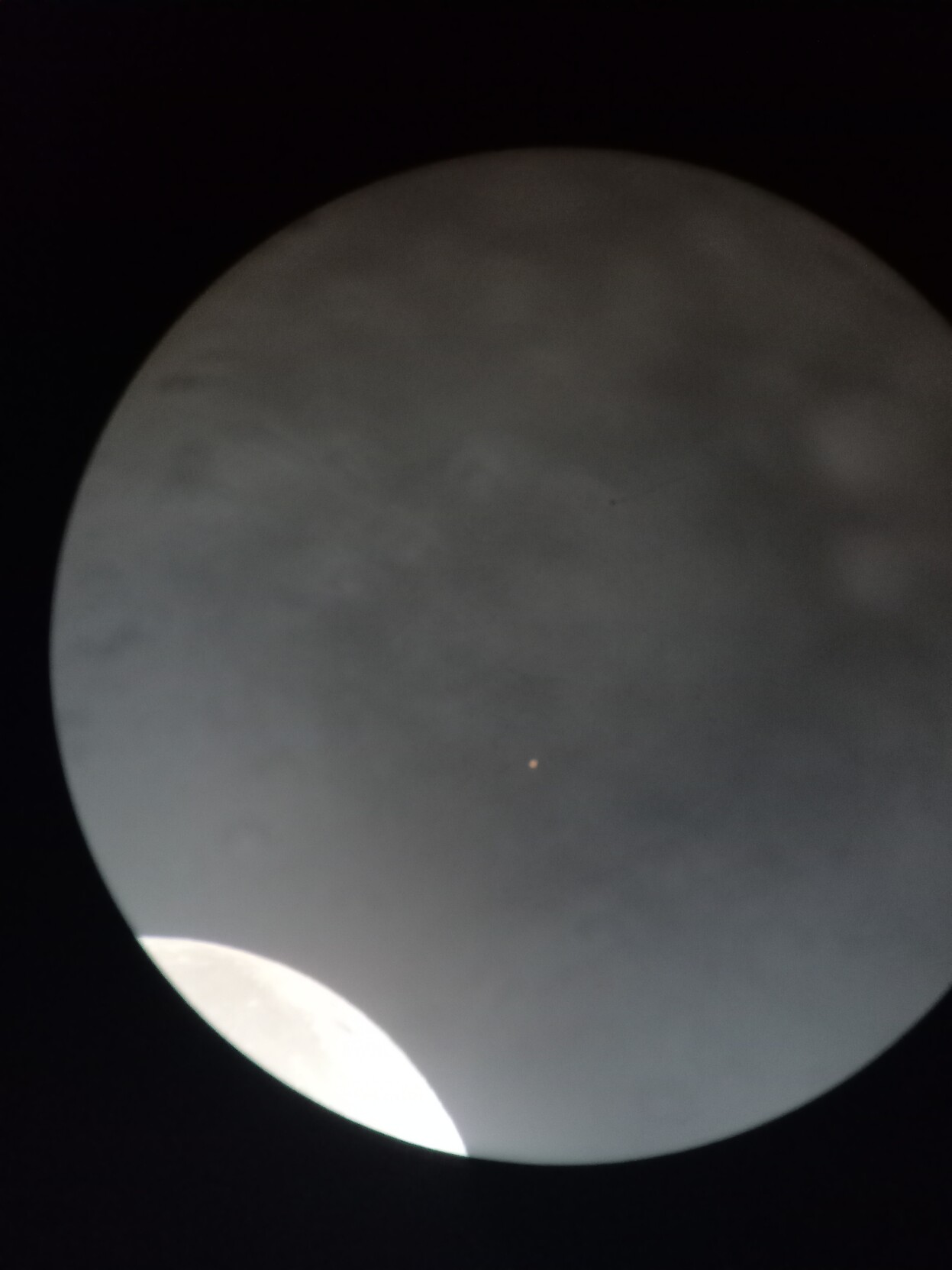
From my position (051 26 26) I made the #MarsMoon #occultation to be 60 minutes and 8 seconds long between first and last contact. #Astrodon
Quick phone shots while I was sketching and timing #MarsMoon #occultation #Astrodon #Astronomy


I made reappearance at my position (051 26 26) as 05.59.20 UT with last contact 05.59.55 UT
I’m sure all the astrophoto experts will get really cool shots of Mars disappearing behind the limb of the Moon tonight but I’m very happy with this given my fairly minimal level of expertise.
#marsmoon
I made first contact at my position (051 26 26) to be 04.59.43 UT Disc fully occulted 05.00.18 UT
#MarsMoon occultation #Astrodon #Astronomy
#marsMoon conjunction happening now - just shy of eclipse here in Boston.
Crazy to think that if i drove a couple towns north, the moon would be covering up Mars!
#parallax
Well it's been overcast and rainy today so I missed the #MarsMoon spectacle.
I was looking forward to the big fiery #Mars corona as the #moon exactly eclipsed the planet. Oh and the gravitational lensing as Mars passed the limb of the moon would've let us count the rivets on Oppy's back.
But no, all was lost in an astronomical failure of cooperative weather.
Driving east across north FL starting around dusk, I noticed mars chasing the beautiful full moon. Watched it slowly catch up, not realizing that what I saw had a name. I was too far south to see it properly but it was cool to notice the unusual event without being prompted. #MarsMoon #mars #moon #occultation
The 🌝 Moon is full, 🔴 Mars is at its brightest… and tonight we have an occultation of Mars to go with our (near)opposition! 🌍 🌝 🔴Around 10-10:30pm here in Toronto… if the skies clear! https://earthsky.org/tonight/moon-occults-mars-on-december-7-and-8-2022/ #mars #moon #occultation #opposition #MarsMoon
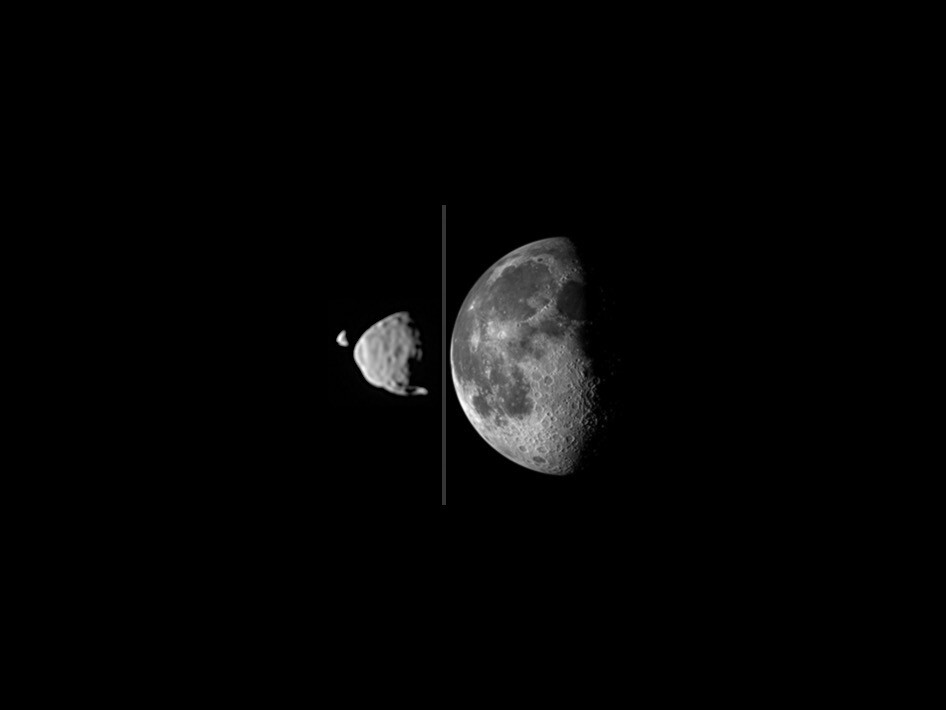
However, the Martian moons orbit much closer to their planet than the distance between #Earth and Earth's moon. #Deimos, at far left, and #Phobos, beside it, are shown together as they actually were photographed by the Mast Camera (Mastcam) of the Mars rover #Curiosity on August 1, 2013.
#SpaceMastodon #Spacedon #Space #Astronomy #Astrodon #ScienceMastodon #Sciencedon #Science #Moon #Moons #Mars #MarsMoon #MarsMoons #EarthsMoon #NaturalSatellite

This illustration provides a comparison for how big the moons of #Mars appear to be, as seen from the surface of Mars, in relation to the size that #Earth's moon appears to be when seen from the surface of Earth. Earth's moon actually has a diameter more than 100 times greater than the larger Martian moon, #Phobos.
#SpaceMastodon #Spacedon #Space #Astronomy #Astrodon #ScienceMastodon #Sciencedon #Science #Moon #Moons #MarsMoon #MarsMoons #Phobos #Deimos
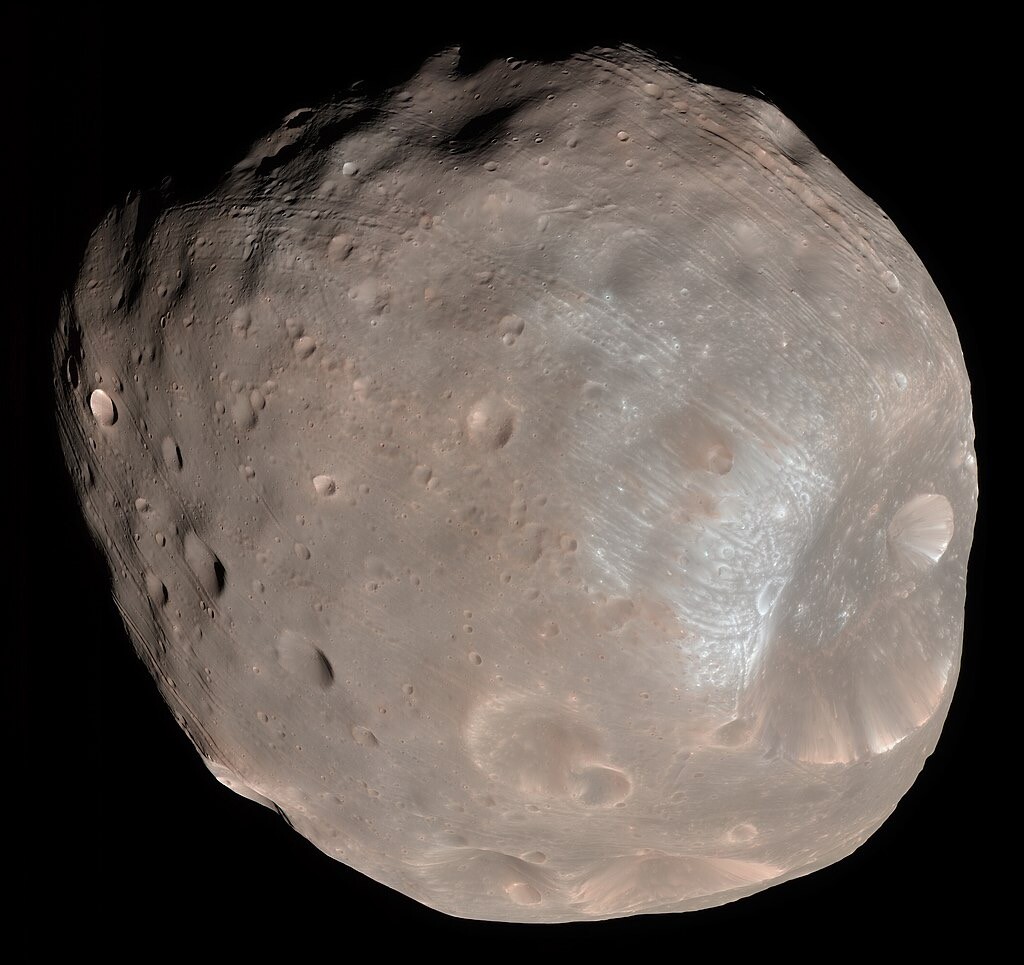
New modeling indicates that the grooves on #Mars’ moon #Phobos could be produced by tidal forces—the mutual gravitational pull of the planet and the moon. Initially, scientists had thought the grooves were created by the massive impact that made #Stickney crater (lower right).
#SpaceMastodon #Spacedon #Space #Astronomy #Astrodon #ScienceMastodon #Sciencedon #Science #Moon #Moons #MarsMoon #MarsMoons
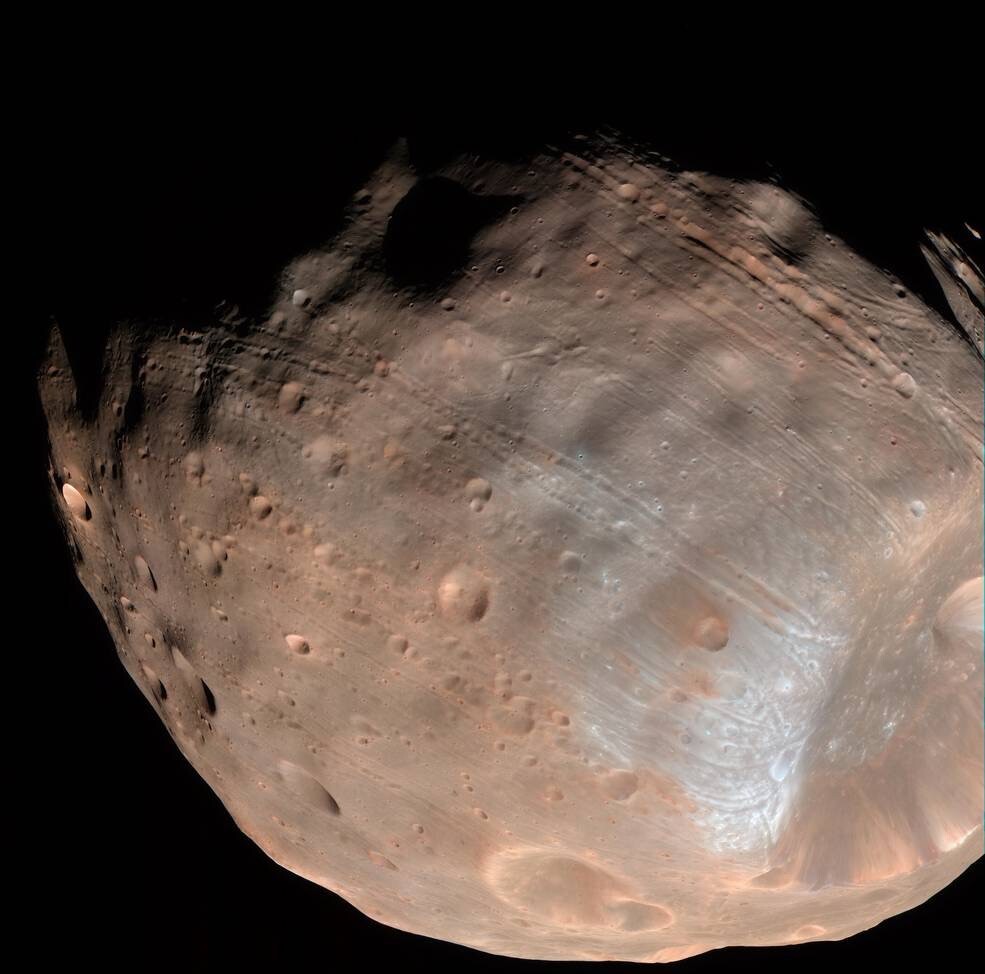
Image of #Phobos from the #Mars #ReconnaissanceOrbiter with #Stickney crater on the right. Phobos is the larger of Mars' two moons and is 17 x 14 x 11 miles (27 by 22 by 18 kilometers) in diameter. It orbits Mars three times a day, and is so close to the planet's surface that in some locations on Mars it cannot always be seen.
#SpaceMastodon #Spacedon #Space #Astronomy #Astrodon #ScienceMastodon #Sciencedon #Science #Moon #Moons #MarsMoon #MarsMoons