#Biosensor

Soul of the CosmosS0ulofthecosmos
2025-12-11

EZ Water: Your Body's Secret Battery & Sensor.

Structured EZ Water stores energy via charge separation (it's a battery!) and acts as an ultra-sensitive biosensor for external energy fields. [1, 2]

EZ Water, Battery, Sensor, Energy, Charge Separation, Structure

Technische Universität Münchentu_muenchen@wisskomm.social
2025-11-04

Students from our university and LMU presented a #biosensor tattoo at the #iGEM2025 competition in Paris. Their “InkSight” concept detects hormone levels via color changes and earned a gold medal and several special prizes: go.tum.de/468291

#SyntheticBiology

📷A.Eckert

2025-10-03

Przełom w bioelektronice. Naukowcy stworzyli sztuczny neuron, który działa jak prawdziwy

Naukowcy z University of Massachusetts (UMass) Amherst stworzyli sztuczny neuron, który z niespotykaną dotąd dokładnością naśladuje swój biologiczny odpowiednik.

Urządzenie nie tylko reaguje na sygnały elektryczne i chemiczne, ale dorównuje prawdziwym neuronom pod względem rozmiaru, zużycia energii i siły sygnału. Odkrycie, opublikowane w prestiżowym czasopiśmie „Nature Communications”, może zrewolucjonizować medycynę i sposób, w jaki technologia integruje się z biologią.

Tym, co wyróżnia nowe urządzenie, jest jego niezwykła energooszczędność, która była dotąd największym wyzwaniem w tej dziedzinie. „Poprzednie wersje sztucznych neuronów zużywały 100 razy więcej mocy niż ten, który stworzyliśmy” – powiedział dr Jun Yao, współautor badania. Nowy neuron działa przy napięciu zaledwie 0,1 wolta, co jest wartością porównywalną z komórkami nerwowymi w ludzkim ciele. Dla porównania, uruchomienie dużych modeli językowych, takich jak ChatGPT, wymaga ogromnych ilości energii elektrycznej.

Sercem sztucznego neuronu jest zaawansowany memrystor (rezystor z pamięcią) zbudowany z białkowych nanoprzewodów produkowanych przez mikrob Geobacter sulfurreducens. Ten biologiczny materiał pozwolił drastycznie obniżyć napięcie potrzebne do działania urządzenia. Naukowcy zintegrowali go z prostym obwodem, aby odtworzyć wszystkie fazy aktywności neuronu: od powolnego gromadzenia ładunku, przez gwałtowny impuls, aż po powrót do stanu spoczynku. Co więcej, wyposażyli go w czujniki chemiczne zdolne do wykrywania jonów i neuroprzekaźników, takich jak dopamina, co pozwala mu reagować na zmiany w otoczeniu.

Aby udowodnić skuteczność swojego wynalazku, badacze przeprowadzili przełomowy eksperyment. Połączyli sztuczny neuron z żywymi, bijącymi komórkami ludzkiego serca (kardiomiocytami). Urządzenie było w stanie w czasie rzeczywistym odczytywać sygnały biologiczne i wykrywać zmiany w aktywności komórek po podaniu im leku – noradrenaliny. To kluczowy krok w kierunku bezpośredniej integracji zaawansowanej elektroniki z żywą tkanką, bez potrzeby stosowania energochłonnych wzmacniaczy sygnału.

Chociaż jest to wczesny prototyp testowany w warunkach laboratoryjnych, odkrycie otwiera drzwi do rewolucyjnych zastosowań. W przyszłości takie neurony mogą pomóc w naprawie uszkodzonych obwodów nerwowych w mózgu, udoskonalić interfejsy mózg-maszyna (BMI) czy służyć jako ultra-czułe biosensory monitorujące stan zdrowia komórek. Ich niska energochłonność może również stać się podstawą do budowy znacznie wydajniejszych komputerów inspirowanych działaniem ludzkiego mózgu.

Sztuczna inteligencja uczy się, gdy ty śpisz

#bioelektronika #biosensor #interfejsMózgMaszyna #komórkaNerwowa #medycyna #memrystor #Nauka #neuromodulacja #news #sztucznyNeuron #technologia

Neuron. Fot. Bioscience Image Library by Fayette Reynolds / Unsplash
BAM MaterialforschungBAMResearch@social.bund.de
2025-09-22

Unser #PaperdesMonats September aus dem Themenfeld #Umwelt stellt einen neuartigen metallorganischen #Biosensor zum Vor-Ort-Nachweis des Tetanustoxins vor. Zentrales Element des Sensors ist ein speziell entwickeltes metallorganisches Gerüst auf Eisenbasis (Fe-MOF). Es vereint elektrische Leitfähigkeit und magnetische Eigenschaften und ermöglicht dadurch einen einfachen Aufbau sowie eine kostengünstige Herstellung des Sensors.

bam.de/Content/DE/Paper-des-Mo

Astrid Honc-GruberAstrid@fediscience.org
2025-08-22

Today marks the conclusion of my internship at @tuberlin 🎓 I had an incredible research experience, thanks to my supervisor, Professor Mario Birkholz (see picture), and my advisors, Professor Anders Henriksson and Phillip Schrenk.

During this time, I learned about the innovative technology of silicon optical sensors 🔬💡 and developed as a researcher by enhancing my data collection methods 📊 and improving the experimental setup. ⚙️ I also honed my skills in interpreting numerical data 📈 and testing hypotheses.

@JLBe
#bioelectronic #microelectronic #biosensor

A photo of Professor Birkholz and me.
Astrid Honc-GruberAstrid@fediscience.org
2025-08-04

How would a signal look like from our micro-ring resonator #MRR #biosensor?

We observe a spectrum in a wavelength range around 1.55 µm by coupling the laser radiation into an array of five MRRs, see bottom figure. It is notable that each MRR has a curved triangular shape of different size this causes the resonance peak of each MRR to occur at different positions in the spectrum.

In the spectrum range investigated, we observed four groups of resonance peaks corresponding to four standing waves occurring to each of the five rings.

Determining the perimeter of the ring was challenging. I used #ImageJ to draw a polygon that approximated the triangular shape and measured the perimeter. Then, with the use of the formulas obtained from P. Steglich, et al(ieeexplore.ieee.org/abstract/d), it was possible to determine the effective refractive index nff and the order m of the standing wave.

#microelectronic #bioelectronic

This image illustrates Array 12 of the minimum chip, featuring the five MRRs and a close-up of one of the rings with a superimposed shape (yellow) that approximates its contour. The perimeter is calculated using the ImageJ program, and the resulting measured spectrum is shown.
Astrid Honc-GruberAstrid@fediscience.org
2025-07-29

I am pleased to share that I successfully coupled the laser radiation into the chip.

After two weeks of learning about the concepts of the micro-ring resonators (#MRR) and attempting to capture the resonances, I finally achieved my goal.

The main challenge I faced was accurately cutting the optical fiber and determining the optimal distance and angle between the fiber and the #waveguide for effective coupling. This process required a significant amount of trial and error. Additionally, for an entire week, I unknowingly worked with a chip that had broken couplers. When I adjusted the z-axis, I accidentally damaged the couplers with the fiber. Fortunately, I have a sufficient number of chips available for multiple trials.

#biosensor #bioelectronic #microelectronic @JLBe @tuberlin

This image depicts the setup used for the experiment. The sensor chip (S) is mounted and has to be coupled to a fiber (F1) connected to the laser source (L), while another fiber (F2) out-couples the laser radiation to the detector (D). Both the detector and the laser are connected to an oscilloscope (O). Additionally, a camera (C), which also functions as a microscope, is linked to a laptop. This setup allows for simultaneous observation of the optical fiber coupled to the waveguide and the measured spectrum (SP).
Astrid Honc-GruberAstrid@fediscience.org
2025-07-21

How are the #microelectronic #bioelectronic chips produced?🤔

The production starts from the blank silicon wafers. Layering follows, where insulating and conductive materials are deposited onto the wafer. The #wafer is then covered with photoresist, and UV light is shone through a photomask to pattern the circuit of the sensor. Next comes the etching process, using chemicals or plasma to remove areas without photoresist. Doping is applied afterwards to alter the electrical properties of the silicon.
These steps are repeated in cycles to build the complex interconnected structure of the chip. Subsequently, layers of metal are deposited to establish connections between the circuit elements. Once completed, the wafers are tested for defects and then packaged 🤯 .

For a demonstration of this process, check out the video from #ihpmicroelectronics (ihp-microelectronics.com/news-). In the previous post, we showed how the #silicon chip originated from this wafer.

The picture shows a full wafer glued to blue tape for chip separation by sawing, from which some #biosensor chips have already been taken.

#biosensor @tuberlin

Astrid Honc-GruberAstrid@fediscience.org
2025-07-15

How does a real chip with a microring resonator (#MRR) look like? 🤔

The #MRR were fabricated on #silicon wafers, with each chip measuring 2.15 by 1.05 cm. The surface of the chips has designated areas where the laser source can be coupled into the #waveguide known as the coupler. After the light passes through the #waveguide and into the MRRs, it is decoupled through an area called the decoupler. The analysis of this radiation by an oscilloscope allows the refractive index to be determined.

Between the coupler and decoupler zones, there are five #MRR structures designed to obtain information on four different analytes, with one structure serving as a reference 🤯.

#biosensor #bioelectronic @JLBe @tuberlin

Astrid Honc-GruberAstrid@fediscience.org
2025-07-11

The microring resonator (#MRR) operates by the principle of evanescent field.

By what? 🤔

Sensors that operate by the principle of an #evanescent field utilizes the extension of the field inside the MRR into the surrounding. The range of this extension is in the order of the wavelengths of the radiation, ie in our case 1.5 micrometers. For #biodetection applications, target #biomolecules caused a variation of the refractive index in the surrounding and a shift in the resonance peak.

See the figure below from E. Luan et al (2018) doi.org/10.3390/s18103519

#bioelectronic #microelectronic #biosensor @JLBe @tuberlin

Universität Freiburgunifreiburg@bawü.social
2025-07-01

Die Ingenieurin Dr. H. Ceren Ateş hat in ihrer Doktorarbeit eine #Biosensor-Plattform entwickelt, die den Einsatz von Antibiotika verbessern und personalisieren kann. Dafür erhält sie nun einen Gips-Schüle-Forschungspreis.

Mehr dazu: ufr.link/gips-schuele-25

#imtek #unifreiburg #mikrosystemtechnik

Dr. H. Ceren Ateş erhält einen Gips-Schüle-Forschungspreis. Foto: Gips-Schüle-Stiftung.
katch wreckkatchwreck
2025-02-05

"Here we report on voltage-gated solid-state nanopores by electrically tunable chemical reactions. We demonstrate repetitive precipitation and dissolution of metal phosphates in a pore through manipulations of cation flow by transmembrane voltage. Under negative voltages, precipitates grow to reduce ionic current by occluding the nanopore, while inverting the voltage polarity dissolves the phosphate compounds reopening the pore to ionic flux."

nature.com/articles/s41467-025

2025-01-25

Nach Angaben des Herstellers #Nix Biosensors erlaubt die #UCI ab der Saison 2025 die Nutzung des Nix Hydration Biosensor während offizieller Radrennen. Damit könnte ein weiterer Schritt in Richtung #datenbasierter #Leistungsoptimierung im Profi-Peloton gegangen werden.

rennrad-news.de/news/uci-geneh

#hydration #biosensor #radsport #fahrrad #daten #peloton

Universität Jenaunijena
2024-11-27

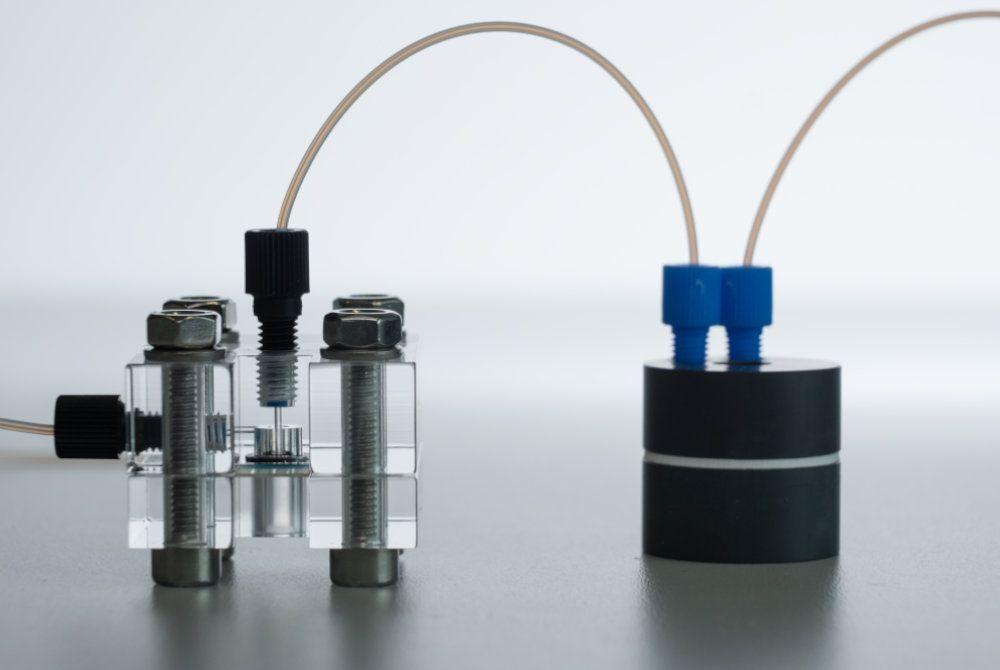
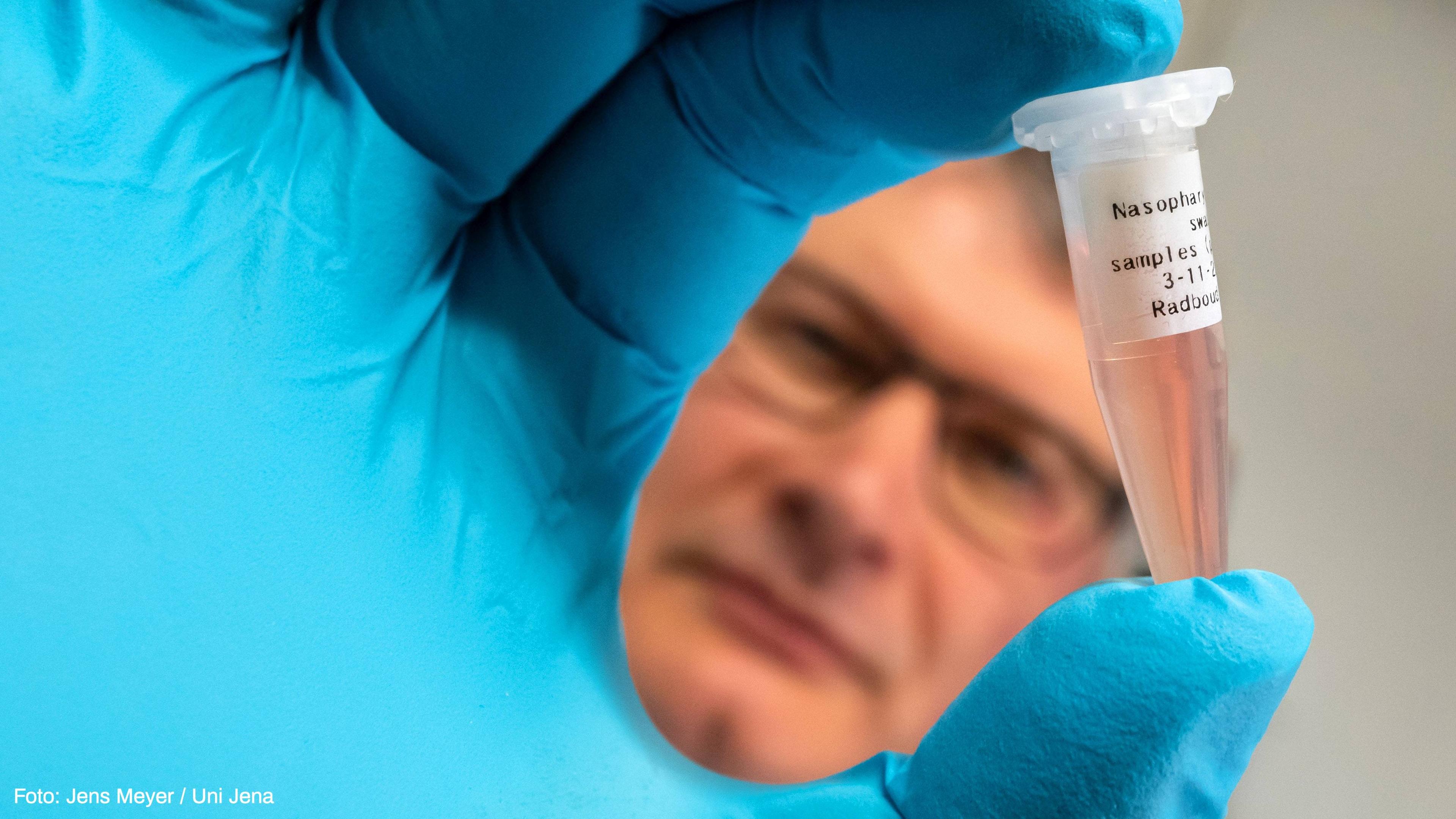
Researchers at have developed a new type of based on the ultra-flat substance . This sensor can detect such as chemokines in complex clinical samples in a highly sensitive, fast and cost-efficient manner.

➡️ uni-jena.de/en/287408/paving-t

Scientist holding a nasal swab sample, which is examined for biomarkers using the developed sensor.
Image: Jens Meyer / Uni Jena
2024-11-27

Researchers @UniJena are developing a #graphene-based #biosensor that can be used directly in complex clinical samples.
nachrichten.idw-online.de/2024

2024-11-27

Forschende @UniJena entwickeln einen #Biosensor auf #Graphen-Basis, der direkt in komplexen klinischen Proben zum Einsatz kommen kann.
nachrichten.idw-online.de/2024

Knowledge Zonekzoneind@mstdn.social
2024-01-04

Wearable #Biosensor measures #Fertility #Hormones in #Sweat : Nature

10 fun facts as #HalleysComet makes its big comeback : Medium

New Class of #Antibiotics Discovered Using #AI : Sci Am

Check our latest #KnowledgeLinks

knowledgezone.co.in/resources/

Client Info

Server: https://mastodon.social
Version: 2025.07
Repository: https://github.com/cyevgeniy/lmst