The Role of Imagination in Human Evolution
Introduction:
Human evolution is a dynamic, multifaceted process spanning more than seven million years. It is characterized by an intricate interplay of anatomical, behavioral, and cognitive transformations. From early ancestors like Sahelanthropus tchadensis to anatomically modern Homo sapiens sapiens, the hominin lineage has undergone remarkable divergence from our closest extant relatives—chimpanzees and bonobos. While we share over 98% of our genetic material with these great apes, our species is uniquely distinguished by symbolic language, complex culture, technological innovation, and cumulative knowledge.
At the heart of this divergence lies the cognitive faculty of imagination. More than a passive or fanciful capacity, imagination is a sophisticated neurological process that enables the mind to simulate scenarios, project future events, and envision realities beyond the present moment. This paper argues that imagination is not a byproduct of cognitive evolution—it is a driving force behind it. Through the lens of imagination, we examine how humans came to innovate, symbolize, ritualize, and build cumulative culture.
Drawing on evidence from paleoanthropology, cognitive archaeology, and neuroscience, this paper explores the foundational role of imagination in human behavioral evolution. Special attention is given to rock art and symbolic material culture, which serve as enduring and visible legacies of ancient imaginative capacities.
Human Cognitive Distinctiveness and the Origins of Imaginative Cognition
Human uniqueness is evident in both physical and behavioral adaptations, from obligate bipedalism and increased brain size to extended childhood and advanced linguistic abilities. Yet these traits gain deeper significance when contextualized through imaginative cognition.
Consider tool use: while several non-human animals use basic tools, only humans create complex, standardized tools that improve over generations. This capacity demands not only physical dexterity but also the cognitive ability to envision form, anticipate function, and mentally model outcomes—clear indicators of imagination in action.
Richard Wrangham’s cooking hypothesis (2009) offers a useful framework. Mastery of fire allowed early hominins to cook food, increasing its digestibility and nutritional value. This shift reduced the metabolic demands of the gut, freeing up energy for brain growth. However, fire itself is not self-evidently useful. It required early hominins to imagine its potential applications, overcome fear, and experiment. This interplay of creativity, risk assessment, and problem-solving exemplifies the evolutionary utility of imagination.
Imagination also enabled social and symbolic behaviors such as ritual, storytelling, and cooperation beyond kin networks. These capacities enhanced survival by fostering group cohesion and transmitting shared knowledge. Language, myth, and culture are each sustained by the ability to imagine alternative realities and shared mental models.
Evolutionary Deep Time: Rethinking the Timeline of Imagination
Recent archaeological discoveries have significantly altered our understanding of when imaginative behavior emerged. The Lomekwi 3 site in Kenya revealed lithic tools dated to 3.3 million years ago, predating the genus Homo and suggesting that australopiths or even Paranthropus engaged in intentional flake production (Harmand et al., 2015). These findings challenge the assumption that tool-making began with Homo habilis and reveal deeper evolutionary roots for imaginative cognition.
Tool-making is not a purely mechanical task—it requires foresight, planning, and mental simulation of cause-effect relationships. These are foundational components of imagination. Early tool industries like the Oldowan and Acheulean reflect increasingly complex conceptual templates, passed down across generations and refined over time.
Similarly, the emergence of symbolic behavior—once thought to appear exclusively in Upper Paleolithic Europe—is now recognized in much older contexts. Ochre markings from Blombos Cave (ca. 75,000 BP), perforated shell beads from North Africa (ca. 82,000 BP), and abstract engravings from Trinil in Java (possibly 500,000 BP) suggest that early humans, and possibly other hominins, engaged in symbolic expression much earlier than previously believed.
These artifacts indicate the presence of what neuroscientist Andrey Vyshedskiy (2020) terms “prefrontal synthesis”—the conscious combination of mental representations to create novel imagery. This ability underpins language recursion, hypothetical reasoning, and the mental flexibility to imagine new scenarios.
Imagination, therefore, was not a sudden leap unique to Homo sapiens. It was a mosaic development, with roots extending into the Pliocene, and gradually expanding the behavioral and cognitive repertoire of our ancestors.
Rock Art: The Archaeology of the Imagination
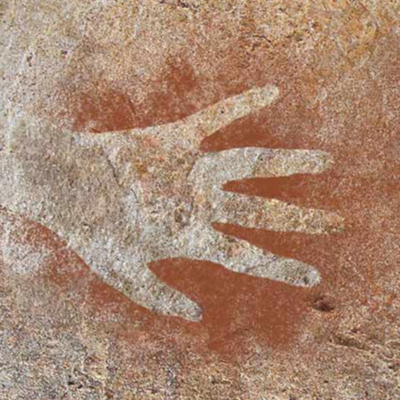
Perhaps no evidence of imagination is more vivid and lasting than prehistoric rock art. From the painted caves of Chauvet and Lascaux in France to the hand stencils in Sulawesi and Arnhem Land’s x-ray figures, rock art offers a direct material record of early human cognition.
These artworks are not mere decoration. They reflect symbolic thinking, abstraction, and shared cultural narratives. The recurrence of motifs—handprints, animals, geometric patterns, therianthropes—suggests the existence of a visual language through which ancient humans communicated identity, belief, and memory.
Notably, rock art appears globally across vastly different environments and epochs. In Africa, sites such as Blombos Cave, Apollo 11, and the Namibian Brandberg demonstrate symbolic marking by early modern humans. In the Sahara, Neolithic depictions of cattle cults and social gatherings reveal the imaginative worlds of pastoralists. In Australia, Aboriginal traditions continue to reflect Dreamtime cosmologies through intricate rock panels that may be tens of thousands of years old.
Many scholars, including David Lewis-Williams (2002), interpret these works as visual expressions of altered states of consciousness. Entoptic phenomena, experienced during trance or ritual, may have inspired many of the abstract forms and hybrid figures. In this sense, rock art externalizes the internal: it manifests individual and collective imagination onto the landscape.
Furthermore, rock art served a communicative function—transmitting stories, recording rituals, and embedding knowledge in place. It is not only a product of imagination but also a medium for sustaining it across generations. In its persistence and power, rock art exemplifies how imagination became a cornerstone of human culture.
Conclusion
Imagination is not a peripheral feature of the human mind—it is central to what makes us human. From striking sparks to painting gods, from crafting spears to building mythologies, imagination has been a catalytic force in our evolutionary journey.
Recent discoveries continue to reshape our understanding of when and how imaginative behavior emerged. Tool-making is no longer the domain of Homo habilis alone. Symbolic expression appears across multiple continents and hominin lineages. As our timelines stretch deeper and broader, one constant remains: imagination is a fundamental driver of cognitive and cultural evolution.
To study the past is to study the minds that imagined it. Through rock art, tools, symbols, and myths, our ancestors reached beyond survival into meaning. In that leap—the leap of imagination—we find the essence of our species.
References
Harmand, S., Lewis, J. E., Feibel, C. S., Lepre, C. J., Prat, S., Lenoble, A., … & Roche, H. (2015). 3.3-million-year-old stone tools from Lomekwi 3, West Turkana, Kenya. Nature, 521(7552), 310–315.
Lewis-Williams, D. (2002). The Mind in the Cave: Consciousness and the Origins of Art. Thames & Hudson.
Vyshedskiy, A. (2020). Neuroscience of imagination and implications for artificial general intelligence. Research Ideas and Outcomes, 6, e54624.
Wrangham, R. (2009). Catching Fire: How Cooking Made Us Human. Basic Books.
#Anthropology #BlombosCave #ChauvetArt #CognitiveArchaeology #CognitiveRevolution #CookingHypothesis #CulturalEvolution #CumulativeCulture #HomoSapiens #HumanEvolution #HumanOrigins #Imagination #LanguageOrigins #MentalSynthesis #Paleoanthropology #PrefrontalSynthesis #PrehistoricArt #RockArt #SymbolicThought #ToolInnovation