
Many thanks to Stéphanie Baulac and Bassem Hassan for hosting me at ICM and for the opportunity to present our lab’s work. Great discussions and a very enjoyable visit to Paris. #newsmayerlab
#NewsMayerLab
Wrapping up 2025 with a small holiday get-together over dinner. Thanks to everyone who made this year inspiring. #newsmayerlab

🎉 Congratulations to Ann Bright!
Our postdoc Ann Bright was invited to present her research at the 2025 SYNAPSES Symposium at Yale University — a prestigious and highly selective event showcasing outstanding postdoctoral neuroscientists from around the world.
We’re proud to see her work recognized on this international stage! 👏
#Postdoc #SynapsesSymposium #NewsMayerlab

Was the layered cortex really unique to amniotes? Salamanders, our anamniote cousins, suggest otherwise.
In a new preprint from Maria Antonietta Tosches’ lab (first author Astrid Deryckere), we show that salamanders share core developmental logic with mammals — but with an ancestral outside-in sequence.
Clonal lineage tracing in salamanders reveals that both superficial and deep-layer neurons arise from the same multipotent radial glia.
Glad to have contributed to this work.
#neuroscience #development #evolution #anamniotes #NewsMayerlab
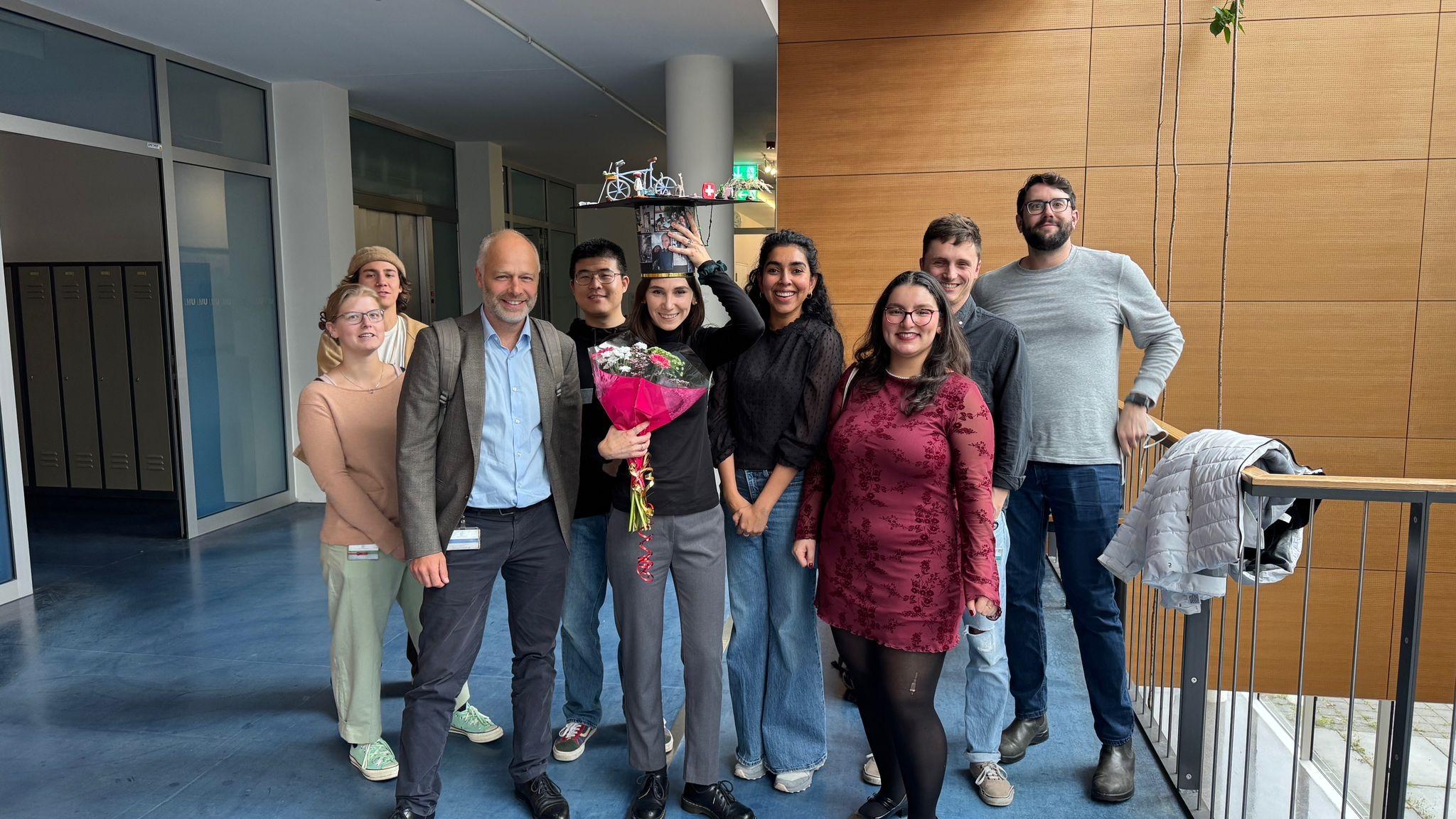
🎉 Big congratulations to Yana Kotlyarenko for successfully defending her PhD!
She carried out her research project in our lab, and it’s been a joy to see her science and ideas grow. Wishing her all the best for the next steps! 🌟
We’ve updated the TrackerSeq pipeline on GitHub! Developed in our lab, TrackerSeq is a tool for processing lineage barcodes in single-cell datasets. Thanks to great work by Connor Lynch, cloneID assignment now uses a network-based approach with Jaccard distance weighting and user-controlled thresholding — reducing false positives while keeping true positives. https://github.com/mayer-lab/TrackerSeq
Great science, great views, and great company — our joint retreat with Rodrigo Villaseñor’s lab (LMU) at Schloss Ringberg was a real highlight. Here's a snapshot from our hike — thanks to everyone who made it such a memorable and inspiring few days!
#Neuroscience #LabRetreat #SchlossRingberg #ScienceLife #NewsMayerlab
Excited to share our collaborative study, now out in Nature Communications:
Astrocyte diversity in the cortex arises from two molecularly distinct radial glia lineages.
A beautiful piece of work from Riccardo Bocchi’s lab at the University of Geneva, with Jiafeng Zhou as first author. My lab contributed to the lineage tracing efforts using TrackerSeq.
Read here: https://www.nature.com/articles/s41467-025-61829-4
Explore the data — single-cell RNA, ATAC, and eGRNs — in our interactive app:
https://mayerlab.net/mouse-inhibitory-neuron-development/
Join the discussion in our Matrix room: #Mouse.Inhibitory.Neuron.Development:mpg.de
#NewsMayerlab #ShinyApp #OpenScience
(7/7)
Gene regulatory network analysis pointed to NFIB as a central hub. It interacts with MEIS2 and TCF4, and drives late-stage enhancer activation. Heterochronic transplants confirmed: maturation competence is sensitive to environmental timing.
#NewsMayerlab #GRN #GeneRegulation #GeneRegulatoryNetwork #Scenic+ #NFIB #Transplantation
(6/7)

We also saw a shift in TF activity.
Footprinting showed increased NFI binding, especially NFIB, in late-born cohorts. These neurons activate maturation modules faster — possibly guided by chromatin remodeling during neurogenesis.
#NewsMayerlab #TFfootprints #TranscriptionFactors #scATACseq
(5/7)

This shift was mirrored in chromatin accessibility.
scATAC-seq revealed stage-specific enhancer activation, with late-born cells opening distinct regulatory elements — especially in distal regions. A dynamic change in the regulatory landscape.
#NewsMayerlab #Chromatin #Epigenetics #scATACseq
(4/7)

Using FlashTag to label isochronic cohorts, we tracked the fate of early- and late-born GABAergic neurons.
Surprisingly, later-born neurons matured faster — reaching advanced transcriptional states in hours rather than days. Differentiation stayed constant, maturation didn’t.
#NewsMayerlab #FlashTag #Birthdating
(3/7)
During corticogenesis, progenitor competence changes over time — generating distinct excitatory neuron types.
But it turns out that in inhibitory lineages, progenitors retain stable differentiation competence. Instead, temporal progression alters maturation dynamics.
#NewsMayerlab #Corticogenesis #PatchClamp
(2/7)
Now out in #NatureNeuroscience: "Temporal control of progenitor competence shapes maturation in GABAergic neuron development in mice".
Congrats to first authors Ann Bright, Yana Kotlyarenko, Florian Neuhaus — and thanks to all collaborators!
https://www.nature.com/articles/s41593-025-01999-y
#NewsMayerlab #NeuroFediverse #SingleCell #DevelopmentalBiology
(1/7)
Just arrived in Oslo for the FENS Regional Meeting to present our lab’s latest work. The town is beautiful — and it’s such a pleasant experience to be somewhere with so little car traffic. Looking forward to connecting with colleagues and sharing our work on Wednesday! #FRM2025 #FENS2025 #NewsMayerlab
Attended the Neurogenomics Conference @humantechnopole in Milan earlier this week. Impressive host institute and an inspiring environment. Thanks to the organisers for putting together a strong and engaging meeting.
Our research is now supported by a 2024 Simons Foundation Autism Research Initiative (SFARI) Pilot Award, co-funded by the Nancy Lurie Marks Family Foundation (NLMFF). I am grateful to both SFARI and NLMFF for investing in high-risk, high-reward science to advance understanding of autism spectrum disorders (ASD) and neurodevelopmental disorders.
The project will explore how mutations in chromatin regulators ASH1L and SETBP1 impair their crucial role in guiding the development of GABAergic neurons—key cells maintaining the brain’s balance between excitation and inhibition. Disruptions in this process are strongly linked to ASD, but the molecular pathways remain poorly understood.
By integrating genomic, proteomic, and functional approaches, we aim to reveal how these enzymes regulate gene activity during inhibitory neuron development and how their dysfunction contributes to ASD.
Official announcements:
SFARI: https://www.sfari.org/2025/04/08/announcing-the-recipients-of-the-2024-pilot-and-pilot-progression-awards/
NLMFF: https://www.nlmfoundation.org/grant/epigenetic-regulators-ash1l-and-setbp1-in-gabaergic-neuron-development-and-asd/
#newsmayerlab #SFARI #NLMFF #AutismResearch #Neurodevelopment #Epigenetics #GABA #Genomics #Chromatin #Neuroscience
Just returned from the Paris-Munich #Epigenetics Symposium—thank you to the organizers for the kind invitation and the opportunity to present our lab’s work. Grateful to be part of such a thoughtful and inspiring community. #newsmayerlab
Our lab at the MPI-BI is now using #Matrix for team communication. A decentralized and secure solution that avoids tech company monopolies and supports open, flexible collaboration. #NewsMayerlab
Client Info
Server: https://mastodon.social
Version: 2025.07
Repository: https://github.com/cyevgeniy/lmst