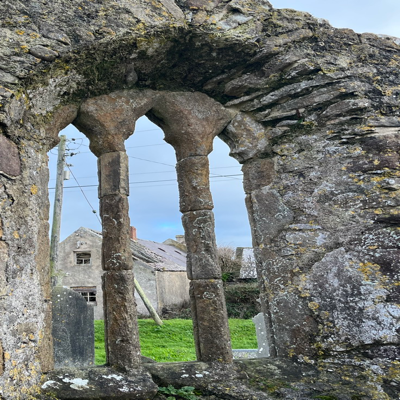
I'm thinking about my next #Pathfinder1e #Ustalav session.
The party sent missives to four nearby thorps and/or hamlets to recruit people to stand with them against the fire #skeleton champions and their allied #wights. The #skeletons agreed to meet at sundown to collect tribute from the local village.
I'm trying to decide how many NPCs would respond to the request for aid. Also, should the village #vampire faction lend aid?

![The image depicts a serene and picturesque scene featuring the historic Whippingham Church, located on the Isle of Wight in England. The church is captured during golden hour, with warm hues bathing its stone facade as it stands against an evening sky that transitions from light to darker shades. Architectural details such as pointed arches, lancet windows, and a prominent spire contribute to the Gothic Revival style evident in this building.
In front of the church sits a wooden gatehouse or entranceway with intricate trusses and doors, indicative of traditional British rural architecture. Surrounding walls made from red brick enclose the grounds, adding a rustic charm to the scene. The foliage of mature trees frames both sides of the composition, suggesting that the photograph was taken in late summer when leaves are at their peak.
The image is identified by a caption reading "10698 - ISLE OF WIGHT WHIPPINGHAM CHURCH," which likely refers to an older reference or cataloging system for this particular photo. The overall atmosphere of the picture conveys a sense of tranquility and historical significance, capturing not only the physical structure but also hinting at its cultural importance within the community it serves.
Additional information about Whippingham Church can be found in various resources documenting British ecclesiastical architecture from approximately 1890 to 1900. This period is marked by a revival of [...]](https://files.mastodon.social/cache/media_attachments/files/115/625/009/139/214/418/original/f2de20392e8e937f.jpeg)


![The image depicts a picturesque coastal scene with traditional thatched-roof cottages nestled on the side of a rocky cliff. The color palette is dominated by earthy tones, including shades of green from the vegetation and beige to brown for the buildings' walls and roofs. A pathway made up of stone slabs leads through the foreground towards these houses, flanked by low stone fences with various sized stones. In the immediate vicinity of the path lies a wooden structure that appears worn, perhaps once serving as a shelter or storage area.
In the background, there is a hint of human activity; individuals can be discerned in some of the windows and near what seems to be an outdoor bathing area connected to one house by a rudimentary railing. The sea's edge comes into view on the left side of the image where waves gently break against jagged rocks protruding from the water.
The overall atmosphere exudes a sense of tranquility, with no modern elements in sight. It captures what appears to be an idyllic slice of life from another era on the Isle of Wight's coast near Shanklin. The photo is marked by "1910 PZ" and identified as Seashore Near Shanklin, which suggests it may have been taken around that time or later with a vintage colorization technique applied to the original print.
The image captures not only architectural details but also evokes the historical ambiance of rural life in Britain during this period. The presen [...]](https://files.mastodon.social/cache/media_attachments/files/115/620/494/850/317/053/original/fd0f0211df08dca7.jpeg)
![The image depicts a scenic coastal view with a shoreline that curves gracefully to the left. A steep cliff rises on one side, adorned with vegetation and some structures, possibly houses or small buildings, nestled within the greenery. The beach is bustling with activity; numerous boats are anchored along the shore, while others appear in various states of repair closer to land. People can be seen engaged around these vessels.
Parallel to the coastline runs a paved path where pedestrians walk beside rows of parked cars and carts, indicating some form of organized transportation or possibly goods delivery services from that era. The promenade extends into the distance, bordered by what seems like bungalows or vacation homes with sloped roofs facing the sea.
The horizon is marked by a long pier stretching out over calm waters towards an amusement pavilion at its far end, suggesting recreational activities were part of this seaside locale's appeal during that period.
In the background, cliffs and rolling hills stretch across the landscape under a cloudy sky, adding to the picturesque quality of the scene. The overall atmosphere is one of leisurely enjoyment in a popular coastal town around 1890-1900 as indicated by the caption "Sandown Bay," referencing Sandown on the Isle of Wight, England.
The image has an aged look with faded colors and noticeable graininess characteristic of early photographic processes. The bottom [...]](https://files.mastodon.social/cache/media_attachments/files/115/617/396/205/954/627/original/50d59fb2fb538b32.jpeg)


![The image depicts a serene and picturesque countryside scene, likely taken between the late 19th century to early 20th century. A winding road meanders through dense green foliage of deciduous trees with lush canopies overhead, indicating it is perhaps spring or summer season due to the vibrant greens present in the leaves. The ground appears dry but slightly weathered by time and use. On either side of the path are well-maintained hedges, composed mostly of shrubs which have a healthy growth pattern indicative of regular care.
The scene conveys an atmosphere of tranquility with no visible pedestrians or vehicles on what seems to be a narrow public roadway suggesting it may not receive much vehicular traffic due to its secluded setting. The absence of modern infrastructure such as street lamps, signs, or buildings points towards the image being taken in a rural area where preservation and maintenance might be less frequent than urban settings.
There's a notable feature which is an old-fashioned signpost on the left side with text that reads '10694 - ISLE OF WIGHT SPENCER ROAD'. The inclusion of such signage suggests this could have been part of historical documentation or photography from around the era mentioned. It’s plausible these images were produced for illustrative purposes, possibly to document and share local landscapes in a publication like an atlas.
Overall, it is a snapshot capturing the natural beauty and [...]](https://files.mastodon.social/cache/media_attachments/files/115/615/980/916/070/069/original/2624a03b0cb37841.jpeg)


![The image depicts a grand and historic building known as Osborne House, located on the Isle of Wight in England. This mansion is characterized by its impressive architecture, featuring multiple towers, large windows, and intricate detailing that suggests it was constructed during an era when such opulent designs were popular among aristocrats.
Atop one tower, there's a flag, possibly representing Sweden or another country with historical ties to the British Royal Family given Queen Victoria’s connections. The building is surrounded by well-manicured gardens, including lawns and flower beds that are typical of Victorian-era estates designed for both aesthetic pleasure and practical entertainment purposes such as hosting guests.
The image appears aged, suggesting it may have been taken around the late 19th or early 20th century when postcards were commonly used to document significant buildings. This particular depiction likely served a similar purpose in that era; capturing an important historical site for both tourism promotion and personal memory of travels abroad.
Osborne House was built between 1845-1851 by Queen Victoria and Prince Albert as their summer residence, reflecting the couple’s desire to enjoy rural life away from court. Its preservation indicates its significance in British history not just architecturally but also culturally given that it served royal family members during significant periods of their [...]](https://files.mastodon.social/cache/media_attachments/files/115/613/621/494/370/669/original/4f1a2497b1c98632.jpeg)