#connectivism

2026-01-20

Digital propinquity: how to engineer serendipity and build connection in remote teams

We cannot teleport physical proximity, but we can replicate its psychological effects in remote teams. This has everything to do with propinquity.

If the physical world provided connection by accident, the digital world requires connection by design.

The most critical loss in the shift to remote work is “propinquity,” a fancy word for physical nearness.

In the 1950s, psychologists discovered that the single best predictor of whether two people would become friends was how close their apartments were to each other.

In the professional world, this is the “hallway track” at a conference.

It is inefficient, but it is highly effective because it facilitates passive, frequent interactions.

You bump into someone at the coffee station.

You exchange a nod.

You accumulate data points about them that transform a transactional contact into a human relationship.

In a remote setting, propinquity does not happen by accident.

There is no digital equivalent of bumping into a donor at the water cooler unless someone deliberately builds it.

This requires a pivot to “Digital Propinquity.”

At The Geneva Learning Foundation, A Swiss non-profit that works globally, we have found that a sense of nearness can be cultivated digitally if we align the right factors.

In our work with health professionals globally, we utilize a concept called “structured serendipity”.

For example, one simple and surprisingly effective method we use is the “Randomized Coffee Trial”, or just “remote coffee”.

In this model, participants opt-in to be randomly paired with a stranger from the network for a short conversation based on a non-work prompt.

This mechanism builds “weak ties,” the casual connections that sociologists know are essential for innovation.

We have also found that we can change how we facilitate dialogue and connections between people and organizations online.

Traditional remote management is often rooted in a culture of surveillance.

It focuses on reporting and asks “Have you done the work?”.

This erodes trust, turning connection into suspicion.

Instead, we implement what we call “digital accompaniment”.

Derived from physical-world experiences of working side-by-side with a shared purpose, this model uses technology to provide sustained, high-touch presence.

The use of technology results in losing some of the signals we are most familiar with, grounded in our experience of the physical world.

We also gain new signals from defying distance to include those who might otherwise never meet.

The challenge is learning to listen to these signals, and how to respond to them.

That is core to our model for facilitation.

We use digital channels that are already part of people’s lives to ask: “How are you navigating this challenge?”.

This initiates and then sustains dialogue on local challenges.

Challenges in very different locations turn out to be remarkably similar. 

This approach prioritizes psychological proximity over supervision, no matter how supportive the latter may be intended to be.

By establishing what we call Accompaniment Pods mediated by Foundation-supported facilitators, such networks can provide the psychological closeness usually found in face-to-face mentorship.

The facilitator acts as a sensor for the network, for example to detect early signs of distress before a participant disengages.

By treating the digital space as a distinct social architecture with its own ‘physics’, we have been able to reconstruct a new kind of intimacy or kinship that distance negates.

A new peer learning programme for those leading change across distance

Distance is no longer a barrier to partnership. It is the condition for a new kind of “augmented reality” where collaboration can be more inclusive and effective than in the physical world. The Geneva Learning Foundation’s Certificate peer learning programme in Artificial Intelligence includes a tactical primer to master the essentials of digital, remote work and partnering with both humans and machines as co-workers. The primer serves as the stepping stone to a broader strategic transformation, where you will learn to build communities of action that scale expertise and deliver results faster. By rejecting the “digital dualism” that treats online interaction as a deficit, you will turn the necessity of working apart into a decisive organizational advantage. Get The Geneva Learning Foundation’s AI framework now. You will then receive the invitation to join the primer on the essentials of partnering and work in the Age of AI.

References

  • Allen, T.J. (1977) Managing the Flow of Technology: Technology Transfer and the Dissemination of Technological Information within the R&D Organization. Cambridge, MA: MIT Press.
  • Festinger, L., Schachter, S. and Back, K. (1950) Social Pressures in Informal Groups: A Study of Human Factors in Housing. Stanford: Stanford University Press.
  • Granovetter, M.S. (1973) ‘The Strength of Weak Ties’, American Journal of Sociology, 78(6), pp. 1360–1380. Available at: https://doi.org/10.1086/225469
  • Korzenny, F. (1978) ‘A Theory of Electronic Propinquity: Mediated Communication in Organizations’, Communication Research, 5(1), pp. 3–24. Available at: https://doi.org/10.1177/009365027800500101
  • Sadki, R., 2023. Digital bridges cannot cross analog gates. https://doi.org/10.59350/srvap-txc24
  • Soto, M., 2013. Institutionalising Serendipity via Productive Coffee Breaks. Nesta. URL https://www.nesta.org.uk/blog/institutionalising-serendipity-productive-coffee-breaks (accessed 2.8.18).
  • Watkins, K.E., Sadki, R., Kim, K., Suh, B., 2019. Changing Learning Paradigms in a Global Health Agency, in: Evidence-Based Initiatives for Organizational Change and Development. IGI Global, pp. 693–703. https://doi.org/10.4018/978-1-5225-6155-2.ch050

About the image

Near, Without Touch © The Geneva Learning Foundation 2025. This installation arranges a series of carved forms in deliberate proximity, each distinct yet subtly responsive to the others. The surfaces twist and lean as if drawn together by an unseen force, suggesting closeness that is sensed rather than physically realized. Made from the same living material but shaped along different trajectories, the figures evoke how connection can emerge through alignment, attention, and shared orientation rather than direct contact. The work reflects on proximity as something that can be engineered and cultivated, reminding us that nearness is not only a matter of distance, but of how carefully space is shaped to allow encounters to happen.

#AccompanimentPods #connectivism #digitalAccompaniment #networks #physicalPresence #propinquity #remoteTeams
2020-09-17

Ideas Engine: What is The Geneva Learning Foundation’s insights mechanism?

It’s a cliché to claim that data is the “new oil”, a resource to be mined. We collect it from the field, refine it with experts, and utilize it for decision-making. However, we rarely ask what this extractive model does to the workers and communities that provide the raw materials. This is a summary of how and why we developed the Ideas Engine to collect and share insights.

The flow of data remains largely one-way. We ask local actors to report on vaccination coverage, disease outbreaks, or supply shortages. Yet, all too often, this valuable information travels up the chain without ever returning to the people who generated it in a way they can use.

What if the act of reporting was, in itself, an act of learning? What if the input mechanism was designed not just to feed a database, but to inform the practitioner? What if this recognized the significance of qualitative experiences that are usually dismissed as anecdotes? 

This shift in perspective is the driving force behind The Geneva Learning Foundation’s Ideas Engine, first launched in July 2020 with a group of more than 600 practitioners who designed the COVID-19 Peer Hub with support from the Bill & Melinda Gates Foundation (BMGF).

This mechanism is helping us move beyond the traditional survey model to create a system of reciprocal value. Every piece of data shared becomes a tool for empowerment, connection, and locally-led change.

Ideas Engine: moving beyond mining the frontline

Epidemiologists are trained to dismiss experience as anecdotal, to minimize bias, and to extract clean data. We treat the local actor as a sensor or a passive instrument to measure coverage or disease incidence. But a local actor is not a sensor. She is a professional with the capacity to think, act, and learn. And yet, data reported by local actors are treated with suspicion, generally assumed to be unreliable for multiple reasons.

When we treat a community volunteer or a district medical officer merely as a source of data, we do more than miss the context. We strip them of their agency. We reduce a thinking, adapting professional operating in a complex adaptive system to an anonymous row in a dataset.

This is an epistemic injustice. It assumes that knowledge resides in the center, with experts who analyze the data, while the periphery become an anonymous source or informant.

When we treat people and communities as data sources, we also fail to capture the tacit knowledge that explains the numbers. We miss the story of how a nurse in Kano negotiated with a community leader to allow vaccinators entry. We miss how a district officer in Bihar adapted cold chain logistics during a flood.

The Insights mechanism that led to developing the “Ideas Engine” is not a survey tool designed to extract information for the center. It is a pedagogical pattern designed to build power at the periphery. It supports local actors’ inherent capacity to learn from each other, while offering global actors a rare opportunity: the chance to listen, to act on what they hear, and to question governing assumptions that drive global strategies.

Our Insights mechanism is designed to capture this layer of reality. It operationalizes what learning theorists like Diana Laurillard describe as a conversational framework, but applies it outside classrooms and at a massive scale. Instead of a teacher-student dialogue, we facilitate a peer-to-peer dialogue across borders. This draws on George Siemens’s connectivism, where learning happens by connecting nodes of information across a network. We then add a critical layer of structure to ensure those connections lead to action. This embodies Cope and Kalantzis’s vision of active knowledge production, where the learner is not a consumer of content, but a creator of it. Last but not least, we draw on the insights from the work of Karen E. Watkins and Victoria Marsick to map the capacity for change or “learning culture” that set outer boundaries that local actors operate within.

This mechanism remixes these theoretical frameworks to life on the outer cusp of chaos. It operates in humanitarian emergencies, disasters, war zones, and extreme poverty, engaging tens of thousands of participants where traditional systems fracture. 

Reciprocity as justice, not transaction

In traditional marketing, there is a concept called give-to-get. You give a free resource to get an email address. This is transactional. Our philosophy is different. We believe that giving back is a requirement of justice.

When a health worker in a conflict zone takes thirty minutes to share a story about overcoming vaccine hesitancy, they are performing unpaid labor for the global good. If we do not return that value to them rapidly and in a usable form, we are participating in the same extraction we claim to oppose.

Learn more: Why answer Teach to Reach Questions?

Our Insights mechanism is therefore built on a specific architecture of reciprocity. It cycles value back to the contributor at every stage of the process. This ensures that the mechanism serves the practitioner first, and the hierarchy is positioned in support of the practitioner. This distinct ethical framework is what allows us to maintain high levels of engagement and trust over time.

The architecture of the Ideas Engine: from reflection to action

The mechanism is a complex assembly of pedagogical scripts, technical workflows, and community engagement loops. It functions as the central operating system for our learning programs, feeding both the Teach to Reach events and the Impact Accelerator.

1. The input: reflections, not reporting

Standard data collection asks for statistics. How many children did you vaccinate? This triggers compliance. Our questions ask for narratives. Tell us about a time you faced a challenge. What did you do?

This phrasing is intentional. It forces the user to pause and reflect on their own practice. This is metacognition. It transforms them from a data subject into a knowledge producer.

2. The immediate return: collections of experiences

Our insights team reads every contribution. The team then does the grueling work of producing a collection of Shared Experiences. This is a compendium with hundreds and sometimes thousands of peer stories. It is filtered only to remove nonsensical or AI-generated content.

We strive to share this back with the community as quickly as possible. This validates tacit knowledge. It tells the health worker that their experience matters enough to be shared with the world rapidly. It is also that a health worker facing a cholera outbreak today is more likely to benefit if the latest experiences are shared when and where they are needed, not on a scholarly publishing calendar that may take months or years. (Our process includes peer feedback, and we posit it actually resolves some of the challenges being faced by academic publishing.)

3. The synthesis: thematic insights reports

While the raw collection is fast, we then use more conventional qualitative research techniques to produce thematic insights reports, also known as “eyewitness reports”. Each report distills dozens, hundreds, or thousands of contributions into short summaries of what we learned from them, on a specific topic or challenge. Written for the community, they identify patterns that no single individual could see on their own. These reports also turn out to be surprisingly relevant and useful for non-local actors.

4. The dialogue: dynamic event-driven knowledge translation

Knowledge in action is dynamic, by definition. The Ideas Engine is about turning knowledge into action. This is why we host Insights Live. These are rapid-fire livestreamed sessions where the data comes alive, with contributors, guides on the side, and anyone else interested joining to discuss how they are putting to use what we are learning together.

We invite the contributors themselves to take the floor as our guests of honor. A lot of what happens in these live session – who speaks, what we learn – we cannot and do not predict in advance. It is emergent. This is more akin to jazz improvisation, rather than the rigid classical music orchestration of presentation webinars. We invite global partners and funders to listen. This reverses the usual power dynamic. We then turn these livestreamed events into podcasts. This ensures that even those with low bandwidth or no time to watch a screen can access the learning.

5. The application: closing the loop

Knowledge is useless if it cannot be shared. This is why we provide tools for dissemination. For example, we prepare short slide decks that contributors can use to present insights to their colleagues and teams.

Crucially, this includes a feedback facility. We track not just who downloaded the deck, but who presented it and what their colleagues said. This allows us to measure the ripple effect of the insight, including actual use and, in some cases, how the use of an insight led to changes in practice and tangible improvements in outcomes.

Does the Ideas Engine actually make a difference?

Does this actually work? Is it better than a survey? The data suggests yes.

In an independent analysis by the University of South Australia’s Centre for Change and Complexity in Learning, researchers examined our Ideas Engine. This was a core component of this mechanism during the COVID-19 Peer Hub. The report revealed the scale of engagement that this proprietary method generates.

  • Scholars contributed 1,103 ideas and 3,061 comments. This is an average of 2.77 comments per idea.
  • 80.2% of participants reported using the Ideas Engine.
  • Of those who used it, 92.9% reported finding ideas that were useful for their work.
  • Perhaps most importantly, the analysis of citations showed that two-thirds of the citations in action plans were to ideas from peers working at different levels of the health system.

This proves that the mechanism does not just collect data. It successfully bridges the gap between knowledge and action by connecting practitioners across hierarchies.

Photo: The Geneva Learning Foundation Collection © 2020

This article was updated on 6 January 2026 to reflect what we have learned since 2020.

#BillCope #connectivism #continuousLearning #DianaLaurillard #immunization #KarenEWatkins #knowledgeManagement #MaryKalantzis #peerLearning #TheGenevaLearningFoundation #VictoriaMarsick
2025-05-06

You’re not imagining it—life is more overwhelming than it used to be.

Thirty years ago, we weren’t expected to be on 24/7.
Now, everything—news, work, education, friendship—flows through endless digital networks.

We scroll, refresh, reply, react.
There’s no pause. No buffer. No off-switch.

This is the Network Society.
Power no longer moves top-down—it moves through likes, clicks, and notifications.
Your attention is the commodity. Your nervous system is the casualty.

We weren’t built for this.
We evolved for rhythm, rest, and relationship—not for a life spent staring into the infinite scroll.

If you’re feeling scattered, anxious, or emotionally fried—you’re not broken.
You’re living in a system that rewards saturation over sanity.

Maybe the first step is naming it.
This isn’t just burnout. It’s digital trauma.

#DigitalFatigue #NetworkSociety #DigitalWellbeing #MentalHealth #RestIsResistance #SlowLiving #Connectivism #InformationOverload

This is one of the blogs about #connectivism and #cMoocs that I host in one section of my library. This is from 2013. learningwithtechs.wordpress.com/2013/10/29/c... That section of links is at tutormentorexchange.net/resource-lin...

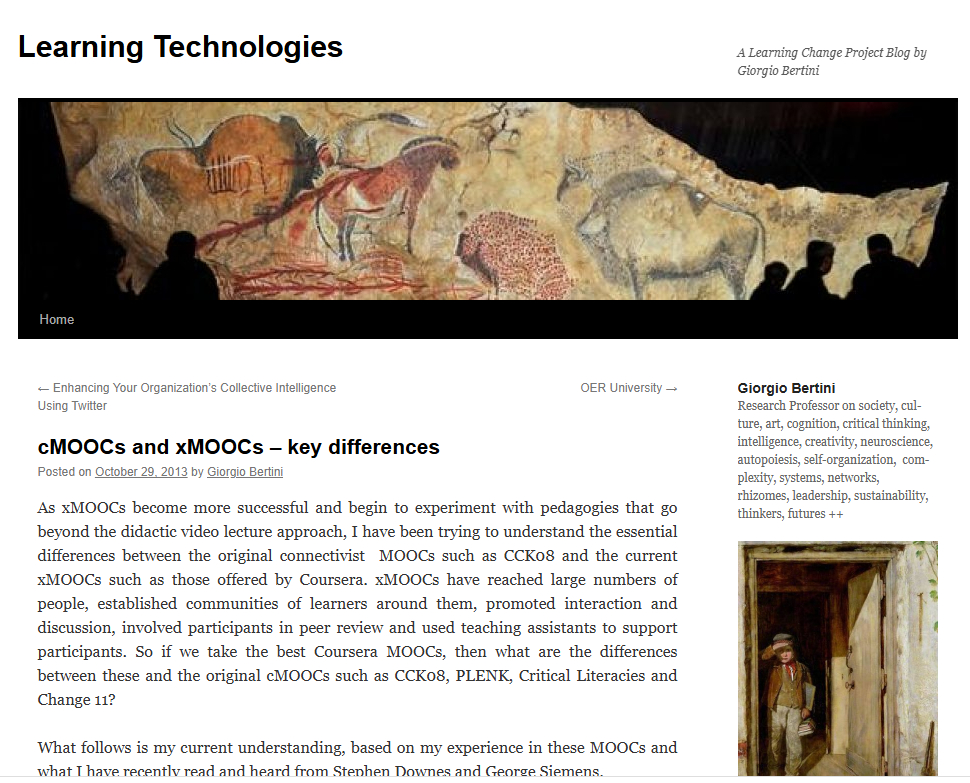
This is from the Learning Technologies blog, from 2013.

cMOOCs and xMOOCs – key differences
Posted on October 29, 2013 by Giorgio Bertini

As xMOOCs become more successful and begin to experiment with pedagogies that go beyond the didactic video lecture approach, I have been trying to understand the essential differences between the original connectivist  MOOCs such as CCK08 and the current xMOOCs such as those offered by Coursera. xMOOCs have reached large numbers of people, established communities of learners around them, promoted interaction and discussion, involved participants in peer review and used teaching assistants to support participants. So if we take the best Coursera MOOCs, then what are the differences between these and the original cMOOCs such as CCK08, PLENK, Critical Literacies and Change 11?
2024-07-10

We started our #ISE2024 lecture on Basic Machine Learning today with "A (very) brief History of AI", which - in the end - took longer than expected ;-) ....stories and anecdotes time again

lecture slides: drive.google.com/file/d/1smo2q

@enorouzi @sourisnumerique @fizise @fiz_karlsruhe #AI #HistoryOfAI #perceptron #expertsystem #knowledgebase #symbolicAI #subsymbolicAI #neuralnetworks #connectivism #generativeAI #creativeAI #AIart #astronaut

Slide from the lecture Information Service Engineering 2024, Basic Machine LEarning 01, "A (very) brief History of AI". The slide is the cover slide for the section. It shows an astronaut in a heavy space suite (like the historical Apollo space suits) in a black & white drawing, who is sitting (probably frustrated) in a ring like structure, which looks like air hoses of a large artificially built structure. The picture has been created with Midjourney.
2024-01-30

Bookmark of 'HIST1900 with Shawn Graham - The History of the Internet'

@electricarchaeo runs a course on the history of the internet that takes, in his words, an “archaeological” approach to its subject. Lots of useful stuff in the online guide to this real-life use of #connectivism

shawngraham.github.io/hist1900

synesthesia.co.uk/stream/bookm

Geoff Caingeoffcain
2022-12-06

I am glad to see scholars still writing about and . The initial work of Downes and Siemens is not finished yet:

cjlt.ca/index.php/cjlt/article

ibieleribieler
2022-08-28

Building an infopunk’s digital garden with Sane - Ness Labs by @ness_labs@twitter.com buff.ly/3R6zz9U

2019-03-08

Planning to watch

Everything is Connected -- Here's How: | Tom Chi | TEDxTaipei

youtube.com/watch?v=rPh3c8Sa37

#EverythingIsConnected #connectivism #holism #microcosm #macrocosm

2018-10-14

el30.mooc.ca/course_outline.ht

"E-Learning 3.0 - Distributed Learning Technology

This course introduces the third generation of the web, sometimes called web3, and the impact on e-learning that follows."

New #MOOC about online learning by and with #StephenDownes himself -- one of the inventors of the very first ("connectivist") MOOCs.

Come join in the fun!

#EL30 #connectivism

Client Info

Server: https://mastodon.social
Version: 2025.07
Repository: https://github.com/cyevgeniy/lmst