🌠CatSalad🐈🥗〰️Īᵐ⁻ⁱⁿ.␠🌌

You're cordially invited to my trolley problem... 🚊

#CatSalad

🌠CatSalad🐈🥗〰️Īᵐ⁻ⁱⁿ.␠🌌 boosted:
Corey S Powellcoreyspowell
2026-01-04

Astronomers have spotted a supermassive black hole fleeing its home galaxy at 900+ kilometers per second, heading off alone into intergalactic space.

I feel you, friend.

sciencealert.com/jwst-confirms

JWST observations homed in on the bow shock at the front of the structure created by a runaway black hole. (van Dokkum et al., arXiv, 2025)
🌠CatSalad🐈🥗〰️Īᵐ⁻ⁱⁿ.␠🌌catsalad@im-in.space
2025-12-30

Yay!! :3

🌠CatSalad🐈🥗〰️Īᵐ⁻ⁱⁿ.␠🌌 boosted:
2025-11-26

Overseas guest? What you need is the children’s menu at the JAXA cafeteria that is served on a space shuttle dinner tray!

(He did in fact agree that this was exactly what was required 😂)

A photo of a tray shaped like the space shuttle with two bowls of food sitting on top.
🌠CatSalad🐈🥗〰️Īᵐ⁻ⁱⁿ.␠🌌 boosted:
Prof. Sam Lawlersundogplanets
2025-11-24

Everybody go read "Termination Shock" by Neal Stephenson, because apparently that whole scenario is actually about to start happening: politico.com/news/magazine/202

🌠CatSalad🐈🥗〰️Īᵐ⁻ⁱⁿ.␠🌌 boosted:
Where are we now?wawn
2025-11-17

2025-11-17 04:00:00 UTC (Delta: 2025-11-16)

☄️C/2024 E1 Wierzchoś
- Barycentric speed: 35.35 km/s (+0.20 km/s)
- Perihelion in: 65 days
- Closest approach to Earth in: 92 days
- Brightness (Mag): 13.67 (-0.03)
- Visibility: Small telescope - dark sky

🌎 Relative to Earth
- Distance (km): 323,162,658.54 km (-1,118,478.97 km)
- Distance (AU): 2.16 (-0.01)
- Light travel time: 17 min 57.99 s (-3.73 s)

🌠CatSalad🐈🥗〰️Īᵐ⁻ⁱⁿ.␠🌌 boosted:
2025-10-31

@ai6yr
The last thing ever seen by Japanese visitors...

It's a Japanese mascot of a black bear with bright red cheeks. Its arms are held up, possibly to attack but more likely just to wave. The photo is taken at a skewed angle, possibly to show this was the last photo taken revealing a monster but more likely because it's cuter that way.
🌠CatSalad🐈🥗〰️Īᵐ⁻ⁱⁿ.␠🌌 boosted:
2025-10-29
An image of Venus captured by Japan’s Akatsuki spacecraft. The planet’s swirling clouds are illuminated along its curved edge. The atmosphere has dark cloud bands and areas that are glowing brightly.
🌠CatSalad🐈🥗〰️Īᵐ⁻ⁱⁿ.␠🌌 boosted:
Wonder of Sciencewonderofscience
2025-10-14

Every second, the Sun ejects 1.5 million tons of material into space at hundreds of miles per second, but Earth's magnetic field protects it from the solar wind.

Credit: NASA Goddard

🌠CatSalad🐈🥗〰️Īᵐ⁻ⁱⁿ.␠🌌 boosted:
2025-10-11

It’s our open day at ISAS. A terrifying prospect, and it’s pouring with rain. But this is a half-scale model of the Martian Moons eXploration (MMX) spacecraft. HALF SCALE. It’s the biggest spacecraft we’ve ever built 😳

A view from above of the lobby at the Sagamihara campus for ISAS JAXA. The space is dominated by a large spacecraft model, covered in gold and flanked by large solar panels. Even at half size, it towers cover the visitors.
🌠CatSalad🐈🥗〰️Īᵐ⁻ⁱⁿ.␠🌌 boosted:
Prof. Sam Lawlersundogplanets
2025-10-10

I have a bazillion new German followers (hello!), and I'm getting interviewed for German public radio in an hour about "sunlight as a service", and I don't speak any German and I've never been to Germany.

The Fediverse is a truly magical place!

🌠CatSalad🐈🥗〰️Īᵐ⁻ⁱⁿ.␠🌌 boosted:
Prof. Sam Lawlersundogplanets
2025-10-10

It's becoming increasingly clear to me that Reflect Orbital's fucking stupid giant mirror satellite, with absolutely NOTHING useful to offer, which will cause countless safety issues, ecological disasters, and destroy the night sky, is going to launch.

A bunch of astronomers and I have sent out a fact sheet about them to a bunch of journalists, but very few are going to write about this. So, let me try posting it all here.

Here's what I know about Reflect Orbital and all the downsides:

🌠CatSalad🐈🥗〰️Īᵐ⁻ⁱⁿ.␠🌌 boosted:
Inkicaninkican
2025-09-19
🌠CatSalad🐈🥗〰️Īᵐ⁻ⁱⁿ.␠🌌 boosted:
2025-09-01

A meeting point in space!

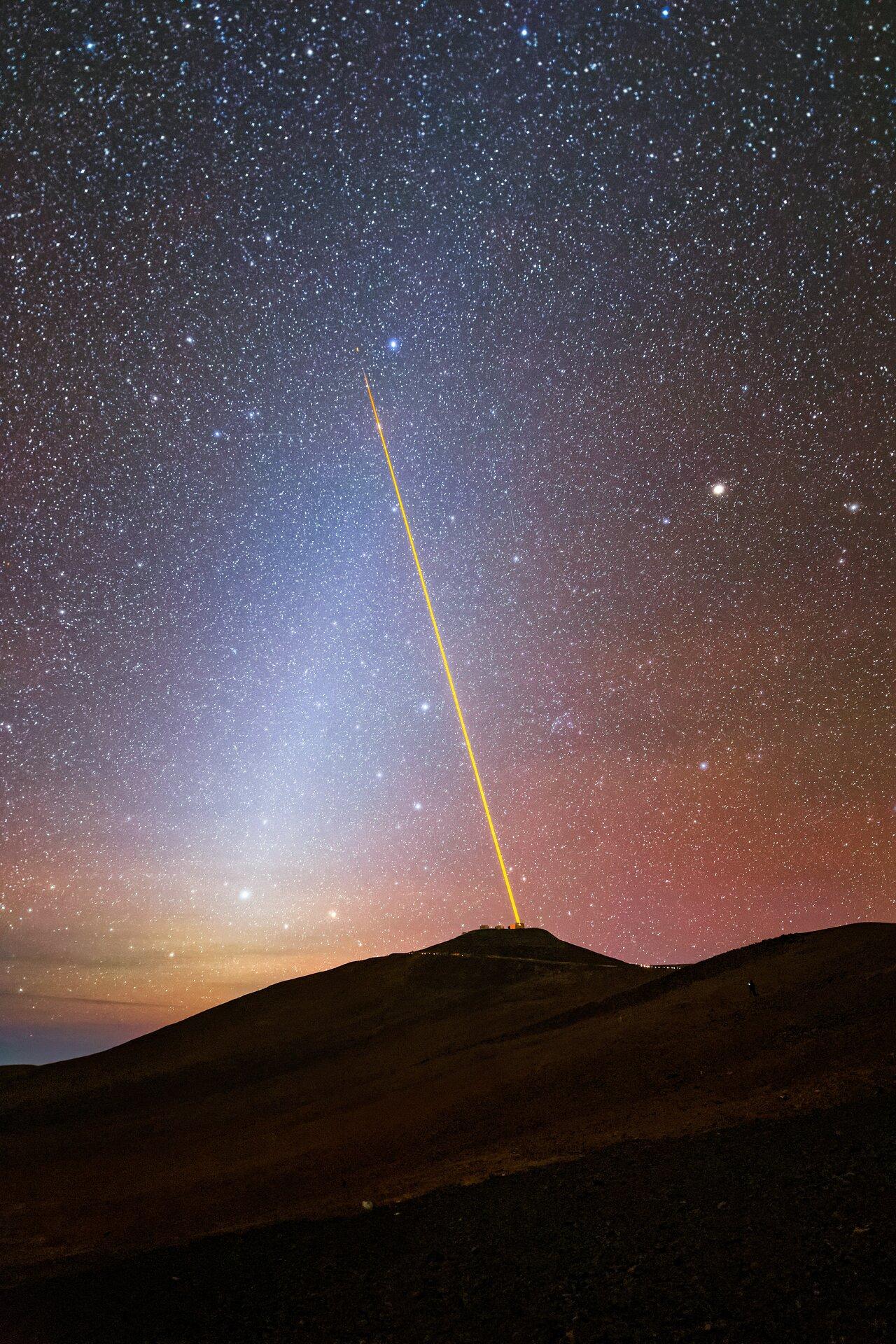
The yellow lasers of our Very Large Telescope create artificial stars that help the VLT deliver sharp images.

Here they seem to meet with a diffuse bluish band: the zodiacal light. This faint glow is due to sunlight scattered by dust particles in the plane of the Solar System, and it can be seen after sunset or before sunrise from very dark locations.

Read more: eso.org/public/images/potw2535

📷 G. Doyen/ESO

A night landscape in a desert. A bright, thin yellow line extends from the top a black mountain into the starry sky. The yellow laser meets with a blurry streak of white that extends from the horizon, forming an upside-down V. The sky just above the mountain is orange and pinkish, with thousands of bright white stars speckling the night sky.
🌠CatSalad🐈🥗〰️Īᵐ⁻ⁱⁿ.␠🌌 boosted:
SETI Institutesetiinstitute
2025-09-01

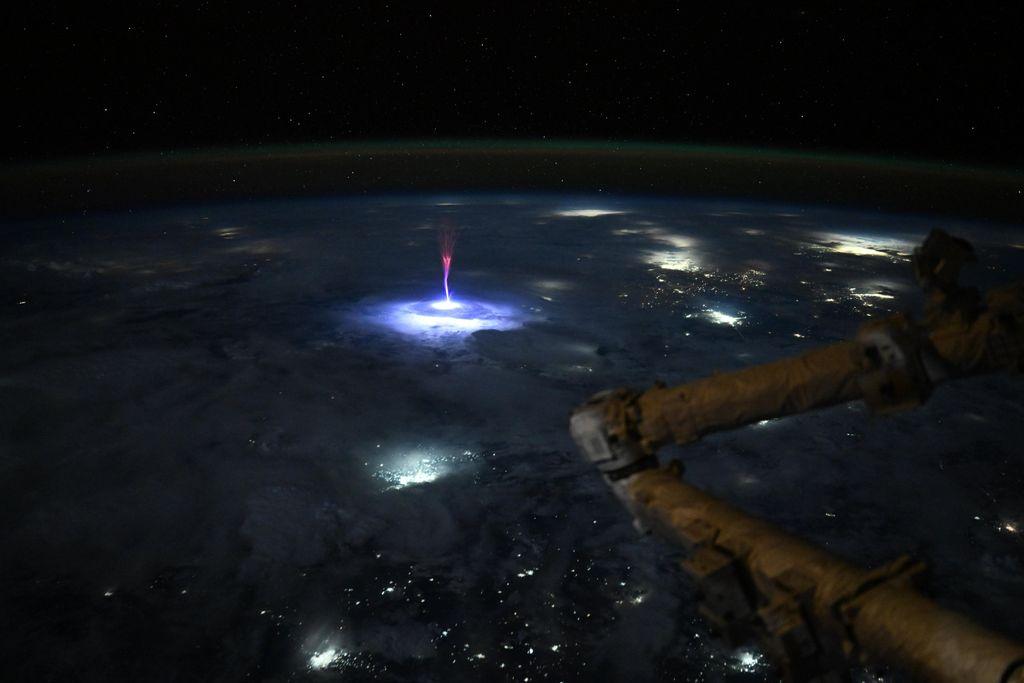
: A gigantic jet was photographed from the International Space Station by astronaut Nichole Ayers on 3 July 2025. Gigantic jets are transient luminous events (TLEs) that appear to initiate as an intracloud flash between the middle negative and upper positive charge regions in a thundercloud. They can reach altitudes of up to 90 km. The phenomenon occurred over Coahuila, Mexico. The station's Canadarm2 is visible in the foreground. Credit: NASA/Nichole Ayers

Taken from the ISS, a gigantic jet spears up from a thunderstorm cloud near the Texas-Mexico border. The spear is blue-white at the cloud, with a massive light spreading out in all directions. Near the top of the jet, the lightning turns to red and branches out. In the foreground is the Canadarm2. The city lights of Dallas, Austin, San Antonio, and Houston are to the northeast, and Torreón, Mexico, to the southwest.
🌠CatSalad🐈🥗〰️Īᵐ⁻ⁱⁿ.␠🌌 boosted:
Wonder of Sciencewonderofscience
2025-08-31

Comet NEOWISE rising over the Earth just before dawn as seen from the International Space Station.

🌠CatSalad🐈🥗〰️Īᵐ⁻ⁱⁿ.␠🌌catsalad@im-in.space
2025-08-27

:3

🌠CatSalad🐈🥗〰️Īᵐ⁻ⁱⁿ.␠🌌 boosted:
Phil Plaitbadastro
2025-08-26

I once had an umbrella so big six people could stand under it, but I've never seen one before that could fit *a hundred billion stars*.

badastronomy.beehiiv.com/p/it-

🌠CatSalad🐈🥗〰️Īᵐ⁻ⁱⁿ.␠🌌 boosted:
Inkicaninkican
2025-08-25
🌠CatSalad🐈🥗〰️Īᵐ⁻ⁱⁿ.␠🌌 boosted:
Reymond Aguinaldomondinspace
2025-08-25

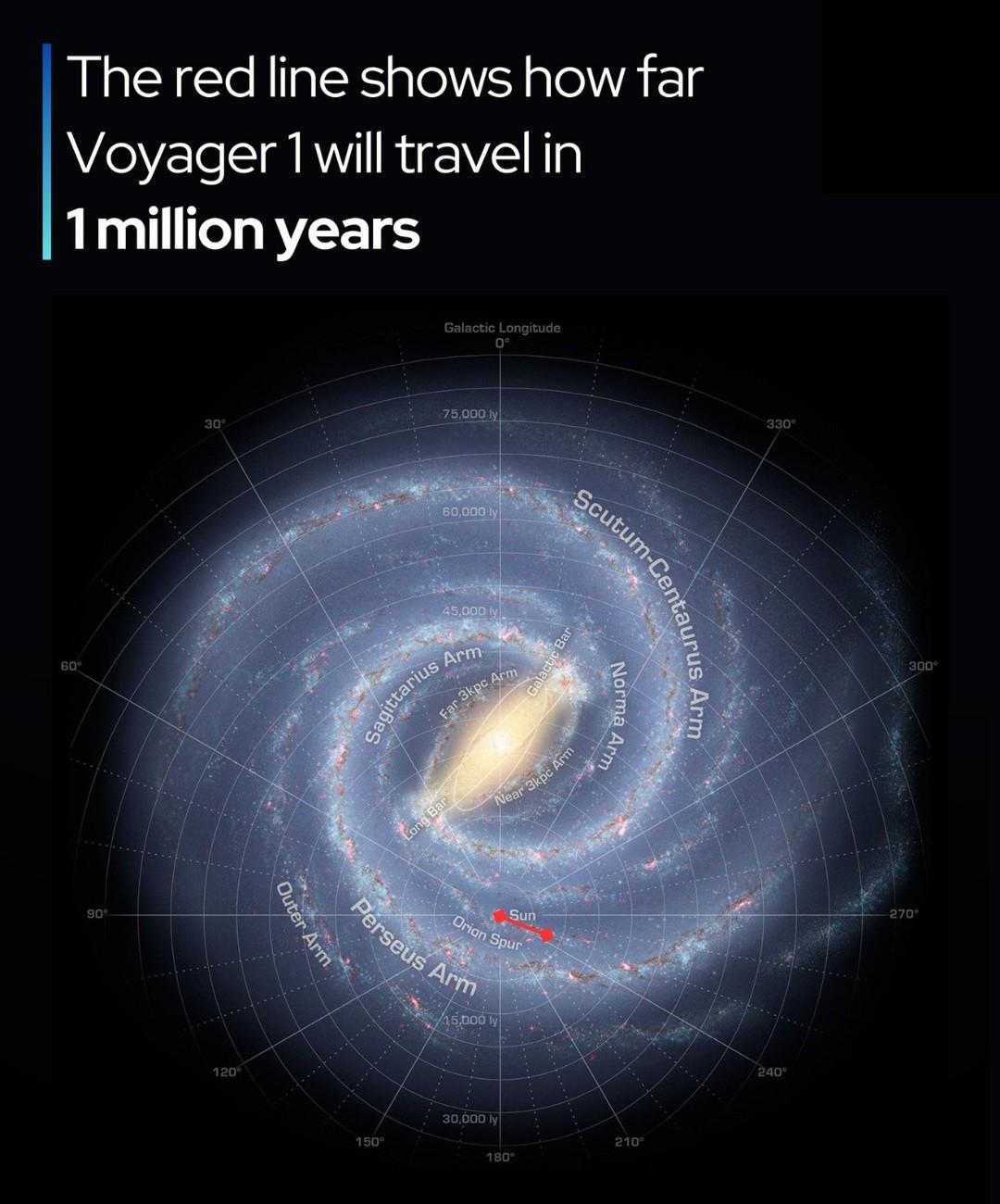
Launched in 1977, Voyager 1 is humanity’s farthest emissary, over 15 billion miles (24.8 billion km) from Earth, racing at 38,000 mph (17 km/s). It still carries the Golden Record, a time capsule of Earth’s culture, into the uncharted depths of the cosmos.

🧵 1/3

A diagram of the Milky Way galaxy showing its spiral structure and major features, with a specific red line indicating the distance Voyager 1 is projected to travel in one million years.

The title text at the top left reads: "The red line shows how far Voyager 1 will travel in 1 million years."

The main graphic is a top-down view of the Milky Way. Concentric circles are marked with distances from the center in light-years (ly). The galactic center is marked. Galactic Longitude is indicated around the circumference, starting at the top, increasing counter-clockwise. Several major spiral arms are labeled, and other features shown.

The red line, originating near the Sun's location, represents Voyager 1's one-million-year travel distance. It extends only a very short, almost imperceptible distance, visually emphasizing the immensity of the Milky Way compared to the probe's travel over that timeframe.
🌠CatSalad🐈🥗〰️Īᵐ⁻ⁱⁿ.␠🌌 boosted:
Corey S Powellcoreyspowell
2025-08-19

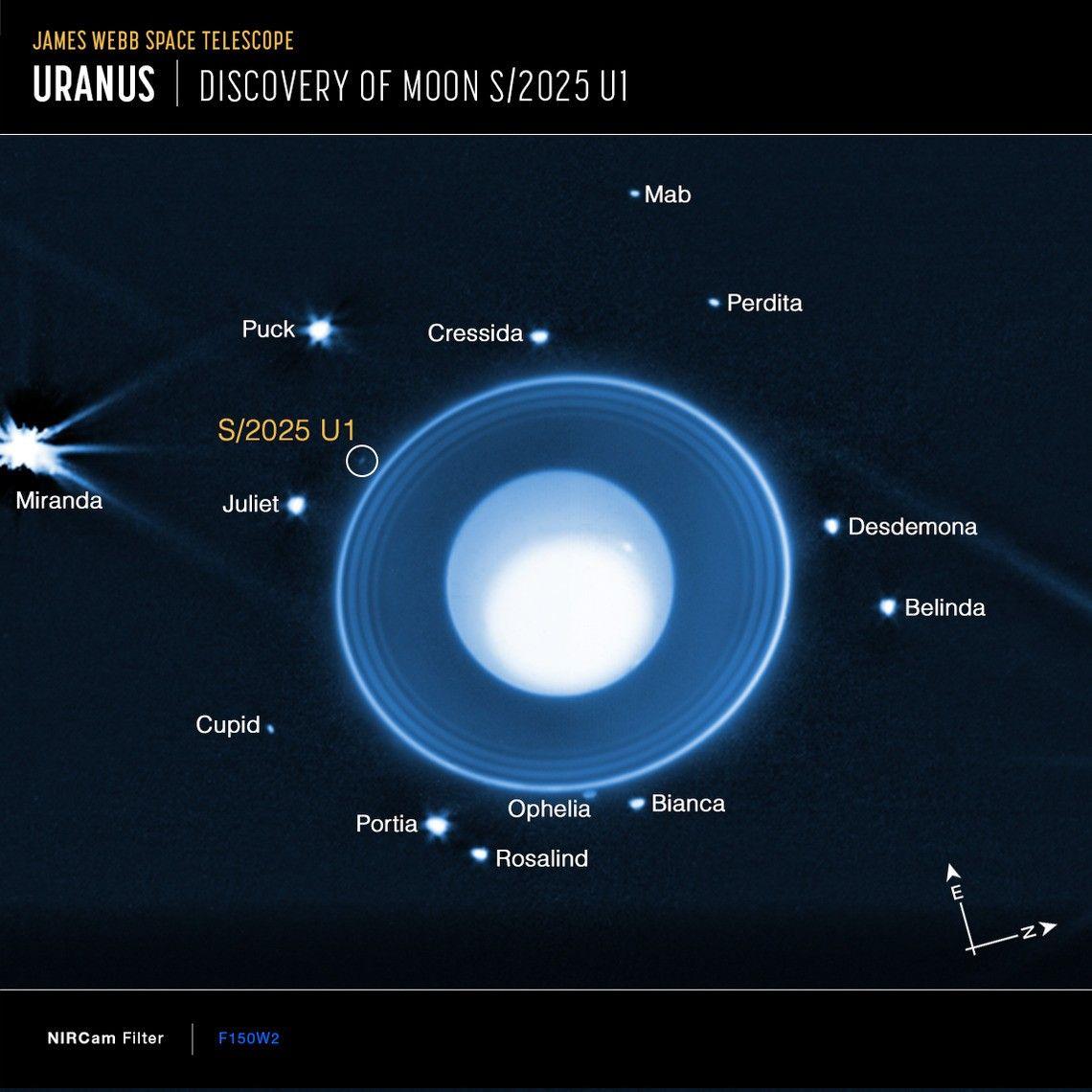
Let's get this over with: Astronomers just found a new moon around Uranus.

It's part of an unusual group of 14 mini satellites orbiting close to the planet, within the orbit of its 1st major moon, Miranda. They may relate to the planet's rings & odd, sideways tilt.

science.nasa.gov/blogs/webb/20

Astronomers using NASA’s James Webb Space Telescope discovered a new moon orbiting Uranus in images taken by Webb’s NIRCam (Near-Infrared Camera). This image shows the moon, designated S/2025 U1, as well as 13 of the 28 other known moons orbiting the planet. (The small moon Cordelia orbits just inside the outermost ring, but is not visible in these views due to glare from the rings.) Due to the drastic differences in brightness levels, the image is a composite of three different treatments of the data, allowing the viewer to see details in the planetary atmosphere, the surrounding rings, and the orbiting moons. The data was taken with NIRCam’s wide band F150W2 filter that transmits infrared wavelengths from about 1.0 to 2.4 microns.

Client Info

Server: https://mastodon.social
Version: 2025.07
Repository: https://github.com/cyevgeniy/lmst