#ComparativeGenomics

2025-09-17

Join our online course on Sex Chromosome Evolution (6–10 Oct) to gain hands-on experience in genomic and transcriptomic analyses.

physalia-courses.org/courses-w
#SexChromosomes #GenomeEvolution #Transcriptomics #ComparativeGenomics

2025-08-18

Pipeline release! nf-core/pairgenomealign v2.2.1 - nf-core/pairgenomealign v2.2.1 – C’est quoi ça?!

Please see the changelog: github.com/nf-core/pairgenomea

#comparativegenomics #dotplot #genomics #last #pairwisealignment #synteny #wholegenomealignment #nfcore #openscience #nextflow #bioinformatics

2025-07-28

Center for Plant Molecular Breeding (CeM2P)
Univerisidade de Campinas - UNICAMP

The fellow will develop biotechnological tools to improve sugarcane resistance, integrating genomic and transcriptomic data.

See the full job description on jobRxiv: jobrxiv.org/job/univerisidade-

#comparativegenomics ...
jobrxiv.org/job/univerisidade-

2025-07-10

Pipeline release! nf-core/pairgenomealign v2.2.0 - nf-core/pairgenomealign v2.2.0 – Chagara ponzu!

Please see the changelog: github.com/nf-core/pairgenomea

#comparativegenomics #dotplot #genomics #last #pairwisealignment #synteny #wholegenomealignment #nfcore #openscience #nextflow #bioinformatics

2025-06-04

Delighted to share our latest scientific article (doi.org/10.1080/21505594.2025.) about #comparativegenomics of #Salmonella enterica serovars Paratyphi A, Typhi and Typhimurium reveals distinct profiles of their #pangenome, mobile genetic elements, #antimicrobialresistance and defense systems repertoire.

A great collaboration with Charles Coluzzi, Hélène Chiapello and Ohad Gal-Mor !

Phylogenetic tree structure of S. Paratyphi A, Typhi and Typhimurium representative isolates.
2025-05-16

Pipeline release! nf-core/pairgenomealign v2.1.0 - nf-core/pairgenomealign v2.1.0 – Goya champuru!

Please see the changelog: github.com/nf-core/pairgenomea

#comparativegenomics #dotplot #genomics #last #pairwisealignment #synteny #wholegenomealignment #nfcore #openscience #nextflow #bioinformatics

CSBJcsbj
2025-05-15

🧬 Can we map the evolutionary history of plant genes through network analysis?

🔗 Hayai-Annotation: A functional gene prediction tool that integrates orthologs and gene ontology for network analysis in plant species. Computational and Structural Biotechnology Journal, DOI: doi.org/10.1016/j.csbj.2024.12

📚 CSBJ: csbj.org/

Hayai-Annotation: A functional gene prediction tool that integrates orthologs and gene ontology for network analysis in plant species. Computational and Structural Biotechnology Journal, DOI: https://doi.org/10.1016/j.csbj.2024.12.011
2025-02-05

Pipeline release! nf-core/pairgenomealign v2.0.0 - nf-core/pairgenomealign v2.0.0 – Naga imo!

Please see the changelog: github.com/nf-core/pairgenomea

#comparativegenomics #dotplot #genomics #last #pairwisealignment #synteny #wholegenomealignment #nfcore #openscience #nextflow #bioinformatics

Jennifer LeonardLeonard@ecoevo.social
2025-01-18
2025-01-08

Passing this along to our Galaxy and BRC communities: NCBI is holding a webinar for researchers in the eukaryotic pathogen and desease vector spaces on Feb 12. Use this link to get more information ow.ly/GAlW50UAuR9

#NCBICGR #ComparativeGenomics

2024-12-18

Pipeline release! nf-core/pairgenomealign v1.1.1 - nf-core/pairgenomealign v1.1.1 – Kani nabe!

Please see the changelog: github.com/nf-core/pairgenomea

#comparativegenomics #dotplot #genomics #last #pairwisealignment #synteny #wholegenomealignment #nfcore #openscience #nextflow #bioinformatics

Microbial Genomics and Metagenomics (MGM) Workshop Learn all about IMG/M and other @jgi.doe.gov data systems for #microbiology #metagenomics #microbiome #bioinformatics #comparativegenomics at our 5-day workshop April 28-May 2, 2025 in Berkeley Registration is now open: mgm.jgi.doe.gov

Rekha Seshadri giving a talk to the participants of the 2024 Microbial Genomics & Metagenomics Workshops (MGM) workshop at the Joint Genome Institute in Berkeley, CA.
Boas Puckerboas_pucker
2024-10-02

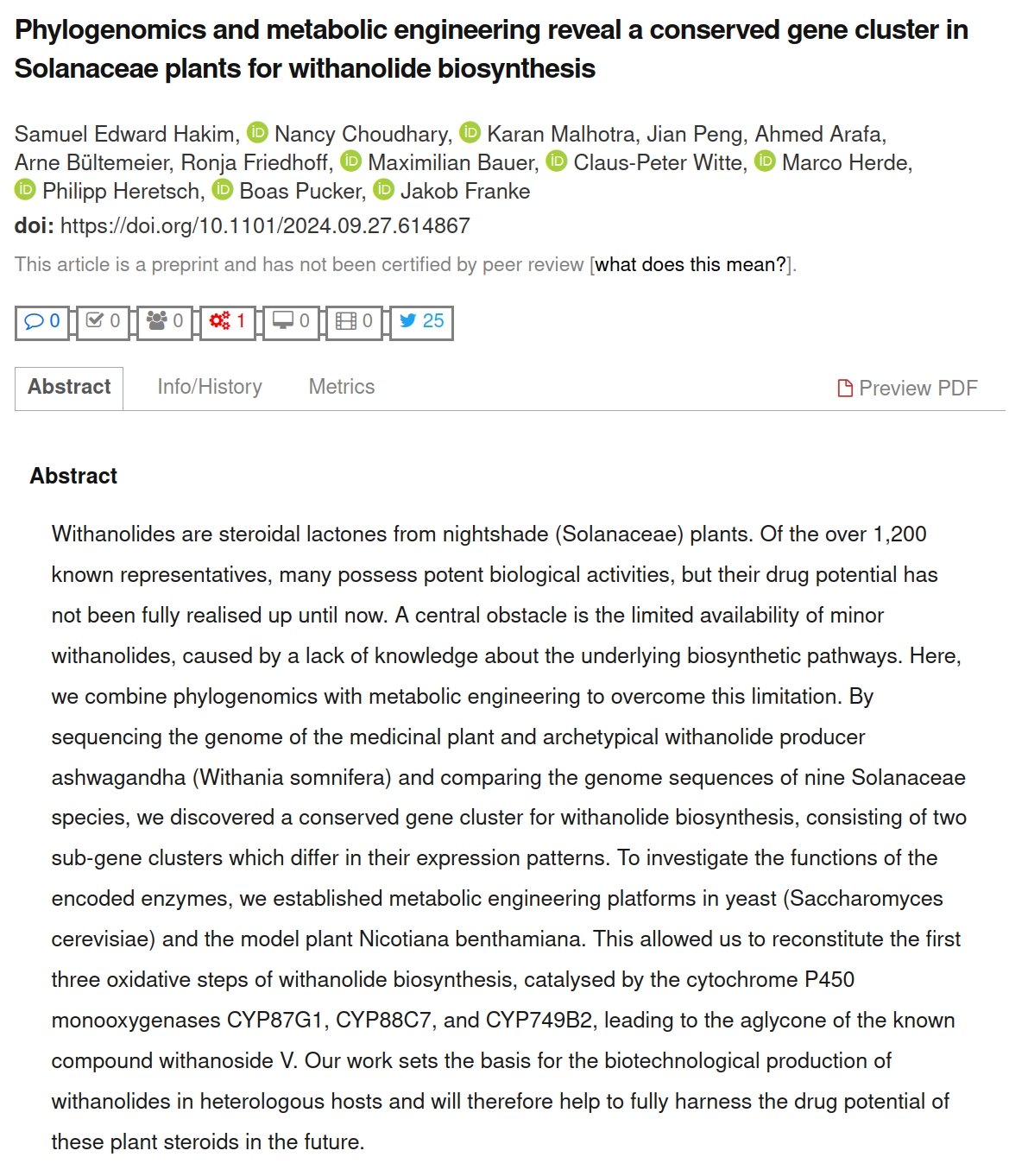
Excited to announce the discovery of a withanolide biosynthetic gene cluster! A huge achievement from our collaboration with the Franke Lab. Explore the findings here:

doi.org/10.1101/2024.09.27.614


@tubraunschweig @PuckerLab @unihannover

Screenshot of the preprint "Phylogenomics and metabolic engineering reveal a conserved gene cluster in Solanaceae plants for withanolide biosynthesis" https://doi.org/10.1101/2024.09.27.614867
2024-05-24

CGV paper is out. Alignments are added per request, and I guess the team would love to hear any user feedback. :) #comparativegenomics #NCBI
doi.org/10.1371/journal.pbio.3

2024-03-11

What is SFASTA?

Genomic and bioinformatic-adjacent sequences (RNA, Protein, Peptides) are stored as FASTA files. Sequencing reads off a machine are stored as FASTQ files, adding a quality score associated with each nucleotide. Currently, these are non-human-readable plaintext files. As sequencing increases, we need to be able to process many more gigabytes and terabytes of files rapidly and with random access (currently solved by bgzip/tabix). becomes incredibly important.

SFASTA, my focus-on-random-access-speed FASTA/Q format replacement, has worked well for medium and large FASTA files, defining large as anything smaller than NT nucleotide database (~203Gb gzip-9 compressed, but likely larger whenever you are reading this). Small files did not benefit from stream compression and crazy indices, although the time cost for small files is irrelevant. But the conversion of nt to SFASTA took an inordinate amount of time, and reading the index into memory did as well. While still smaller and faster than gzip-9, this does not accomplish what I want.

Why?

FASTA files are frequently compressed with an outdated, slow, inefficient compression algorithm (gzip). Modern alternatives provide better compression ratios, decompression ratios, and faster throughput. The speed of reading FASTA files is quite important, with multiple tools that try to be the fastest. Clearly, this is an unsolved problem, and sticking to a text-based, non-human-readable format is a choice that only occurs due to the momentum of existing tools.

Genomics is moving to “Genomics at scale” and away from single-genome analyses. A flat file format adds unnecessary processing time to query hundreds of genomes instantly. For my own usage, I’d like to be able to query NT and fill up the GPU with random, on-the-fly examples. This is entirely achievable with modern computers but not with outdated file formats and compression.

What does SFASTA mean?

SFASTA previously stood “Snappy FASTA” as it used the Snappy algorithm, but now it uses ZSTD. The name remains as the command remains sfa, which can be typed with one hand on the home line on a standard keyboard.

Further Speed-ups

So, it’s clear my custom-built index was a failure. Enter B+-tree. While fighting post-COVID brain fog, I eventually managed to build a naive implementation. My benchmarks for creating a tree with 128 million key/value pairs threatened to take over 20 hours (for 20 samples, so 1 hour each). Hacking away at that, I did shrink it, but only some. Then, I modified a copy to use the sorted-vec crate. Finally, while reading further up on the topic, I discovered fractal trees, which merely add a buffer to each node and process it when calling for a flush or exceeding the buffer size. I am now within a minute of creating such a large index. For this implementation, the fractal tree uses sorted-vecs as the key vector.

For B+ trees and fractal trees, the order of the nodes (how many children each node can have) is incredibly important. For creating trees, an order of 32 seems to be the sweet spot (this is tested on u64 as both keys and values). For fractal trees, 64 with a larger buffer seems to be the sweet spot. The figure below shows the fastest order, 64, and buffer 128. The image below is for 1 million items.

Text is difficult to read, but the number is the order, and for fractal trees, the second number is the buffer size.

The Big Tree

My NT test dataset is a bit over 128 million entries, u64 range 0 to 128_369_206, with keys and values as the xxh3 hashed integer. You can see the spread below. Here the larger buffer size (up to 256) performs the best, but many are in the less than a minute sweet spot.

Searching the Tree

Now that building a tree for NT takes under a minute, compressing and queueing the nucleotide sequences and IDs into the file will be the bottleneck for creation. Building the tree is also a one-time cost, so it is not the highest priority. The focus now is searching the tree, which will happen quite frequently depending on the final use case.

I’m just now getting to start on this, but as you can see below, where input is the order of the nodes, a larger order decreases the time to find a key. This is an even better sign for the fractal trees, as they are more efficient with larger orders. The image below shows very little difference, with sorted vec having a bit of a slowdown. I have no idea why, possibly due to a line of code that did not change as I’m simultaneously playing around with three versions. As my fractal tree implementation uses sorted-vec, these results are quite equivalent. The search code is nearly identical. This is the next step.

Here, the x-axis is node order, with tests for 16, 32, 64, and 128.

What Hasn’t Worked

  • 2bit/4bit nucleotide encodings – did not increase throughput or decrease on-disk size. Still worth further investigation.

Immediate Next Steps

As this is a write-once file format, at least at this stage, I plan to do the following:

  • Smaller struct for read-only mode, i.e., buffer is no longer needed
  • Benchmark sorted-vec against Eytzinger order
  • Load only parts of the tree from disk, have efficient serialization
  • Possibly try a bumpalo arena for querying the on-disk tree
  • Batch insertion – Maybe this was all for naught
  • Stream VBytes storage for keys/values of tree?

Ultimate Goals

  • LD_PRELOAD to work with existing tools
  • Python library
  • C API

I’ve been programming in Rust for a couple of years and have experimented with many different things, including the bevy game engine. I would still argue I’m a middling skilled Rust developer, as I’m also a population geneticist. Thus, some weeks are spent without writing a single line of code or only writing in Python for statistical analysis. Thus, I expect much room for improvement, although I’m proud of where I’ve gotten this so far.

Plots made with criterion.

https://josephguhlin.com/sfasta-fast-index-building/

#bioinformatics #comparativeGenomics #fileFormats #rust

Alliance of Genome ResourcesAllianceGenome@genomic.social
2023-10-25

Exciting news!
The Rat Genome Database rgd.mcw.edu
is pleased to announce the release of an updated #Cardiovascular Disease Portal featuring data and tools to support cardiovascular disease research. To learn more, rgd.mcw.edu/wg/updated-cvd-por #comparativegenomics

Logo of the RGD Cardiovascular Disease Portal, a white graphic heart, in a mauve circle, encircled by a darker pink circle. The heart casts a shadow in an intermediate pink towards the lower right.
2023-07-11

I'm wondering if anybody has tried (considered even) #tabix indexing #PAF files. These files are used for #ComparativeGenomics, so you'd need two indexes, one on the reference and one on the query. Conceptually it makes sense to me but I've not seen it done anywhere.

Dimitris KontopoulosDGKontopoulos@ecoevo.social
2023-04-28

Delighted to share our new Science #EvolgenPaper! science.org/doi/10.1126/scienc

We introduce #TOGA, a #ComparativeGenomics method that combines the detection of orthologous genes with gene annotation. In plain words, TOGA can take advantage of a well-annotated #genome and transfer its annotations to a genome of a different species (e.g., from the human genome to that of a squirrel). 1/2

This figure highlights how TOGA can integrate annotation and orthology inference based on intronic and intergenic alignments (among other things).

Using a high-quality genome as reference, TOGA can generate gene annotations, can identify orthologs/duplicated/lost genes, can produce codon alignments, as well as assembly quality benchmarks for genomes of query species.
2023-04-17

We hope that the comparative genomics analyses made available through this study will provide a route towards the application of genomics-informed conservation programmes across the great diversity of invertebrate species. A big thank to all the amazing people from the Darwin Tree of Life Project that made this reserch possible! #biodiversity #conservation #comparativegenomics #PacBio #DarwinTreeofLife #Ensembl #emblebi #sangerinstitute #wellcometrust

2023-04-06

Client Info

Server: https://mastodon.social
Version: 2025.07
Repository: https://github.com/cyevgeniy/lmst