
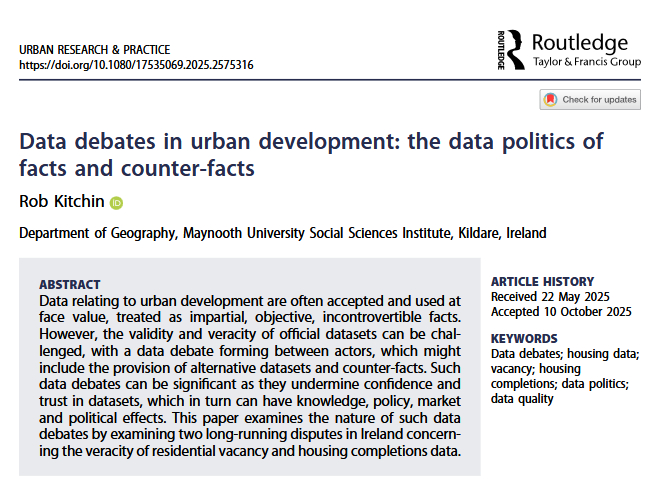
Take a look at our new research article published by Rob Kitchin (@robkitchin.bsky.social) on data debates in urban development. doi.org/10.1080/1753... #DataDebates #HousingData #Vacancy #HousingCompletions #DataPolitics #DataQuality
#DataPolitics

Non vorrei dire, ma credo che il sito a questo punto abbia solo cookie tecnici e zero raccolta dati (wiki a parte, ovvio, ma lì i dati restano gestibili per gli utenti).
Terze parti? Solo CDN dello spazio europeo.
Statistiche? super compliant.
Addio al banner.
E l’ho anche federato (tramite alias, perché ho uno spazio condiviso).
(A breve metterò un po’ di post derivanti dal diario autoetnografico che ho tenuto)
#privacy #fediverse #dataPolitics

This is a fun #interactivefiction exercise or a #game (?) by Saranyan Vigraham at https://saranyan.com/projects/gdc. It comes with a short write-up at https://www.saranyan.com/blog/ai-cultural-intelligence-game. Do check it out, there are some interesting design choices made in it. #gamedesign #surveillance #DataPolitics #aiethics

Calculating Empires: Macht und Technologie im Wandel der Zeit.
Die Installation von Kate Crawford und Vladan Joler auf der Ars Electronica zeigt die Geschichte und Politik der Technologie seit 1500. Sie untersucht die Verbindung von Kommunikation, Datenverarbeitung, Klassifikation und Kontrolle und bietet einen tiefen Einblick in die technologische Realität, um eine neue Zukunft zu imaginieren.
#CalculatingEmpires #HistoryOfTechnology #DigitalArt #DataPolitics #ArsElectronica #CriticalArt

https://open.spotify.com/episode/1B0a8npLiVNohVN9hli4OJ?si=7J0Xo6pWSJWnf0w-6gxrsA
In this episode of Generative Dialogues, Mark Carrigan and Helen Beetham discuss the implications of recent developments in academic publishing and generative AI. Key topics include:
- The Taylor & Francis deal with Microsoft: Discussion of the £8 million agreement for AI access to the publisher’s library and its implications for academic publishing.
- The changing landscape of academic journals: How the traditional journal system is evolving towards platform-based models and the role of AI in this transition.
- The political economy of academic publishing: Analysis of the profit motives driving publishers and how AI fits into their business strategies.
- Peer review challenges: Examination of existing issues in the peer review process and how AI might exacerbate or potentially address these problems.
- The impact on academic careers and reputation: How AI and platform-based publishing may affect scholarly visibility, citation metrics, and career progression.
- Inequalities in academic publishing: Discussion of how AI and data-driven systems may reinforce existing hierarchies and inequalities in academia.
- Environmental concerns: Brief mention of the ecological impact of AI-driven publishing and research practices.
- Alternatives to traditional publishing: Exploration of potential alternatives, including open-access models, artisanal approaches to academic writing, and community-led publishing initiatives.
- The role of theory in digital education: Reflection on how theoretical frameworks can inform our understanding of these technological shifts in academia.
Throughout the conversation, Mark and Helen balance critical analysis of current trends with cautious exploration of potential positive developments and alternatives. They emphasize the need for academics to engage critically with these changes while recognizing the complex systemic nature of the challenges faced.
https://markcarrigan.net/2024/08/29/academic-publishing-in-an-era-of-chatgpt/
#books #dataJustice #dataPolitics #generativeAI #higherEducation #journals #publishing

Satisfaction du weekend :
Arriver à faire des cartes d'analyse électorale par bureau de vote un peu à la chaîne.
C'est encore perfectible, notamment sur les échelles de couleurs (j'ai pas encore le truc), mais c'est instructif !

#introduction trial 2. Slowly learning. I’m an associate professor in #sociology at #NTNU in #Trondheim #Norway. Trondheim is not very centrally located. Thus, social media helps in keeping up with others work.
Interested in #power #democracy and #technology. I had many projects on #techgovernance #emergingtechnologies #nanotechnology #biotechnology.
Now, I’m interested in questions of the collective good and public values in public investments in techosciences. #datapolitics #datagovernance

Hello Mastodon! I am looking for folks or/and circles in the areas of #STS #DigitalActivism #SocialMovements #ContentiousPolitics #CriticalDataStudies #Datafication #DataPolitics

To help some of the newcomers make connections: name 5–7 things that interest you but aren't in your profile, as tags so they are searchable. Then boost this post or repeat its instructions so others know to do the same.
#datapolitics
#materialsemiotics
#actornetworktheory
#lusatia
#carbon
#accounting
#fossilfuels

November 2018 - our newsletter #intheloop is out #DataActivism #datapolitics #art and more https://tacticaltech.org/in-the-loop/201811/
Client Info
Server: https://mastodon.social
Version: 2025.07
Repository: https://github.com/cyevgeniy/lmst