#OpenAccessPublishing

Open Education Weeksharing@oeweek.oeglobal.org
2026-02-12

Office Hour: Openly License Something!

Office Hour: Openly License Something, hosted by Open Oregon Educational Resources Peter Musser, Head of Library Services for ISKME/OER Commons, will help you openly license and share your work publicly. No experience necessary! đŸ—“ïž Start: March 2, 2026 8:00 pm UTC ⏳ End: March 2, 2026 9:00 pm UTC 📍 Location: Albany, United States, Albany, United States Participate in #OEWeek25 activities https://oeweek.oeglobal.org/

oeweek.oeglobal.org/activity/o

Open Oregon Educational Resources
Open Education Weeksharing@oeweek.oeglobal.org
2026-02-12

Open Education Talks- Strategies for Supporting Students in Open Education

Open Education Talks is a series of 15-minute lightning talks and digital posters about facets of open education. These talks aim to create an accessible, virtual space for conversations about open education. We welcome proposals from educators, students, administrators, librarians, instructional designers, and all other roles related to the design, delivery, and evaluation of open education in [
] đŸ—“ïž Start: March 4, 2026 7:00 pm UTC ⏳ End: March 4, 2026 8:30 pm UTC 📍 Location: Calgary, Canada, Calgary, Canada Participate in #OEWeek25 activities https://oeweek.oeglobal.org/

oeweek.oeglobal.org/activity/o

Open Education Talks 2026
Open Education Weeksharing@oeweek.oeglobal.org
2026-02-12

Open Education Talks- Utilizing GenAI and Technology in Supporting OE and OER

Open Education Talks is a series of 15-minute lightning talks and digital posters about facets of open education. These talks aim to create an accessible, virtual space for conversations about open education. We welcome proposals from educators, students, administrators, librarians, instructional designers, and all other roles related to the design, delivery, and evaluation of open education in [
] đŸ—“ïž Start: March 11, 2026 6:00 pm UTC ⏳ End: March 11, 2026 7:30 pm UTC 📍 Location: Calgary, Canada, Calgary, Canada Participate in #OEWeek25 activities https://oeweek.oeglobal.org/

oeweek.oeglobal.org/activity/o

Open Education Talks 2026
Open Education Weeksharing@oeweek.oeglobal.org
2026-02-12

Open Education Talks- Enhancing OER Publishing and Connections with Open Scholarship

Open Education Talks is a series of 15-minute lightning talks and digital posters about facets of open education. These talks aim to create an accessible, virtual space for conversations about open education. We welcome proposals from educators, students, administrators, librarians, instructional designers, and all other roles related to the design, delivery, and evaluation of open education in [
] đŸ—“ïž Start: March 18, 2026 6:00 pm UTC ⏳ End: March 18, 2026 7:30 pm UTC 📍 Location: Calgary, Canada, Calgary, Canada Participate in #OEWeek25 activities https://oeweek.oeglobal.org/

oeweek.oeglobal.org/activity/o

Open Education Talks 2026
Open Education Weeksharing@oeweek.oeglobal.org
2026-02-12

Open Education Talks: User-Centric Approaches to OE and Affordability

Open Education Talks is a series of 15-minute lightning talks and digital posters about facets of open education. These talks aim to create an accessible, virtual space for conversations about open education. We welcome proposals from educators, students, administrators, librarians, instructional designers, and all other roles related to the design, delivery, and evaluation of open education in [
] đŸ—“ïž Start: March 25, 2026 6:00 pm UTC ⏳ End: March 25, 2026 7:30 pm UTC 📍 Location: Calgary, Canada, Calgary, Canada Participate in #OEWeek25 activities https://oeweek.oeglobal.org/

oeweek.oeglobal.org/activity/o

Open Education Talks 2026
2026-02-07

Weekly Update from the Open Journal of Astrophysics – 07/02/2026

It’s Saturday once more so time for another update of activity at the Open Journal of Astrophysics. Since the last update we have published a further six papers, bringing the number in Volume 9 (2026) to 24 and the total so far published by OJAp up to 472.

I will continue to include the posts made on our Mastodon account (on Fediscience) to encourage you to visit it. Mastodon is a really excellent service, and a more than adequate replacement for X/Twitter which nobody should be using; these announcement also show the DOI for each paper.

The first paper to report this week is “The Impact of Star Formation and Feedback Recipes on the Stellar Mass and Interstellar Medium of High-Redshift Galaxies” by Harley Katz (U. Chicago, USA), Martin P. Rey (U. Oxford, UK), Corentin Cadiou (Lund U., Sweden) Taysun Kimm (Yonsei U., Korea) and Oscar Agertz (Lund). This paper was published on Monday 2nd February 2026 in the folder Astrophysics of Galaxies. It introduces MEGATRON, a new model for galaxy formation simulations, highlighting that feedback energy controls star formation at high redshift and highlighting the importance of the interstellar medium.

The overlay is here:

You can find the officially accepted version on arXiv here and the announcement on Fediverse here:

https://fediscience.org/@OJ_Astro/116000695648050758

The second paper is “Photometric Redshifts in JWST Deep Fields: A Pixel-Based Alternative with DeepDISC” by Grant Merz (U. Illinois at Urbana-Champaign) and 6 others, all based in the USA. This paper was published on Monday February 2nd 2026 in the folder Instrumentation and Methods for Astrophysics. This paper explores the effectiveness of the DeepDISC machine learning algorithm in estimating photometric redshifts from near-infrared data, demonstrating its potential for larger image volumes and spectroscopic samples

The overlay for this one is here:

The official version of the paper can be found on arXiv here and the Fediverse announcement here:

https://fediscience.org/@OJ_Astro/116000777572439111

Next, published on Wednesday 4th February in the folder Astrophysics of Galaxies, is “Inferring Interstellar Medium Density, Temperature, and Metallicity from Turbulent H II Regions” by Larrance Xing (U. Chicago, USA), Nicholas Choustikov (U. Oxford, UK), Harley Katz (U. Chicago) and Alex J. Cameron (DAWN, Denmark). This paper argues that supersonic turbulenc affects the interpretation of H II region properties, potentially impacting inferred metallicity, ionization, and excitation from in nebular emission lines, motivating more extensive modelling.

The overlay is here:

The official version can be found on arXiv here and the Fediverse announcement is here:

https://fediscience.org/@OJ_Astro/116011384659092223

The fourth paper this week, also published on Wednesday 4th February, but in the folder Solar and Stellar Astrophysics, is “A Systematic Search for Big Dippers in ASAS-SN” by B. JoHantgen, D. M. Rowan, R. ForĂ©s-Toribio, C. S. Kochanek, & K. Z. Stanek (Ohio State University, USA), B. J. Shappee (U. Hawaii, USA), Subo Dong (Peking University), J. L. Prieto Universidad Diego Portales, Chile) and Todd A. Thompson (Ohio State). This study identifies 4 new dipper stars and 15 long-period eclipsing binary candidates using ASAS-SN light curves and multi-wavelength data, categorizing them based on their characteristics.

Here is the overlay:

The official version can be found on arXiv here and the Fediverse announcement is here:

https://fediscience.org/@OJ_Astro/116011460612040834

Fifth, and next to last this week we have “Unveiling the drivers of the Baryon Cycles with Interpretable Multi-step Machine Learning and Simulations” by Mst Shamima Khanom, Benjamin W. Keller and Javier Ignacio Saavedra Moreno (U. Memphis, USA). This paper was published on Thursday 5th February 2026 in the folder Astrophysics of Galaxies. This study uses machine learning methods to understand how galaxies lose or retain baryons, highlighting the relationship between baryon fraction and various galactic measurements.

The overlay is here:

The accepted version can be found on arXiv here, and the fediverse announcement is here:

https://fediscience.org/@OJ_Astro/116016883984380622

Finally for this week we have “The Bispectrum of Intrinsic Alignments: II. Precision Comparison Against Dark Matter Simulations” by Thomas Bakx (Utrecht U., Netherlands), Toshiki Kurita (MPA Garching, Germany), Alexander Eggemeier (U. Bonn, Germany), Nora Elisa Chisari (Utrecht) and Zvonimir Vlah (Ruđer Boơković Institute, Croatia). This paper was accepted in December, but publication got delayed by the Christmas effect so was published on February 6th 2026, in the folder Cosmology and Nongalactic Astrophysics. This study uses N-body simulations to accurately measure three-dimensional bispectra of halo intrinsic alignments and dark matter overdensities, providing a method to determine higher order shape bias parameters.

The overlay is here:

You can find the published version of the article here, and the Mastodon announcement is here:

https://fediscience.org/@OJ_Astro/116022562915557971

And that concludes this week’s update. I will do another next Saturday.

#arXiv241107282v2 #arXiv250409744v3 #arXiv250706818v3 #arXiv250719594v2 #arXiv251027032v2 #arXiv260202949v1 #ASASSN #AstridSimulations #AstrophysicsOfGalaxies #bispectrum #CosmologyAndNonGalacticAstrophysics #DEEPDisc #DiamondOpenAccess #DiamondOpenAccessPublishing #dipperStars #galaxyClusters #galaxyFormation #galaxyHaloes #HighEnergyAstrophysicalPhenomena #HIIRegions #InstrumentationAndMethodsForAstrophysics #InterstellarMedium #intrinsicAlignments #JWST #largeScaleStructureOfTheUniverse #MachineLearning #MEGATRON #NebularEmission #OpenAccess #OpenAccessPublishing #OpenJournalOfAstrophysics #PhotometricRedshifts #SolarAndStellarAstrophysics #starFormation #TheOpenJournalOfAstrophysics #Turbulence
Open Education Weeksharing@oeweek.oeglobal.org
2026-02-06

Pressbooks, Omeka and TIND, Oh My!

This session will introduce you to tools and platforms offered by Rhode Island College and the Adams Library for digitally publishing faculty and student creative and scholarly works. Explore the college archives and institutional repository and discover opportunities to publish ebooks and online exhibits. đŸ—“ïž Start: March 3, 2026 7:00 pm UTC ⏳ End: March 3, 2026 8:00 pm UTC 📍 Location: Providence, United States, Providence, United States Participate in #OEWeek25 activities https://oeweek.oeglobal.org/

oeweek.oeglobal.org/activity/p

Open Education Weeksharing@oeweek.oeglobal.org
2026-02-03

Pioneers of Open Knowledge: A History of Open Access at IU Indianapolis

This session will talk about the history of open access at IU Indianapolis, beginning with the creation of one of the first institutional repositories in the state of Indiana and highlighting the major milestones reached since its inception. Come learn about how University Library has been a pioneer of open access to educational resources and knowledge and how it continues to push for [
] đŸ—“ïž Start: March 2, 2026 7:00 pm UTC ⏳ End: March 2, 2026 8:00 pm UTC 📍 Location: Indianapolis, United States, Indianapolis, United States Participate in #OEWeek25 activities https://oeweek.oeglobal.org/

oeweek.oeglobal.org/activity/p

Open Education Weeksharing@oeweek.oeglobal.org
2026-02-02

The Open Education Journey: Creating and Sharing Open Education Resources

Mark Open Education Week and join us for a panel event celebrating the authors behind the University of Leeds Open Books programme. This session is designed for anyone curious about open education – whether you’re involved or just beginning to explore what open educational resources might look like in your own teaching or practice. Authors of open educational resources from across the [
] đŸ—“ïž Start: March 2, 2026 2:45 pm UTC ⏳ End: March 2, 2026 4:15 pm UTC 📍 Location: Leeds, United Kingdom, Leeds, United Kingdom Participate in #OEWeek25 activities https://oeweek.oeglobal.org/

oeweek.oeglobal.org/activity/o

2026-01-31

Weekly Update from the Open Journal of Astrophysics – 31/01/2026

It’s Saturday once more so time for another update of activity at the Open Journal of Astrophysics. Since the last update we have published a further three papers, bringing the number in Volume 9 (2026) to 18 and the total so far published by OJAp up to 466.

I will continue to include the posts made on our Mastodon account (on Fediscience) to encourage you to visit it. Mastodon is a really excellent service, and a more than adequate replacement for X/Twitter which nobody should be using; these announcement also show the DOI for each paper.

The first paper to report this week is “Probing Stellar Kinematics with the Time-Asymmetric Hanbury Brown and Twiss Effect” by Lucijana Stanic (University of Zurich, Switzerland) and 13 others based in Zurich, Lausanne and Geneva (all in Switzerland). This was published on Monday 26th January 2026 in the folder Instrumentation and Methods for Astrophysics. This research demonstrates that intensity interferometry can reveal internal stellar kinematics, providing a new way to observe stellar dynamics with high time resolution.

The overlay is here:

You can find the officially accepted version on arXiv here and the announcement on Fediverse here:

https://fediscience.org/@OJ_Astro/115961234375736584

The second paper is “DIPLODOCUS I: Framework for the evaluation of relativistic transport equations with continuous forcing and discrete particle interactions” by Christopher N Everett & Garret Cotter (University of Oxford, UK). This was published on Tuesday January 27th 2026 in the folder High-Energy Astrophysical Phenomena. DIPLODOCUS is a new framework for mesoscopic modelling of astrophysical systems, using an integral formulation of relativistic transport equations and a discretisation procedure for particle distributions.

The overlay for this one is here:

The official version of the paper can be found on arXiv here and the Fediverse announcement here:

https://fediscience.org/@OJ_Astro/115966199181415094

Next, also published on Tuesday January 27th but in the folder Cosmology and Nongalactic Astrophysics we have “The Atacama Cosmology Telescope: DR6 Sunyaev-Zel’dovich Selected Galaxy Clusters Catalog” by M. Aguena et al. (101 authors altogether), on behalf of the ACT-DES-HSC Collaboration. This article reports on the discovery of 10,040 galaxy clusters in the Atacama Cosmology Telescope data, including 1,180 clusters at high redshifts, using the Sunyaev-Zel’dovich effect.

The overlay is here:

The official version can be found on arXiv here and the Fediverse announcement is here:

https://fediscience.org/@OJ_Astro/115966458299870033

And finally for this week we have a paper published yesterday, Friday 30th January 2026, in the folder Astrophysics of Galaxies. This is the paper I blogged about yesterday: “A Cosmic Miracle: A Remarkably Luminous Galaxy at zspec = 14.44 Confirmed with JWST” by Rohan Naidu (MIT Kavli Institute) and an international cast of 45 others. This article reports on the discovery by the James Webb Space Telescope (JWST) of a bright galaxy, MoM-z14, located 280 million years post-Big Bang, that challenges models of galaxy formation and the star-formation history of early galaxies.

The overlay is here:

The accepted version can be found on arXiv here, and the fediverse announcement is here:

https://fediscience.org/@OJ_Astro/115982837486159819

And that concludes the update for this week. I will do another next Saturday.

#ACTDESHSCCollaboration #arXiv250511263v2 #arXiv250721459v3 #arXiv250813296v4 #arXiv250913152v2 #AstridSimulations #AstrophysicsOfGalaxies #CosmologyAndNonGalacticAstrophysics #DiamondOpenAccess #DiamondOpenAccessPublishing #DIPLODOCUS #galaxyClusters #galaxyFormation #HanburyBrownAndTwiss #HighEnergyAstrophysicalPhenomena #InstrumentationAndMethodsForAstrophysics #JWST #largeScaleStructureOfTheUniverse #MoMZ14 #OpenAccess #OpenAccessPublishing #OpenJournalOfAstrophysics #PlasmaPhysics #relativisticTransportEquations #starFormation #StellarKinematics #SunyaevZeDovichEffect #TheOpenJournalOfAstrophysics

2026-01-24

Weekly Update from the Open Journal of Astrophysics – 24/01/2026

It’s Saturday once more so time for another update of activity at the Open Journal of Astrophysics. Since the last update we have published a further three papers, bringing the number in Volume 9 (2026) to 14 and the total so far published by OJAp up to 462. This week was slightly affected by a Federal holiday in the USA on January 19th; there were no arXiv announcements the following day.

I will continue to include the posts made on our Mastodon account (on Fediscience) to encourage you to visit it. Mastodon is a really excellent service, and a more than adequate replacement for X/Twitter which nobody should be using.

The first paper to report this week is “The Properties of Little Red Dot Galaxies in the ASTRID Simulation” by Patrick LaChance, Rupert A. C. Croft, Tiziana Di Matteo & Yihao Zhou (Carnegie Mellon U.), Fabio Pacucci (Harvard-Smithsonian CfA), Yueying Ni (U. Michigan Ann Arbor), Nianyi Chen (Princeton U.) and Simeon Bird (UC Riverside), all based in the USA. This paper was published on Monday 19th January 2026 in the folder Cosmology and Nongalactic Astrophysics; the study analyses mock observations of “Little Red Dot” galaxies created from the ASTRID simulation, having high stellar masses and containing massive black holes; not all features match real observations.

The overlay is here:

You can find the officially accepted version on arXiv here and the announcement on Fediverse here:

https://fediscience.org/@OJ_Astro/115921308789068125

The second paper is “Angular bispectrum of matter number counts in cosmic structures” by Thomas Montandon (U. Montpellier, France), Enea Di Dio (U. GenĂšve, Switzerland), Cornelius Rampf (Ruđer BoĆĄković Institute, Croatia) and Julian Adamek (U. ZĂŒrich, Switzerland). This was published on Wednesday January 21st, also in the folder Cosmology and Nongalactic Astrophysics. This paper presents thee first full-sky computation of the angular bispectrum in second-order perturbation theory, offering insights into the Universe’s initial conditions, gravity, and cosmological parameters. The results align well with simulations.

The overlay for this one is here:

The official version of the paper can be found on arXiv here and the Fediverse announcement here:

https://fediscience.org/@OJ_Astro/115932387870297108

Next, and last for this week, we have “The Kinematic Properties of TĆ»O Candidate HV 11417 with Gaia DR3” by Anna J. G. O’Grady (Carnegie Mellon University, USA). This was published on Wednesday 21st January 2026 in the folder Solar and Stellar Astrophysics. This work uses updated data to confirm that HV 11417, a potential Thorne-Ć»ytkow Object, is probably part of the Small Magellanic Cloud and qualifies as a runaway star.

The overlay is here:

The official version can be found on arXiv here and the Fediverse announcement is here:

https://fediscience.org/@OJ_Astro/115932444483985982

That concludes the update for this week. I will do another next Saturday.

#angularBispectrum #arXiv250105422v3 #arXiv251123368v2 #AstridSimulations #AstrophysicsOfGalaxies #bispectrum #CosmologyAndNonGalacticAstrophysics #DiamondOpenAccess #DiamondOpenAccessPublishing #GaiaDR3 #largeScaleStructureOfTheUniverse #LittleRedDots #OpenAccess #OpenAccessPublishing #OpenJournalOfAstrophysics #SolarAndStellarAstrophysics #TheOpenJournalOfAstrophysics #ThorneƻytkowObjects

Open Education Weeksharing@oeweek.oeglobal.org
2026-01-21

Copim Conference 2026! Exploring the future of community-led open access books

This free, two-day hybrid conference will bring together the people and projects shaping the future of equitable, community-driven open access book publishing. Timed to coincide with the conclusion of the Copim Open Book Futures project in April 2026, this gathering will look forward and debate: what’s next for community-led open access books? ‘Community-led’ publishing can be [
] đŸ—“ïž Start: February 26, 2026 10:00 am UTC ⏳ End: February 27, 2026 4:15 pm UTC 📍 Location: London, United Kingdom, London, United Kingdom Participate in #OEWeek25 activities https://oeweek.oeglobal.org/

oeweek.oeglobal.org/activity/c

2026-01-17

Weekly Update from the Open Journal of Astrophysics – 17/01/2026

It’s Saturday once more so time for another update of activity at the Open Journal of Astrophysics. Since the last update we have published seven papers, bringing the number in Volume 9 (2026) to 11 and the total so far published by OJAp up to 459. This week has been quite busy; for only the second time in recorded history we published at least one paper each working day.

I will continue to include the announcements made on our Mastodon account (on Fediscience) to encourage you to visit it. Mastodon is a really excellent service, and a more than adequate replacement for X/Twitter which nobody should be using.

The first three papers this week were all published on Monday January 12th in the folder Astrophysics of Galaxies.

The first paper to report this week is “Rotational Kinematics in the Globular Cluster System of M31: Insights from Bayesian Inference” by Yuan (Cher) Li & Brendon J. Brewer (U. Auckland, New Zealand), Geraint F. Lewis (U. Sydney, Australia) and Dougal Mackey (independent researcher, Australia). This study uses Bayesian modelling to explore the kinematics of globular clusters in the Andromeda Galaxy, revealing distinct rotation patterns that suggest different subgroups were added at separate times.

The overlay is here:

You can find the officially accepted version on arXiv here and the announcement on Fediverse here:

https://fediscience.org/@OJ_Astro/115881522738421378

The second paper is “DESI Data Release 1: Stellar Catalogue” by Sergey Koposov (U. Edinburgh, UK) and an international cast of 67 other authors. This paper introduces and describes the stellar Value-Added Catalogue (VAC) based on DESI Data Release 1, providing measurements for over 4 million stars, including radial velocity, abundance, and stellar parameters.

The overlay for this one is here:

The official version of the paper can be found on arXiv here and the Fediverse announcement here:

https://fediscience.org/@OJ_Astro/115881586884465975

Next we have “On the origins of oxygen: ALMA and JWST characterise the multi-phase, metal-enriched, star-bursting medium within a ‘normal’ z>11 galaxy” by Joris Witstok (Cosmic Dawn Centre, Copenhagen, Denmark) and 37 others in locations dotted around the world. This paper presents new ALMA observations of the JADES-GS-z11-0 galaxy confirm the presence of the [O III] 88 ”m line, suggesting it consists of two low-mass components undergoing star formation and enriched in metals.

The overlay is here:

The official version can be found on arXiv here and the Fediverse announcement is here:

https://fediscience.org/@OJ_Astro/115881659633273777

The fourth paper this week is also in the folder Astrophysics of Galaxies. but was published on Tuesday 13th January. It is entitled “Accelerated calibration of semi-analytic galaxy formation models” by Andrew Robertson and Andrew Benson (Carnegie Observatories, USA). This paper presents a faster calibration framework for galaxy formation models, using fewer simulations for each evaluation. However, the model shows discrepancies suggesting the model needs to be made more flexible.

The overlay is here:

You can find the officially accepted version on arXiv here and the Mastodon announcement here:

https://fediscience.org/@OJ_Astro/115887131054018297

Next one up, published on Wednesday 14th January in the folder Cosmology and Nongalactic Astrophysics, is “Constraints from CMB lensing tomography with projected bispectra” by Lea Harscouet & David Alonso (U. Oxford), UK), Andrina Nicola (U. Manchester, UK) and AnĆŸe Slosar (Brookhaven National Laboratory, USA). This study presents angular power spectra and bispectra of DESI luminous red galaxies, finding that the galaxy bispectrum can constrain the amplitude of matter fluctuations and the non-relativistic matter fraction. The overlay is here:

You can find the officially accepted paper on arXiv here and the Mastodon announcement here:

https://fediscience.org/@OJ_Astro/115893813149036197

The sixth paper this week is “Universal numerical convergence criteria for subhalo tidal evolution” by Barry T. Chiang & Frank C. van den Bosch (Yale U., USA) and Hsi-Yu Schive (National Taiwan University, Taiwan). This was published on Thursday 15th January in the folder Cosmology and Nongalactic Astrophysics; it presents an analysis of a simulation suite that addresses the ‘overmerging’ problem in cosmological simulations of dark matter subhalos, showing that up to 50% of halos in state-of-the art simulations are unresolved. The overlay is here:

The final accepted version of this paper can be found on arXiv here. The Mastodon announcement follows:

https://fediscience.org/@OJ_Astro/115898339098021093

Finally for this week we have “Detectability of dark matter subhalo impacts in Milky Way stellar streams” by Junyang Lu , Tongyan Lin & Mukul Sholapurkar (UCSD, USA) and Ana Bonaca (Carnegie Observatories, USA). This was published on Friday 16th January (i.e. yesterday) in the folder Astrophysics of Galaxies. The study develops a method to estimate the minimum detectable dark matter subhalo mass in stellar streams, ranking them by sensitivity and identifying promising lines for further research.

The overlay is here:

The officially accepted version can be found on arXiv here and the Fediverse announcement here:

https://fediscience.org/@OJ_Astro/115904083514716420

That concludes the update for this week. I will do another next Saturday.

#ALMA #arXiv250207781v3 #arXiv250514787v3 #arXiv250707968v2 #arXiv250722888v4 #arXiv250900143v2 #arXiv251026901v2 #arXiv260105380v2 #AstrophysicsOfGalaxies #BayesianMethods #CosmologyAndNonGalacticAstrophysics #DarkEnergySurvey #darkMatter #DES #DiamondOpenAccess #DiamondOpenAccessPublishing #galaxyFormation #JWST #M31 #MilkyWay #OpenAccess #OpenAccessPublishing #OpenJournalOfAstrophysics #Oxygen #semiAnalyticModels #subhalos #TheOpenJournalOfAstrophysics #Tomography #weakGravitationalLensing

2026-01-10

Weekly Update from the Open Journal of Astrophysics – 10/01/2026

Welcome to the first proper update for 2026 from the Open Journal of Astrophysics. The New Year brings us to Volume 9. In many countries, especially in Europe, Christmas is celebrated on January 6th so this week was also affected by the holiday season. Nevertheless, since the last update we have published four papers, bringing the number in Volume 9 (2026) to 4 and the total so far published by OJAp up to 452.

The first paper this week (and of course the first of 2026) is “A targeted, parallax-based search for Planet Nine” by Hector Socas-Navarro and Ignacio Trujillo (both of the Instituto de Astrofísica de Canaria, Spain). This article describes a targeted search for the hypothesized Planet Nine in the outer solar system, using parallax position shifts. No credible candidates were found within the observed field. It was published on Tuesday January 6th in the folder Earth and Planetary Astrophysics. The overlay is here:

You can find the officially accepted version on arXiv here and the announcement on Fediverse here:

https://fediscience.org/@OJ_Astro/115847068676034973

The second paper is “Going beyond S8: fast inference of the matter power spectrum from weak-lensing surveys” by Cyrille Doux (UniversitĂ© Grenoble Alpes, France) and Tanvi Karwal (U. Chicago, USA). This was published on Wednesday January 7th in the folder Cosmology and Nongalactic Astrophysics and it presents a new framework to extract the scale-dependent matter power spectrum from cosmic shear and CMB lensing measurements, revealing a consistent suppression in the matter power spectrum in galaxy-lensing. The overlay is here:

The official version of the paper can be found on arXiv here and the Fediverse announcement here:

https://fediscience.org/@OJ_Astro/115853112748106265

Next we have “Constraining the Stellar-to-Halo Mass Relation with Galaxy Clustering and Weak Lensing from DES Year 3 Data” which is led by G. Zacharegkas et al. (Argonne National Laboratory, USA) and has 102 other authors too numerous to list by name from many institutions around the world again too numerous to list by name. It presents a framework to analyze the relationship between a galaxy’s stellar mass and its dark matter halo mass, using data from the Dark Energy Survey. The findings align with previous results. This paper was published on Thursday January 8th in the folder Astrophysics of Galaxies. The overlay is here:

The official version can be found on arXiv here and the Fediverse announcement is here:

https://fediscience.org/@OJ_Astro/115858972601709198

Finally for this week we have “Distance measurements from the internal dynamics of globular clusters: Application to the Sombrero galaxy (M 104)” by Katja Fahrion (University of Vienna, Austria) and 9 others based in Spain, Australia, UK, USA, Brazil, Germany and Switzerland. This was published on Friday 9th January (yesterday) in the folder Astrophysics of Galaxies. This study uses the globular cluster velocity dispersion method to measure the distance to the Sombrero galaxy, finding it to be approximately 9.0 Mpc away. The overlay is here:

The officially accepted version can be found on arXiv here and the Fediverse announcement here:

https://fediscience.org/@OJ_Astro/115864438724623861

That concludes the update for this week. I will do another next Saturday.

#arXiv250405473v2 #arXiv250616434v3 #arXiv250622367v3 #AstrophysicsOfGalaxies #CosmologyAndNonGalacticAstrophysics #DarkEnergySurvey #DES #DiamondOpenAccess #DiamondOpenAccessPublishing #EarthAndPlanetaryAstrophysics #galaxyClustering #galaxyHalo #OpenAccess #OpenAccessPublishing #OpenJournalOfAstrophysics #Planet9 #PowerSpectrum #StellarMass #TheOpenJournalOfAstrophysics #weakGravitationalLensing

2025-12-19

Supplement to the Open Journal of Astrophysics – “Pulsar Science with the SKAO”

It’s been a busy day at the Open Journal of Astrophysics as we’ve published 12 related papers in the form of our first ever Supplement; officially it is Vol. 8 Supplement Issue 1. The idea of a Supplement is to publish a set of related papers together. I imagine it might be of interest for publishing conference proceedings, etc.

The topic of this Supplement is Pulsar Science with the Square Kilometre Array Observatory and it includes updates to the Science Case for the SKAO, the previous version of which is 10 years old. All the papers are indendependently peer-reviewed, which took some organizing and a lot of time because many potential referees are themselves members of the SKA Pulsar Science Working Group! Anyway, the final versions of all the papers hit the arXiv this morning so I published them all today.

Rather than include all 12 papers in tomorrow’s Saturday update I decided just to show the overlay for the overview of the special issue, which is here:

The following paragraph describes the content of the supplement and includes links to the other 11 papers in the issue.

The large instantaneous sensitivity, a wide frequency coverage and flexible observation modes with large number of beams in the sky are the main features of the upcoming SKA observatory’s two telescopes, the SKA-Low and the SKA-Mid, which are located on two different continents. Owing to these capabilities, the SKAO telescopes are going to be a game-changer for radio astronomy in general and pulsar astronomy in particular. The eleven articles in this special issue on pulsar science with the SKA Observatory describe its impact on different areas of pulsar science. Phase 1 of the rollout of the SKAO telescope is likely to double the known pulsar population in new surveys described in the first three papers (Keane et al. 2025Abbate et al. 2025Bagchi et al. 2025). These new discoveries will improve our understanding of the dynamics, evolution and gas content of globular clusters and the black hole at the centre of the Milky Way galaxy apart from increasing the samples for each of different kinds of radio emitting neutron stars (Levin et al. 2025). The larger population sample will enhance our understanding of the magneto-ionic interstellar medium (Tiburzi et al. 2025Xu et al. 2025), the pulsar magnetosphere (Oswald et al. 2025) and pulsar wind nebulae (Gelfand et al. 2025). Moreover, the discovery of exotic neutron star systems will test gravity theory ever more stringently (Krishnan et al. 2025) and will probe fundamental physics at sub-atomic level (Basu et al. 2025). Finally, this enhanced sample is likely to make the sky portrait sharper in nano-Hertz gravitational waves impacting on our understanding of the Universe in a fundamental way (Shannon et al. 2025). In summary, the papers in this special issue describe the way the upcoming SKA Observatory’s telescopes address fundamental physics through the study of pulsars and gravitational waves.

#DiamondOpenAccessPublishing #OpenAccessPublishing #OpenJournalOfAstrophysics #PulsarScience #pulsars #SKAO #SquareKilometreArray #SquareKilometreArrayObservatory #TheOpenJournalOfAstrophysics

2025-12-13

Weekly Update from the Open Journal of Astrophysics – 13/12/2025

It’s time once again for the usual Saturday morning update of the week’s new papers at the Open Journal of Astrophysics. Since the last update we have published a further five papers, which brings the number in Volume 8 (2025) up to 195, and the total so far published by OJAp up to 430.

The first paper this week is “Cosmic Rays Masquerading as Cool Cores: An Inverse-Compton Origin for Cool Core Cluster Emission” by Philip F. Hopkins (Caltech), Eliot Quataert (Princeton), Emily M. Silich, Jack Sayers, Sam B. Ponnada and Isabel S. Sands (Caltech).  This was published on Tuesday 9th December 2025 in the folder marked High-Energy Astrophysical Phenomena. It presents an argument  that cosmic-ray inverse-compton emission could contribute significantly to the X-ray surface brightness (SB) in cool-corre clusters, implying that gas densities may have been overestimated therein.

The overlay is here:

You can find the officially accepted version on arXiv here and the Fediverse announcement is here:

Open Journal of Astrophysics

@OJ_Astro@fediscience.org

New Publication at the Open Journal of Astrophysics: "Cosmic Rays Masquerading as Cool Cores: An Inverse-Compton Origin for Cool Core Cluster Emission" by

Philip F. Hopkins (Caltech), Eliot Quataert (Princeton), Emily M. Silich, Jack Sayers, Sam B. Ponnada and Isabel S. Sands (Caltech)

doi.org/10.33232/001c.154053

December 9, 2025, 7:22 am 1 boosts 0 favorites

The second paper of the week is “Detecting False Positives With Derived Planetary Parameters: Experimenting with the KEPLER Dataset” by Ayan Bin Rafaih (Aitchison College, Lahore, Pakistan) and Zachary Murray (UniversitĂ© CĂŽte d’Azur, France). This one was published on 9th December 2025 in the folder Earth and Planetary Astrophysics. It is an investigation into the performance of a range of machine-learning algorithms on the KEPLER dataset, using precision-recall trade-off and accuracy metrics.

The overlay is here:

You can find the official version of this one on arXiv here. The federated announcement on Mastodon is here:

Open Journal of Astrophysics

@OJ_Astro@fediscience.org

New Publication at the Open Journal of Astrophysics: "Detecting False Positives With Derived Planetary Parameters: Experimenting with the KEPLER Dataset" by Ayan Bin Rafaih (Aitchison College, Lahore, Pakistan) and Zachary Murray (UniversitĂ© CĂŽte d’Azur, France)

doi.org/10.33232/001c.154054

December 9, 2025, 7:34 am 1 boosts 0 favorites

Next one up is “The role of peculiar velocity uncertainties in standard siren cosmology” by Chris Blake and Ryan J. Turner (Swinburne, Australia). This paper discusses the impact of peculiar velocities on the error in H0 determinations from local distance indicators with observed redshifts, incorporating the effect of bulk flows. It was published on Tuesday 9th December in the folder Cosmology and Nongalactic Astrophysics.

The overlay is here:

You can find the official accepted version on arXiv here. The fediverse announcement is here:

Open Journal of Astrophysics

@OJ_Astro@fediscience.org

New Publication at the Open Journal of Astrophysics: "The role of peculiar velocity uncertainties in standard siren cosmology" by Chris Blake and Ryan J. Turner (Swinburne, Australia)

doi.org/10.33232/001c.154055

December 9, 2025, 7:47 am 1 boosts 0 favorites

The fourth article of the week is “Transient QPOs of Fermi-LAT blazars with Linearly Multiplicative Oscillations” by P. Penil (Clemson University, USA) and 7 others based in the USA, Italy and Germany. This was published on Thursday 10th December in the folder High-Energy Astrophysical Phenomena. This paper presents an investigation of patterns of quasi-periodic oscillations in observed blazar systems characterized by periodic multiplicative amplitudes including both the periodicities and long-term variations.  The overlay is here:

You can find the official published version on arXiv here. The Fediverse announcement follows:

Open Journal of Astrophysics

@OJ_Astro@fediscience.org

New Publication at the Open Journal of Astrophysics: "Transient QPOs of Fermi-LAT blazars with Linearly Multiplicative Oscillations" by P. Penil (Clemson University, USA) and 7 others based in the USA, Italy and Germany

doi.org/10.33232/001c.154123

December 10, 2025, 12:22 pm 0 boosts 1 favorites

The last paper for this week is “Tidally Delayed Spin-Down of Very Low Mass Stars” by Ketevan Kotorashvili and Eric G. Blackman (U. Rochester, USA). This was published on Friday 12th December (yesterday) in the folder Solar and Stellar Astrophysics. It discusses the effect of tides from sub-stellar companions on rotational evolution of very low-mass stars, suggesting that these may explain the dearth of field, late-type M dwarfs with intermediate rotation periods.

The overlay is here:


You can find the officially-accepted version on arXiv here, and the Mastodon announcement is here:

Open Journal of Astrophysics

@OJ_Astro@fediscience.org

New Publication at the Open Journal of Astrophysics: "Tidally Delayed Spin-Down of Very Low Mass Stars" by Ketevan Kotorashvili and Eric G. Blackman (U. Rochester, USA)

doi.org/10.33232/001c.154268

December 12, 2025, 10:31 am 1 boosts 0 favorites


And that concludes the update for this week. I will do another of these regular announcements next Saturday, which will be the last such update for 2025. Will we make it past 200 for the year? Tune in next week to find out!

#arxiv241117916v3 #arxiv250713906v3 #arxiv250718712v2 #arxiv250813801v2 #arxiv250903101v2 #blazars #coolCoreClusters #cosmicRays #cosmologyAndNongalacticAstrophysics #diamondOpenAccess #diamondOpenAccessPublishing #earthAndPlanetaryAstrophysics #fermiLat #highEnergyAstrophysicalPhenomena #kepler #machineLearning #openAccess #openAccessPublishing #openJournalOfAstrophysics #peculiarMotions #quasiPeriodicOscillations #solarAndStellarAstrophysics #standardSirens #theOpenJournalOfAstrophysics #tidalSpinDown #transientAstronomy #veryLowMassStars

2025-12-06

Weekly Update from the Open Journal of Astrophysics – 06/12/2025

Once again it’s time for the usual Saturday morning update of the week’s new papers at the Open Journal of Astrophysics. Since the last update we have published a further six papers, which brings the number in Volume 8 (2025) up to 190, and the total so far published by OJAp up to 425. I blogged about the significance of the latter figure here.

The first paper this week is “The galaxy-IGM connection in THESAN: observability and information content of the galaxy-Lyman-alpha cross-correlation at z>6” by Enrico Garaldi (U. Tokyo, Japan), Verena Bellscheidt (Tech. U. Munich, Germany), Aaron Smith (U. Texas Austin, USA) and Rahul Kannan (York U. Canada). This paper was published on Monday 1st December 2025 in the folder Cosmology and Nongalactic Astrophysics. It describes an investigation of the impact of observational limitations on the ability to retrieve the intrinsic galaxy-Lyman-alpha cross correlation from line-of-sight observations.

The overlay is here:


You can find the officially accepted version on arXiv here and the Fediverse announcement is here:

Open Journal of Astrophysics

@OJ_Astro@fediscience.org

New Publication at the Open Journal of Astrophysics: "The galaxy-IGM connection in THESAN: observability and information content of the galaxy-Lyman-alpha cross-correlation at z>6" by Enrico Garaldi (U. Tokyo, Japan), Verena Bellscheidt (Tech. U. Munich, Germany), Aaron Smith (U. Texas Austin, USA) and Rahul Kannan (York U. Canada)

doi.org/10.33232/001c.151666

December 1, 2025, 8:37 am 1 boosts 0 favorites

The second paper of the week is “A Less Terrifying Universe? Mundanity as an Explanation for the Fermi Paradox” by Robin H.D. Corbet (U. Maryland, USA). This paper was published on 1st December 2025 in the folder Instrumentation and Methods for Astrophysics. It presents a discussion of possible explanations for the lack of s evidence for the presence of technology-using extraterrestrial civilizations in the Galaxy (usually called the Fermi paradox). The overlay is here:


You can find the official version of this one on arXiv here. The federated announcement on Mastodon is here:

Open Journal of Astrophysics

@OJ_Astro@fediscience.org

New Publication at the Open Journal of Astrophysics: "A Less Terrifying Universe? Mundanity as an Explanation for the Fermi Paradox" by Robin H.D. Corbet (U. Maryland, USA)

doi.org/10.33232/001c.151454

December 1, 2025, 8:50 am 2 boosts 2 favorites


Next one up is “Sulphur abundances in star-forming regions from optical emission lines: A new approach based on photoionization models consistent with the direct method” by Enrique PĂ©rez-Montero, Borja PĂ©rez-DĂ­az, & JosĂ© M. VĂ­lchez ( (Instituto de AstrofĂ­sica de AndalucĂ­a, Spain), Igor A. Zinchenko (LMU, Germany), Asier Castrillo, Marta GavilĂĄn, Sandra Zamora & Ángeles I. DĂ­az (Universidad Autonoma de Madrid, Spain). This was published on 1st December 2025 in the folder Astrophysics of Galaxies. This study uses the emission lines produced in the optical part of the spectrum and with photoionization models to derive sulphur chemical abundances in the gas-phase of star-forming galaxies.

The overlay is here:


You can find the official accepted version on arXiv here. The fediverse announcement is here:

Open Journal of Astrophysics

@OJ_Astro@fediscience.org

New Publication at the Open Journal of Astrophysics: "Sulphur abundances in star-forming regions from optical emission lines: A new approach based on photoionization models consistent with the direct method" by Enrique Pérez-Montero, Borja Pérez-Díaz, & José M. Vílchez ( (Instituto de Astrofísica de Andalucía, Spain), Igor A. Zinchenko (LMU, Germany), Asier Castrillo, Marta Gavilån, Sandra Zamora & Ángeles I. Díaz (Universidad Autonoma de Madrid , Spain)

doi.org/10.33232/001c.151253

December 1, 2025, 9:12 am 0 boosts 0 favorites

The fourth article of the week is “Bayesian Posteriors with Stellar Population Synthesis on GPUs” by Georgios Zacharegkas & Andrew Hearin (Argonne National Laboratory, USA) and Andrew Benson (Carnegie Observatories, USA). This is an exploration of a range of computational techniques aimed at accelerating Stellar Population Synthesis predictions of galaxy photometry using the JAX library to target GPUs (Graphics Processing Units, in case you didn’t know). This paper was published on Tuesday December 2nd 2025 in the folder Astrophysics of Galaxies.

The overlay is here:


You can find the official published version on arXiv here. The Fediverse announcement follows:

Open Journal of Astrophysics

@OJ_Astro@fediscience.org

New Publication at the Open Journal of Astrophysics: "Bayesian Posteriors with Stellar Population Synthesis on GPUs" by Georgios Zacharegkas & Andrew Hearin (Argonne National Laboratory, USA) and Andrew Benson (Carnegie Observatories, USA)

doi.org/10.33232/001c.151255

December 2, 2025, 7:38 am 3 boosts 1 favorites

Next one up is “IAEmu: Learning Galaxy Intrinsic Alignment Correlations” by Sneh Pandya Yuanyuan Yang, Nicholas Van Alfen, Jonathan Blazek and Robin Walters (Northeastern University, Boston, USA). This presents a neural-network-based emulator that predicts the galaxy position-position, position-orientation, and orientation-orientation, correlation functions and their uncertainties using mock catalogs based on the halo occupation distribution (HOD) framework. It was published on December 2nd 2025 in the folder Cosmology and Nongalactic Astrophysics. The overlay is here:

The official accepted version can be found on arXiv here. The Mastodon announcement is here:

Open Journal of Astrophysics

@OJ_Astro@fediscience.org

New Publication at the Open Journal of Astrophysics: "IAEmu: Learning Galaxy Intrinsic Alignment Correlations" by Sneh Pandya Yuanyuan Yang, Nicholas Van Alfen, Jonathan Blazek and Robin Walters (Northeastern University, Boston, USA)

doi.org/10.33232/001c.151749

December 2, 2025, 7:52 am 1 boosts 0 favorites

The last paper for this weel is “Unraveling the Nature of the Nuclear Transient AT2020adpi” by Paarmita Pandey (Ohio State University, USA) and a team of 15 others based in the USA, UK and Australia. This was published on Thursday December 4th 2025 in the folder High-Energy Astrophysical Phenomena. It is an investigation into a particular transient event AT2020adpi and a discussion of whether it is an extreme example of AGN variability or a Tidal Disruption Event (TDE). The overlay is here:

You can find the officially-accepted version on arXiv here, and the Mastodon announcement is here:

Open Journal of Astrophysics

@OJ_Astro@fediscience.org

New Publication at the Open Journal of Astrophysics: "Unraveling the Nature of the Nuclear Transient AT2020adpi" by Paarmita Pandey (Ohio State University, USA) and 15 others based in the USA, UK and Australia

doi.org/10.33232/001c.151453

December 4, 2025, 8:48 am 1 boosts 0 favorites

And that concludes the update for this week. I will do another next Saturday.

#arxiv241002850v2 #arxiv250405235v4 #arxiv250614736v2 #arxiv250619919v2 #arxiv250903593v3 #arxiv250922878v2 #astrophysicsOfGalaxies #at2020adpi #bayesianMethods #cosmologyAndNongalacticAstrophysics #diamondOpenAccessPublishing #fermiParadox #gpus #highEnergyAstrophysicalPhenomena #instrumentationAndMethodsForAstrophysics #intrinsicAlignments #lymanAlpha #machineLearning #nuclearTransient #openAccessPublishing #openJournalOfAstrophysics #photoionization #seti #starFormation #stellarPopulations #suplhur #theOpenJournalOfAstrophysics #thesanSimulations

2025-12-03

Yet Another Elsevier Scandal

I wish to draw your attention to an article in the Spanish newspaper El Pais. I encourage you to read the full article, which in English here, and the headline is this:

The article is about a very dodgy journal called Science of the Total Environment published by Elsevier. As far as I can tell, despite the scandal, this journal is still listed in Scopus which is meant to mean that it is a quality journal. One shouldn’t be surprised however, because Scopus is itself owned by Elsevier. Why anyone would trust Scopus for anything is completely beyond me.

As well as the huge revenues and profit margins revealed in the article, it also mentions that Erik Engstrom, CEO of RELX (the multinational that owns Elsevier), earned more than €15 million ($17.4 million) in 2024 between his salary and other compensation. Nice work if you can get it


Here’s a quote:

The scandal exposes the windfall profits of scientific publishers, who in recent years have amassed billions of dollars in earnings from public funds earmarked for science.

Quite so. I’ve been saying as much for years, in fact, and it is the major reason for setting up the Open Journal of Astrophysics. In my opinion, however, the scandalous behaviour of publishers is only half the problem: equally to blame are the institutions that go along with it.

#elsevier #journalOfTheTotalEnvironment #openAccessPublishing #scopus

2025-11-29

Weekly Update from the Open Journal of Astrophysics – 29/11/2025

It’s Saturday again, so it’s time for the usual update of the week’s new papers at the Open Journal of Astrophysics. Publishing this week was interrupted by the Thanksgiving holiday in the United States, which meant there were no arXiv announcements yesterday. Nevertheless, since the last update we have published another four papers, which brings the number in Volume 8 (2025) up to 184, and the total so far published by OJAp up to 419.

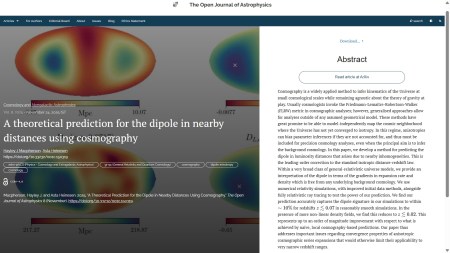
The first paper this week is “A theoretical prediction for the dipole in nearby distances using cosmography” by Hayley J. Macpherson (U. Chicago, USA) and Asta Heinesen (Niels Bohr Institute, Denmark). This was published on Monday 24th November 2025 in the folder Cosmology and Nongalactic Astrophysics. It presents a method to predict the dipole in luminosity distances that arises due to nearby inhomogeneities to leading-order correction to the standard isotropic distance-redshift law. Incidentally, I wrote about a talk by one of the authors here.

The overlay is here:


You can find the officially accepted version on arXiv here and the Fediverse announcement is here:

Open Journal of Astrophysics

@OJ_Astro@fediscience.org

New Publication at the Open Journal of Astrophysics: "A theoretical prediction for the dipole in nearby distances using cosmography" by Hayley J Macpherson (U. Chicago, USA) and Asta Heinesen (Niels Bohr Institute, Denmark)

doi.org/10.33232/001c.150319

November 24, 2025, 8:25 am 2 boosts 1 favorites


The second paper of the week is “A Targeted Gamma-Ray Search of Five Prominent Galaxy Merger Systems with 17 years of Fermi-LAT Data” by Siddhant Manna and Shantanu Desai (IIT Hyderabad Kandi, India). This one was published on Tuesday November 25th 2025 in the folder marked High-Energy Astrophysical Phenomena. It describes a search for gamma-ray emission in Fermi-LAT data from five merging galaxy systems with marginal detections for two of them

The overlay is here:


You can find the official version of this one on arXiv here. The federated announcement on Mastodon is here:


Next one up is “Metallicity fluctuation statistics in the interstellar medium and young stars – II. Elemental cross-correlations and the structure of chemical abundance space” by Mark R. Krumholz (ANU, Australia), Yuan-Sen Ting (Ohio State U., USA), Zefeng Li (Durham U., UK), Chuhan Zhang (ANU), Jennifer Mead (Columbia U., USA) and Melissa K. Ness (ANU). This was published in the folder Astrophysics of Galaxies on Wednesday November 26th. It presents an extended stochastically-forced diffusion model for the chemical evolution of galaxies, making quantitative predictions for the degree of correlation in abundance patterns in both gas and young stars.

The overlay is here:


You can find the official accepted version on arXiv here. The fediverse announcement is here:

Open Journal of Astrophysics

@OJ_Astro@fediscience.org

New Publication at the Open Journal of Astrophysics: "Metallicity fluctuation statistics in the interstellar medium and young stars – II. Elemental cross-correlations and the structure of chemical abundance space" by Mark R. Krumholz (ANU, Australia), Yuan-Sen Ting (Ohio State U., USA), Zefeng Li (Durham U., UK), Chuhan Zhang (ANU), Jennifer Mead (Columbia U., USA) and Melissa K. Ness (ANU)

doi.org/10.33232/001c.150356

November 26, 2025, 8:34 am 1 boosts 1 favorites

The fourth and final paper of the week is “Simulating realistic Lyman-alpha emitting galaxies including the effect of radiative transfer” by Hasti Khoraminezhad & Shun Saito (Missouri Institute of Science & Technology, USA), Max Gronke (U. Heidelberg, Germany) and Chris Byrohl (MPA Garching, Germany). An empirical model for Lyman-alpha emitters (LAEs) which provides predictions for the halo occupation distributions and relationship between luminosity and halo mass, including the distribution of satellite LAEs. It was published on Thursday November 27th 2025 in the folder Astrophysics of Galaxies.
The overlay is here:

You can find the official published version on arXiv here. The Fediverse announcement follows:

Open Journal of Astrophysics

@OJ_Astro@fediscience.org

New Publication at the Open Journal of Astrophysics: "Simulating realistic Lyman-alpha emitting galaxies including the effect of radiative transfer" by Hasti Khoraminezhad & Shun Saito (Missouri Institute of Science & Technology, USA), Max Gronke (U. Heidelberg, Germany) and Chris Byrohl (MPA Garching, Germany)

doi.org/10.33232/001c.151254

November 27, 2025, 9:20 am 1 boosts 1 favorites

And that concludes the update for this week. I will do another next Saturday.

#arxiv250701095v3 #arxiv250714572v2 #arxiv250716707v2 #arxiv250806232v2 #astrophysicsOfGalaxies #chemicalAbundances #cosmography #cosmology #cosmologyAndNongalacticAstrophysics #diamondOpenAccess #diamondOpenAccessPublishing #fermiLat #galaxyMergers #gammaRay #highEnergyAstrophysicalPhenomena #lymanAlphaEmitters #metallicity #openAccess #openAccessPublishing #openJournalOfAstrophysics #theOpenJournalOfAstrophysics

Client Info

Server: https://mastodon.social
Version: 2025.07
Repository: https://github.com/cyevgeniy/lmst