
#PeriodicalStudies

2026-02-17

@tntype @dbellingradt @BiblioWingate @dohanian

awesome find of the day: I discovered that 15 years ago I was a rather diligent note taker when conducting my doctoral research on Damascus, reading Arabic newspapers at the AUB library all day, everyday for months on end. Apparently, a local, water and steam powered paper mill was established north of #Beirut at نهر انطلياس in late 1882 by ثابت and باحوط. The official inauguration took place with much pomp in the presence of the Vali etc. in March 1883. In November 1882, the Jesuit weekly البشير even printed at least one issue on the new mill’s paper as a marketing device showing off its quality and calling on all printing presses and schools in Syria to utilise this local paper (also, of course, in the service of progress and the nation) .
gpa.eastview.com/crl/mena/?a=d

#PrintingHistory #PeriodicalStudies

2026-02-09

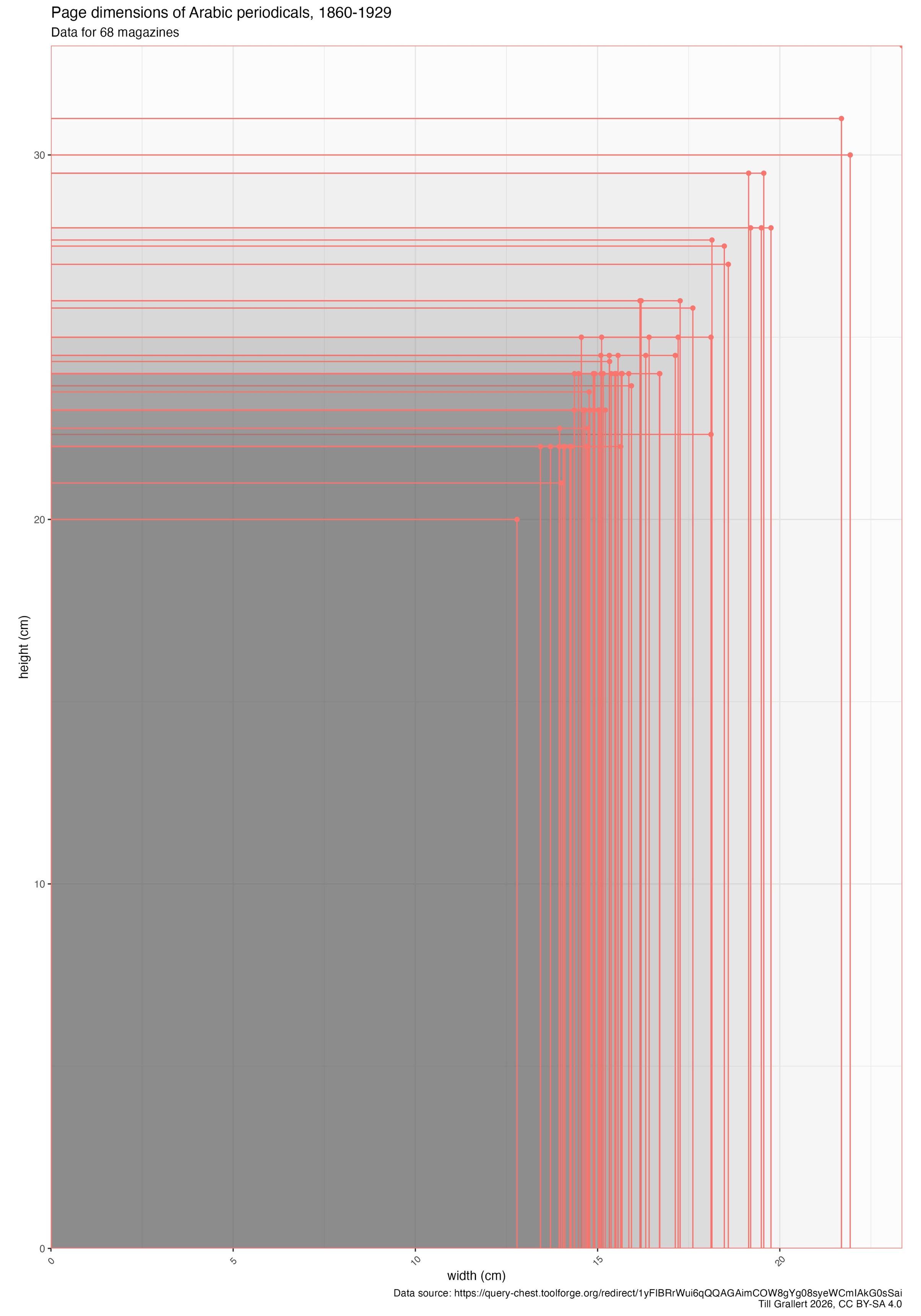
@tntype @dbellingradt @BiblioWingate @dohanian After running exiftools on a large number of digital facsimiles to compute average page dimensions and combining this ratio with the measured height of Arabic magazines found in library catalogues, it appears that page dimensions of 24.43 cm by 16 cm are somewhat close to Medium octavo after we account for some additional height caused by measuring the outside dimensions of bound library copies.

digitalcourage.social/@tillgra

#PeriodicalStudies #PrintingHistory #الصحافة_العربية

2026-01-28

Is there any meaningful literature on the paper trade in the late Ottoman Empire (second half of the 19th century onwards) that I might have missed? I tried all keywords I could think of in the common databases for scholarly literature and searched through works on the history of printing and publishing but came up practically empty-handed.

Amy Ayalon, Hala Auji, Titus Nemeth ( @tntype ), and the late Kathryn Schwartz mention paper in passing. The body of literature on watermarks and manuscripts doesn’t help either as this isn’t concerned with the cheap, industrially produced paper for periodical printing I am interested in.

Is there a chance of @dbellingradt or
@BiblioWingate knowing more?

#PaperHistory #OttomanEmpire #PeriodicalStudies #PaperTrade

2026-01-23

A small Friday-evening project came to fruition. Analysing data on the dimensions of Arabic periodicals from #Wikidata, a quick and simple plot allows for a number of observations: Firstly, newspapers and magazines are of different sizes and the former tend to be significantly larger than the latter. This bestows confidence on our data set. Misclassification is seemingly rare, particularly for magazines. Secondly, the size of magazines is quite stable at around 24cm with a slight tendency towards larger heights in the 1920s. Thirdly, newspapers are of a much less consistent size with the majority of observations falling into the mid-thirties.

#PeriodicalStudies #الصحافة_العربية #MultilingualDH #DH #DigitalHumanities

A boxplot of page heights along a temporal axis for Arabic periodicals published before 1930. Each periodical is recorded with its first year of publication and a single measure. In the cases where Wikidata returned multiple measures, these were averaged into a single data point. The plot divides the data set into newspapers (blue) and magazines (red) based on an explicit classification provided by Wikidata.
2025-11-07

This week I have been digging around in the #InternetArchive looking for digitised Arabic periodicals. With a bit of #Rstats and far too many hours of #XSLT and #TEI/XML spent on identifying titles based on the very patchy metadata provided by uploaders, there are quite some exciting finds:

The API returned 4500+ items for the keywords "جريدة", "مجلة", and "صحيفة", of which I could identify 781 as pertaining to 100 individual Arabic periodicals published before 1930. Links to all of these have been uploaded to #Wikidata, which will increase their visibility to scholars and the interested public.

There are, of course, thousands of items for which I couldn’t programmatically establish a title with sufficient certainty, let alone try and link them to existing records without actually looking at the digital facsimile and reading the information provided on front-pages and mastheads.

Check out query-chest.toolforge.org/redi to see the results.

#ArabPeriodicalStudies #PeriodicalStudies #DigitalHumanities #wdpd2025

2025-11-06

While I thoroughly enjoy the wealth of old Arabic periodicals on the Internet Archive, I am also frustrated by the state of metadata. Why do people laboriously upload thousands of individual issues but provide nothing but the **one-word** title? Don’t they want the material to be found? Is there something else to it?

Take, for example, archive.org/details/al-masrah_, which is the only known digitised copy of المسرح, published by محمد عبد المجيد حلمي in Cairo from 1925 onwards. wikidata.org/wiki/Q124972737

#DigitalHumanities peeps and #Librarians, can you recommend publications on the state of the Internet Archive’s crowd-sourced metadata?

#الصحافة_العربية #ArabPeriodicalStudies #digipres #metadata #periodicalStudies

2025-10-21

I’ve just seen this fantastic work worth highlighting during #OAWeek: Somebody is uploading scans of Palestinian periodicals to the @internetarchive at scale: archive.org/search?query=creat . They even add metadata at the issue level!

#CulturalHeritage #الصحافة_العربية #Palestine #Gaza #ArabPeriodicalStudies #PeriodicalStudies

2025-10-20

I also wrote a #SPARQL query to see the linguistic composition of the periodical press until 1930 at all locations with titles published in languages of the Eastern Mediterranean: #Arabic, #Ottoman, #Armenian, #Coptic, #Greek, #Farsi, #Ladino, #Azerbaijani

As a table: query-chest.toolforge.org/redi

As a map with layers for each language, because sometimes geographic distribution is interesting: query-chest.toolforge.org/redi

#Wikidata #PeriodicalStudies #ArabPeriodicalStudies #الصحافة_العربية #Multilinguality #multilingualDH

2025-10-20

Of course a map is nice to have, but a simple table might often be the more useful thing. So I just wrote the #SPARQL to query #Wikidata for all Arabic periodicals published before 1930 with indicators whether there are known holdings and digitised collections. The table allows to quickly search for titles, years and places of publication.

As a boon to #multilingualDH, the language of results depends on your OS’s settings.

query-chest.toolforge.org/redi

#PeriodicalStudies #الصحافة_العربية #ArabPeriodicalStudies

2025-10-19

How do you know a text about China published in an Arabic journal in Cairo in 1907 is a translation from a Western language in Latin script? The Arabic transcriptions of Chinese names do not make sense phonetically. Take for example "جريدة سهان باو التي تصدر في مدينة شنغاي وهي التي أسست سنة ١٨٦٨” referencing, as I believe, the newspaper "申报" (Shen Bao).

source: al-Muqtabas, openarabicpe.github.io/journal

申报 on Wikidata: wikidata.org/wiki/Q919710

#Multilinguality #PeriodicalStudies #Transcriptions

2025-09-23

East View's Global Press Archive is a wonderful resource for anybody interested in periodical studies outside the Global North or anybody interested in the history of the societies covered by this corpus. They even provide a union list of all titles for download! But why, oh why, would this list include faulty URLs for every periodical? These cannot be resolved without the acronym of the collection a periodical is part of — information that is not present in the union list itself .... WHY?????!!!!

gpa.eastview.com/

#failure #periodicalStudies #DigitalHumanities #multilingualDH

2025-09-17

Zur Abwechslung mal etwas Inhaltliches anlässlich des Historikertages. Was weiß #Wikidata über die Vielsprachigkeit von Periodikapublikationen an einzelnen Orten, an denen auch Periodika in Sprachen Westasiens publiziert wurden?

query-chest.toolforge.org/redi

#Histag25 #PeriodicalStudies

The image displays a table titled "The global periodical press before 1930: locations with periodicals in publication languages of the Eastern Mediterranean." The table is structured with columns labeled "lang," "langLabel," "count," "pubPlaceLabel," and "pubPlace." Each row represents a different language and its corresponding count of periodicals published in Istanbul. The languages listed include Ottoman Turkish, Arabic, French, Turkish, Greek, Persian, Armenian, Bulgarian, English, German, Judaeo-Spanish, Karamanli Turkish, and Urdu. The count of periodicals ranges from 169 for Ottoman Turkish to 1 for Urdu, German, Judaeo-Spanish, and Karamanli Turkish. The publication place for all listed languages is Istanbul, with the identifier "Q406." The table is presented in a clean, organized format with blue headers and a search bar at the top, indicating the location as "Istanbul."

Provided by @altbot, generated privately and locally using Ovis2-8B

🌱 Energy used: 0.213 Wh
2025-08-19

I just added holding information for 100+ Arabic newspapers and magazines published before 1930 from the National Library of Israel to #Wikidata (many are marked as belonging “to the Absentee Property Collection (AP)” in the MARC files from the catalogue and thus a direct result of the #Nakba ). This significantly extends the coverage of pre-Nakba Palestinian periodicals and will allow more people to discover the rich cultural heritage of #Palestine.

URL for a map of all known holdings of pre-Nakba periodicals in Palestine: query-chest.toolforge.org/redi

For a documentation of the process and our larger project see my ‘Adding Every Arabic Periodical Published Before 1930 to Wikidata: Moving the Scholarly Crowd-Sourcing Project Jarāʾid to the Digital Commons’. Transformations: A DARIAH Journal 1: Workflows (July 2025): 1–39. doi.org/10.46298/transformatio.

#PeriodicalStudies #SPARQL #ArabPeriodicalStudies #الصحافة_العربية

a map of the east coast of the Mediterranean (what is now Israel & Palestine plus parts of several neighboring countries) with place names in Arabic, showing several green and yellow colored circles with numbers in them repenting counts of sites near those circles. Circles indicate location of publication for periodicals published pre-Nakba (1949) for periodicals with known library holdings.
2025-03-04

This is a first: فروق was an Ottoman newspaper published in Athens in 1911. But apparently they didn’t have access to movable-type and lithographed a handwritten paper using a printed template to print into.

Facsimiles are available from HTU at tufs.ac.jp/common/fs/asw/tur/h

#OttomanEmpire #Greece #PeriodicalStudies #Printing #lithography

2024-11-16

I finally managed to write up some of the thoughts that went into contributing the bibliographic information on Arabic periodicals and their known holdings to #Wikidata. I have published a preprint to Zenodo: zenodo.org/records/14112648. Feel free to share and to comment under this post.

#PeriodicalStudies #MultilingualDH #ArabicPeriodicals #Arabic #Ottoman #Mahjar #الصحافة_العربية #DigitalHumanities #dh #LinkedOpenData

2024-08-26

Does anybody know the history of the Judeo-Arabic press in #India? #Wikidata provides a number of locations beyond the common north-African centre: tinyurl.com/wikidata-judeo-ara

#PeriodicalStudies #Arabic

2024-08-07

Last week, I pushed metadata for some 700+ Ottoman Turkish periodicals published mainly between the Young Turk Revolution of 1908 and the end of the empire to #Wikidata. Data is based on Baykal's wonderful index (doi.org/10.1163/9789004394889).

Together with the Arabic periodicals added earlier this year, coverage of periodical history beyond English, French or German on Wikidata is pretty good. Thanks to these efforts, English is now severely under represented (percentage of periodicals represented on Wikidata): w.wiki/ArRb.

Arabic is the second most prominent language (after English) and Ottoman the ninth. Swedish is a surprising third and, given the difference in the number of speakers, quite astonishing that there were at least c.2750 Swedish newspapers published before 1930 compared to the grand total of c.3000 Arabic titles in the same period.

#MultilingualDH #PeriodicalStudies #dh #DigitalHumanities

Bubble chart of the most prominent publication languages for periodicals published worldwide before 1930 according to Wikidata. English ist first, followed by Arabic, Swedish, French, german, Spanish, Russian, Dutch, Ottoman Turkish, Italian.
d'aïeux et d'ailleursdaieuxetdailleurs@framapiaf.org
2024-05-24

Juste en renseignant sur #Wikidata les lieux de publication (voire un peu plus) pour les périodiques ayant un article #Wikipédia (catégorie : fr.wikipedia.org/wiki/Cat%C3%A), l'Ouest breton est un peu mieux représenté.

Reste à faire du systématique pour le #Finistère : #BNF + AD29 (permaliens, #pressenumérisée et #opencontent ❤️ ). Ca me changera des #timeline #CôtesdArmor et #LoireAtlantique 😇 patrimoine-et-numerique.fr/res

#bretagne #periodicalstudies #LOD #archives #presse
poke @tillgrallert @linda2900

Cartographie des périodiques antérieurs à 1930 récemment modifiés sur Wikidata
2024-05-22

If you want to track recent edits to periodical data on #Wikidata, you can use #SPARQL for that too. Here is the link to a map of all periodicals published worldwide before 1930, whose data has been edited during the last week: w.wiki/AA6L

#PeriodicalStudies #multilingualDH #CrowdSourcing #DecoloniseKnowledge #DH #DigitalHumanities #LOD #SemanticWeb

Map of all periodicals published worldwide before 1930, showing only those whose information has been edited on Wikidata during the last week.
d'aïeux et d'ailleursdaieuxetdailleurs@framapiaf.org
2024-05-18

Olala un nouveau champ d'éléments à enrichir sur #Wikidata (genre j'en manquais...).
#presseancienne #Bretagne
RT @tillgrallert - #Wikidata currently holds information on almost 20000 periodicals published worldwide before 1930: w.wiki/A6s8. But, as one would suspect, quality of data and coverage differs widely between regions.
Toot : digitalcourage.social/@tillgra
#PeriodicalStudies #multilingualDH #crowdsourcing #DH #DigitalHumanities #LOD #SemanticWeb

Client Info

Server: https://mastodon.social
Version: 2025.07
Repository: https://github.com/cyevgeniy/lmst