The waning Washington Post
Saturday’s copy of the Washington Post could not have made much of a thump whenever it landed on our front walk this morning. At two sections and 36 pages, it was a sadly diminished descendant of what has been the thinnest daily edition of the paper for as long as I can remember, even before I started work there in December of 1993.
(Back then, average weekday print circulation had just peaked at 832,332; as of June, it reportedly stood at 97,000. The Post’s digital subscriptions hit a high mark of 3 million in January of 2021 and had fallen to 2.5 million by late October.)
In addition to having separate A, Metro, Sports and Style sections compressed into those two sections, part of a cutback to the print edition made in June, Saturday’s paper was also absent many familiar, favorite bylines–the result of a disturbing exodus of talent from my former employer.
Even after more than two decades of seeing buyouts encourage dozens of the Post’s more experienced journalists to head for the exits, the numbers and the names of Posties taking a buyout this time are shocking. Among the dozens hitting the ejection seat:
- Philip Bump, a hard-working explainer of policy and politics whom you can count on to bring data;
- David Von Drehle, a brilliant writer whom the Post lost once to Time and then reclaimed;
- Catherine Rampell, one of the smartest observers of economic policy on the op-ed page and anywhere;
- Joel Achenbach, a veteran science scribe whose stories were a mandatory read, but espcially his stories about space;
- Dan Steinberg, who captured the frequent pain of life as a D.C. sports fan like nobody else in Sports;
- Monica Norton, one of my best editors in Financial;
- Sally Jenkins, a generational talent of a sports columnist;
- Erik Wemple, a media critic unwilling to buy the industry’s bullshit who eventually saw the Post’s new management spike one of his columns.
It’s a horrible hollowing out even before you count the Post journalists who jumped before they could be pushed. See, for example, humor writer Alexandra Petri, whom The Atlantic was smart enough to poach and who has been joined by enough other Post refugees that the paper might as well now be that magazine’s farm team.
The Nats have never had a fire sale like this, and the Post isn’t even getting prospects in return–just personnel expenses saved, with the buyout packages paid via the paper’s miraculously overfunded pension fund.
The better comparison is not to our home team but to an out-of-town squad that won’t leave Washington: Elon Musk’s DOGE minions, who might have struggled to do this much damage to the Post if they had commandeered an office at 1301 K Street NW.
I have not yet canceled our subscription because the Post continues to do good and useful work, especially at the national and international level. But its local coverage has shrunk to the point of often becoming borderline useless, leaving me to piece together a replacement for it by reading the likes of WAMU, Greater Greater Washington, ArlNow, The 51st and the Virginia Mercury.
The proximate cause for this destruction of journalistic value is the new crop of management led by CEO and publisher Will Lewis, a Fleet Street import with a record of questionable journalistic ethics in London who has shown himself to be a newsroom cancer since his arrival two winters ago.
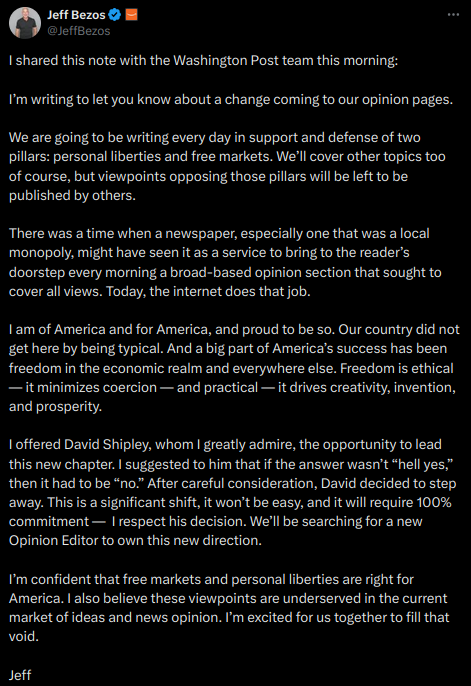
But Washington Post owner Jeff Bezos hired Lewis and has yet to fire him. Bezos spiked the paper’s endorsement of Kamala Harris two weeks before the election, had the paper insult the intelligence of its readers with its explanation (followed by more than 300,000 of them canceling their digital subscriptions), and then spent millions to curry favor with President Trump. Bezos directed the opinions section to become a defender of “personal liberties and free markets” and has since seen some of that section’s better advocates of those things leave even as hacks like Marc Thiessen remain.
Bezos has, however, yet to interfere with the paper’s news coverage–which would be my own subscription-canceling moment.
This is much worse than what I thought might happen when Bezos stunned D.C. with his $250 million purchase of the Post in 2013, and it is an even steeper drop from how things seemed to have progressed a decade ago. My journalistic alma mater now seems trapped in the grip of a billionaire with no need to sell such a trivial asset but also no interest in investing to improve it.
That may be fine financially for Bezos and his other businesses, many of which are heavily exposed to Trump’s uninformed whims. But if this is how he leaves the Washington Post, there should be no amount of packages shipped, data centers built, or rockets launched that will erase this stain from his record.
#1301KStreet #BezosWashingtonPost #buyouts #DOGE #JeffBezos #LocalNews #newspaper #wapo #WashPost #washingtonPost #WillLewis