#implementationscience

2026-02-08

Rethinking human resources for malaria control and elimination in Africa

The comprehensive policy review by Halima Mwenesi and colleagues “Rethinking human resources and capacity building needs for malaria control and elimination in Africa” argues that the stagnation in global malaria progress is fundamentally a human resources crisis rather than solely a biological or technical failure.

The authors posit that the current workforce is insufficient in number and ill-equipped with the necessary skills to navigate the complex transition from malaria control to elimination.

It is a critical indictment of the status quo in malaria training and offers a roadmap for structural reform.

This article summarizes key points from the policy review and examines how The Geneva Learning Foundation’s peer learning-to-action model could be used by national programmes to transform the health workforce.

The mismatch between training and operational needs

The authors identify a severe imbalance in training priorities where capacity building has historically favored biomedical and basic sciences such as entomology and parasitology.

While essential, this focus has led to a neglect of operational, translational, and implementation sciences.

The report highlights that while the global community produces high-level scientists who understand the parasite, it fails to produce “translational scientists” who can bridge the gap between global guidelines and local realities.

This has resulted, they argue, in a workforce lacking the practical competencies to operationalize complex elimination strategies that require precision and adaptation.

The deficit in leadership and social sciences

A major finding is the specific deficit in so-called “soft skills” and social sciences which are increasingly critical as programs move toward elimination.

The authors argue that modern malaria control requires competencies in leadership, health diplomacy, anthropology, sociology, and political analysis.

Program managers currently lack the training to navigate complex political landscapes, mobilize domestic resources, or engage effectively with communities to sustain interventions.

The review emphasizes that understanding community behavior and social determinants is as critical as understanding vector behavior but this is rarely reflected in curricula.

Data illiteracy and the failure of surveillance

The paper identifies pervasive “data illiteracy” across the workforce.

Health workers collect vast amounts of data to satisfy donor reporting requirements but often lack the skills to interpret or use it for local decision-making.

This results in a “data-rich but information-poor” environment.

As countries move toward elimination, the need for real-time, granular surveillance becomes paramount.

The current workforce is unable to perform the rapid data analysis required to detect and respond to outbreaks at the sub-national level.

Fragmentation and lack of coordination

The review critiques the fragmentation of investments in training, capacity-building, and technical assistance driven by donor agendas.

It notes a lack of coordination among donors and agencies which leads to a proliferation of uncoordinated short courses and workshops that do not necessarily align with national strategic plans.

This fragmentation is exacerbated by a lack of data on the workforce itself.

Many countries lack a central registry of malaria personnel which makes it impossible to forecast needs, plan for attrition, or manage career pathways.

The call for structural transformation

The authors call for a radical shift toward “South-South” collaboration where African institutions take the lead in training.

They advocate for moving away from ad hoc workshops toward institutionalized, long-term capacity building.

Crucially, they recommend the use of digital platforms to democratize access to knowledge for mid-level and community-based cadres who are often excluded from elite fellowships.

How can learning science help transform malaria training investments into tangible health worker performance?

For a global health epidemiologist accustomed to viewing disease control through the lens of biological interventions and coverage rates, the human resource crisis described by Mwenesi and colleagues represents a “delivery failure” of validated tools.

The Geneva Learning Foundation (TGLF) learning science model functions as a structural intervention designed to repair broken delivery mechanisms in global health and humanitarian response.

The following analysis translates the TGLF approach into terms recognizable to an epidemiologist or program manager who operates with the assumption that training is primarily about the transmission of technical knowledge.

Moving from passive transmission to implementation fidelity

Epidemiologists understand that a vaccine with high efficacy in a trial often has low effectiveness in the real world due to poor administration or cold chain failure.

Similarly, Mwenesi et al. identify that technical malaria guidelines fail because the “human infrastructure” cannot implement them.

Traditional training assumes that if you lecture health workers on a protocol, which is a transmission of information, they will execute it.

This is a “single-loop” assumption.

The TGLF model introduces an “implementation loop.”

Instead of merely receiving information, learners in the TGLF network must design a micro-project to apply the new guideline in their specific district, execute it, and report back on the results using their own local data.

This turns the workforce from passive recipients of protocols into active testers of implementation fidelity.

It directly addresses the “translational science” gap identified in the paper by forcing the learner to translate theory into practice immediately.

Sceptics often argue that this approach places an undue burden on an already overworked workforce.

However, the TGLF model embeds learning into the workflow itself.

This is not additional work but rather “learning-based work.”

Participants do not create hypothetical projects.

They identify a bottleneck they are currently facing, such as a specific pocket of malaria transmission, and use the learning cycle to address it.

This transforms the training from an external interruption into an operational support mechanism.

By embedding learning into the workflow, it operationalizes Mwenesi’s call for translational science.

It considers the daily struggle of the health worker as a form of structured scientific inquiry: they hypothesize a solution, test it, and report the results.

This is implementation as science.

Operationalizing data use for local decision-making

Mwenesi notes that health workers collect data but do not use it.

In the TGLF model, data is not something sent “up” to the ministry.

It is the raw material for peer support and feedback.

In a TGLF peer learning exercise, a district medical officer in Ghana shares their case management data to compare performance with a peer in Uganda.

They share because they want to, not because they are required to.

This creates a social incentive to understand and analyze one’s own data.

It builds the “data literacy” the authors call for not through abstract statistics courses but through the practical necessity of explaining one’s own performance to a colleague.

This process transforms data from a compliance burden into a tool for local problem-solving.

Is there a risk that peer learning will pool ignorance?

Is there a valid concern regarding the risk of “pooled ignorance” where peers might reinforce incorrect practices?

The TGLF model mitigates this through “structured emergence.”

The model does not dismiss expert knowledge but uses global guidelines as the “anchor” for local problem-solving.

In this system, a health worker cannot simply state an opinion.

They must submit an action plan that is peer-reviewed against a rubric derived from WHO guidelines.

This process ensures fidelity to technical standards while allowing for necessary local adaptation.

The aggregation of thousands of these peer-reviewed plans creates a new form of rigorous, practice-based evidence that complements expert guidance.

Scaling “soft skills” through structured peer review

The review calls for leadership and diplomacy skills but notes these are hard to teach in workshops.

The TGLF model builds these skills implicitly through its pedagogical structure.

When a participant submits an action plan, they must receive and respond to critical feedback from peers in other countries.

They must negotiate differing viewpoints and defend their technical choices.

This mimics the “health diplomacy” and leadership dynamics required in real-world program management.

Furthermore, because they must engage community stakeholders to implement their projects, they practice the anthropological and social engagement skills Mwenesi identifies as missing.

They learn leadership not by studying a theory of leadership but by leading a change initiative in their facility.

While some experts argue that soft skills require “hard contact” in physical spaces, TGLF results suggest that physical proximity often limits a worker to their known environment and existing biases.

The TGLF model introduces a form of “cosmopolitan localism.”

When a nurse in rural Nigeria must explain her challenge to a peer in urban India, she is forced to articulate her context with a clarity and diplomacy not required when speaking to a neighbor.

This defiance of distance fosters a quantum leap in communication capabilities.

Participants report that the skills learned in negotiating these digital, cross-cultural peer relationships directly translate to better engagement with their physical-world colleagues and community leaders.

Addressing the incentive structure and correcting expertise asymmetry

The paper critiques the “brain drain” and the reliance on experts from the Global North.

TGLF operationalizes the “South-South” collaboration recommended by the authors by creating a flat digital hierarchy.

In this model, the “expert” is not a visiting consultant from Geneva but a peer who has successfully solved the problem in their own context.

A nurse in Nigeria learns how to improve bed net usage from a nurse in Kenya who solved that exact refusal issue last month.

This actually results in greater interest, comprehension, and use of official guidelines.

It also validates local knowledge and creates the “critical mass of thinking professionals” that Mwenesi argues is essential for elimination.

It shifts the source of authority from external experts to the collective intelligence of the network.

Transforming the economy of per diem

A common critique of moving away from face-to-face training is the reliance of health workers on per diems for financial survival.

Mwenesi implies that the current system is unsustainable.

The TGLF model operates on the evidence that per diem-driven training often restricts access to a “training aristocracy” of recurrent participants while excluding the frontline workers who most need the knowledge.

TGLF replaces the financial incentive with a professional survival incentive.

In the Nigeria Immunization Collaborative, over 4,300 health workers participated without per diems.

They did so because the program addressed the specific pain points of their daily work.

This filters the workforce for “positive deviants,” or those with high intrinsic motivation who are most likely to drive elimination efforts, rather than those primarily motivated by daily subsistence allowances.

A “surveillance system” for human resources and performance

Finally, the review notes the lack of registries and data on the workforce itself.

The TGLF digital network acts as a real-time sensor of workforce capacity.

By engaging thousands of health workers simultaneously, the platform generates data on who is active, what problems they are facing, and where their skills are deficient.

For an epidemiologist, this is equivalent to a surveillance system for human resources.

It provides the visibility needed to forecast gaps and target interventions precisely, replacing the “blind” proliferation of uncoordinated workshops with a data-driven approach to capacity building.

Regarding concerns that digital platforms fail in low-resource settings due to poor connectivity, TGLF utilizes a “cognitively quiet” design that functions on low-bandwidth connections and mobile devices.

This design respects the technological reality of the African context.

Data from the Teach to Reach program, which has engaged over 60,000 participants in remote, ongoing peer learning activities , demonstrates that when the technology is adapted to the user rather than the other way around, participation rates exceed those of physical workshops.

This scale allows for the identification of systemic patterns and workforce gaps that would be invisible in a smaller, face-to-face cohort.

Reference

Mwenesi, H., Mbogo, C., Casamitjana, N., Castro, M.C., Itoe, M.A., Okonofua, F., Tanner, M., 2022. Rethinking human resources and capacity building needs for malaria control and elimination in Africa. PLOS Glob Public Health 2, e0000210. https://doi.org/10.1371/journal.pgph.0000210

Reda Sadki (2023). How do we reframe health performance management within complex adaptive systems?. Reda Sadki: Learning to make a difference. https://doi.org/10.59350/mx5qr-qet97

Reda Sadki (2024). Prioritizing the health and care workforce shortage: protect, invest, together. Reda Sadki: Learning to make a difference. https://doi.org/10.59350/zzqr4-9g482

Reda Sadki (2024). Protect, invest, together: strengthening health workforce through new learning models. Reda Sadki: Learning to make a difference. https://doi.org/10.59350/g24b4-7fj64

Reda Sadki (2024). What is double-loop learning in global health?. Reda Sadki: Learning to make a difference. https://doi.org/10.59350/s4xtw-b7274

Reda Sadki (2024). World Malaria Day 2024: We need new ways to support health workers leading change with local communities. Reda Sadki: Learning to make a difference. https://doi.org/10.59350/yrn1r-hpz62

#brainDrain #cosmopolitanLocalism #dataQualityAndUse #doubleLoopLearning #HalimaMwenesi #healthWorkerMotivation #healthWorkerPerformance #healthWorkforce #HRH #implementationScience #leadership #learningStrategy #learningBasedWork #localization #malaria #peerLearning #performance #softSkills #TeachToReach #translationalScience
Rethinking human resources and capacity building needs for malaria control and elimination in Africa
2025-11-25

How can governments protect and promote mental health and well-being across sectors?

For decades, global health policy has approached mental illness primarily as a clinical challenge, a condition to be managed within the walls of hospitals and clinics by medical professionals. This biomedical focus, while essential, has often obscured the broader context in which mental health is shaped. A new publication from the World Health Organization, Guidance on policy and strategic actions to protect and promote mental health and well-being across government sectors, marks a significant shift in normative standards. It posits that mental health is not merely a health outcome but a structural one, determined as much by the fiscal policy, urban planning, and labor laws of governments as by psychiatric care.

A technical framework for cross-sectoral governance

The guidance emerges against a backdrop of escalating costs. The global economic burden of mental health conditions is projected to reach US$6 trillion by 2030. In response, the WHO outlines a “whole-of-government” approach, moving beyond general advocacy to provide specific policy directives for ministries that have historically operated independently of mental health considerations.

The document details an eight-step implementation cycle, requiring high-level political dialogue, rigorous situational analysis, and the drafting of sector-specific policies. It assigns distinct responsibilities to key government sectors:

  • Finance and Treasury: The guidance suggests that fiscal policies – including tax rates and welfare allocations – must be evaluated for their impact on health equity, rather than viewing mental health funding solely as a healthcare expenditure.
  • Interior and Justice: It recommends a shift in the role of police and prisons, advocating for the retraining of first responders to manage crises through de-escalation rather than coercion, and establishing independent mechanisms to report abuse.
  • Education and Employment: The framework calls for schools to embed social-emotional learning into standard curricula and for labor ministries to enforce standards that mitigate psychosocial risks in the workplace, such as precarious contracts and unsafe working conditions.

This approach frames mental health as a shared liability across the state apparatus, requiring coordinated action to address the social and structural determinants such as poverty, discrimination, and violence that drive poor mental health outcomes.

The challenge of implementation in resource-constrained settings

While the normative framework is clear, the practical pathway to implementation remains complex, particularly in low- and middle-income countries (LMICs). The current development finance landscape is characterized by shrinking budgets and a fracturing of global health funding. Governments in LMICs face the dual challenge of executing complex, multi-sectoral strategies while managing severe fiscal constraints.

One critical question for policymakers is operational: How can a Ministry of Health in a resource-constrained setting effectively engage other sectors – such as finance or justice – to adopt these recommendations without significant new external funding? Moving from high-level policy documents to localized action requires a mechanism that can bridge the gap between statutory intent and the reality of service delivery.

So what are the options to do more with less?

Peer learning as a mechanism for structural change

The Geneva Learning Foundation (TGLF) offers an operational model that addresses this implementation gap by utilizing the existing capacity of the health and social workforce. Rather than relying on traditional, resource-intensive capacity-building or technical assistance models, TGLF employs a “learning-to-action” methodology rooted in structured peer interaction. This approach connects thousands of frontline professionals – ranging from district administrators to social workers – into a structured digital network to learn from and support each other in actual implementation.

This model could support this WHO guidance in three specific ways:

  • Generating actionable local data: In contexts where central data is scarce, the network functions as a distributed sensor. In a recent deployment in Nigeria, working with NPHCDA and UNICEF, 4,300 health workers generated over 400 root cause analyses within weeks. By identifying specific local barriers to service delivery the network produced the granular evidence needed to inform the cross-sectoral policies advocated by the WHO, and turn them into practice.
  • Facilitating cross-sectoral integration: The WHO guidance necessitates collaboration between siloed professionals. TGLF’s model creates a forum where professionals from different sectors can share experience as they work to drive change, each in their own context. A school nurse can analyze crisis response strategies alongside a social worker from a different district, fostering the “collective intelligence” required to implement complex, multi-agency directives right down to the community level.
  • Improving cost-efficiency: By digitizing the peer-learning process and utilizing peer accountability rather than external consultants, the model achieves a cost reduction of approximately 90 percent compared to conventional implementation methods. This efficiency could allow governments to begin operationalizing the WHO guidelines immediately using existing payroll structures, rather than waiting for external grants.

By validating local knowledge and structuring peer accountability, this innovative model provides a practical means to transform the WHO’s technical guidance into sustained administrative action. It demonstrates that the capacity to reform mental health governance lies not only in new financial instruments but in the structured coordination of the workforce already present on the ground.

Image: Crossing Into Clarity, The Geneva Learning Foundation Collection © 2025. A corridor built from carved, interlocking forms – half letters, half symbols – evokes the dense, overlapping pressures that shape mental health across societies. As the viewer steps through this textured passage, the individual ahead emerges into a space of light and openness, suggesting the possibility of coherence after complexity. The piece reflects a core truth of whole-of-government mental health action: when fragmented systems align, even imperfectly, they create pathways that help people move from burden toward balance, and from confusion toward care.

Reference

Michelle Funk, Dévora Kestel, Natalie Drew Bold, Celline Cole, Maria Francesca Moro, 2025. Guidance on policy and strategic actions to protect and promote mental health and well-being across government sectors. World Health Organization, Geneva, Switzerland. https://www.who.int/publications/i/item/9789240114388

#governmentSectors #implementationScience #lmics #mentalHealth #peerLearning #genevaLearningFoundation #wellBeing #workforce

Guidance on policy and strategic actions to protect and promote mental health and well-being across government sectors
Jan R. Boehnkejrboehnke
2025-09-02

Amy Malaguti presents on developing a screening pathway for early diagnosis of chronic liver disease.

The ongoing project explores implementing Fibrosis-4 index & Fibroscan in a community detox setting and whether it is worth it.

2025-08-22

📄 'Process Evaluation of an Ambulance-Delivered Early Intensive Blood Pressure-Lowering Stroke Trial: Design, Rationale, and Reflection' - an article in the #KargerPublishers research collection on #ScienceOpen:

🔎🔗 scienceopen.com/document?vid=e

#AcuteStroke #INTERACT4 #PrehospitalCare #ImplementationScience #BloodPressureControl

2025-08-07

'Readiness Evaluation for Artificial Intelligence-Mental Health Deployment and Implementation (READI): A Review and Proposed Framework' - an article in Technology, Mind, and Behavior (TMB), published by the American Psychological Association, on #ScienceOpen:

➡️🔗 scienceopen.com/document?vid=8

#READIFramework #AIinMentalHealth #ClinicalPsychology #TechEthics #ImplementationScience

Jan R. Boehnkejrboehnke
2025-06-19

Telehealth interventions for managing can be cost-effective and improve access and health outcomes in rural and remote areas. This (n=15) stresses variability in findings and need for standardised implementation:
journals.sagepub.com/doi/full/

Jan R. Boehnkejrboehnke
2025-06-13

A new paper discusses workflow development for ePRO symptom monitoring to support PRO(M) implementation into practice using the Action, Actor, Context, Target, Time framework:
link.springer.com/article/10.1

Jan R. Boehnkejrboehnke
2025-03-28

9th National Patient-Reported Outcome Measures Research Conference
birmingham.ac.uk/research/cent

Conference: 19th June 2025
at Uo Birmingham

Submission deadline: 11th April

The call "PROMising Futures" highlights focal areas for submissions:

Innovative ways to develop and implement PROMs

Presentation of PROMs to clinicians and patients

and the description of the clinical utility of PROMs.

Pflegewissenschaft Uni Baselnursing@mstdn.nursing.unibas.ch
2025-03-11

"Implementation Science meets Systems Science: Harnessing the Power of Systems Thinking and System Dynamics for Effective Implementation in Health Sciences"
nursing.unibas.ch/de/aktuell/n
💡 In the SNSF-funded workshop, participants explored and applied systems science approaches to their implementation science projects, receiving valuable feedback during consultation sessions.
Big thanks to Dr. Decouttere & Prof. Vandaele for sharing their expertise! 👏

#ImpSci #ImplementationScience #SystemsScience

Gruppenfoto SNF Workshop
Pflegewissenschaft Uni Baselnursing@mstdn.nursing.unibas.ch
2025-02-12

Implementation Science Webinar Series 2025
Nun im 5. Jahr bietet IMPACT wieder eine Implementation Science Webinar-Serie.
Die vier Veranstaltungen finden am 16. April, 7. Mai, 17. September und 26. November 2025, jeweils von 17:00 bis 18:30 Uhr statt. Internationale Experten geben einen Einblick in verschiedene Bereiche der Implementierungswissenschaft.
nursing.unibas.ch/de/aktuell/s
Die Anmeldung zu den Webinaren ist kostenlos.

#Pflegewissenschaft #Pflege #Nursing #nursres #ImplementationScience

2024-11-26

Why guidelines fail: on consequences of the false dichotomy between global and local knowledge in health systems

Global health continues to grapple with a persistent tension between standardized, evidence-based interventions developed by international experts and the contextual, experiential local knowledge held by local health workers. This dichotomy – between global expertise and local knowledge – has become increasingly problematic as health systems face unprecedented complexity in addressing challenges from climate change to emerging diseases.

The limitations of current approaches

The dominant approach privileges global technical expertise, viewing local knowledge primarily through the lens of “implementation barriers” to be overcome. This framework assumes that if only local practitioners would correctly apply global guidance, health outcomes would improve.

This assumption falls short in several critical ways:

  1. It fails to recognize that local health workers often possess sophisticated understanding of how interventions need to be adapted to work in their contexts.
  2. It overlooks the way that local knowledge, built through direct experience with communities, often anticipates problems that global guidance has yet to address.
  3. It perpetuates power dynamics that systematically devalue knowledge generated outside academic and global health institutions.

The hidden costs of privileging global expertise

When we examine actual practice, we find that privileging global over local knowledge can actively harm health system performance:

  • It creates a “capability trap” where local health workers become dependent on external expertise rather than developing their own problem-solving capabilities.
  • It leads to the implementation of standardized solutions that may not address the real needs of communities.
  • It demoralizes community-based staff who see their expertise and experience consistently undervalued.
  • It slows the spread of innovative local solutions that could benefit other contexts.

Evidence from practice

Recent experiences from the COVID-19 pandemic provide compelling evidence for the importance of local knowledge. While global guidance struggled to keep pace with evolving challenges, local health workers had to figure out how to keep health services going:

  • Community health workers in rural areas adapted strategies.
  • District health teams created new approaches to maintain essential services during lockdowns.
  • Facility staff developed creative solutions to manage PPE shortages.

These innovations emerged not from global technical assistance, but from local practitioners applying their deep understanding of community needs and system constraints, and by exploring new ways to connect with each other and contribute to global knowledge.

Towards a new synthesis

Rather than choosing between global and local knowledge, we need a new synthesis that recognizes their complementary strengths. This requires three fundamental shifts:

1. Reframing local knowledge

  • Moving from viewing local knowledge as merely contextual to seeing it as a source of innovation.
  • Recognizing frontline health workers as knowledge creators, not just knowledge recipients.
  • Valuing experiential learning alongside formal evidence.

2. Rethinking technical assistance

  • Shifting from knowledge transfer to knowledge co-creation.
  • Building platforms for peer learning and exchange.
  • Supporting local problem-solving capabilities.

3. Restructuring power relations

  • Creating mechanisms for local knowledge to inform global guidance.
  • Developing new metrics that value local innovation.
  • Investing in local knowledge documentation and sharing.

Practical implications

This new synthesis has important practical implications for how we approach health system strengthening:

Investment priorities

  • Funding mechanisms need to support local knowledge creation and sharing
  • Technical assistance should focus on building local problem-solving capabilities
  • Technology investments should enable peer learning and knowledge exchange

Capacity building

Knowledge management (KM)

New paths forward

Moving beyond the false dichotomy between global and local knowledge opens new possibilities for strengthening health systems. By recognizing and valuing both forms of knowledge, we can create more effective, resilient, and equitable health systems.

The challenges facing health systems are too complex for any single source of knowledge to address alone. Only by bringing together global expertise and local knowledge can we develop the solutions needed to improve health outcomes for all.

References

Braithwaite, J., Churruca, K., Long, J.C., Ellis, L.A., Herkes, J., 2018. When complexity science meets implementation science: a theoretical and empirical analysis of systems change. BMC Med 16, 63. https://doi.org/10.1186/s12916-018-1057-z

Farsalinos, K., Poulas, K., Kouretas, D., Vantarakis, A., Leotsinidis, M., Kouvelas, D., Docea, A.O., Kostoff, R., Gerotziafas, G.T., Antoniou, M.N., Polosa, R., Barbouni, A., Yiakoumaki, V., Giannouchos, T.V., Bagos, P.G., Lazopoulos, G., Izotov, B.N., Tutelyan, V.A., Aschner, M., Hartung, T., Wallace, H.M., Carvalho, F., Domingo, J.L., Tsatsakis, A., 2021. Improved strategies to counter the COVID-19 pandemic: Lockdowns vs. primary and community healthcare. Toxicology Reports 8, 1–9. https://doi.org/10.1016/j.toxrep.2020.12.001

Jerneck, A., Olsson, L., 2011. Breaking out of sustainability impasses: How to apply frame analysis, reframing and transition theory to global health challenges. Environmental Innovation and Societal Transitions 1, 255–271. https://doi.org/10.1016/j.eist.2011.10.005

Salve, S., Raven, J., Das, P., Srinivasan, S., Khaled, A., Hayee, M., Olisenekwu, G., Gooding, K., 2023. Community health workers and Covid-19: Cross-country evidence on their roles, experiences, challenges and adaptive strategies. PLOS Glob Public Health 3, e0001447. https://doi.org/10.1371/journal.pgph.0001447

Yamey, G., 2012. What are the barriers to scaling up health interventions in low and middle income countries? A qualitative study of academic leaders in implementation science. Global Health 8, 11. https://doi.org/10.1186/1744-8603-8-11

Share this:

#climateChangeAndHealth #decolonization #evidenceBasedInterventions #expertise #globalHealth #healthSystems #implementationScience #localKnowledge

What are the consequences of the false dichotomy between global and local knowledge in health systems
Modele Ogunniyi, MD, MPHmodeldoc.bsky.social@bsky.brid.gy
2024-11-16

Thanks to this stellar team of speakers who shared their expertise, discussing #Outcomes beyond #MACE ➡️ #hypertension #cardiooncology #implementationscience in #heartfailure #QCOR24 at #AHA24 @ahascience.bsky.social #boldhearts #AHA100 #cardiosky #medsky

2024-11-12

How can we reliably spread evidence-based practices at the speed and scale modern health challenges demand?

At a symposium of the American Society for Tropical Medicine and Hygiene (ASTMH) Annual Meeting, I explored how peer learning could help us tackle five critical challenges that limit effectiveness in global health.

  1. Performance: How do we move beyond knowledge gains to measurable improvements in health outcomes?
  2. Scale and access: How do we reach and include tens of thousands of health workers, not just dozens?
  3. Applicability: How do we ensure learning translates into changed practice?
  4. Diversity: How do we leverage different perspectives and contexts rather than enforce standardization?
  5. Complexity: How do we support locally-led leadership for change to tackle complex challenges that have no standard solutions?

https://www.youtube.com/watch?v=Q08dbbzUzzc

For epidemiologists working on implementation science, peer learning provides a new path for solving one of global health’s most persistent challenges: how to reliably spread evidence-based practices at the speed and scale modern health challenges demand.

The evidence suggests we should view peer learning not just as a training approach, but as a mechanism for viral spread of effective practices through health systems.

How do we get to attribution?

Of course, an epidemiologist will want to know if and how improved health outcomes can be attributed to peer learning interventions.

The Geneva Learning Foundation (TGLF) addresses this fundamental challenge in implementation science – proving attribution – through a three-stage process that combines quantitative indicators with qualitative validation.

The process begins with baseline health indicators relevant to each context (such as vaccination coverage rates, if it is immunization), which are then tracked through regular “acceleration reports” that capture both metrics and implementation progress.

Rather than assuming causation from correlation, participants must explicitly rate the extent to which they attribute observed improvements to their intervention.

The critical innovation comes in the third stage: those claiming attribution must “prove it” to the community of peers, by providing specific evidence of how their actions led to the observed changes – a requirement that both controls for self-reporting limitations and generates rich qualitative data about implementation mechanisms.

This methodology has proven particularly valuable in complex interventions where randomized controlled trials may be impractical or insufficient.

What are examples of peer learning in action?

Here are three examples from The Geneva Learning Foundation’s work that demonstrate scale, reach, and sustainability.

Within four weeks, a single Teach to Reach cohort of 17,662 health workers across over 80 countries generated 1,800 context-specific experiences describing the “how” of implementation, especially at the district and community levels.

In Côte d’Ivoire, working with Gavi and The Geneva Learning Foundation, the national immunization team used TGLF’s model to support community engagement. Within two weeks, over 500 health workers representing 85% of the country’s districts had begun implementing locally-led innovations. 82% of participants said they would use TGLF’s model for their own needs, without requiring any further assistance or support.

In TGLF’s COVID-19 Peer Hub, 30% of participants successfully implemented recovery plans within three months – a rate seven times higher than a control group that did not use TGLF’s model.

Participants who actively engaged with peers were not only more likely to report successful implementation, but could demonstrate concrete evidence of how peer interactions contributed to their success, creating a robust framework for understanding not just whether interventions work, but how and why they succeed or fail across different contexts.

Quantifying learning

Using a simple methodology that measures learning efficacy across five key variables – scalability, information fidelity, cost effectiveness, feedback quality, and uniformity – we calculated that properly structured peer learning networks achieve an efficacy score of 3.2 out of 4, significantly outperforming both traditional cascade training (1.4) and expert coaching (2.2).

But the real breakthrough came when considering scale. When calculating the Efficacy-Scale Score (ESS) – which multiplies learning efficacy by the number of learners reached – the differences became stark:

  • Peer Learning: 3,200 (reaching 1,000 learners)
  • Cascade Training: 700 (reaching 500 learners)
  • Expert Coaching: 132 (reaching 60 learners)

Learn more: Calculating the relative effectiveness of expert coaching, peer learning, and cascade training

The mathematics of scale

For epidemiologists, the mechanics of this scaling effect may feel familiar.

In traditional expert-led training, if N is the total number of learners and M is the number of available experts who can each effectively coach K learners, we quickly hit a ceiling where N far exceeds M×K.

TGLF’s model transforms this equation by structuring interactions so each learner gives and receives feedback from exactly three peers, guided by expert-designed rubrics.

This creates a linear scaling pattern where total learning interactions = 3N, allowing for theoretically unlimited scale while maintaining quality through structured feedback loops.

Information loss and network resilience

One of the most interesting findings concerns information fidelity. In cascade training, knowledge degradation follows a predictable pattern:

where Kn is the knowledge at the nth level of the cascade and α is the loss rate at each step. This explains why cascade training, despite its theoretical appeal, consistently underperforms.

In contrast, TGLF’s peer learning-to-action networks showed remarkable resilience. By creating multiple pathways for knowledge transmission and building in structured feedback loops, the system maintains high information fidelity even at scale.

Learn more: Why does cascade training fail?

References

Arling, P.A., Doebbeling, B.N., Fox, R.L., 2011. Improving the Implementation of Evidence-Based Practice and Information Systems in Healthcare: A Social Network Approach. International Journal of Healthcare Information Systems and Informatics 6, 37–59. https://doi.org/10.4018/jhisi.2011040104

Hogan, M.J., Barton, A., Twiner, A., James, C., Ahmed, F., Casebourne, I., Steed, I., Hamilton, P., Shi, S., Zhao, Y., Harney, O.M., Wegerif, R., 2023. Education for collective intelligence. Irish Educational Studies 1–30. https://doi.org/10.1080/03323315.2023.2250309

Watkins, K.E., Sandmann, L.R., Dailey, C.A., Li, B., Yang, S.-E., Galen, R.S., Sadki, R., 2022. Accelerating problem-solving capacities of sub-national public health professionals: an evaluation of a digital immunization training intervention. BMC Health Serv Res 22, 736. https://doi.org/10.1186/s12913-022-08138-4

Share this:

#AmericanSocietyForTropicalMedicineAndHygiene #ASTMH #attribution #cascadeTraining #globalHealth #implementationScience #peerLearning #TheGenevaLearningFoundation #TropMed24

ASTMH 2024 How can we reliably spread evidence-based practices at the speed and scale modern health challenges demand
Christos Argyropoulos MD, PhDChristosArgyrop@med-mastodon.com
2024-10-11

Keep things simple if you want things done.

Here is my rule of 10: 10mg of empagliflozin, 10mg of ramipril, 10mg of rosuvastatin, 10mg of ezetimibe and 10mg finerenone is a solid 10/10 for cardiovascular and kidney disease in diabetes. It is potent combo and easy to remember.#implementationscience

Christos Argyropoulos MD PhDChristosArgyrop
2024-10-11

Keep things simple if you want things done.

Here is my rule of 10: 10mg of empagliflozin, 10mg of ramipril, 10mg of rosuvastatin, 10mg of ezetimibe and 10mg finerenone is a solid 10/10 for cardiovascular and kidney disease in diabetes. It is potent combo and easy to remember.#implementationscience

Jan R. Boehnkejrboehnke
2024-09-04

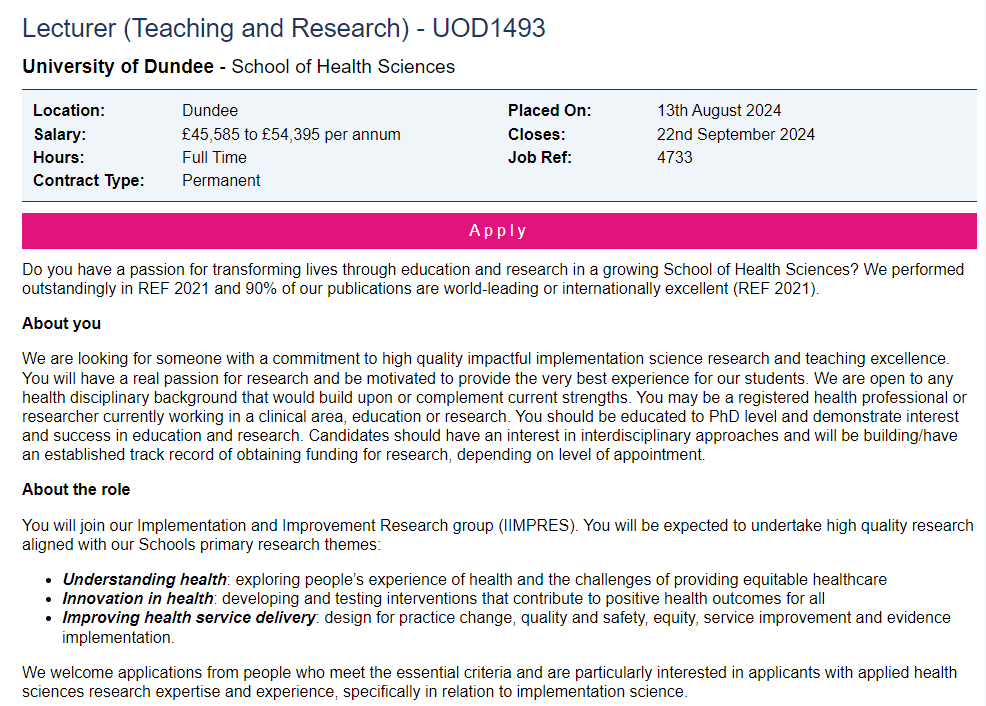
Come and work with us at the School of Health Sciences:

Lecturer / Assistant Prof

Deadline 22.09.2024
www.jobs.ac.uk/job/DJE823/l...

Screenshot, some key points from the jobs.ac.uk advert:

Lecturer (Teaching and Research)
Location:	Dundee
Salary:	£45,585 to £54,395 per annum
Hours:	Full Time
Contract Type:	Permanent
About the role

You will join our Implementation and Improvement Research group (IIMPRES). You will be expected to undertake high quality research aligned with our Schools primary research themes:

Understanding health: exploring people’s experience of health and the challenges of providing equitable healthcare; 
Innovation in health: developing and testing interventions that contribute to positive health outcomes for all; 
Improving health service delivery: design for practice change, quality and safety, equity, service improvement and evidence implementation.

We welcome applications from people who meet the essential criteria and are particularly interested in applicants with applied health sciences research expertise and experience, specifically in relation to implementation science.
Jan R. Boehnkejrboehnke
2024-08-21

Vacancy at our School :

dundee.ac.uk/work-for-us/jobs/
Deadline: 03.09.!

The post is based in the Implementation and Improvement Research group and open to a wide range of health-related research topics and backgrounds.


Jan R. Boehnkejrboehnke
2024-07-17

With view to I will point out that conceptually it is interesting to consider differences in outcomes and how they relate to , but research and practice likely will benefit from a focus on the mediating factors:
- service provision and quality in the area;
- initiation of treatment;
- adherence & participation in treatment;
- and its support (formal and informal)
to name only a few.

Client Info

Server: https://mastodon.social
Version: 2025.07
Repository: https://github.com/cyevgeniy/lmst