#plumescrolling

🌲🧿 "Max"t💽d🏵️n 🔎🍄MaxPow3r11@mastodon.online
2025-06-23
Nature with SteveNatureWithSteve
2025-06-18

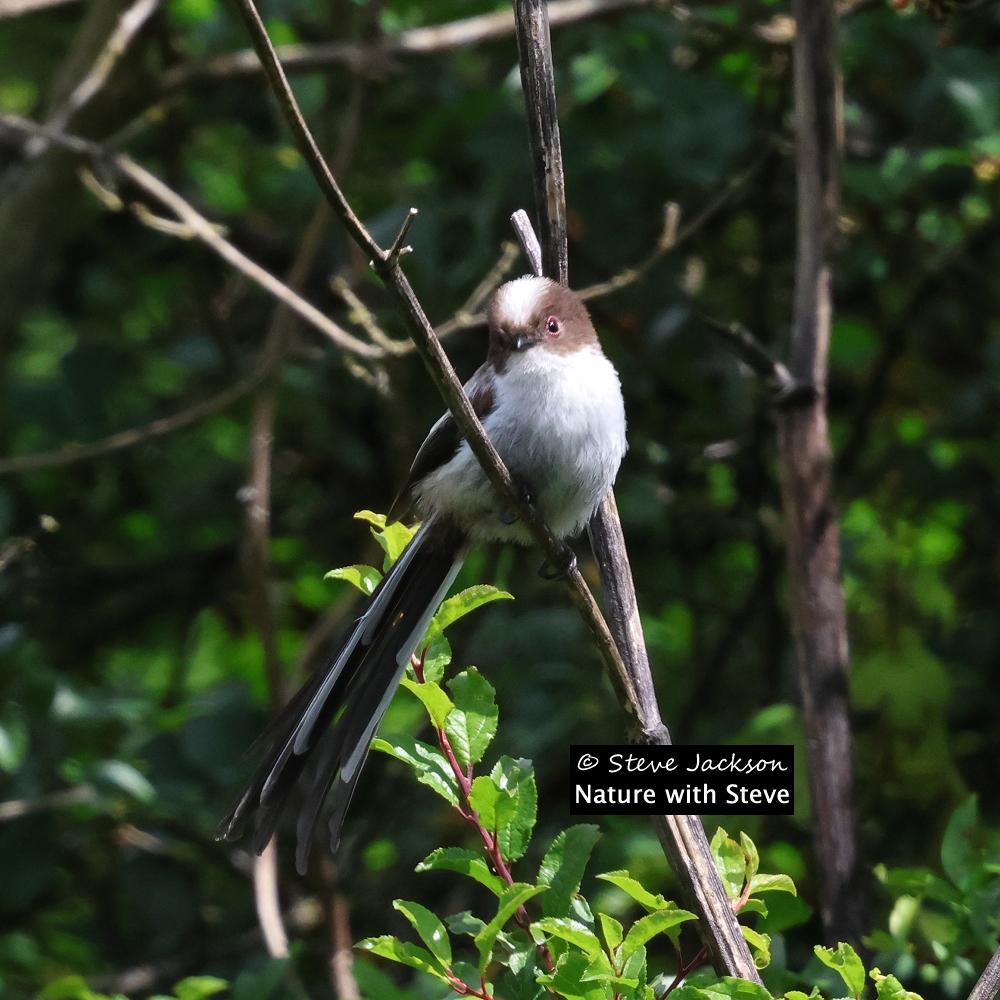
A juvenile Long-tailed Tit, at Upton Warren last month. The youngster already has the trademark long tail; in time the broad band of brown plumage on each side of the face will become a narrower, black stripe running above the eye, and the pink rim around the eye will become less noticeable. In addition, pinkish hues will develop on the parts of the back and belly.

Photo of a juvenile Long-tailed Tit (Aegithalos caudatus), perched on a leafless twig with their body facing towards the right of the picture but their head turned and facing towards us. Appropriately named, this bird has a tail (with feathers which are mostly black, with some that are white) which is longer than the head and body combined. The top of the bird’s head (from above the small, black beak to the crown and beyond) is white while each aide of the face is brown; the dark eyes each have a pink rim. The throat, chest and belly are white, the one wing that we can see has black and white feathers, the back is not visible. The feet are black. A mixture of twigs and foliage can be seen around and behind the bird.
Nature with SteveNatureWithSteve
2025-06-15

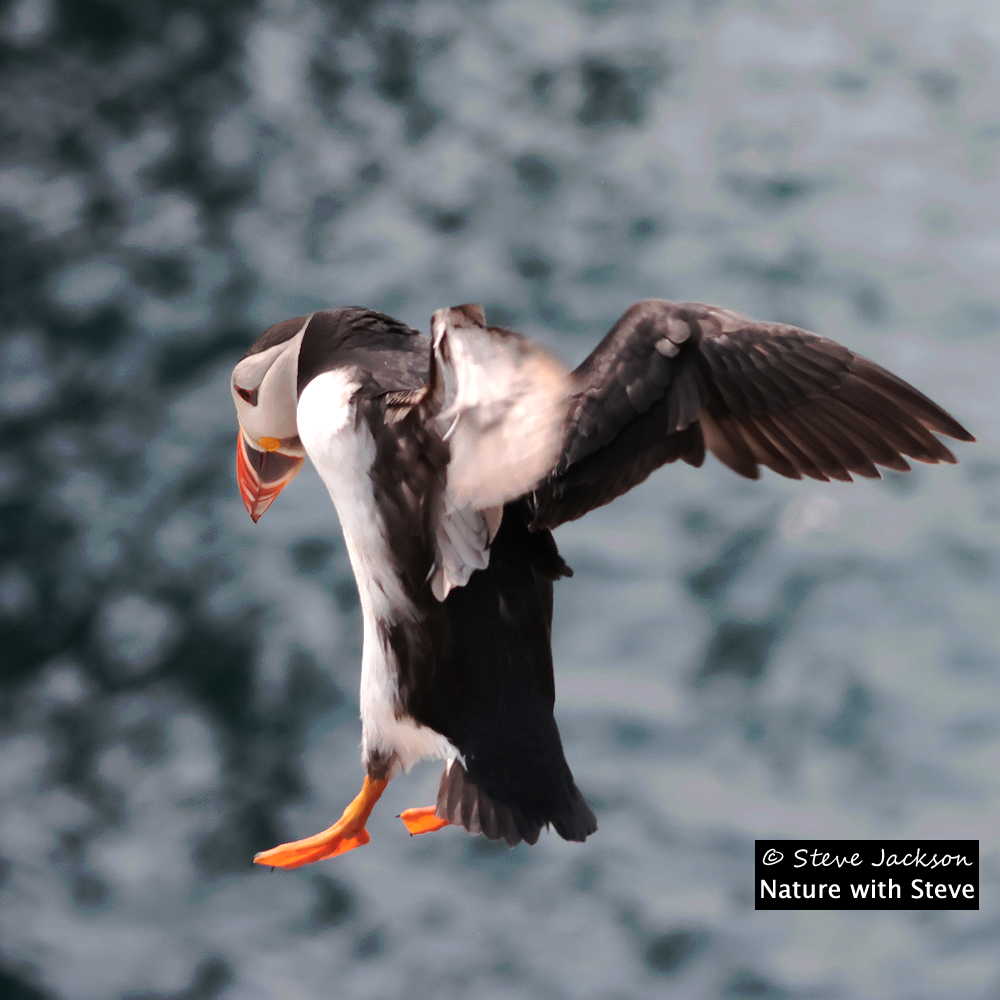
Here’s another Puffin from last Sunday’s Skomer trip. This one is demonstrating how these birds can fly despite having wings that don’t look big enough: jetpacks. Puffin-sized, invisible jetpacks. The secret is out. 😉

Photo of an Atlantic Puffin (Fratercula arctica) in mid air as he or she makes a vertical descent before landing. The bird is facing towards the left of the image and slightly away from us, head looking down, body upright, feet lowered, narrow wings held out behind the body caught in mid flap. The bird is short and stocky but looks more elongated here in vertical pose; the top of the head, the neck, the back, the upper sides of the wings and the tail are black, while the sides of the face, the chest, the belly and the undersides of the wings are white. The beak, which is much taller than it is broad and triangular in shape, is blue near the base and red towards the pointed tip, with yellowish lines around the blue part and within the red part. The short legs and the webbed feet are orange. He or she might not actually be wearing an invisible jetpack, but it would explain a lot if they were.
Nature with SteveNatureWithSteve
2025-06-14

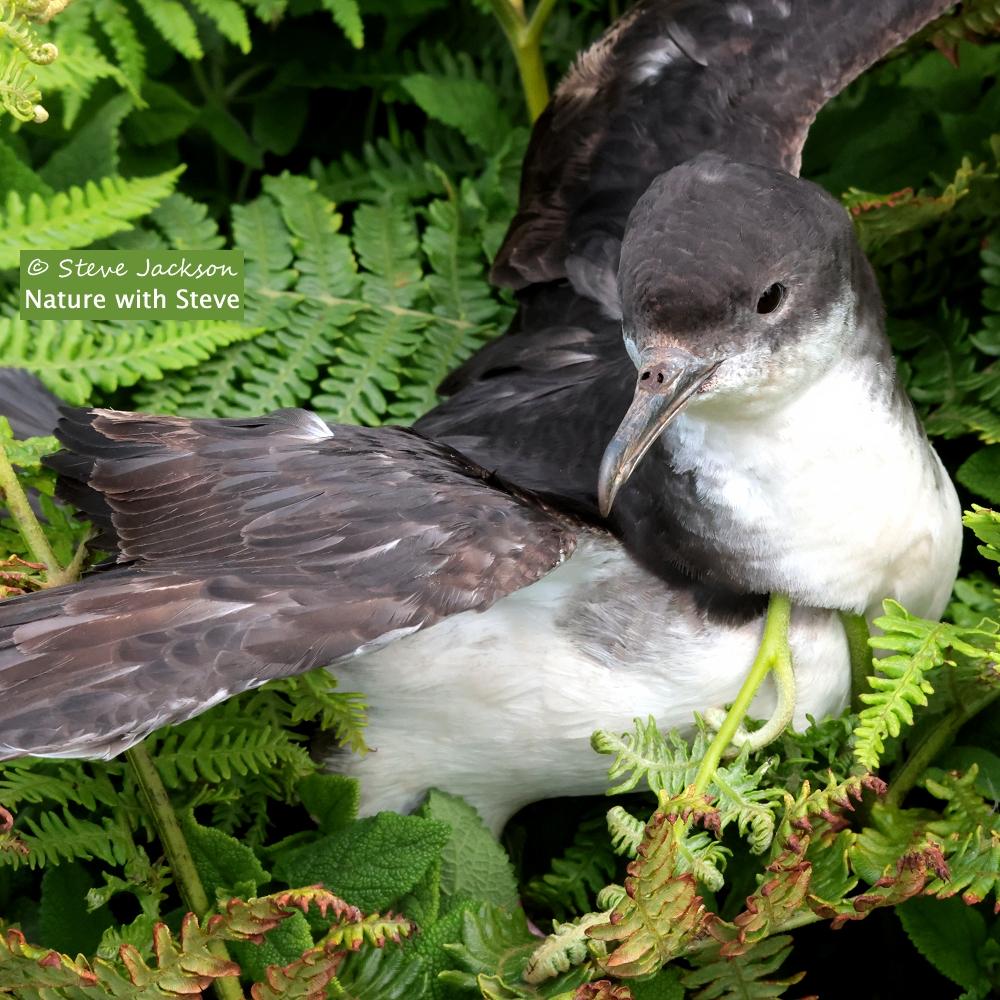
A grounded Manx Shearwater who either misjudged their landing, or tried returning to their burrow on Skomer Island (to feed their young) during daylight hours and was attacked by Gulls. My brother Rob and I took photos, marked the spot, and reported the bird to the island’s volunteer staff.

Photo of a Manx Shearwater, a Gull-like seabird, at rest amongst some Bracken. The upper parts of the bird, including most of the head and the back of the neck, are dark grey with hints of brown in the wing feather. The underparts, including the throat, the lower parts of the cheeks, and the front of the neck, are whitish. The bird's body is facing towards the right of the image, and the wings are outstretched (so we can't see their full length); the head is turned to the bird's right and looking slightly towards the left. The bill is of medium length, straight, and with a hooked tip. The legs and feet are hidden in Bracken.
Nature with SteveNatureWithSteve
2025-06-12
A Eurasian Wren (Troglodytes troglodytes) sat on the edge of a roof, near the apex, facing towards the right side of the picture with the feathers on his ‘shoulder’ being ruffled by the wind. One of Britain’s smallest birds, the Wren has a pale brown face, throat, chest and belly, the rest of the body being a darker brown, with darker mottling above and below. The tail is very short, and the beak of medium length.
Nature with SteveNatureWithSteve
2025-06-12

The look of love. 🥰 A pair of Puffins on Skomer Island gazing into each other's eyes.*

* Or engaged in a staring contest and waiting to see who will blink first. 😉

Photo of two Atlantic Puffins (Fratercula arctica) standing on a ledge, looking at each other. The Puffin on the left has their back to us, and their head turned to the right. The Puffin on the right is standing with their right side towards us, and their head turned so that we see their full face. The birds have black backs, wings, tails and necks, with the tops of their heads also black while the sides of their faces are white. Their eyes are black with orange rims, and their legs and webbed feet are orange. Their colourful beaks are narrow when seen from the front, triangular in shape seen from the side. The base of the beak has a large patch of blue-grey enclosed within a pale yellow border, while the rest of the beak is red with a couple of pale yellow stripes.
Nature with SteveNatureWithSteve
2025-06-11

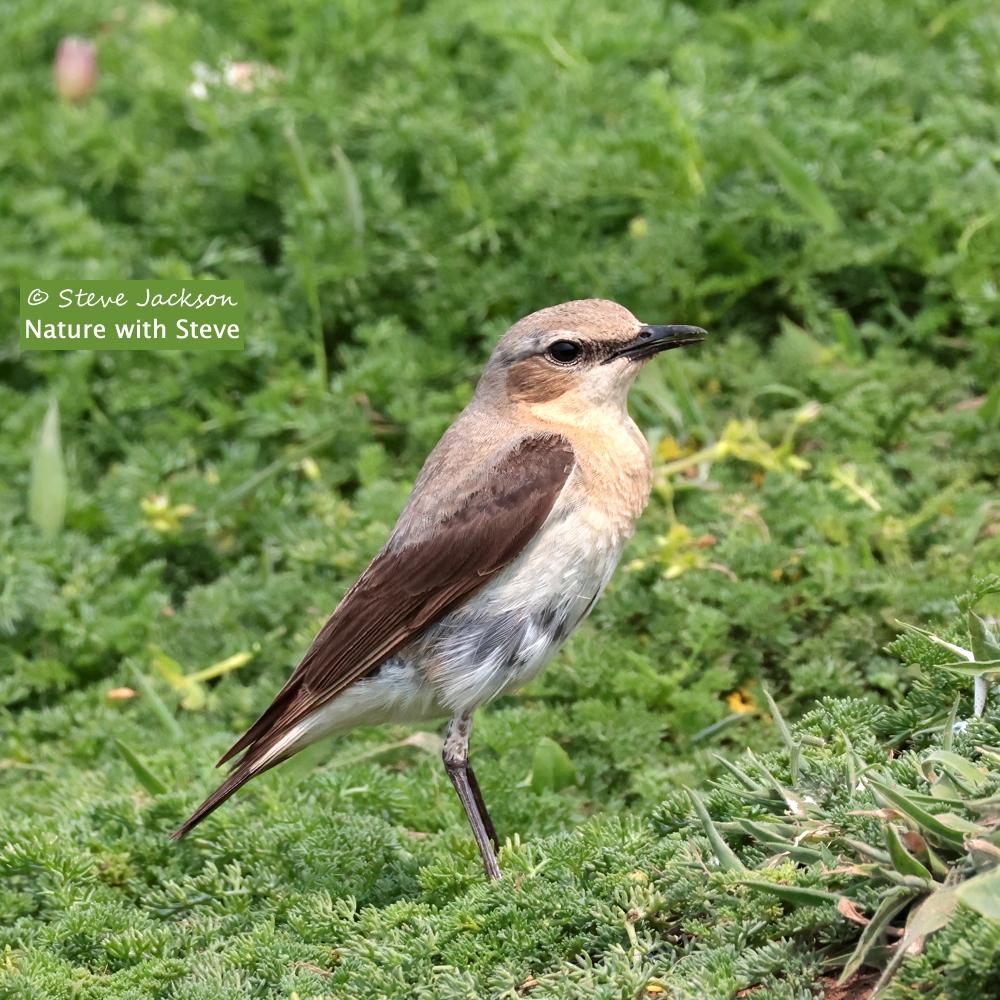
Hopping about amongst the Puffins at The Wick on Skomer Island on Sunday was another bird: a female Northern Wheatear (Oenanthe oenanthe). The name we use for this white-rumped Summer visitor is derived from the Old English words for ‘white’ and ‘arse’!

Nature

Photo of a female Northern Wheatear, a species of songbird, standing in a fairly erect posture in an area of low vegetation (mainly Mayweed which is not yet in flower). The bird is facing towards the right. Her beak and her eye are black, with a thick, blackish stripe running between them and extending, in a thinner line, for a short distance behind the eye. The top of her head, and her back, are a pale brownish-grey, and the wing feathers are a dark brownish-black. Her cheek is brown, her throat whitish, her chest light brown, and her belly white. Her legs are dark grey (as are her feet, but in this image they are hidden in the vegetation).
Nature with SteveNatureWithSteve
2025-06-09

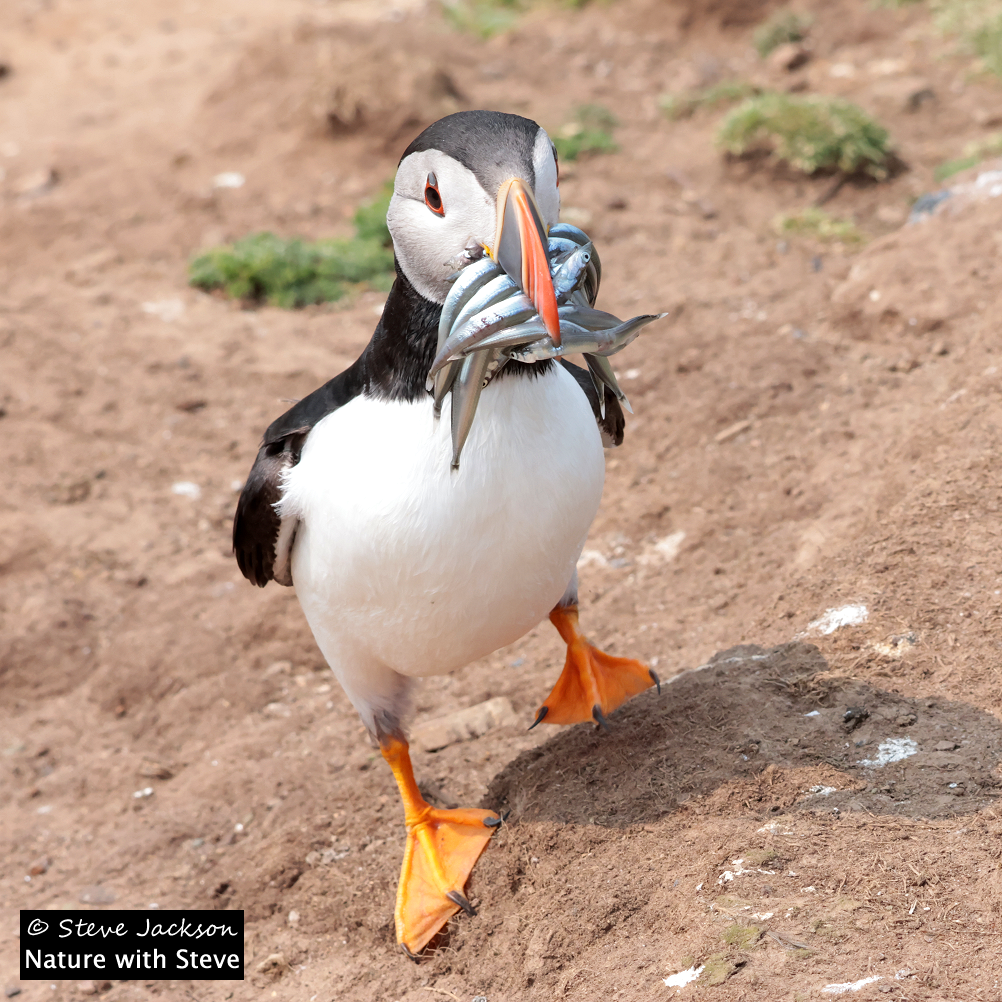
After my visit to Skomer Island yesterday with my brother @rob_camera I may have just one or two photos to share with you. In the same way that this Puffin may have just one or two Sand Eels for the hungry young Puffling waiting in a nearby burrow... 😉 😃

A Puffin (Fratercula arctica), with around a dozen Sand Eels in his or her beak. The bird is short and stocky; the top of the head, the neck, the back, the wings and the tail are black, while the sides of the face, the chest and the belly are white. The beak, which is much taller than it is broad, is blue near the base and red towards the pointed tip, with yellowish lines around the blue part and within the red part. The short legs and the webbed feet are orange. The bird is walking towards us and slightly to our right, across sandy soil on which there are a few small patches of green leaves, and quite a few small whitish patches – Puffin poop!
Nature with SteveNatureWithSteve
2025-06-06

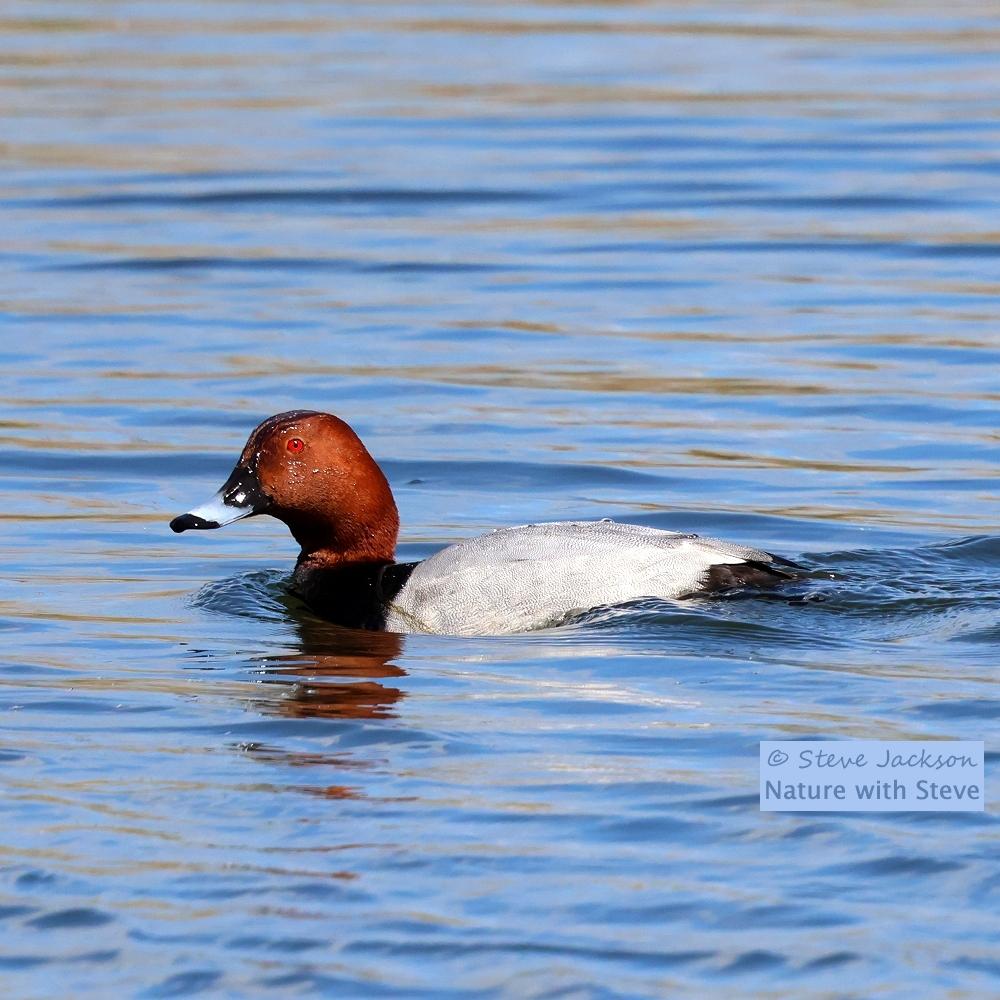
He’s got his (red) eye on me! A male Common Pochard (Aythya ferina), at RSPB Ham Wall last month. Fewer than a thousand pairs of these omnivorous diving ducks breed in the UK, but the wintering population can be as high as 30,000 birds.

Photo of a male Pochard, swimming fast towards the left of the image. His beak is pale blue with a black tip and base (or is it black with a pale blue middle?), his head is a dark orange colour, his eye is red with a black pupil, and his body is black at the front and rear, with grey-coloured flanks, wings and back in between.
🌲🧿 "Max"t💽d🏵️n 🔎🍄MaxPow3r11@mastodon.online
2025-06-05
Nature with SteveNatureWithSteve
2025-06-05

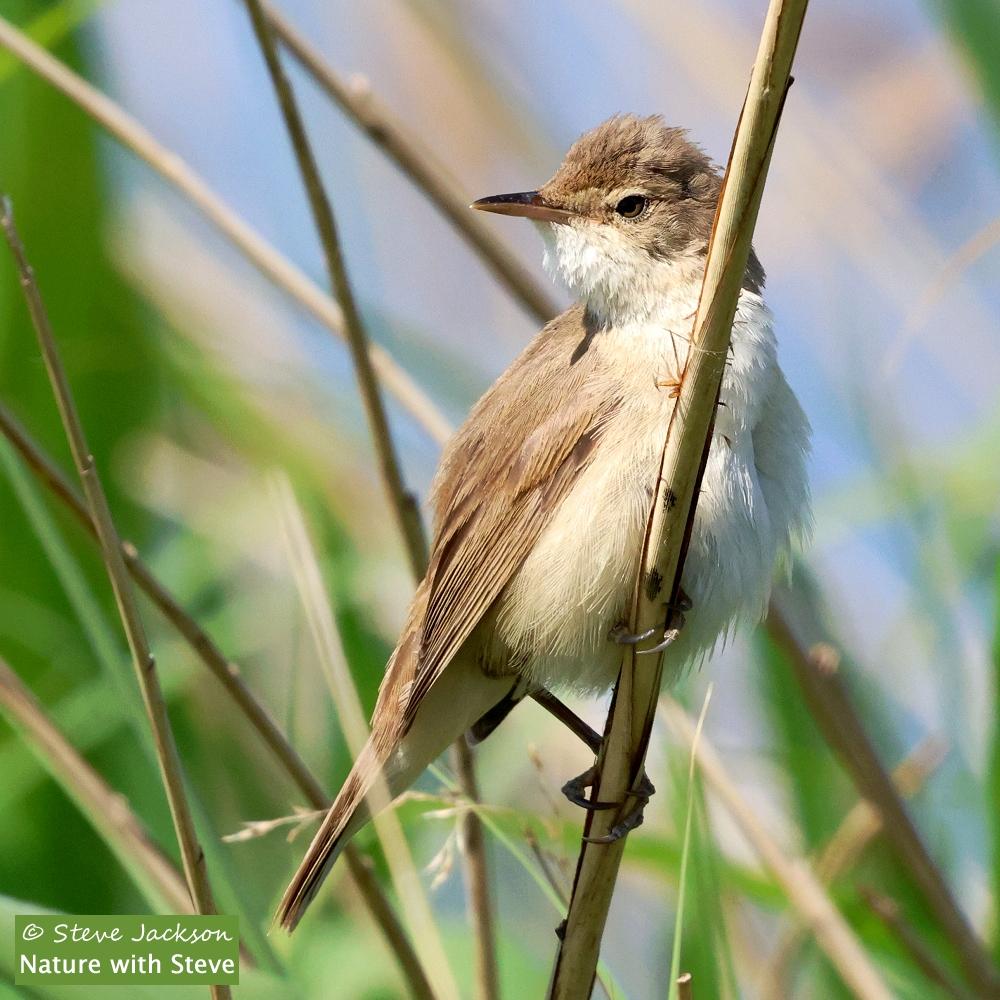
A Eurasian Reed Warbler (Acrocephalus scirpaceus) at RSPB Middleton Lakes last month, near to where I watched a singing Sedge earlier the same day. Both birds, uncharacteristically, perched where I could photograph them, although this one did keep his head behind that reed stem most of the time!

Photo of a Reed Warbler perched on a brown reed stem, with more stems and green leaves in the background. The bird is perched on the other side of the stem, with his body towards the right of the image but his head turned to the left (so that only a part of the back of his head is hidden by the stem). His head is brown, except for the throat and the front of the neck which are whitish. That whitish colour continues down the chest, the belly and the underside of the tail, with the flanks shaded with a very pale brown or buff. The upperparts of the bird's body - the 'shoulders', back, wings and the top of the tail, are brown. The eye is brown with a black pupil; the beak too is brown, the upper part being darker than the lower part. The legs and feet, mostly hidden or in shadow, are dark in colour.
Nature with SteveNatureWithSteve
2025-06-04

A male at RSPB Ham Wall at the beginning of May. A stunning bird, but the environmental impact of releasing tens of millions of Pheasants each year for shooting really needs to be addressed (not to mention the ethical issues around using living creatures for recreational target practice). Love Pheasants, loathe killing for ‘sport’.

A ‘head and shoulders’ photo of a male Common Pheasant (Phasianus colchicus), who is looking towards the left side of the image. The plumage on his head and neck is mostly bluish-green, but the side of the face is dominated by a large red patch of wattling which surrounds the yellow eye and hangs down the cheek. There is a partial white 'collar' separating the head and neck from the body below, where the feathers are brown and flecked with black, with a purple sheen. The beak, which has a hooked tip, is whitish in colour.
Nature with SteveNatureWithSteve
2025-06-02

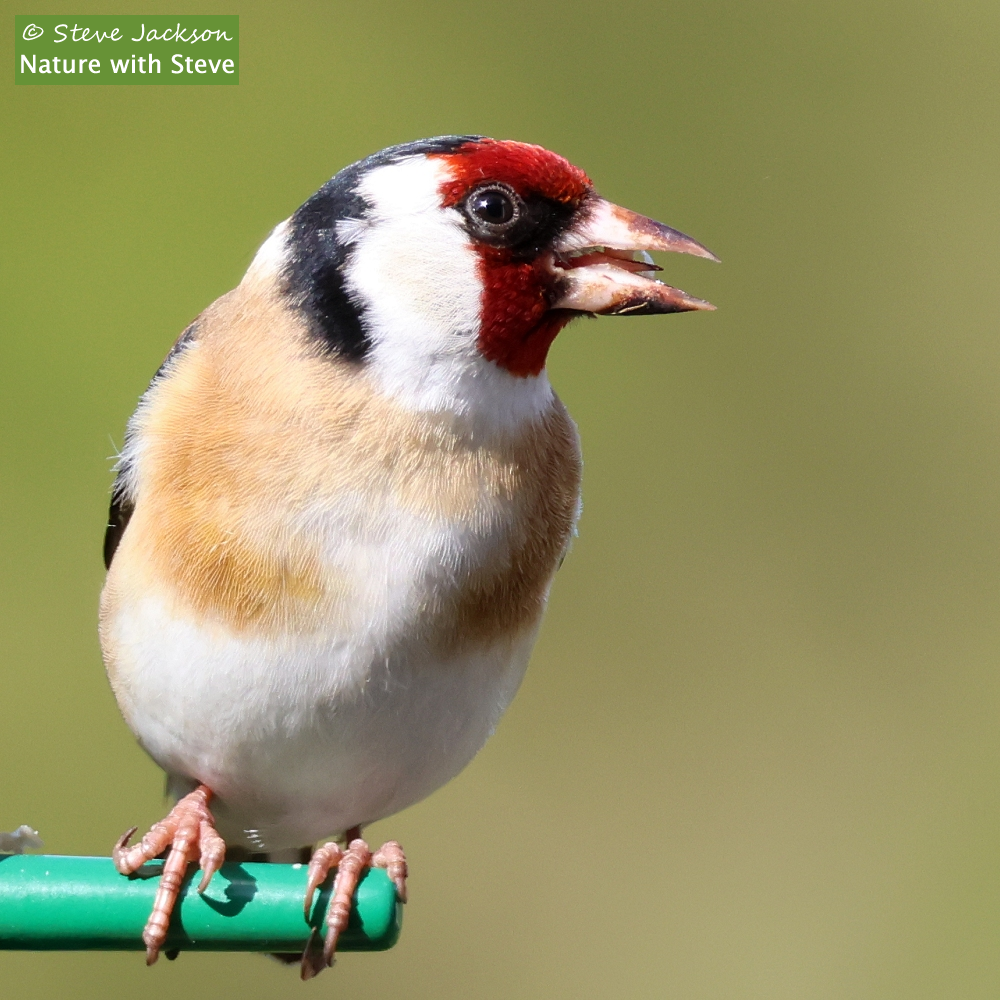
A European sucks seeds at the bird feeder. Sorry, what? Ah, my mistake. That should read: A European succeeds at the bird feeder. 😉

Photo taken from the window of a holiday cottage the Peak District, where I stayed in April 2024. (The feeder was in the garden of the cottage next door, but perfectly placed for me to enjoy the who visited it.)

Photo of a European Goldfinch (Carduelis carduelis) on the green plastic perch of a bird feeder (with the feeder itself out of shot). The bird’s body is facing towards us (so we can see the chest and belly but only hints of one of the wings and the tail and nothing of the back) but the head is facing towards the right side of the image; the beak is partly open, with a pointed tongue visible. The head is white, with red extending from the base of the upper part of the beak to the front part of the top of the head, and from the base of the lower part of the beak to the throat; black between the two areas of red, enclosing the eye; and more black extending from the top of the head (where it joins with the red) down the back of the head almost to the white nape of the neck, then extending down both sides of the head behind the white cheeks, to the neck. The chest is a pale golden brown colour, and the belly is white. What little we can see of the left wing is black (the yellow bar giving this species its name is hidden from view), and the glimpses of the underside of the tail suggest that this is whitish with black around the edges. The legs and feet are pink, with darker claws. The beak of the Goldfinch is somewhat longer than those of other finches, and with a sharper, more pointed tip - and adaptation for seed extraction. The beak is pinkish towards the base, and brownish towards the tip.
Nature with SteveNatureWithSteve
2025-06-01

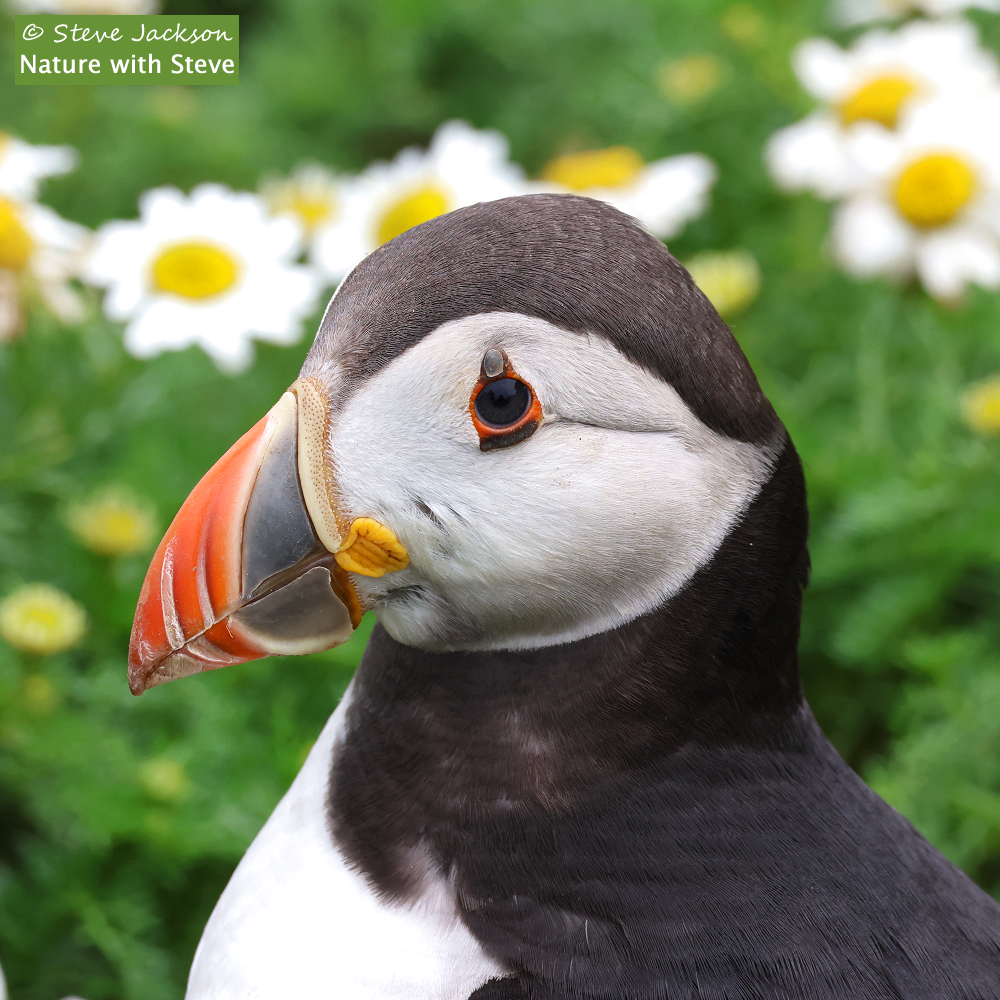
Really looking forward to being back amongst the Puffins (and all the other birds) on Skomer Island with my brother @rob.camera next weekend! 😍

A ‘head and shoulders’ photo of a North Atlantic Puffin, facing towards the left of the image. The side of the Puffin’s head is white, while the top and back of the head, the neck, and the back, are black; the chest is white. The eye is dark in colour, with an orange rim. The large, colourful beak is almost triangular in shape (seen from the side); at its base a large patch of grey-blue enclosed by a thick, pale yellow border; the rest of the beak is red with a couple of thin yellowish stripes. In the background, out of focus, are Mayweed flowers; they are like large Daisies, having white petals and yellow centres.
Nature with SteveNatureWithSteve
2025-05-31

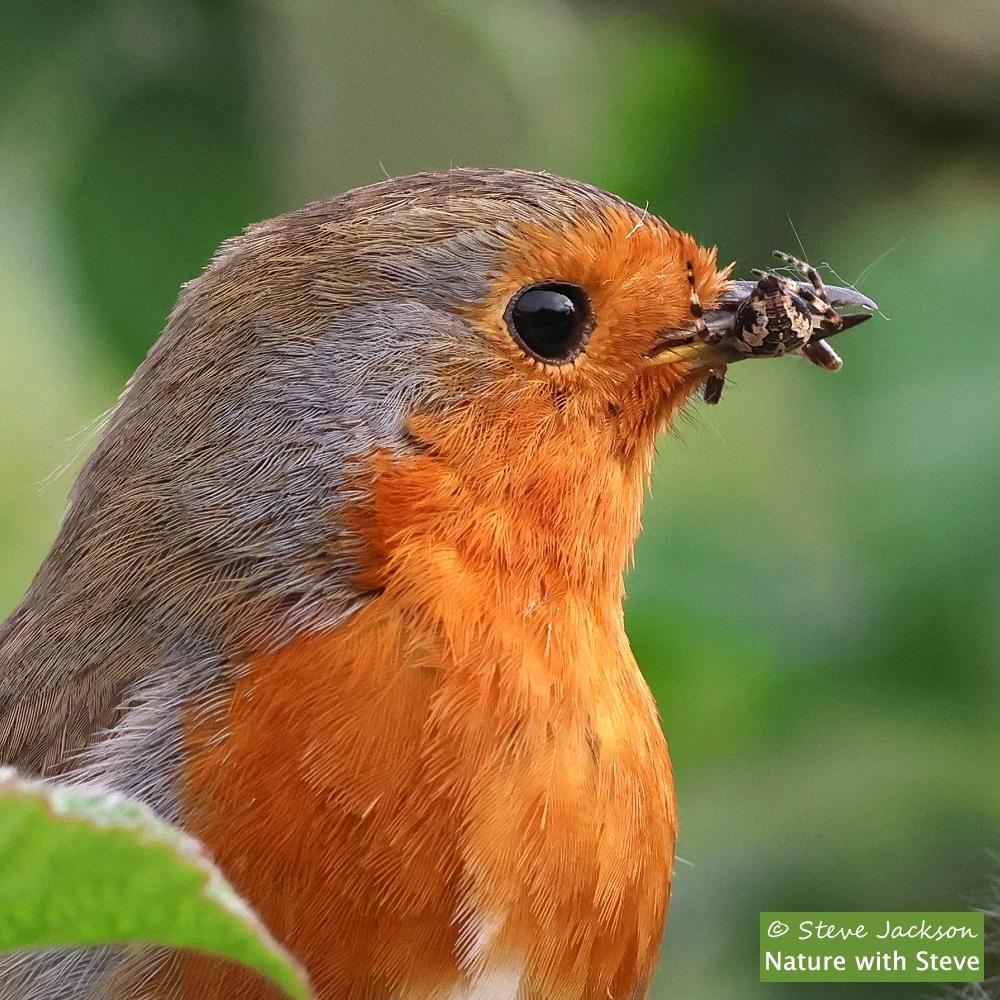
“Spider for tea?” I said “No, not for me!”
So the Robin with barely a frown,
Quickly did eat its eight-legged treat,
Which must have tickled on the way down.

European with Garden prey, at RSPB Ham Wall, , at the beginning of this month.

Close-up ‘head and shoulders’ photo of a European Robin (Erithacus rubecula) holding a Garden Spider (Araneus diadematus) in his or her beak. The Robin, facing towards the right side of the image, has an orangey-red face, throat and chest. The top and back of the head and the back are brown. Between those two colours, from behind the eye and downward, is a band of grey, variable in thickness. The Spider is held upside down and with the head facing away from us, so that we see the top of the abdomen (patterned with dark and pale brown markings) and some of the legs.
Nature with SteveNatureWithSteve
2025-05-26

Yesterday my brother @rob_camera and I paid our first visit Upton Warren nature reserve in – here are a few of the I saw and photographed. Our day ended with sightings of another bird, spotted by others in the Avocet Hide, and identified by me - more about that (plus some rubbish pics!) in my reply to this post.

Four photos of birds combined in one image. Clockwise from top left: A male Bullfinch (black head, grey back and upper wings, black lower wings and tail, pinkish red neck, chest and belly). A juvenile Pied Wagtail (a small bird, with black, white and grey plumage above and white below, with a long tail). A Juvenile Long-tailed Tit (another bird with a long tail; this one has a mostly brown head with pink rims to his or eyes, and whitish underparts). A Little Ringed Plover (a small, fast-moving bird on gravelly ground on the shore of a lake; mostly brown above and white below but with a black collar, and a black band running from the cheek across the forehead, within which a dark eye with a prominent yellow rim can be seen).
Nature with SteveNatureWithSteve
2025-05-24

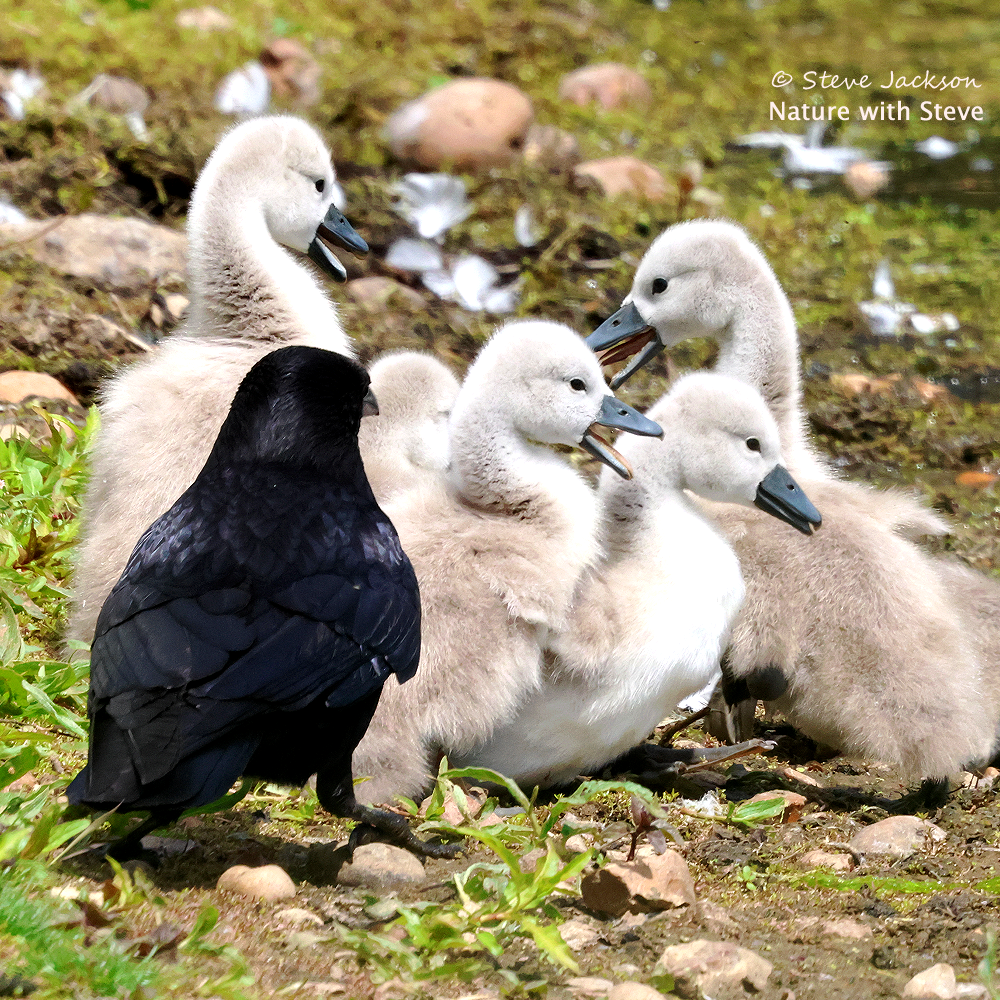
Who’s afraid of the Big Bad . . . Crow? These Cygnets were not happy, that’s for sure. Neither was their Mum, just out of picture, who soon sent the Corvid packing! Photographed at Brandon Marsh, near Coventry, yesterday.

A photo of six Mute Swan cygnets, huddled together for safety, three with their beaks open (and tongues showing) as they call in alarm – a Carrion Crow is making a close approach on the ground beside them even though both predator and would-be prey are around the same size. The cygnets are covered with fuzzy down, whitish in places and brownish in others; their beaks are grey. As the Crow is approaching them from our side of the picture we see his or her back; the plumage is black, with some hints of bluish-grey on the ‘shoulders’ and the back of the head.
Nature with SteveNatureWithSteve
2025-05-21

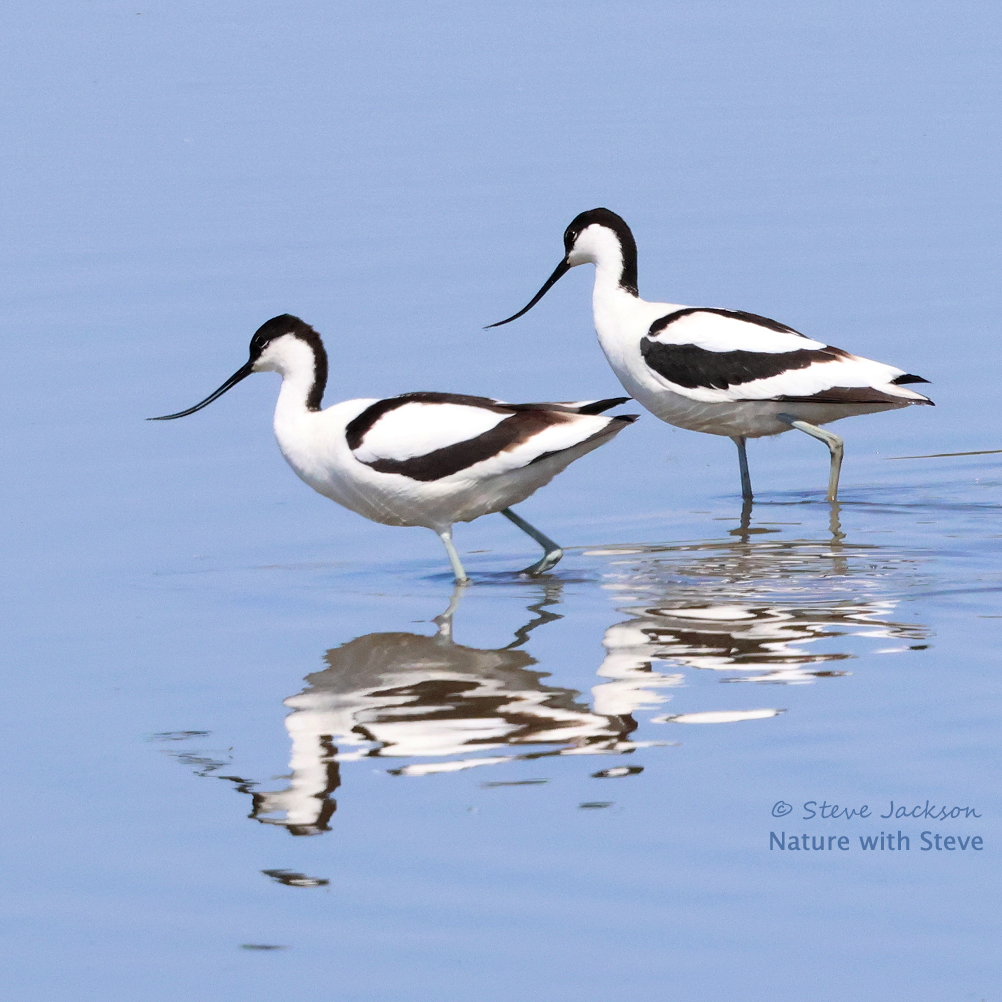
Avocets again? Why not. I'm collecting ’em – I'll soon ’ave a set...

(Photographed yesterday at RSPB Middleton Lakes.)

Photo of two Avocets (Recurvirostra avosetta). The Avocet is a wading bird with long legs, a long bill, and a slightly elongated neck. The bird’s plumage is mostly white, but the top part of the head, and the back of the neck, is black; there are also black markings around the borders of the wings and the tail. The beak too is black, and not only is it elongated, it turns upwards towards the end. The long legs, partly under water in this image, are a pale blue colour. Both birds are facing towards the left of the image so that we see their left sides, broken reflections of which can be seen in the blue water.

Client Info

Server: https://mastodon.social
Version: 2025.07
Repository: https://github.com/cyevgeniy/lmst