#scab

2026-02-14

Today in Labor History February 14, 1949: Canadian asbestos workers began a six-month strike. It also marked the beginning of the Quiet Revolution, a period of intense socio-political change in Quebec. The strike began at midnight on February 14, when miners walked off the job at four asbestos mines. Most of the mines were owned by American or English-Canadian companies, but most of the workers were francophones. The largest company was the American Johns-Manville firm. The workers’ demands included the elimination of asbestos dust inside and outside of the mill and a small raise. Six weeks into the strike, Johns-Manville hired scabs to keep the mines open. 5,000 strikers attacked the scabs, destroying their property and intimidating them through force. Miners and police fought on the picket line. They arrested hundreds of miners. On March 14, someone blew up a part of a railroad track leading into the Johns-Manville property. On May 5, the strikers barricaded a mine and every road into and out of town. They only backed down when the police pledged to open fire on them. The next day, the police beat miners and began mass-arresting them. This intimidated the union leadership to the point that they gave in and agreed to return to work with few gains.

#workingclass #LaborHistory #PoliceBrutality #strike #scab #asbestos #quebec #mining

Striking asbestos workers in the street, with signs in French and in English.
2026-01-25

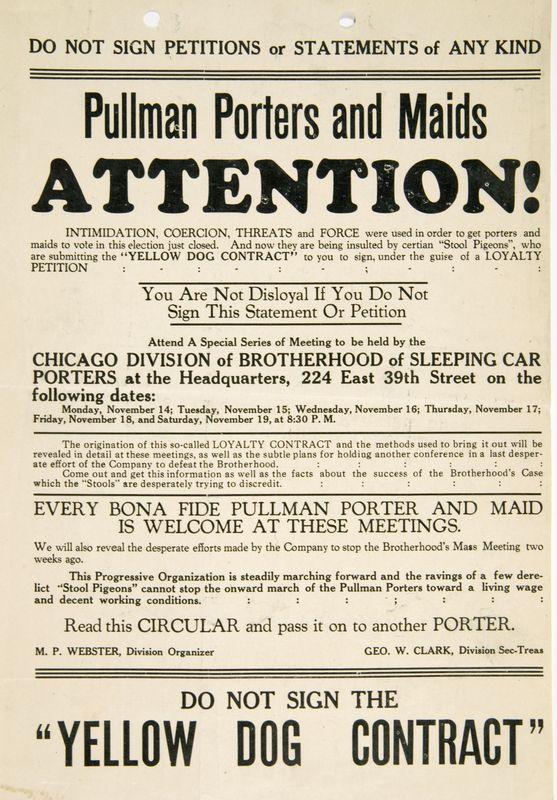
Today in Labor History January 25, 1915: The Supreme Court upheld "yellow dog" contracts, which forbid membership in labor unions. The United Mine Workers Journal wrote, in 1921: “This agreement has been well named… It reduces to the level of a yellow dog any man that signs it, for he signs away every right he possesses under the Constitution and laws of the land and makes himself the truckling, helpless slave of the employer.” Yellow dog contracts remained valid until the Norris-LaGuardia Act of 1932.

#workingclass #LaborHistory #union #unionbusting #scab #mining

Poster warning Pullman Porters not to sign Yellowdog Contracts.
2026-01-23

Today in Labor History January 23, 1913: Joe Hill's song "Mr. Block" first appeared in the Wobbly (IWW) newspaper the "Industrial Worker."

Mr. Block (by Joe Hill)
1. Please give me your attention, I'll introduce to you
A man who is a credit to the old Red White and Blue
His head is made of lumber and solid as a rock
He is a common worker and his name is Mr. Block
And Block thinks he may be President some day

Chorus
Oh Mr. Block, you were born by mistake
You take the cake, you make me ache
[Go] tie a rock on your block and then jump in the lake
Kindly do that for Liberty's sake!

2. Yes, Mr. Block is lucky - he got a job, by gee!
The shark got seven dollars for job and fare and fee
They shipped him to a desert and dumped him with his truck
But when he tried to find his job he sure was out of luck
He shouted, "That's too raw! I'll fix them with the law!"

3. Block hiked back to the city but wasn't doing well
He said "I'll join the union, the great AF of L".
He got a job that morning, got fired by the night
He said, "I'll see Sam Gompers and he'll fix that foreman right!"
Sam Gompers said, "You see, you've got our sympathy."

4. Election day he shouted, "A Socialist for Mayor!"
The comrade got elected [and] he happy was for fair
But after the election he got an awful shock
[When] a great big socialistic bull did rap him on the block
And Comrade Block did sob, "I helped him get his job!"

5. Poor Block he died one evening, I'm very glad to state
He climbed the golden ladder up to the pearly gate
He said, "Oh Mister Peter, one thing I'd like to tell
I'd like to meet the Astorbilts and John D Rockerfell!"
Old Pete said, "Is that so? You'll meet them down below!"

youtube.com/watch?v=-wqEhj73urg

#workingclass #LaborHistory #IWW #joehill #mrblock #scab

Liam O'Mara IV, PhDLiamOMaraIV
2026-01-14

600 striking dockers at in Australia on in 1929 rushed the steamship Mareeba, which was tended by workers. joined with the scabs to fight the union men. A scab shot his revolver into the crowd and was, of course, not arrested.

2026-01-12

Today in Labor History January 12, 1876: Working class novelist Jack London was born. As a kid, he was an oyster pirate in Oakland, along the shores of the San Francisco Bay. As a young man, he became a hobo, riding the rails from town to town, looking for handouts and sometimes work. He wrote about these experiences in his short novel, “The Road.” He was also a lifelong alcoholic, which contributed to his early death. In his novel, “John Barleycorn,” he wrote about both his alcoholism and his experiences as a laborer in numerous low-paid, backbreaking jobs. He was also a socialist and a champion of unions and working-class activism. With respect to strikebreakers, he famously wrote: "After God had finished the rattlesnake, the toad, the vampire, He had some awful substance left with which He made a scab. A scab is a two-legged animal with a cork-screw soul, a water-logged brain, a combination backbone of jelly and glue. Where others have hearts, he carries a tumor of rotten principles." London was also one of the first Haoles (non-Native Hawaiian, or white person) to learn how to surf in Hawaii.

#workingclass #LaborHistory #jacklondon #fiction #union #scab #socialism #hawaii #surfing #novel #alcoholism #oakland #pirate #books #author #writer @bookstadon

Very grainy image of Jack London surfing, Waikiki, 1907, next to three men in an outrigger.
2026-01-05

Today in Labor History January 5, 1869: Isaac Meyers and Frederick Douglass organized the First U.S. National Colored Convention. At the convention, they created the Colored National Labor Union. At the time, white unions routinely refused to accept African American members or to show solidarity with black workers. Additionally, employers often hired black scabs during strikes by white unions, while the KKK often recruited within white unions, exacerbating mistrust. Over time, the union became more and more political (much like most modern unions), until it became a de facto branch of the Republican Party (which in those days was known as the party of abolition).

#workingclass #LaborHistory #union #frederickdouglass #racism #kkk #Abolition #republican #solidarity #strike #scab

February 6, 1869 Illustration from Harper's Weekly of the Colored National Labor Union convention in Washington, D.C. Store Web page states: "from Harper's Weekly magazine with 6 x 9 [inch] wood-engraved illustration of the The National Colored Convention in Session at Washington, D.C." Public Domain. https://commons.wikimedia.org/wiki/File:NationalColoredUnionConventionHarpersWeekly1869.jpg

"Time is measured with a stopwatch in our hands. It’s a labour camp, not a modern factory" - Polish lighting company using private militia, 12 hours a day temp workers, and assault to break #strike

internationalviewpoint.org/spi

#Poland #scab #strikes #union #unions #Valeo #Chrzanow #Trzebinia #Myslowice #France #Solidarnosc #August80 #Romania #RaceToTheBottom #SUDIndustrie #CGTVleo #FOValeo #Paris #capitalism #UnionBusting #exploitation #ClassWar

Ars Technica Newsarstechnica@c.im
2025-11-14

Scientist pleaded guilty to smuggling Fusarium graminearum into US. But what is it? arstechni.ca/KEx5 #fusariumgraminearum #syndication #Science #fungus #crops #wheat #scab

2025-11-14

No Starbucks during the strike! Make a donation or buy merch in support, at this link.
#Starbucks #union #busting #fair #pay #health #care #sick #time #barista #coffee #shop #donate #support #striking #workers #strike #not #scab sbworkersunited.org/

2025-11-01

Today in Labor History November 1, 1919: Over 400,000 miners across the country went on strike. The strike took place in the wake of World War I, and the ongoing Red Scare, in which the authorities were rounding up, imprisoning and deporting thousands of suspected communists, anarchists and radicals. There was also a major steel strike already under way. The mine owners accused the miners of Bolshevism and claimed they were being funded by Lenin and Trotsky. Ultimately, the strike succeeded in winning wage gains for hundreds of thousands of unionized miners. However, conditions for nonunion miners continued to deteriorate, leading to another strike, the following year, in West Virginia. In this strike, the mine owners used private cops to terrorize and murder striking miners, leading to the Matewan Massacre (1920), and the Battle of Blair Mountain (1921), the largest armed insurrection since the Civil War, and the largest labor uprising in U.S. history. Miners also struck in July, 1919, to protest the imprisonment of IWW labor activist Tom Mooney, wrongly convicted for the San Francisco Preparedness Day Parade bombing, and for higher wages to keep up with the post-war inflation. This time, their own union opposed the strike, leading to wild cat actions across the country. Insurgent miners took over the United Mine Workers (UMW) convention in Cleveland, even though union officials tried to exclude rebellious locals. The UMW was so concerned with suppressing wildcat strikes and dissension among their ranks that they even supplied scabs to help mine owners put down the wildcat strikes.

Read my article about about the Matewan Massacre and the Battle of Blair Mountain here: michaeldunnauthor.com/2024/04/

Read my article about Tom Mooney here: michaeldunnauthor.com/2024/05/

#workingclass #LaborHistory #mining #coal #union #strike #umw #matewan #massacre #communism #anarchism #prison #deportation #redscare #scab

Cartoon showing a miner, holding a pick, being tugged in two different directions, with 1 hand labeled “order to strike” tugging from one side, and on the other, a hand labeled “court injunction.” By Omaha daily bee - Omaha daily bee., November 02, 1919, Public Domain, https://commons.wikimedia.org/w/index.php?curid=83599638
2025-10-11

Don’t be a #scab. #rubygems needs maintainers and on call support due to @rubycentral’s own actions. Stepping in now is no different than crossing a picket line. Just don’t do it

#ruby #rails #rubycentral

California Politics HuddleCA_Politics_Huddle
2025-09-30

CPH Daily Bulletin 9/29/2025

LMFAO... Sen. Cassidy (R-LA): Stanford Hit Student Over Trans Union Dues

newsmax.com/us/bill-cassidy-st

2025-07-28

Today in Labor History July 28, 1917: The Silent Parade took place in New York City, in protest against murders, lynchings, and other violence directed towards African Americans. Organizers set up the parade to protest the East Saint Louis race riots (May-July 1917), when whites murdered up to 200 African Americans, and caused 6,000 black residents to become homeless. While Woodrow Wilson was entering World War I to “make the world safe for democracy,” black Americans were asking when he’d do the same for them.

The Silent March was organized by a coalition of groups, led by the new NAACP. Up to 15,000 participated. Organizers wanted president Wilson to enact anti-lynching legislation. He refused. Wilson appointed numerous racists to his cabinet and was an outspoken defender of segregation on “scientific” grounds. He was also fond of telling racist jokes. As an academic, prior to his political career, he was an apologist for slavery. And he used his authority to actively prevent admitting African Americans into Princeton as students or faculty. Ironically, one of the primary organizers of the Silent March, W.E.B. DuBois, had been an enthusiastic supporter of the Woodrow Wilson presidential candidacy, calling him a “liberal Southerner,” who would deal fairly with Negros.

The East Saint Louis racist pogrom occurred during one of the largest migrations of black workers from the South to the North. Between 1910 and 1920, half a million African Americans migrated north to Chicago, Saint Louis, Detroit, Philadelphia, and other cities. In 1919, there were 38 different racist riots in the U.S., all directed against the black community. The massacre in East Saint Louis began in response to a strike by white employees of the Aluminum Ore Company, after the bosses hired black replacement workers, a common practice of the bosses to divide the working class and weaken unions. Additionally, many of the unions were overtly racist and excluded black workers, including the Aluminum Ore union. To make matters worse, employment agents were going to the South and recruiting African Americans under false pretenses, offering them stable jobs and housing when, in reality, they were being recruited to work as scabs. So, it is likely that many, if not most, of the workers didn’t even know they were being hired as scabs. Regardless, they wouldn’t have been allowed to join the union, either.

Racism by unions and white workers was not inevitable in those days, and it was certainly counterproductive to the aims of working people of all backgrounds and identities. Consider that in 1920, in rural Mingo County, West Virginia, when the coal bosses brought in African American workers as scabs, the UMWA encouraged them to join the union and the strike, and achieved solidarity between white, native-born workers, African Americans from the South, and Italian immigrants. This is portrayed in John Sayles film, Matewan. And by 1916, thanks largely to the superb organizing of Ben Fletcher, all but two of Philadelphia’s docks were controlled by the IWW, uniting a workforce that was 33% Irish, 33% Polish & Lithuanian, and 33% African American. Fletcher also traveled up and down the east coast organizing dockers across race. At that time, roughly 10% of the IWW’s 1 million members were African American.

Read my biography of Fletcher here: michaeldunnauthor.com/2021/05/

#workingclass #LaborHistory #africanamerican #racism #lynching #protest #riots #naacp #union #strike #scab #IWW #benfletcher #webdubois #BlackMastadon
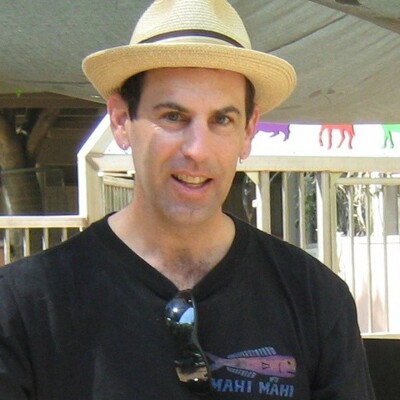
Photograph of Mykael Ash’s painting that depicts the 1917 East Saint Louis Massacre. He used spent shell casings from recent gun violence in his hometown of East Saint Louis.
2025-07-20

Today in Labor History July 20, 1934: Police shot at picketing strikers on Bloody Friday of the Minneapolis General Strike, killing two and wounding 67. The teamsters strike had begun in May. While the teamsters’ national leadership was conservative and opposed to strikes, Local 574, in Minneapolis, was affiliated with the Communist Party, and Local 544 was connected with the Trotskyist Communist League. They began organizing their members for a strike in spite of the national leadership. They effectively shut down nearly all transport in the city, except for food, which they permitted to prevent starvation. The police, and vigilantes working for the bosses, routinely attacked them on the picket line. Consequently, workers in other industries joined them in solidarity, leading to a General Strike. On July 20, as the cops tried escort scabs onto a worksite, picketers with clubs tried to block them. The cops opened fire with shotguns. An eyewitness said he saw a man stepping on his own intestines and another carrying his own severed hand.
youtube.com/watch?v=hr7cTjkAY1

#workingclass #LaborHistory #minneapolis #GeneralStrike #policebrutality #police #acab #communism #policemurder #scab #union #strike #teamsters

Working Class Historyworkingclasshistory
2025-07-05

📣 New Podcast! "5 July 1777: Scab first used in print" on @Spreaker
spreaker.com/episode/5-july-17

2025-07-03

Today in Labor History July 3, 1936: Striking workers battled scabs and undercover cops outside the Remington Rand plant in Norwood, Ohio. The riot last four days, as the company repeatedly tried to bring in scabs on buses, without uniformed police protection, in hopes of provoking violence they could exploit to discredit the union. On July 7, strikers boarded the buses and drove off the scabs. On August 12, police shot 2 Remington Rand workers in Syracuse, NY, provoking the governor to threaten calling in the National Guard. Much of the violence in this strike was instigated by undercover cops, posing as scabs. The strike had begun in May and lasted through April of 1937. During the strike, company president James Rand, Jr. devised the "Mohawk Valley formula" a corporate plan for strikebreaking that was utilized by many corporations since. The plan included strategies for discrediting union leaders, frightening the public with threats of violence, use of local cops and vigilantes to intimidate and bully the strikers, puppet organizations composed of of "loyal employees" to influence public debate, fortified workplaces, the hiring of strikebreakers, and threats to close the plant and ruin the local economy if work was not promptly resumed. One example from this formula was when Rand lied to the media that the strike was over. This led to an uproar amongst the rand and file, who accused union leadership of selling them out. In another dirty trick, the company told the picketers that many of their fellow workers had decided to come back to work. They had 85 security guards dress up as workers and armed them with bricks and clubs. When they “came back to work,” picketers attacked them. The media photographed and printed images of these “labor goons’” unprovoked attack on “honest working men.”

youtu.be/IDdYlHV64rs

#workingclass #LaborHistory #remingtonrand #union #strike #scab #police #policebrutality #nationalguard #syracuse #ohio #Riot #vigilante #propaganda #misinformation #fakenews

2025-06-08

Today in Labor History June 8, 1904: A battle between the Colorado state militia and striking miners occurred in Dunnville, Colorado. As a result, six union members died and 15 were taken prisoner. The authorities deported 79 of the strikers to Kansas. Most of this was done under the auspices of Rockefeller, who effectively owned the state government and militia.

This incident occurred during the Colorado Labor Wars of 1903-1904. Big Bill Haywood and the Western Federation of Labor (WFM) led the strikes. However, they were violently suppressed by Pinkerton and Baldwin-Felts detectives, local cops and militias. Scholars have said “There is no episode in American labor history in which violence was as systematically used by employers as in the Colorado labor war of 1903 and 1904.”
James McParland ran the Pinkerton agency in Denver. He had served as an agent provocateur in the Pennsylvania miners’ union in the 1870s. The state convicted and executed 20 innocent Irish coal miners because of his false testimony. (I depict that story in my novel, “Anywhere But Schuylkill.”) McParland also tried to sabotage the WFM, in Colorado, by placing spies and agents provocateur within the union. And he unsuccessfully tried to get Big Bill Haywood convicted for murdering former Idaho Governor Frank Steunenberg. Haywood was innocent.

You can read more on the Pinkertons here: michaeldunnauthor.com/2024/04/

You can pick up my novel here:
keplers.com/
greenapplebooks.com/
christophersbooks.com/
boundtogether.org//
historiumpress.com/michael-dun

Or send me $25 via Venmo (@Michael-Dunn-565) and your mailing address, and I will send you a signed copy!

#workingclass #LaborHistory #colorado #laborwars #bigbillhaywood #wfm #union #strike #Pinkertons
#scab #solidarity #jamesmcparland #books #novel #historicalfiction #author #writer #AnywhereButSchuylkill @bookstadon

Famous Western Federation of Miners poster entitled "Is Colorado in America?" Shows American flag, with the stripes filled with phrases like: Martial law declared in Colorado; Habeas corpus suspended; Free Press throttled; Free Speech denied; Bull Pens for union men; Union men exiled from homes and families in Colorado; constitutional right to bear arms questioned in colorado. By Western Federation of Miners - Political Posters, Labadie Collection, University of Michigan, Public Domain, https://commons.wikimedia.org/w/index.php?curid=68853818
2025-06-03

Today in Labor History June 3, 1913: IWW Marine Transport Workers Union in New Orleans continued their strike against United Fruit Company (now known as Chiquita) after wages were cut by five dollars per month. The strike, which started on June 2, turned deadly on June 13, when police opened fire on strikers trying to stop scabs from loading a ship, killing two of them. The IWW lost this strike. However, they were highly successful in other longshore strikes up and down the Eastern Seaboard. At this time, the IWW controlled all but 2 of the Philadelphia docks. Their multiracial union was led by Ben Fletcher, an African-American docker. Fletcher was also instrumental in organizing the Baltimore dockers.

You can read my longer article about Ben Fletcher here: michaeldunnauthor.com/2021/05/

#workingclass #LaborHistory #IWW #wobblies #union #strike #racism #neworleans #philadelphia #police #policebrutality #acab #policemurder #scab #antiracism #solidarity #BlackMastadon

Police mug shots of Fletcher

Client Info

Server: https://mastodon.social
Version: 2025.07
Repository: https://github.com/cyevgeniy/lmst