
EUDI-Wallet: Digitale Brieftasche geht in Testphase
https://netzpolitik.org/2026/eudi-wallet-digitale-brieftasche-geht-in-testphase/
Anfang 2027 soll in Deutschland eine staatliche EUDI-Wallet bereitstehen. In einer Testumgebung können Behörden und Unternehmen deren Funktionen nun testen. Parallel dazu läuft ein Pilotprojekt in Sachsen.
#bundesdigitalministerium #dresden #eudi_wallet #karstenwildberger #sachsen #sprind #netzpolitik
Credits: Gemeinfrei-ähnlich freigegeben durch unsplash.com Markus Spiske
#sprind


Deutschlands Bundesagentur für Sprunginnovation (SPRIND) sucht Lösungen zum Schutz kritischer Infrastruktur vor Drohnen. Unkomplizierte Förderung soll Abhilfe schaffen.
https://thevector.de/2026/01/sprind-deutschland-soll-springen/
@sprind_de #SPRIND #Drohnen #KritischerInfrastruktur #ITsicherheit #Cybersicherheit #Cybersecurity #Datenschutz #InnovationDE #Fediverse
🆔Was bedeutet die EUID-Wallet für die Freie Wohlfahrt?
Eine Infoveranstaltung der BAG Freie Wohlfahrtspflege am 30. Januar 2026, 10-12 Uhr in Kooperation von #DRK mit @sprind_de.
https://www.bagfw.de/veranstaltungen/detail/infoveranstaltung-zum-eu-digital-identity-wallet

The challenge: to develop a fully autonomous system capable of neutralizing small and micro UAVs (Unmanned Aerial Vehicles) of up to 25 kg and 200 km/h autonomously, precisely, and non-destructively in real time—without explosives, without kinetic means, and without collateral damage.
https://sprind.org/en/actions/challenges/funke-anti-drone-response-2.0
#drones #innovation #tech #challenge #uavs #sprind

Freiberger Forscher gewinnen Gold & Seltene Erden aus Elektroschrott – ohne Gift & mit Millionen-Förderung
https://oiger.de/2026/01/07/haecksel-schaum-magnet-maschine-aus-sachsen-saugt-gold-und-seltene-erden-aus-elektronikschrott/196085
#Metall #Gold #Palladium #recycling #Freiberg, #SelteneErden #SPRIND #Förderung #Helmholtz-#Elektroschrott

@TwraSun
also wenn dann sollte man schon mini-Fusionsreaktoren bauen [Zukunftsmusik] , obwohl ich da bzgl. effizienz und safety schon meine Zweifel habe.
aktuell bleibt nur das, was schon funktiioniert. PV+Wind+Biomasse + akku +H2-Speicher
siehe
#sprind #iter
da braucht man kein uran.
ich Weiß nicht ob das Endprodukt weniger Strahlt

Why Germany Is Losing Its Innovators — and How Geopolitical Crises Could Become Europe’s Biggest Opportunity
During my conversations with potential investors from China, the United States, and Brazil, one thing became increasingly clear: Germany’s current innovation programs are not built for the realities of global competition. Initiatives such as SPRIND and EXIST, although well-intentioned, are deeply rooted in academic structures, heavy documentation, and predefined evaluation processes. They are excellent tools for research, universities, and early technical exploration — but they provide no practical support when founders are negotiating with international investors who expect speed, flexibility, clarity, and strategic alignment.
Germany has developed strong funding instruments for knowledge creation, yet almost none for scalable entrepreneurship. There is too little risk capital, too much administrative overhead, and far too few incentives for entrepreneurs who want to build companies that could genuinely change the world. SPRIND and EXIST help teams publish papers and build prototypes, but they do not help founders close deals with foreign investors, reach global markets, or keep groundbreaking technologies in Germany. In fact, their rigidity often slows teams down precisely when agility and rapid execution are needed most.
This is the core issue: Germany promotes knowledge, not impact.
We create excellent research, but not the environment in which ambitious founders can transform that research into globally competitive companies. As a result, innovators with truly transformative ideas often leave Germany — not because they want to, but because the system gives them no alternative. The domestic environment pushes them out, while the global market pulls them in.
Germany’s innovation programs are important for academic progress, but they do not produce economic strength. They generate knowledge, not global market leaders. And if we want to retain emerging technologies — such as sovereign cloud infrastructure, open-source automation, AI safety tooling, or decentralized architectures — we need less bureaucracy and far more courage to fund high-risk, high-impact ventures.
Geopolitical Crises as a Catalyst for European Technological Leadership
Today’s geopolitical crises — from supply chain disruptions to energy instability and the growing competition between digital superpowers — also present a historic opportunity for Europe. For the first time in decades, the global environment favors nations capable of building sovereign digital infrastructure and reducing dependency on external powers. Europe now has the chance to create technologies that not only strengthen its own autonomy but also challenge or even replace American Big Tech.
But this opportunity can only be seized if Europe fundamentally shifts how it allocates capital. We must move away from the familiar pattern of structural conservatism, where funding is spread thinly across traditional sectors such as agriculture and the automotive industry — sectors that often receive money not for innovation, but to preserve outdated structures. Incremental updates to old industries will not prepare us for the future.
Instead, we need targeted, bold, and transformative funding programs that prioritize:
- renewable and decentralized energy systems
- sovereign, open-source digital infrastructure
- AI safety and transparent, auditable algorithms
- sustainable, modern agriculture
- automation technologies and resilient hardware
- cloud independence and true data ownership
- green industrial transformation
- next-generation cybersecurity
Technology must become a central pillar of Europe’s economic strategy — not a side project, not a subsidy for legacy sectors, not an afterthought. If we continue investing in the past, we will be overtaken by every major region of the world. But if we redirect capital toward the areas that genuinely move society forward — energy independence, open-source innovation, automation, AI safety, and sovereign cloud — Europe can become a global leader once again.
Software that enables digital sovereignty is not just a technological advantage; it is a geopolitical necessity. And if we act decisively now, it can become the foundation for European market leadership in the decades ahead.
Strategic Autonomy in the Primary and Secondary Sectors
This does not mean abandoning our foundational industries. On the contrary, any serious strategy for European resilience must preserve autonomy in the primary sector (food, raw materials) and secondary sector (core manufacturing). Europe must remain capable of feeding itself and producing essential goods without being dependent on China, Russia, or rising autocracies — including the United States.
However, this autonomy must be modern, not nostalgic. Public investment should not exist to protect outdated technologies. It must exist to strengthen long-term independence. That means:
- green, autarkic, decentralized energy production
- sustainable and regenerative agriculture
- a complete transition from fossil fuel combustion to clean power
- industrial production powered by wind, solar, hydrogen, and circular material cycles
Europe has enormous potential in wind and solar energy — far more than we utilize today. If deployed strategically, these resources could not only meet our own energy needs but also enable new industries, support electrified manufacturing, and empower sovereign digital infrastructure at scale.
Strategic independence means building the internal resilience necessary to remain free — economically, politically, and technologically — even in turbulent times. And that resilience can only be built through innovation, not through holding onto the past.
The Path Forward
We have the knowledge. We have the resources.
What we lack is the political courage and financial strategy to convert research into globally competitive companies. The geopolitical window of opportunity is open — but it will not stay open forever.
If we want to shape the future rather than be shaped by it, we must invest in the sectors that truly matter:
- digital sovereignty
- open-source ecosystems
- renewable energy
- sustainable agriculture
- resilient automation
- decentralized infrastructure
- AI safety and transparency
- next-generation manufacturing
The future belongs to those who build it.
And Europe must decide — now — whether it wants to build or merely observe.
#aiSafety #automation #berlin #decentralization #digitalSovereignty #entrepreneurship #europa #europeanIndependence #europeanTech #exist #futureVision #geopoliticalStrategy #germany #greenTech #infrastructureAutomation #innovation #openSource #renewableEnergy #riskCapital #sovereignCloud #sprind #startupEcosystem #sustainableEconomy #techInnovation #techPolicy #ventureCapital


@stefanmuelller
Ist das ne @sprind_de Initiative ?

Im Juli gewinnt Google die Sparkasse als Kunden, bevor die EUID Wallet mit exakt dem selben Usecase Live geht wird: https://www.t-online.de/digital/aktuelles/id_100803168/sparkasse-und-google-starten-alterspruefung-das-sollten-kunden-wissen.html
#euid #sprind
Hat jemand Hintergründe warum die Sparkasse diesen Weg geht, ist es der Zeitdruck bzw kein Interesse an europäischer Infrastruktur oder gibt es andere Gründe?

@bsi
also ganz viele Leute aus der linksrotgrün-erleuchteten Szene * .. wohl viele Aktivisten und Leute die mit Werbekonzernen -> targeted marketing etc. nichts am Hut haben . und diese auch nicht fördern wollen.
quasi:
nenne mir dein Geschäftsmodell und ich sage Dir wer du bist ..
der #nabu ist schon weiter als der bund und hat eine eigene instanz ...
---
.
**reine didaktische finale Frage:**
Worauf bezieht sich dieses (noch) ?
wird erwartet, dass es viel mehr werden oder wegen der Anfang25 abflauenden Motivation des
@umweltministerium
(damals noch #BMUV, das #ministerienbingo sollte auch mal strukturiert werden ... ; gibts ne zentrale Seite dafür ? .. so als Übersicht ? - #organigramm-Anforderung ! @verbraucherzentrale_nrw , @bfdi
)
Das #UmweltMinisterium ist ja
[grade wieder / (noch) nicht aktiv ]
und hat sich LEIDER hier noch nicht mehr mit @Umweltbundesamt
und @oekoinstitut zu vernetzt
oder meintet ihr mit dem "noch" - wer "ausser" den IT-Nerds hier , aktiv ist ??
---
P.S. Focus & structure
neu und noch aktiver als zuvor ist jetzt sogar das #sprind .. aber noch auf mastodon.social
-> ist das nicht eine bundeseinrichtung und gehört auf social.bund.de oder wisskomm ?
https://mastodon.social/@sprind_de/115213322498282431
https://wisskomm.social/@LeibnizHKI/115247930191315205
also @NFDI nfdi hat sich auf jeden Fall schon gut hier vernetzt
oha .. da kann man ja noch mitmachen .
Bewerbungen sind bis 7. November 2025 möglich
Die #Sprind - #Challenge
fördert innovative Verfahren zur Rückgewinnung kritischer Metalle aus Abfallströmen.

#Leipzig ist #Innovationsstandort: In der Heimat der radikalen Neudenker:innen + Videos
https://www.l-iz.de/wirtschaft/wirtschaft-leipzig/2025/09/leipzig-ist-innovationsstandort-in-der-heimat-radikaler-neudenkerinnen-videos-633905
#SPRIND #EUid #KI #AI #ErneuerbareEnergien #Interviews #Videos #Innovationen

Aus dem #TagesspiegelBackground #Cyber: #Cyberagentur, #Sprind, #CIH und #BWI - sie alle sollen dafür sorgen, dass #Innovation in der #Bundeswehr ankommt. Doch in der Praxis treffen neue Ideen oft auf alte Strukturen. (€) https://background.tagesspiegel.de/it-und-cybersicherheit/briefing/wer-bringt-innovation-in-die-bundeswehr
https://background.tagesspiegel.de/it-und-cybersicherheit/briefing/wer-bringt-innovation-in-die-bundeswehr

This episode with Joscha Bach was really impressive.
This is one of the very few episodes I did not listen to with double speed - so much content and brilliant thoughts.
#ArtificialIntelligence #Consciousness #CognitiveScience #SPRIND #science

The next #SPRIND #Funke is just around the corner – can you predict the topic?
Drop your guess in the comments. Let’s see who’s got their finger on the pulse of #innovation. https://www.sprind.org/en/actions/challenges
Die Rulemapping Group GmbH hat eine Finanzierungsrunde über 12 Millionen Euro abgeschlossen, an der #SPRIND, Hidden Peak Capital und prominente Business Angels als Investoren beteiligt waren.
https://www.sprind.org/worte/magazin/rulemapping-finanzierung

„Wir sind die Dual-Use-Innovationsagentur in Deutschland“ – so stellt sich die @Cyberagentur auf der #NAT25 vor. Beim Fireside Chat mit Aria und #SPRIND betont Forschungsdirektor Prof. Hummert: „Deutschland braucht keine neue Agentur für militärische Innovation – wir machen das!“ Keine neuen Agenturexperimente, sondern bestehende Strukturen nutzen.
#Cyberagentur #Neuroadaptive #Cybersicherheit #Innovation #Berlin

hat die #SPRIND verbindungen zu universitäten ?
bzw. zur #Kreislaufwirtschaft .. .
#EnergieWirtschaft
die Website ist etwas design-Lastig und gleichzeitig sparsam mit Informationen zu projekten
ich habe jetzt grade erst gesehen, dass @sprind_de auch hier ist . -> muss ich mich gleich mal vernetzen.
#OpenScience
#FutureTech
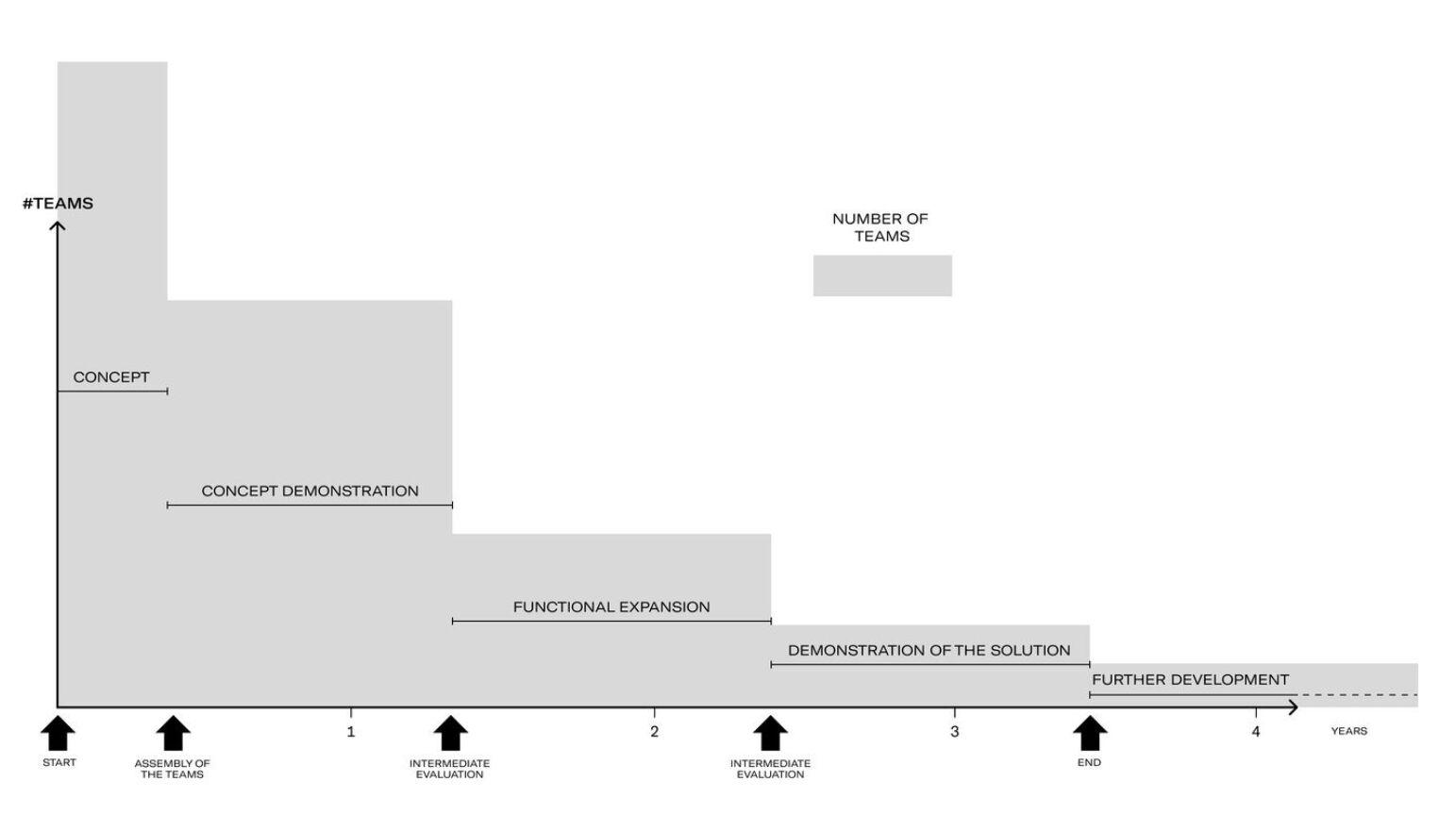
Die öffentliche Innovationsförderung ist oft zu langsam und zu unflexibel, um mit dem rasanten Fortschritt in Bereichen wie KI Schritt zu halten. #SPRIND Challenges sind Innovationswettbewerbe, die gezielt Anreize für die Entwicklung bahnbrechender Technologien setzen. Seit 2021 hat SPRIND zehn Challenges gestartet und dabei rund 85 Teams unterstützt.
Mehr über die Challenges: https://www.sprind.org/taten/challenges/artikel/ueberblick
Client Info
Server: https://mastodon.social
Version: 2025.07
Repository: https://github.com/cyevgeniy/lmst