Wish I could easily find punk fiction writers.
No solar or cyber or hope punk. Real punk fiction that goes against the mainstream. Like Kathy Acker or Burroughs or Virginie Despentes.
If you know someone, rec them here so I can check them out.
Wish I could easily find punk fiction writers.
No solar or cyber or hope punk. Real punk fiction that goes against the mainstream. Like Kathy Acker or Burroughs or Virginie Despentes.
If you know someone, rec them here so I can check them out.
Do whatever the fuck you want.
In accordance to your ethics and the common good above all else.
.
.
.

So, I am a Computational Biologist. Keep that in mind. I’m an actual scientist who works with ecological concepts, specifically the microbiome. One of the most insufferable reactions to the cyberpunk era we inhabit is the emergence of anti-science ideas from the left in response to techno-fascism. The strange part is that many people on the left do not even recognize them as anti-science, because they assume the left is aligned with science and the right opposed to it; ergo, if the left says it, it must be scientific. It is insane: washing your hands is technology. Medicine is technology.
I think, because the Internet has hijacked people’s brains, many conflate technology with electronics or machines. Anthropologically, technology consists of material objects, techniques, and organized practices through which humans intentionally intervene in their environments. Technology is culture, and human culture is technology. When someone learns a skill or a discipline from someone else, that is an extension of technology.
Technology encompasses craft traditions (blacksmithing), agriculture, and institutionalized processes of teaching and learning. Agriculture is one of the oldest forms of technology. Yes, farmers are tech workers. I write code, but I also spent a large amount of time on a farm, and I can tell you that many tech workers who pride themselves on writing code would not know what to do with farm equipment.
So, from that broad perspective, we can sum technology up in one word: education. A basic heuristic for determining if something is cultural or not is: can it be taught and learned? These words? I was taught English, and I am using an invented language to transmit knowledge to you; ergo, I am using technology to transmit cultural knowledge to you. Reading a book is thus using a piece of human technology. So, being anti-tech connotes being anti-education.
What got me thinking about this is a toot I read on Mastodon:
The truth is that society needs to develop ethically and ecologically more than it does technologically. That’s not to say that we should shun technology, but our development along other lines lags far behind our technological capacity.
Sounds valid, right? That is the distinct smell of bull shit.This is a clear example of what is called a platitude. Platitudes are memetically hijacking people’s brains. Memetics actually hijack your brain—they change it. It’s similar to how a retrovirus can alter the genome of its host. So, trying to have conversations with these people is pointless, which is why I avoid the chronically online Internet scene and arguing with them.
It made me want to scream. As I mentioned earlier, technology is basically a set of things you learn from other humans—typically within a culture—that helps you do or make something. You know what else is learned within human society? A normative set of cultural values about how we ought to behave. So, both technology and culture emerge from the same thing simultaneously and mutually. You cannot have humans intervening in things to achieve ecological development, because that is technology, and you cannot educate humans on ethics without an invented language. It is literally an anti-education argument.
Ethics and technology arise together from the same human conditions and social processes. It makes little sense to claim that technology is “outpacing” ethics. The two do not develop independently. We form ethical norms in response to new capacities and circumstances. There would be no cultural norms about how to use the Internet if the Internet did not exist. And, there would be no ethical debates about AI if AI did not exist. Ethical reflection emerges alongside technological change because both are products of human culture.
As new problems create new technologies that create new problems, societies respond by negotiating norms, rules, and expectations appropriate to those contexts. The same pattern appears in politics. Politics concerns who gets what, when, and how—it is the negotiation of power, rights, and resources. Without resources or competing claims, there would be nothing to negotiate. Ethics and politics are not trailing behind technology because they are co-emergent responses to the same underlying realities.
Stepping Back From Social Media To Read a Book
I’m taking a break. After spending like two years in the worst parts of the Internet modeling the memetic spread of conspiracy-driven behavioral patterns and developing social media software as a side hustle, I think I’m going to take a step back and… I don’t know… maybe read a book? lol.
I’m a Computational Biologist who pretty much studies the memetics of conspiracy theories and how they act as another vector/epidemiological layer. I’ve also been working on various contracts for social media development stuff. Working on the shit I’ve been working on for years forces you to see the worst parts of people that they split off. It makes you hate everyone — and I mean everyone.
#rules 🔥 Embrace chaos or cling to control? The allure of #anarchy vs. structured order is sparking a fierce ideological clash – are you ready to break free or build stronger?

good morning, enjoy a crime cat.
#TheCrimeCats say mo brain cells mo problems.
consider supporting http://ko-fi.com/thecrimecats
#comic #comics #ComicStrip #DailyComic #IndieComic #WebComic #cat #cats #crime #anarchy #anticapitalism #antifascism

Your BlueSky Feed Is Porn You Didn’t Ask For Because Your Friends Are Gooners With a Severe Porn Addiction
A common complaint I see people make on Bluesky is: why am I being served so much porn or things I am not interested in? They will incorrectly believe that the algorithm is broken. It’s not broken. You didn’t know the people you knew as well as you thought you did. Porn addiction is a thing, and porn addiction is especially common with weebs. You’re seeing deranged shit because people you follow have porn addictions and are into deranged shit. So, though you may not be consuming porn, people in your network are. That activity kicks into your feeds.
The issue I have with that is that it essentially normalizes being sex pests in a space on the Internet. That sets the expectation that it is good—attractive, even—to act like that elsewhere. That expectation alienates relationships. Bluesky creates a cultural space that offers an unrealistic, bizarre representation of social relationships, which isolates and alienates the users who stay on there consuming erotica and porn like they do.
So, user repos in Bluesky have a property for likes. Bluesky’s underlying AT Protocol stores likes as first-class structured records in each user’s AT Protocol repository. In the AT Protocol lexicon, a like is an app.bsky.feed.like record type. Unlike a simple boolean flag on a post, it is its own record with a creation timestamp and a subject field that holds a strong reference to the liked record.
That strong reference is composed of an AT-URI and a CID. The AT-URI identifies the exact record in the network by DID, collection, and record key. The CID is a cryptographic content identifier that uniquely identifies the exact content of that liked record.
These like records exist under the app.bsky.feed.like namespace in the user’s repo. Bluesky’s repo model is built so that these repos are hosted on a user’s Personal Data Server and are publicly readable through the AT Protocol APIs. Because of that, the like record and its fields can be fetched, indexed, and used by any client or service that can query the protocol.
The protocol exposes operations like getLikes. This returns all of the like records tied to a particular subject’s AT-URI and CID. It also exposes getActorLikes. This returns all of the subject references a given actor has liked. Those API calls return structured like objects with timestamps and subject references directly from the public repository data.
Various feeds hosted by different PDSs use the likes property to construct the feeds that you see. Since the likes of people you follow are included in your social graph, along with your own likes, you’re going to get served the porn they are consuming. Because likes are public and anyone can write an algorithm to see everyone’s likes, you can clearly see just how much porn people are consuming.
Honestly, what started to turn my stomach about the people on Bluesky is how they behave across different contexts. If you look through the records of the posts they interact with, you’ll see them engaging with political posts in the replies like a normal person. Then, when you look through their AT Protocol records, you see hours and hours of them interacting with every kind of porn imaginable. I am not exaggerating. Hours of likes for porn posts within 1–10 minutes of each other. Am I sex-negative? A prude? No, this site is filled with furry, gay bara porn, lol. You can have a drink without being an alcoholic. The problem with these people is like people who can’t have one drink without drinking the whole fucking day; they can’t consume porn in healthy ways.
I think people assume that their feed is customized for them and based on their likes. No—feeds are generalized based on what everyone likes and then served to your subgraph. It’s not just about who you follow; it’s about who they follow. So if you follow someone who follows a lot of people with porn addictions, you will see porn. Bluesky isn’t weighting the algorithm to do this. Basically, it’s the people in your social network with furry, hentai, or trans porn addictions who are driving it.
When so called #anarchists announce they are blocking me here because i point out as a #disabled, #transgender person #anarchy obviously doesn't work and that's why societies worldwide have services through governments that help us all, i should take a moment to show my thanks. It makes #Mastodon a much better place.
If they are here in #Seattle, even better. Go smash some more Starbucks windows comrades, the #revolution i'm sure is near.

BlueSky’s Solution To Moderating Is Moderating Without Moderating via Social Proximity
I have noticed a lot of people are confused about why some posts don’t show up on threads, though they are not labeled by the moderation layer. Bluesky has begun using what it calls social neighborhoods (or network proximity) as a ranking signal for replies in threads. Replies from people who are closer to you in the social graph, accounts you follow, interact with, or share mutual connections with, are prioritized and shown more prominently. Replies from accounts that are farther away in that network are down-ranked. They are pushed far down the thread or placed behind “hidden replies.”
Each person gets their own unique view of a thread based on their social graph. It creates the impression that replies from distant users simply don’t exist. This is true even though they’re still technically public and viewable if you expand the thread or adjust filters. Bluesky is explicitly using features of subgraphs to moderate without moderating. Their reasoning is that if you can’t see each other, you can’t harass each other. Ergo, there is nothing to moderate.
Bluesky mentions that here:
https://bsky.social/about/blog/10-31-2025-building-healthier-social-media-update
As a digression, I’m not going to lie: I really enjoyed working on software built on the AT protocol, but their fucking users are so goddamn weird. It’s sort of like enjoying building houses, but hating every single person who moves into them. But, you don’t have to deal with them because you’re just the contractor. That is how I feel about Bluesky. I hate the people. I really like the protocol and infrastructure.
I sort of am a sadist who does enjoy drama, so I do get schadenfreude from people with social media addictions and parasocial fixations who reply to random people on Bluesky, because they don’t realize their replies are disconnected from the author’s thread unless that person is within their network. They aren’t part of the conversation they think they are. They’re algorithmically isolated from everyone else. Their replies aren’t viewable from the author’s thread because of how Bluesky handles social neighborhoods.
Bluesky’s idea of social neighborhoods is about grouping users into overlapping clusters based on real interaction patterns rather than just the follow graph. Unlike Twitter, it does not treat the network as one big public square. Instead, it models networks of “social neighborhoods” made up of people you follow, people who follow you, people you frequently interact with, and people who are closely connected to those groups. They’re soft, probabilistic groupings rather than strict labels.
Everyone does not see the same replies. Bluesky is being a bit vague with “hidden.” Hidden means your reply is still anchored to the thread and can be expanded. There is another way Bluesky can handle this. Bluesky uses social neighborhoods to judge contextual relevance. Replies from people inside or near your social neighborhood are more likely to be shown inline with a thread, expanded by default, or served in feeds. Replies from outside your neighborhood are still public and still indexed, but they’re treated as lower-context contributions.
Basically, if you reply to a thread, you will see it anchored to the conversation, and everyone will see it in search results, as a hashtag, or from your profile, but it will not be accessible via the thread of the person you were replying to. It is like shadow-banning people from threads unless they are strongly networked.
Because people have not been working with the AT Protocol like I have, they assume they are shadow-banned across the entire Bluesky app view. No—everyone is automatically shadow-banned from everyone else unless they are within the same social neighborhood. In other words, you are not part of the conversation you think you are joining because you are not part of their social group.
Your replies will appear in profiles, hashtag feeds, or search results without being visually anchored to the full thread. Discovery impressions are neighborhood-agnostic: they serve content because it matches a query, tag, or activity stream. Once the reply is shown, the app then decides whether it’s worth pulling in the rest of the conversation for you. If the original author and most participants fall outside your neighborhood, Bluesky often chooses not to expand that context automatically.
Bluesky really is trying to avoid having to moderate, so this is their solution. Instead of banning or issuing takedown labels to DIDs, the system lets replies exist everywhere, but not in that particular instance of the thread.
I find this ironic because a large reason why many people are staying on Bluesky and not moving to the fediverse—thank God, because I do not want them there—is discoverability, virality, and engagement.
In case anyone is asking how I know so much about how these algorithms work: I was a consultant on a lot of these types of algorithms, so I certainly hope I’d know how they work, lol. No, you get no more details about the work I’ve done. I have no hand in the algorithm Bluesky is using, but I have proposed and implemented that type of algorithm before.
I have an interest in noetics and the noosphere. A large amount of my ontological work is an extension of my attempts to model domains that have no spatial or temporal coordinates. The question is how do you generalize a metric space that has no physically, spatial properties. I went to school to try to formalize those ideas. Turns out they’re rather useful for digital social networks, too. The ontological analog to spatial distance, when you have no space, is a graph of similarities.
This can be modeled by representing each item as a node in a weighted graph, where edges are weighted by dissimilarity rather than similarity. Highly similar items are connected by low-weight edges, while less similar items are connected by higher-weight edges. Distances in the graph, computed using standard shortest-path algorithms, then correspond to degrees of similarity. Closely related items are separated by short path lengths, while increasingly dissimilar items require longer paths through the graph. It turns out that attempts to generalize metric spaces for noetic domains—to model noetic/psychic spaces—are actually pretty useful for social media algorithms, lol.
Astroturfing Is Pretty Pointless When Social Subgraphs Are Fragmented (e.g., the Fediverse)
I am seeing astroturfing in the fediverse again, by AT Protocol developers implicitly trying to shill their products. I think it is stochastic behavior by developers with too much time on their hands. Honestly, I do not care. I like the people on ActivityPub more, but I like the AT Protocol better, and I have developed for both. Astroturfing on ActivityPub networks is fascinating to me because it is so pointless.
I am actually a Computational Biologist and Computer Scientist whose specialty is combinatorics, social graphs, graph theory, etc. Specifically, I use this to create epidemiological models for the memetic layer of human behaviors that act as vectors for diseases, using the SIRS model. I do not just study germs; I study human behaviors.
The models I construct extend into a “memetic layer,” in which beliefs, norms, and behaviors (such as risk-taking, compliance with public health measures, or susceptibility to misinformation) spread contagiously through social networks. These behaviors function as vectors that modulate biological transmission rates. As a result, the spread of ideas can accelerate, dampen, or reshape the spread of disease. By running computational simulations and agent-based models on these graphs, I study how network structure, influential nodes, clustering, and platform-specific dynamics affect behavioral contagion. I also examine how these factors influence epidemiological outcomes.
To say it very concisely, I study how the spread of bat-shit insane beliefs, shit posts, and memes influences whether or not there is a measles outbreak in Texas. Ironically, this is an evolution of my studying semiotics, memetics, and chaos magick in high school. I got a job where I can use occult, anarchist techniques professionally.
I think a large reason why I do not care about astroturfing in the fediverse is that it’s so pointless, lol. Astroturfing to manipulate the narrative would actually work better on Bluesky to keep people there than trying to recruit from the fediverse. Furthermore, big instances are relatively small. Some people on Bluesky have follower lists larger than an entire large instance in the fediverse.
Within ActivityPub networks, astroturfing rarely propagates far, because whether information spreads depends on properties of the social graph itself. Dense connectivity, short paths between communities, and a sufficient number of cross-cutting ties support diffusion. ActivityPub’s architecture tends to produce graphs that are fragmented and highly modular. This limits the reach of coordinated activity.
ActivityPub is a system where each instance maintains its own local user graph and exchanges activities through inboxes and outboxes. This makes it autonomous and decentralized. The network consists of loosely connected subgraphs. Cross-instance edges appear only through explicit follow relationships. The ActivityPub protocol does not provide a shared or complete view of the network. Measurements of the fediverse consistently show uneven connectivity between instances, clustering at the instance level, and relatively long effective path lengths across the network. Under these conditions, large cascades are uncommon.
Instance-level clustering means that in ActivityPub networks, users interact much more with others on the same server than with users on different servers. Because each instance has its own local timeline, culture, and moderation, connections form densely within instances and only sparsely across them through explicit follow relationships. This creates a network made up of tightly connected local communities linked by relatively few cross-instance ties, which slows the spread of information beyond its point of origin.
However, with the AT Protocol, global indexing and aggregation are explicitly supported. Relays and indexers can assemble near-complete views of the social graph. Applications built on top of this infrastructure operate over a graph that is denser and easier to traverse. There are fewer structural barriers between communities. The diffusion dynamics change substantially when content can move across the graph without relying on narrow federated paths.
Astroturfing depends on coordinated amplification, typically through tightly synchronized clusters of accounts intended to manufacture visibility. Work on coordinated inauthentic behavior shows that these tactics gain traction when they intersect highly connected regions of the graph or bridge otherwise separate communities. In networks with strong modularity, coordination remains local. ActivityPub’s federation model produces this kind of modularity by default. Coordinated clusters stand out clearly within instances. Their effects remain confined to those local neighborhoods.
Astroturfing on ActivityPub therefore tends to stall on its own because of the underlying graph topology. Without dense inter-instance connectivity or any form of global indexing, coordinated campaigns have a hard time moving beyond the immediate regions where they originate. Systems built on globally indexable social graphs, including those enabled by the AT Protocol, expose a much larger surface for viral spread. Network structure and connectivity account for the divergence where that is independent of moderation, cultural norms, ideology, or intent.
It’s just really funny to me how these stochastic techbro groups waste so many resources. I personally don’t want to go viral, which is why I avoid platforms where I can. The fact that it’s harder to achieve high virality on ActivityPub is exactly why I prefer the fediverse over the Atmosphere. One way to think about it is that you can change the ‘genetics’ of a system with a retrovirus, where memetic entities act as cultural retroviruses to reprogram the cultural loci of a space. That is their end goal. They are trying to hijack cultures memetically. You see this a lot with culture jamming.
Basically, the astroturfing on ActivityPub networks is designed to jam and subvert the culture. But, as I have already said, the topological structure makes memetic virality stall. They cannot achieve that kind of viral spread in the fediverse, which is why I cannot understand why they do this every year.
The Virulent Infection of BlueSky by Extremely Online, Brain-Rotten Zombies from X Continues
So, it appears a new migration from Twitter to Bluesky is underway. It appears to be some of the most virulent former 4chan users possible. Yep, I got off Bluesky just in time, lol. I’ve been keeping tabs on a particularly virulent and toxic subgraph on Twitter for years. It pretty much stayed off Bluesky because they couldn’t act like abusive dumpster fires there. Welp, looks like they’re becoming more active on Bluesky. It’s not looking good over there.
That they are on the move says something. It’s sort of like how the US is suddenly a place that is hospitable to measles. It was all but eradicated here.
My husband likes to say that you can tell where not to be by where I am looking from somewhere else. I like fires. So if I am observing your platform or community from a distance, you probably don’t want to be there.
Edit:
I had originally posted the above on a now-defunct federated blog. It got blasted to Mastodon. Someone replied and asked what I think is causing this. I debated actually answering, then decided that I’ve had enough of the dumpster fire that is social media. I decided not to wade through social media tech discourse into what will mostly likely be an Internet argument with a complete stranger. I am a techie dragon, and I engage with things to learn how they work so I can tinker with them. I only engaged with tech discourse to get my hands on how the tech works. There’s nothing in it for me to be part of larger conversations. Arguing with random strangers on social media is not an epistemically useful format. I do think I should answer, though. Just on my blog.
I treat social media like I do an addictive substance. I do not believe in abstinence, but I do believe in harm-reduction paradigms, so when I see everyone overdosing on social media, I pull back and shut down a lot of accounts. The Fediverse instance where the first part of this blog post was posted has been taken down, moved to this blog, and this section appended to it.
I often use the word weeb pejoratively. Here, I am using it categorically. There really isn’t an “official” name outside of otaku or weeb culture. I am at the fringes and intersections of it as a furry. My husband is a millennial weeb. With that being said—
The migration is in large part because Bluesky is capturing the otaku/weeb niche of X. X hosted networks that were ecosystems of “anime fans.” These included anime and manga artists, doujin and hentai artists, VTuber fans, NSFW illustrators, fandom shitposters, niche fetish communities, and other chronically and extremely online content creators and influencers. That culture relied heavily on timelines, informal networks, and discovery through reposts, replies, and algorithmic amplification.
Elon Musk pretty much destabilized X’s ecosystems and social networks from multiple directions at once. Algorithm changes made reach inconsistent. Moderation created anxiety and uncertainty about what would get suppressed or unintentionally “viral”. Bots, engagement farming, and blue-check reply spam actively poisoned fandom conversations.
Bluesky is the memetic and cultural progeny of early imageboard cultures. I conducted a phylogenetic analysis of the memetics, which you can check out here:
Bluesky is a competitor of X for otaku and fandom communities. Bluesky has a lot of the aspects of old Twitter dynamics around which fandom culture evolved. Recently, Bluesky introduced something big in those communities: going live. Since X is no longer habitable for weebs, they are moving to Bluesky.
For example, the AT protocol already has PinkSea:
And, of course, there is WAFRN:
I cope and deal with issues via personal, private sublimation and not so much exhibitionism of my art or consumption of art. So, while I do make comic books and do a shit ton of weeby art, it’s for the purpose of sublimation, so I’m not too interested in being a part of a community. That’s a large reason I am not active in those spaces. I’m quite cynical, in general, so I am suspicious of any community — and I mean any community, at all. Honestly, I am mildly contemptuous of mass participation or any sense of belonging. So, my art stays private, because it is created for me – and just me.
Why War Tunnels are the ANSWER Against Drones
#Anarchy #Anarchism #Socialist #Socialism #War #Warfare #Drones #History #Politics #Economics #Philosophy
The Problems FPV Drones STILL Can’t Solve
#Anarchy #Anarchism #Socialist #Socialism #Drones #War #Warfare #History #Politics #Economics #Philosophy
good morning, enjoy a crime cat.
#TheCrimeCats say have you considered that being flammable makes getting set on fire your fault?
consider supporting http://ko-fi.com/thecrimecats
#comic #comics #ComicStrip #DailyComic #IndieComic #WebComic #cat #cats #crime #anarchy #anticapitalism #antifascism
@PetzDerBert @CU29 Das kommt darauf an, in wessen Interesse das Wörterbuch geschrieben wird. Wenn ich mir so angucke, was unter #anarchy #anarchie in so manchem Wörterbuch steht (Unordnung, Gesetzlosigkeit,...) - Bullshit vom Feinsten, der die Interessen des Kapitals abbildet.
Grant them removed, and grant that this your noise
Hath chid down all the majesty of England;
Imagine that you see the wretched strangers,
Their babies at their backs and their poor luggage,
Plodding tooth ports and costs for transportation,
And that you sit as kings in your desires,
Authority quite silent by your brawl,
And you in ruff of your opinions clothed;
What had you got? I’ll tell you. You had taught
How insolence and strong hand should prevail,
How order should be quelled; and by this pattern
Not one of you should live an aged man,
For other ruffians, as their fancies wrought,
With self same hand, self reasons, and self right,
Would shark on you, and men like ravenous fishes
Would feed on one another.
William Shakespeare (1564-1616) English dramatist and poet
Sir Thomas More, Act 2, sc. 4, l. 55ff (c. 1592)
More about this quote: wist.info/shakespeare-william/…
#quote #quotes #quotation #qotd #shakespeare #williamshakespeare #anarchy #breakingthelaw #conflict #foreigners #immigration #insecurity #lawbreaking #lawlessness #mob #mobrule #mobviolence #riot #socialcontract #violence #xenophobia
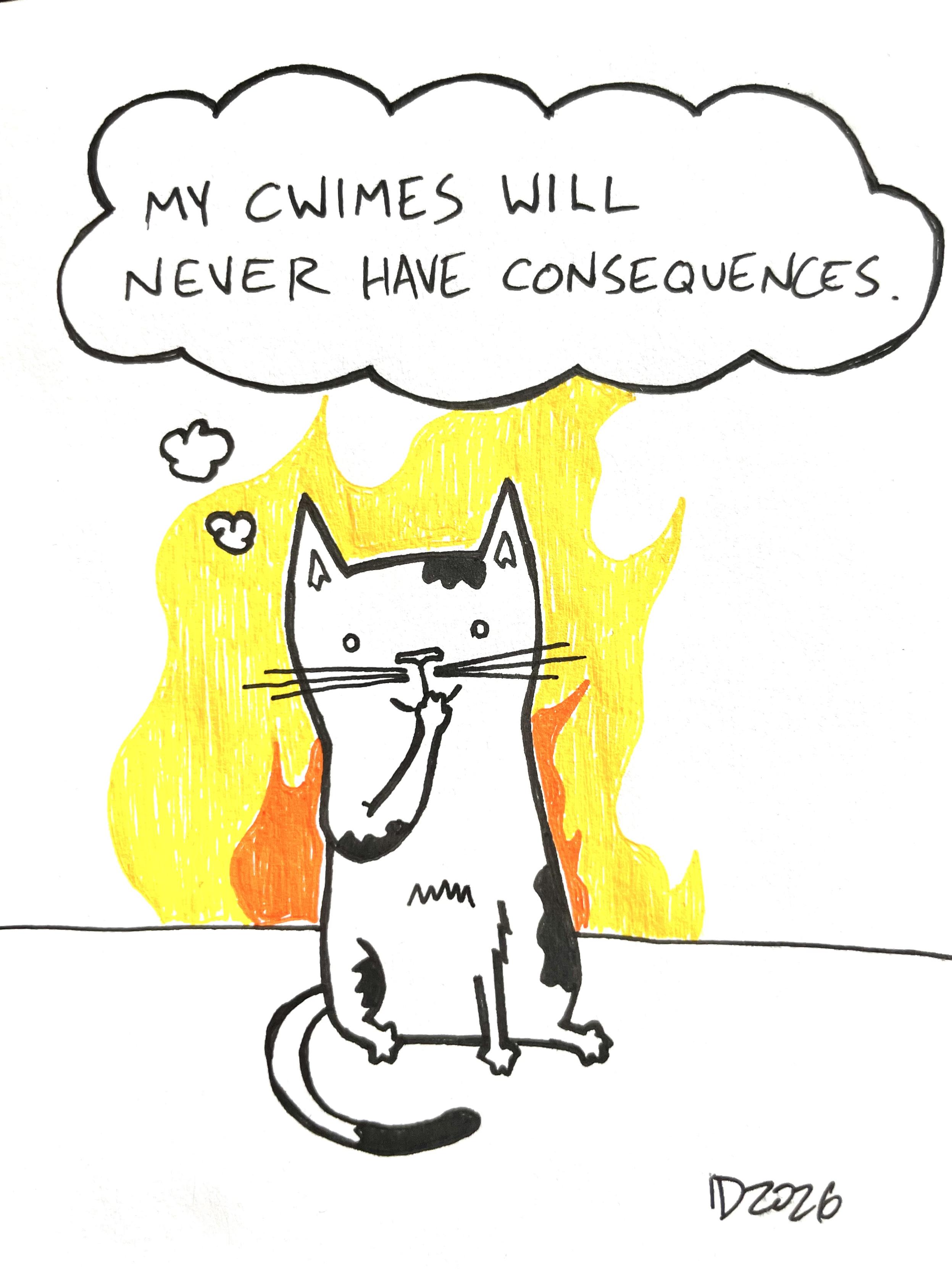
good morning, enjoy a crime cat.
#TheCrimeCats say even if i'm in charge of everything, i'm just a wittle dumbdumb baby bwain. pwease be nice to me and give me whatevew i want and make sure my cwimes have no consequences.
consider supporting http://ko-fi.com/thecrimecats
#comic #comics #ComicStrip #DailyComic #IndieComic #WebComic #cat #cats #crime #anarchy #anticapitalism #antifascism
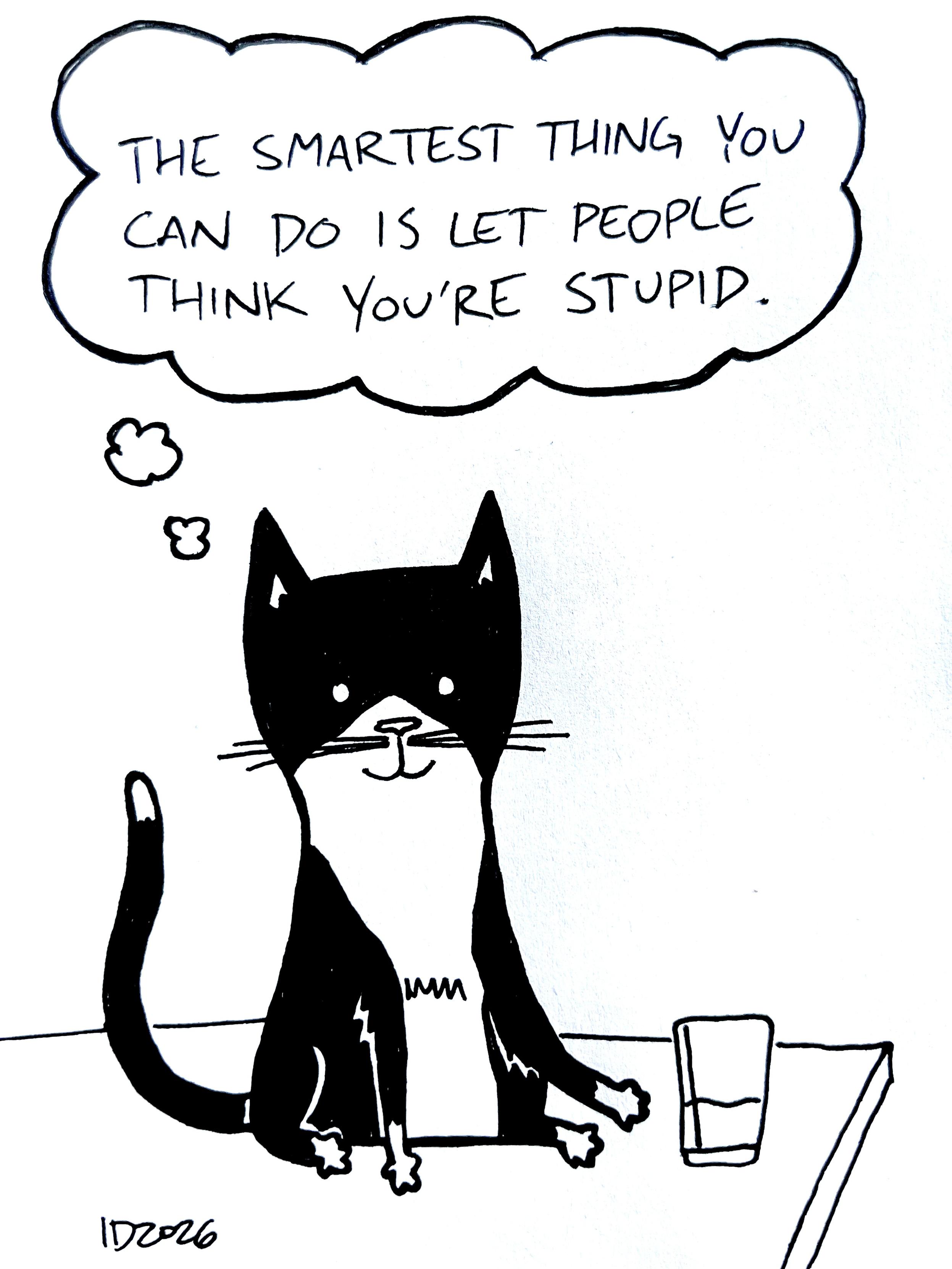
I write books about anarchist ethics and politics in a context of dystopia and, like the writers of The Thick of It or Veep, doing that you find that the horror stories you write about simply get overtaken by real, actually happening events.
The horrors are now. The monsters are about us now. How are we planning to survive them?