#PhD2

Dr N Karnkar
2025-08-30

Trying to get back to astrophotography after a long hiatus. As a starter, Lagoon Nebula (M8) photons for an hour.

80mm refractor, imx585 camera, no filter, PMC-Eight mount, 30mm guidescope, 2 mins sub, open-source software (NINA, PHD2, ASCOM, Carte du Ciel, DeepSkyStacker, Siril, Cosmic Clarity, GraXpert, Darktable), Bortle 5 sky.

Ada Czerwonogoraadita
2025-04-06

Recién salido del horno, con una publicación breve sobre un capítulo de mi tesis: “La comunidad de aprendizaje profesional docente a través de sus interacciones”

yodemoliendohoteles.wordpress.

Julien :ve: 🔭:python:jdlbt@techhub.social
2024-10-15

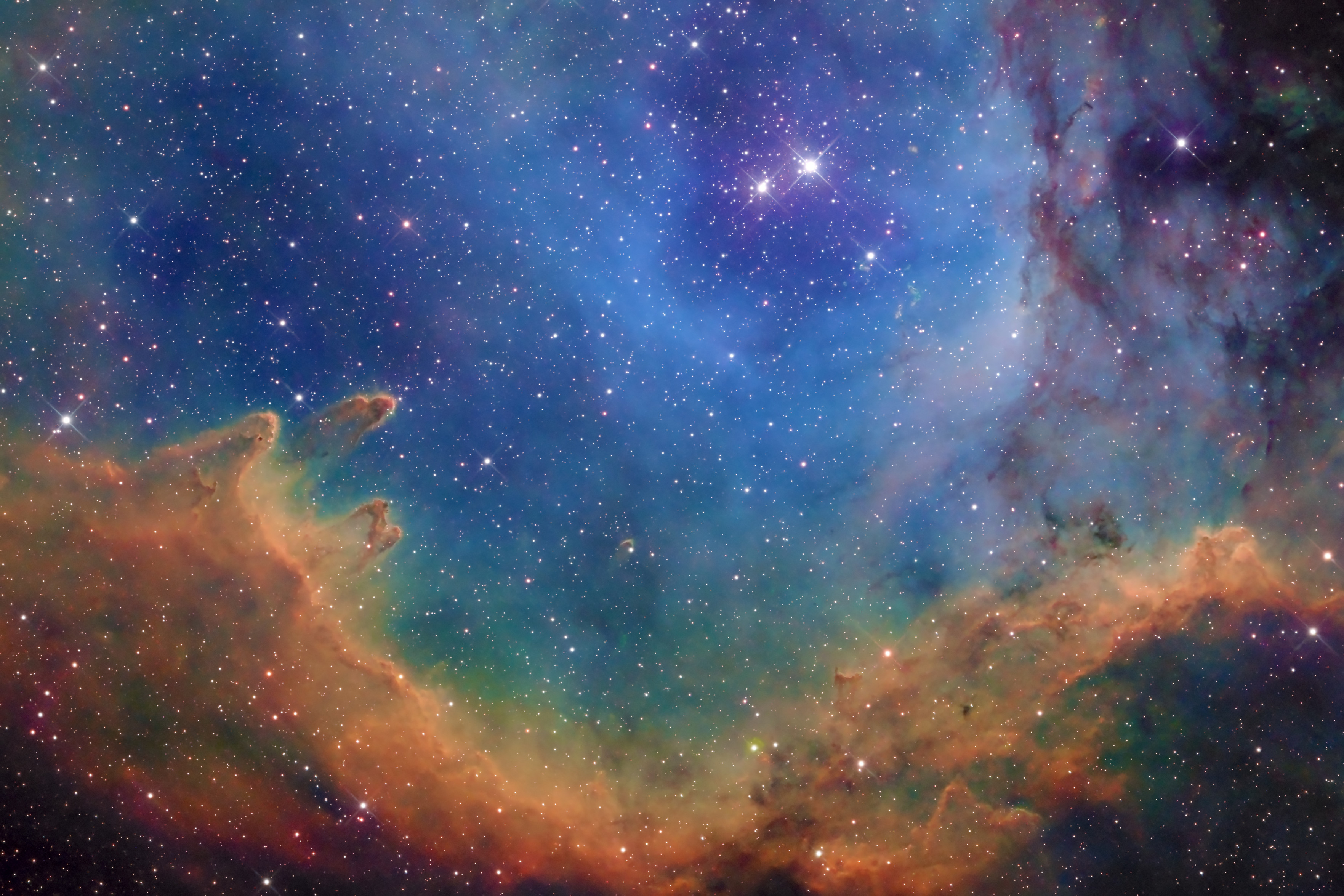
I'm not done with the processing of my Soul Nebula (IC 1848) data but I thought I'd share this little crop from the larger image which has strong "cosmic cliffs" vibes.

Image: CC BY-NC-SA 4.0

#astrophotography #astronomy #astrodon #ic1848 #nebula #sho #DeepSky #space #darktable #kstars #ekos #phd2 #foss #CreativeCommons #ccbyncsa

Astrophotography of a section of the Soul Nebula. In the bottom third of the image are bright orange and yellow gases forming a wave like structure with pillars extending into the rich blue background.
Julien :ve: 🔭:python:jdlbt@techhub.social
2024-09-28

The Helix Nebula (NGC 7293) is a planetary nebula in the constellation Aquarius. At approximately 655 light-years from Earth, it is one of the closest of the bright planetary nebulae.

The planetary nebula is formed by the shedding of the outer layers of its central star near the end of its evolution. The energy from the central star causes the expelled gases to fluoresce.

High resolution image and technical details on Telescopius: telescopius.com/pictures/view/

Image license: CC BY-NC-SA 4.0.

#astrophotography #astronomy #photography #astrodon #nebula #PlaneratyNebula #DeepSky #space #NGC7293 #KStars #ekos #phd2 #GIMP

Photography of the Helix Nebula. The nebula has the shape of a eye oriented at an angle in the image. The contour of the nebula is dark orange and its center is a blue circle. The transition between the two is yellow and forms knot structures oriented radially.
Julien :ve: 🔭:python:jdlbt@techhub.social
2024-09-15

Some nights the guiding is poor, some nights it is good. Tonight it is very good.

With the RA and Dec curves so flat, I would say it is dead good!

With a pixel scale of 1.38"/px and assuming a normal distribution, a <0.3" guiding error means that 99.7% of the time (±3𝜎) the total guiding error is less than 1.2 times the size of a pixel on the main camera!

#astrophotography #guiding #phd2

Screenshot of the PHD2 guiding application. The top part of the application shows the camera view with a few stars visible and green circles and a crosshair on one of the stars.

The bottom section shows a graph of the right ascension (RA) and declination (Dec) guiding errors versus time. The curves are very flat, indication minimal error. The RMS total error is indicated at 0.29 arcsecond.
Julien :ve: 🔭:python:jdlbt@techhub.social
2024-09-08

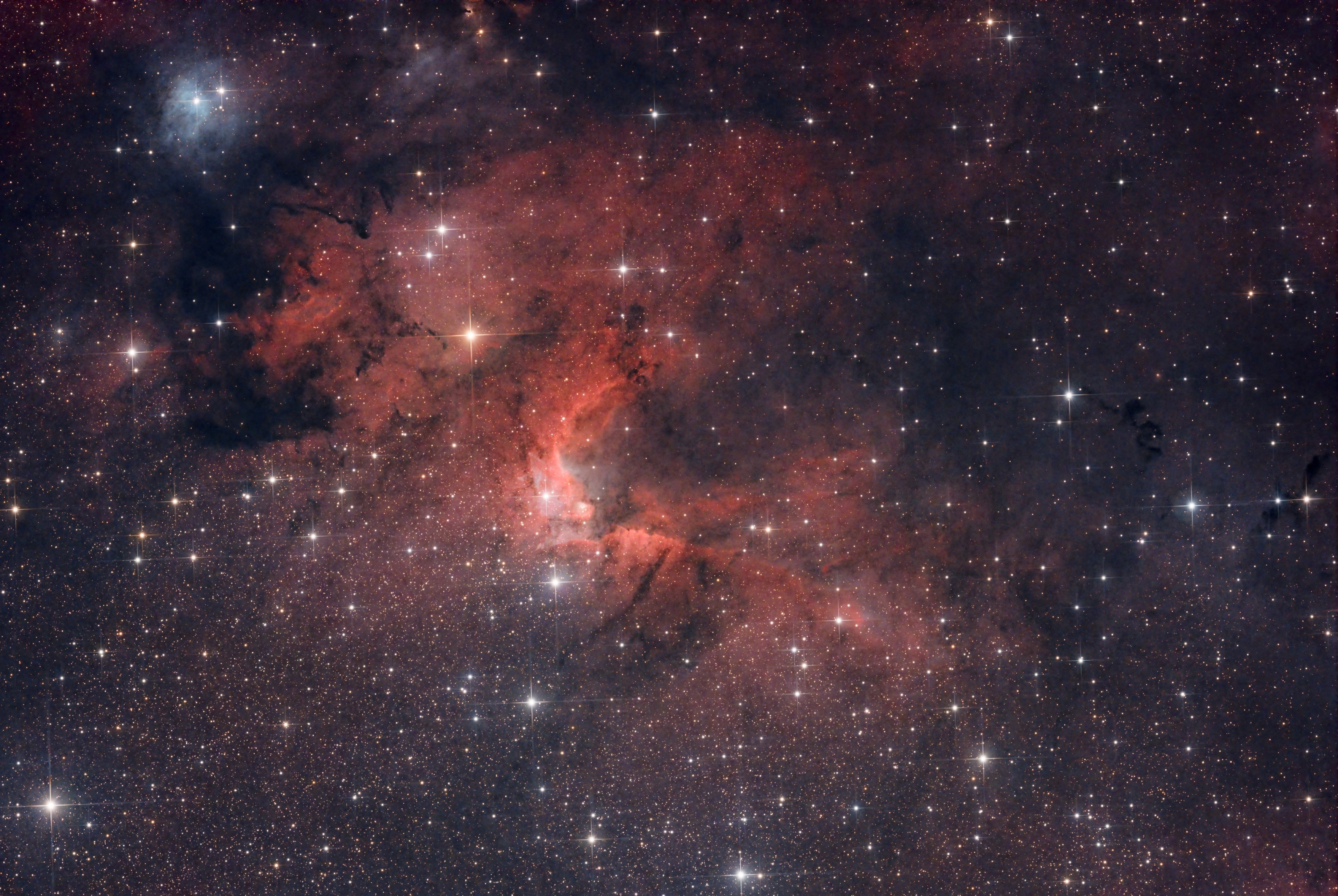
Sh 2-155, from the Sharpless catalog, also known as the Cave Nebula, is a diffuse nebula in the constellation Cepheus, within a large nebula complex containing emission, reflection and dark nebulae. Sh 2-155 is an ionized H II region with ongoing star formation activity, at an estimated distance of 2400 light-years from Earth.

Technical details, high resolution and annotated versions available on Telescopius: telescopius.com/pictures/view/

Image license: CC BY-NC-SA 4.0.

#astrophotography #astronomy #photography #astrodon #nebula #DeepSky #space #sh2-155 #RGBHa #KStars #ekos #phd2 #GIMP

At the center of a dense star field, the cave nebula is a cloud of red ionized hydrogen gas forming a C shape with the opening oriented towards the top-right of the image.

A large dark cloud of interstellar dust located on the left of the nebula blocks the light from the emission nebula and background stars. Multiple smaller dark clouds can be seen around the nebula.

A large orange star is located between the center of the nebula and the large dust cloud.

In the top left corner, the light from two large stars reflect on the surrounding interstellar dust, forming a light blue halo.
Julien :ve: 🔭:python:jdlbt@techhub.social
2024-08-10

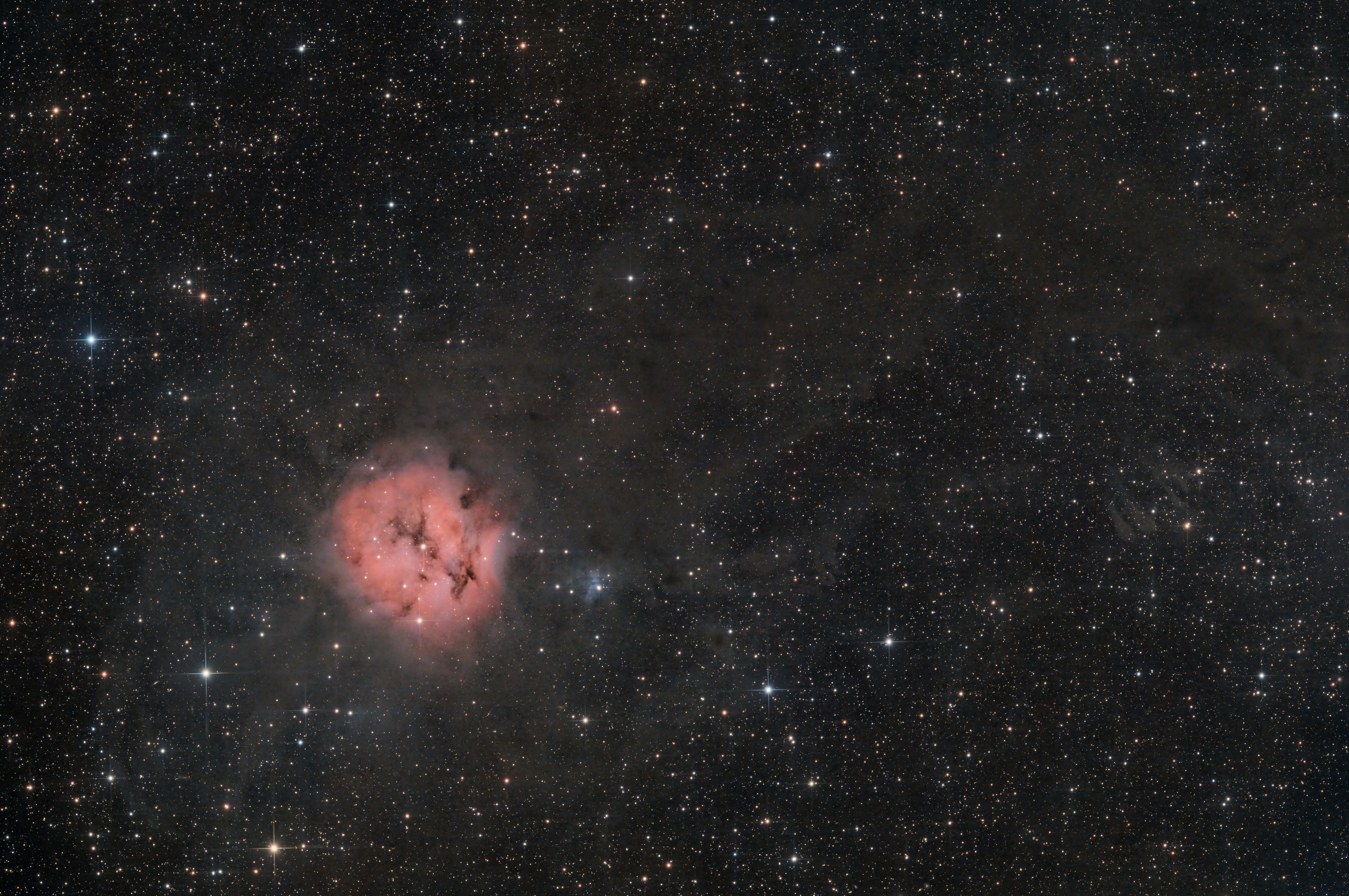
Here's a quick processing of the broadband RGB data on the Cocoon Nebula (IC 5146) in the constellation Cygnus. Narrow-band Ha data to be added later.

#astrophotography #astronomy #astrodon #kstars #ekos #phd2 #IC5146 #Nebula #space

The Cocoon nebula is a pink circular cloud about 1/6 the width of the image located in the bottom-left lower third of the image. A large cloud of interstellar dust surrounds the nebula and extends all the way to the right edge of the image. The background is a dense star field. The bright stars have four distinct diffraction spikes.
Julien :ve: 🔭:python:jdlbt@techhub.social
2024-08-03

SH 2-119 (from the Sharpless catalog of H II regions), also known as the Clamshell Nebula, is an emission nebula in the constellation Cygnus. It is fainter and not as frequently imaged as its western neighbour, the North America Nebula.

This image was captured over six nights between July 13 and August 1st. Two different dual narrow-band filters were used to capture the different wavelengths of the sulphur, hydrogen and oxygen emissions.

Technical details, high resolution and annotated versions available on Telescopius: telescopius.com/pictures/view/

Image license: CC-BY-NC-SA 4.0.

#astrophotography #astronomy #photography #astrodon #nebula #DeepSky #space #sh2-119 #sho #kstars #ekos #phd2 #DarkTable

The Clamshell Nebula has an oval shape with its long axis along the bottom-left to top-right diagonal of the image. The contour of the nebula is dark orange and gold. The center of the nebula is dark blue and features a bright white star.
Julien :ve: 🔭:python:jdlbt@techhub.social
2024-07-30

The Crescent Nebula (NGC6888) is a cosmic bubble about 25 light-years across, in the constellation Cygnus, blown by winds from its central massive Wolf-Rayet star (WR136).

This image was captured on July 26 & 28 under quite bad sky conditions; low transparency due to smoke from wild fires in the West combined with Moon illumination.

Annotated version & technical details on Telescopius: telescopius.com/pictures/view/

Image license: CC-BY-NC-SA 4.0

#astrophotography #astronomy #nebula #deepsky #photography #astroberry #kstars #ekos #phd2 #darktable #astrodon #ngc6888

A bubble of red/pink filament gas structures resembling as crescent (or the Euro symbol)  surrounded by a shell of blue/turquoise gas. In the background are emission nebulae from the extensive H-II regions of the Cygnus constellation.
Julien :ve: 🔭:python:jdlbt@techhub.social
2024-07-07

The Elephant Trunk Nebula (IC 1396) in the constellation Cepheus in SHO palette.

This image was captured over three nights with an OSC (RGB) camera and two different dual narrow-band filters (Sulphur + Oxygen and Hydrogen + Oxygen emissions) allowing the SHO palette (Sulphur=Red, Hydrogen=Green and Oxygen=Blue). SHO images are usually captured with a monochrome camera and three separate narrow-band filters, one for each emission line.

Technical details, high resolution and annotated versions available on Telescopius: telescopius.com/pictures/view/

Image license: CC-BY-NC-SA 4.0.

#astrophotography #astronomy #photography #astrodon #nebula #DeepSky #space #ic1396 #kstars #ekos #phd2

Image of the Elephant Trunk Nebula. The nebula has a circular shape in rainbow-like colors with the outer parts in dark orange-red, progressing to blue in the center. A yellowish pillar protrudes from the bottom towards the center of the nebula (the elephant trunk). Dark interstellar dust blocking some of the nebula light are also visible.
Julien :ve: 🔭:python:jdlbt@techhub.social
2024-06-17

The Pelican Nebula (IC 5070) is an emission nebula associated with the North America Nebula in the constellation Cygnus. It is separated from the North America Nebula by a foreground molecular dust cloud.

Annotated & high quality versions and technical details available on Telescopius: telescopius.com/pictures/view/

The work on the Newtonian paid off and I'm happy with the results. This was the first time I tried the 150 mm f/5 Newtonian with the Starizona Nexus 0.75x coma corrector/reducer and my older ASI183MC Pro camera. The pixel scale (0.88"/px) with this setup is a good match with the scope's resolution limit and the faster focal ratio of f/3.7 with the reducer helps with the somewhat noisier camera.

Image license: CC-BY-NC-SA 4.0

#astrophotography #astronomy #nebula #deepsky #photography #astroberry #kstars #ekos #phd2 #astrodon

Astrophotograph of the Pelican Nebula, a pink & blue emission cloud partially obscured by black molecular dust clouds.
Julien :ve: 🔭:python:jdlbt@techhub.social
2024-06-16

Yesterday's guiding. Never had this good guiding before! The whole night was between this and 0.45". This is with the 6" Newtonian on the HEQ5 (belt modded) and an off axis guider (0.88"/px). No wind and exceptionally good seeing for this corner of the world.

#astrophotography #phd2 #phd2guiding

Screenshot of the PHD2 guiding application showing a very flat guiding error curve and a total RMS error of 0.36 arcsecond over a 200s period.
Julien :ve: 🔭:python:jdlbt@techhub.social
2024-06-13

A view of the extensive H II emission regions in the constellation Cygnus, just North of the star Sadr (γ Cygni), which forms the intersection of the asterism known as the Northern Cross.

At the bottom right is the NGC 6914 reflection nebula, blue halos created by the reflection of the light from blue giant stars on the surrounding interstellar dust.

The field of view is 3.2 x 2.1 degrees, with the celestial North to the left of the image.

High quality/resolution version & technical details on Telescopius: telescopius.com/pictures/view/

Image license: CC-BY-NC-SA 4.0

#astrophotography #astronomy #nebula #deepsky #photography #astroberry #kstars #ekos #phd2 #DarkTable #raspberrypi #astrodon

Astrophotograph showing red-pink glowing gas clouds in a dense star field. Darker regions look like black ink was dropped on the image.
Julien :ve: 🔭:python:jdlbt@techhub.social
2024-06-08

Linking a post from last year with a photo taken with the exact same setup and same location. techhub.social/@jdlbt/11060579

#astrophotography #astronomy #nebula #deepsky #photography #astroberry #kstars #ekos #phd2 #raspberrypi #astrodon

Julien :ve: 🔭:python:jdlbt@techhub.social
2024-06-04

All setup, listening to the birds while I wait for darkness...

#astrophotography #astronomy #kstars #ekos #phd2 #astroberry #RaspberryPi

Photo of an astrophotography rig on the edge of a field with a clear pre dusk sky background. In the foreground is a tablet showing the Kstars / Ekos software open.
Julien :ve: 🔭:python:jdlbt@techhub.social
2024-06-01

It was also the first time I tried using a tablet instead of a laptop to remotely control the Kstars/Ekos & PHD2 software running on the Raspberry Pi attached to my astrophoto rig over VNC.

Although Kstars/Ekos are not designed for tactile use, I found it perfectly functional with the way the VNC client uses the screen as a big touchpad and allows for zooming.

Also, combining the use of the tablet's "night mode" and "extra dimming" feature with a contrasting color theme in Kstars allowed for a visually comfortable experience with little blue light that would otherwise ruin night vision.

I will probably keep using the laptop for initial setup but then use the tablet to monitor and make adjustments when required.

#astrophotography #kstars #ekos #phd2 #astroberry #RaspberryPi #foss #linux

2024-01-18

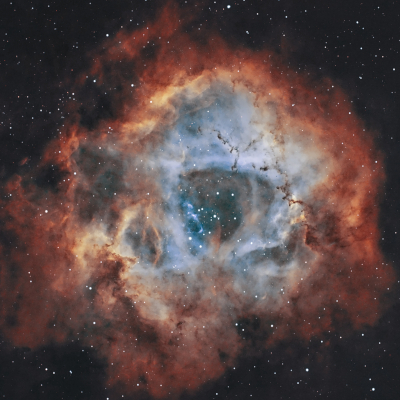
Nach vielen Wochen mit grauem Himmel gab es um den 09.01.2024 endlich ein paar klare (und sehr kalte) Nächte bei uns. Und dank der Neumondphase keinen Mond am Himmel.
Techdata: Exposure time - 65x240 sec (4,3h)
Telescope TS72 f/6, Main camera Touptek ATR3COMS26000KPA
SW: #NINA / #PHD2 (OAG) / #Siril 👍 / #GIMP / #Lightroom
#astrophotography #astrofotografie

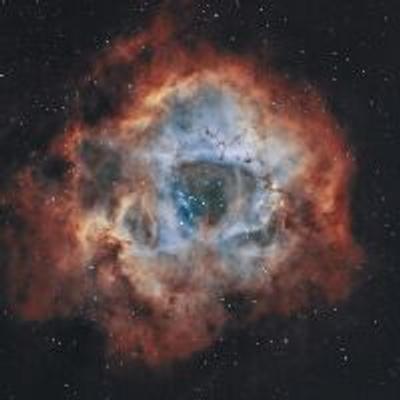
Astrofoto des Rosettennebels (NGC 2244). Eine Gaswolke, die in rottönen bis magenta vor dem dunklen Hintergrund leuchtet und deren Form etwas an eine Rosenblüte  (mit Blick in den Blütenkelch) erinnert.
Julien :ve: 🔭:python:jdlbt@techhub.social
2023-12-29

I'm grateful to all the developers of the different open source software I use in the image capture and processing.

#Kstars #Ekos #PHD2 #indi #Astroberry #Darktable #Gimp #ImageMagik #Linux #astropy #foss

Client Info

Server: https://mastodon.social
Version: 2025.07
Repository: https://github.com/cyevgeniy/lmst