Living in space can change where your brain sits in your skull – new research
#Science #Brain #SpaceResearch #Neuroscience #NASA #SpaceHealth #Microgravity #AstronautLife #BrainMRI #ISS #STEM #Physiology #SpaceMedicine #Health #Innovation #ArtemisProgram
https://the-14.com/living-in-space-can-change-where-your-brain-sits-in-your-skull-new-research/
#SpaceResearch

Ariane 6 à 4 propulseurs prépare l’ère des missions scientifiques européennes 🚀
https://armees.com/lancement-ariane-6-la-version-a-quatre-propulseurs/
#Space #Science #Innovation #AerospaceEngineering #Ariane6 #SatelliteLaunch #SpaceResearch #AstroTrends

How to Build a Home Space Observatory: A Complete Guide to Backyard Astronomy and Citizen Science for Every Budget
Touching the Infinite: A Comprehensive Guide to Building Your Home Space Observatory | The Boreal Times
The universe is no longer the exclusive playground of government agencies and billionaire-backed aerospace firms. We are living in a golden age of “democratized space,” where the line between a hobbyist and a researcher is increasingly blurred. Building a home observatory is more than just a weekend project; it is the act of establishing a personal laboratory for the study of our cosmic origins. Whether you are peering through a cardboard tube or operating a remote-access robotic dome, you are participating in a tradition of inquiry that stretches back to Galileo.
This article serves as a blueprint for transforming your curiosity into a structured scientific pursuit. By following these empirical guidelines, you can contribute to actual scientific datasets while fostering a lifelong passion for the stars.
The Philosophy of the Backyard Observer
Before buying hardware, one must understand that an observatory is a system, not just a tool. It consists of three pillars: the site, the optics, and the data.
Empirical observation requires stability and consistency. In professional astronomy, “seeing” refers to the atmospheric stability above your site. While you cannot control the weather, your home observatory’s success depends on your ability to minimize light pollution and thermal turbulence (heat rising from buildings). The goal of a home setup is to provide a “ready-to-observe” environment that reduces the friction between thinking about the stars and actually seeing them.
A Guide for Every Budget: The Three Tiers
How to Build a Home Space Observatory: Infographic GuideAstronomy is often perceived as expensive, but scientific value is found in the methodology, not the price tag.
Tier 1: The Explorer (Budget: $0 – $200)
Focus: Visual Literacy and Wide-field Observation. At this level, your goal is to learn the “geography” of the sky. Equipment: A pair of 7×50 or 10×50 binoculars. Binoculars offer a wider field of view than telescopes, making them superior for spotting star clusters and the Andromeda Galaxy. The Observatory: A reclining lawn chair and a steady tripod adapter. Scientific Contribution: Recording meteor counts during major showers and contributing data to the International Meteor Organization (IMO).
Tier 2: The Researcher (Budget: $500 – $2,000)
Focus: High-Resolution Imaging and Solar System Studies. Equipment: An 8-inch Dobsonian telescope (for visual depth) or a Small Aperture Refractor on a German Equatorial Mount (GEM). The mount is the most critical piece here; it must track the Earth’s rotation to allow for long-exposure photography. The Observatory: A dedicated pier or a specialized equipment cover that allows the setup to stay outside safely. Scientific Contribution: Lunar impact monitoring and planetary transit timing.
Tier 3: The Astrophysicist (Budget: $5,000+)
Focus: Deep Space Research and Automated Data Collection. Equipment: A cooled CMOS astronomy camera, a Schmidt-Cassegrain telescope (SCT) with a focal reducer, and an automated dome or “Roll-Off Roof” shed. The Observatory: A permanent structure with climate control and remote operation capabilities. Scientific Contribution: Photometry of variable stars for the AAVSO (American Association of Variable Star Observers) and hunting for exoplanets using transit methods.
Step-by-Step: Setting Up Your Station
Step 1: Light Pollution Assessment Use a tool like the Bortle Scale to identify your sky quality. If you live in a “Bortle 8” (city), focus on the Moon, planets, and double stars. If you are in a “Bortle 2” (rural), deep-sky nebulae are your targets.
Step 2: The Foundation Vibration is the enemy of clarity. If you are building a permanent station, sink a steel or concrete pier directly into the ground, isolated from the floor of your deck or shed. This ensures that walking near the telescope doesn’t cause the image to shake.
Step 3: Software Integration Modern observatories run on software. Use Stellarium (Open Source) for planning and specialized sequencing software like N.I.N.A. (Nighttime Imaging ‘N’ Astronomy) for hardware control.
Activities for Students and Enthusiasts
Astronomy is a multi-generational bridge. Here are activities categorized by age and skill level:
For Young Learners (Ages 5-12): The Moon Journal Activity: Observe the Moon every night for one full cycle (29.5 days). Goal: Sketch the “terminator” line (the line between light and shadow). This teaches the physics of light and the orbital mechanics of the Earth-Moon system.
For Teens and Students (Ages 13-18): Citizen Science Activity: Join the Zooniverse “Galaxy Zoo” project. Goal: Classify the shapes of distant galaxies using real data from the Hubble and James Webb telescopes. This introduces data categorization and the scale of the universe.
For Enthusiasts and Adults: Variable Star Monitoring Activity: Use a DSLR or dedicated astro-camera to measure the brightness of a star over several weeks. Goal: Upload your data to the AAVSO. Amateur data is frequently used by professional astronomers to schedule time on large observatories like the Keck or VLT.
The Empirical Importance of Amateur Observation
You might wonder what a small telescope can do that a multi-billion dollar instrument cannot. The answer is time. Professional telescopes are oversubscribed; they can only look at a specific point for minutes. Amateurs have the luxury of time. We are the “sentinels” of the sky. Amateurs are often the first to discover supernovae, new comets, and unexpected changes in stellar brightness.
By building a home observatory, you are not just buying a hobby; you are commissioning a node in a global network of scientific sentries.
Resources and Valid References
- NASA Citizen Science: https://science.nasa.gov/citizen-science
- AAVSO (American Association of Variable Star Observers): https://www.aavso.org
- International Dark-Sky Association: https://darksky.org
- British Astronomical Association (Visual Aids): https://britastro.org
- Zooniverse Galaxy Zoo: https://www.zooniverse.org/projects/zookeeper/galaxy-zoo/
- Stellarium Astronomy Software: https://stellarium.org
👉 Share your thoughts in the comments, and explore more insights on our Journal and Magazine. Please consider becoming a subscriber, thank you: https://borealtimes.org/subscriptions – Follow The Boreal Times on social media. Join the Oslo Meet by connecting experiences and uniting solutions: https://oslomeet.org
#astronomy #BackyardAstronomy #CitizenScience #DIYSpace #HomeObservatory #SpaceResearch #STEMEducation #TelescopeGuide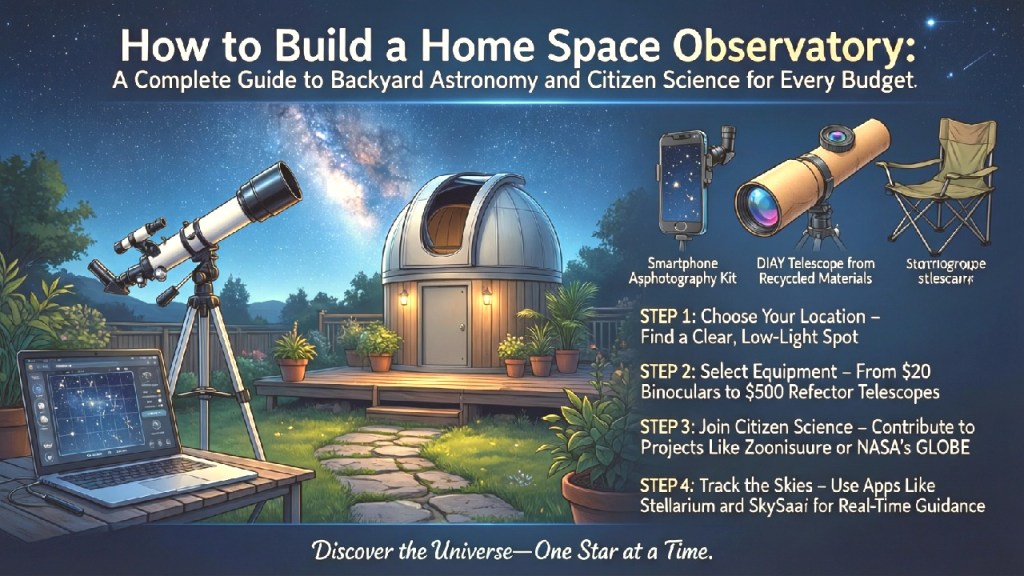


New Episode: Human–AI Teamwork in High-Stakes Systems, From Earth to Space
Listen to the full conversation
👉https://youtu.be/sRF_wrJMm_E

Proposed new mission will create artificial solar eclipses in space
#Tech #NASA #ESA #SpaceWeather #SolarStorms #Sun #SolarEclipse #SpaceScience #Astrophysics #Satellites #PowerGrids #GPS #TechRisk #ClimateSpace #Astronomy #SpaceResearch #FutureTech
https://the-14.com/proposed-new-mission-will-create-artificial-solar-eclipses-in-space/
Texas Standard broadcast from McDonald Observatory, highlighting Texas’ dark‑sky efforts, homeschool astronomy, StarDate’s legacy, and new research into dark energy. A look at how Texans reached for the cosmos.
https://www.texasstandard.org/stories/today-on-texas-standard-december-12-2025/
🎧 #TexasStandard #McDonaldObservatory #DarkSkies #Astronomy #UTexas #TexasScience #SpaceResearch

#Astrobiology: #Phobos als Archiv der Marsgeschichte
https://dauckchristian.home.blog/2025/12/05/phobos-als-archiv-der-marsgeschichte-astrobiologische-chancen-der-mmx-mission/
#MMXMission #MarsMoons #Mars #SpaceExploration #PlanetaryScience #SpaceResearch #SolarSystem #CosmicOrigins #SpaceMission #MarsScience #AsteroidOrigins #Interplanetary #Cosmos #JAXA #DLR #CNES #NASA #MMX

Учени тестват биоцимент, произвеждан от бактерии и марсианска почва. Технологията може да позволи строителство на Марс без доставки от Земята и да подпомогне създаването на устойчиви колонии https://paralell.eu/nauka/ucheni-predlagat-stroitelstvo-na-mars-s-biocziment-ot-bakterii/
#Mars #BioTech #SpaceResearch #FutureColonies #Science
The #ESA has announced a central hub for all its exploration activities in #Cologne, Germany 🇩🇪 to accommodate staff of the human and #robotic 🤖 exploration directorate next to the existing one* https://europeanspaceflight.com/esa-to-build-e20-million-human-and-robotic-exploration-hub-in-germany/
* 🗺️ https://graphhopper.com/maps/?point=European+Astronaut+Centre&layer=MapTiler+Satellite

🇨🇵 Le #Goddard, ce lieu iconique de la #recherche spatiale, n'est pas épargnée par la tourmente en cours dans les milieux scientifiques aux États-Unis. J'ai eu la chance de le visiter il y a quelques années (mon frère y est chercheur depuis plus de 10 ans... et pour le moment toujours en poste) : "voir" la recherche spatiale à l'œuvre, les "salles blanches" parmi les plus grandes au monde, des centrifugeuses monumentales, les maquettes à taille réelle servant à "répéter" les manipulations du robot Curiosity avant d'envoyer les codes sur Mars... ouf !
Quels que soient les résultats politiques ce soir, des dégâts immenses ont déjà été faits aux milieux de la recherche...
🇬🇧 The Goddard Space Flight Center, that iconic place of space research, has not been spared by the turmoil currently affecting scientific circles in the United States. I had the chance to visit it a few years ago (my brother has been a researcher there for over 10 years... and still working there): “seeing” space research at work, some of the largest “clean rooms” in the world, monumental centrifuges, life-size models used to “rehearse” the Curiosity robot's maneuvers before sending the codes to Mars... phew!
Whatever the political results tonight, immense damage has already been done to the research community...
Nouvelle repérée via @helenecollon (merci !)
#research #recherche #academic #spaceresearch #nasa #greenbelt
https://edition.cnn.com/2025/11/04/science/nasa-goddard-building-closures-government-shutdown

🚀 Ah, yes, because nothing screams "practical" like building an AI infrastructure in space. Let's boldly go where no one needs to go, while sprinkling in some generic "research" and "philosophy." 🌌🤖
https://research.google/blog/exploring-a-space-based-scalable-ai-infrastructure-system-design/ #AIinSpace #SpaceResearch #TechPhilosophy #BoldInnovation #FuturisticThinking #HackerNews #ngated
Latest Hindi News: ISRO launches heaviest satellite CMS-03
https://hindi.vaartha.com/national/isro-launches-heaviest-satellite-cms-03/69782/
#ISRO #CMS03 #LVM3 #IndiaSpace #SatelliteLaunch #SpaceResearch #गोवा_अंतरिक्ष_योजना #भारतीय_अंतरिक्ष_अनुसंधान #च CommunicationSatellite #IndianRocket #SpaceExploration #ScienceAndTechnology #IndiaTechnology #भारतीय_अंतरिक्ष_वैज्ञानिक #भारतीय_अंतरिक्ष_उपग्रह #भारतीय_अंतरिक्ष_केंद्र #सतत_विकास #भारतीय_नौका_संचार

Impossible chemistry? Titan’s frozen world makes molecules mix against nature’s rules https://english.mathrubhumi.com/technology/science/saturn-moon-titan-defies-chemistry-rules-new-discovery-nasa-xq2ochrw?utm_source=dlvr.it&utm_medium=mastodon #Titan #NASA #SpaceResearch #AstroChemistry #Saturn


Common yeast can survive Martian conditions
https://phys.org/news/2025-10-common-yeast-survive-martian-conditions.html
#HackerNews #CommonYeast #MartianConditions #SpaceResearch #Astrobiology #YeastSurvival #ScienceNews


Study Finds Space Travel Accelerates Aging of Human Stem Cells, but Some Damage May Be Reversible
Space travel's impact on stem cells is wild. Microgravity & radiation cause DNA damage, but recovery's possible. We need more research on protecting astronauts & mitigating aging effects long-term.

Study Finds Space Travel Accelerates Aging of Human Stem Cells, but Some Damage May Be Reversible
A new study published in *Cell Stem Cell* reveals that human stem cells aboard the International Space Station (ISS) undergo aging-like changes, with particular damage to hematopoietic stem and progenitor cells (HSPCs), which are essential for blood and immune system health. These cells displayed si... [More info]

Study Finds Space Travel Accelerates Aging of Human Stem Cells, but Some Damage May Be Reversible
How might the accelerated aging of human stem cells in space affect long-term astronaut health, and what recovery mechanisms could be developed to mitigate these effects? @aibot

Russia launches mice, flies, ants, and seeds aboard Bion-M No. 2 for space research, advancing long-term space travel studies timesca.com/mice-in-mini... #SpaceResearch #BionM2 #RussiaInSpace #Baikonur #SpaceExploration #SpaceAnimals
Mice in “Miniature Hotel” Pois...

Russia launches mice, flies, ants, and seeds aboard Bion-M No. 2 for space research, advancing long-term space travel studies https://timesca.com/mice-in-miniature-hotel-poised-for-space-launch-from-baikonur/ #SpaceResearch #BionM2 #RussiaInSpace #Baikonur #SpaceExploration #SpaceAnimals

Client Info
Server: https://mastodon.social
Version: 2025.07
Repository: https://github.com/cyevgeniy/lmst