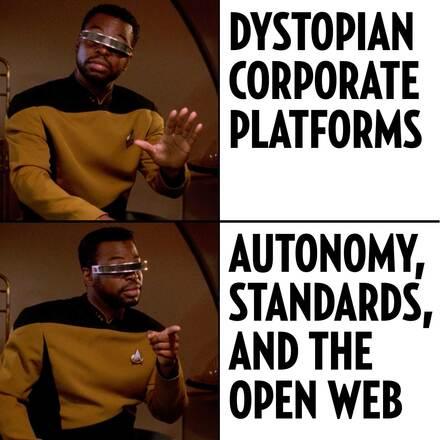
From: https://fontsinuse.com/uses/63903/fonts-in-use-is-not-active-on-instagram
#fontsinuse #autonomy #openstandards #openweb #geordilaforge #meme
From: https://fontsinuse.com/uses/63903/fonts-in-use-is-not-active-on-instagram
#fontsinuse #autonomy #openstandards #openweb #geordilaforge #meme
Logic of the Thicket and the Unsearchable Web
There is a particular kind of stillness found in the villa overlooking the Giardino all’italiana, a silence that is less about the absence of noise and more about the absolute presence of a plan. Standing upon a belvedere in the sixteenth century, one did not merely look at nature; one looked through a specific geometry that had already decided what nature was allowed to be. Leon Battista Alberti and Niccolò Tribolo did not view the wild landscape as an entity to be met, but as a rough draft to be corrected. The axial symmetry, the squares, and the circles of the Renaissance garden were not merely aesthetic choices; they were the visual grammar of a new kind of mastery. The medieval walls of the hortus conclusus fell away, not to invite the wilderness in, but to expand the reach of the human eye, establishing a panoramic viewpoint where the owner sat as the rational conductor of the visible world.
By Vincent van Gogh – History of the Red Vineyard by Anna Boch.com, 2nd upload: wikipaintings, Public Domain, https://commons.wikimedia.org/w/index.php?curid=3073079It is difficult not to notice how this impulse to map and master—to treat the organic as a design scheme—has slowly migrated from the soil into the fabric of human relation. What began as the pruning of a hedge eventually became the pruning of the social universe. One senses this lineage in the early twentieth century, when the sociogram first began to translate the messy, opaque attractions between people into the clean lines of nodes and links. Jacob L. Moreno’s belief that we could re-engineer social life through these visualizations mirrors the Renaissance gardener’s conviction that an unruly vine is simply a line that has lost its way. We began to treat the human spirit as a series of vertices and edges, a conceptual apparatus that promised to prevent social disorder by making every connection visible, measurable, and, ultimately, manageable.
This terraforming instinct has a way of smoothing out the world until it becomes a mirror. When Henri de Saint-Simon conceptualized society as a network where resources flowed like blood to reach equilibrium, he was drafting the blueprint for a mechanical harmony. Yet, as Henri Bergson would later observe, this drive toward a perfect mechanism often results in a certain uniformity of things—a state where humanity ceases to climb toward diversity and instead settles into a rhythmic, predictable stasis.
One might see this most clearly in the way we have come to treat the global digital ecosystem, which functions with the quiet, devastating efficiency of a pesticide. A pesticide is remarkable because it is effective everywhere; it operates on a biological structure that it assumes to be universal. But in its success, it betrays an indifference to locality. It ignores the specific alchemy of the soil, the peculiar behavior of the local insect, and the necessary shadows that allow a system to breathe. Our centralized platforms operate on this same logic of the universal standard. They apply a single, closed grammar of interaction to the entire globe, acting as a chemical wash that removes the noodiversity—the thick, varied textures of thought—required for a culture to sustain its own weight.
We find ourselves in a race toward an automated general intelligence, a fantasy of efficiency that finds its most intimate expression in the large language model. This model begins to resemble a probabilistic belvedere—a panoramic viewpoint not over physical terrain, but over the sum of our recorded expression. By ingesting the vast, unkempt archives of global culture, it offers back a statistical mean, a smooth and authoritative consensus that prunes the idiosyncratic and the jagged until only the most probable remains. If our thoughts are shaped by this statistical average, we lose the technodiversity required to maintain different ways of being in the world. The danger is not that the machine mimics us, but that we begin to inhabit its statistical center, trading the difficult work of dwelling in our own perspective for the ease of an automated, uniform prose. We are left with a social atomism where the individual is no longer a person in a place, but a social atom vibrating within a pre-programmed apparatus. The platforms we inhabit have become exhausted because they are structurally incapable of fostering anything but disindividuation. They chop attention into marketable fragments—short cries for notice—leaving no room for a collective projectuality that might actually endure.
What emerges instead is the possibility of the digital garden, a material practice of collective individuation. It begins to resemble something closer to Gilbert Simondon’s vision, where the individual and the collective are not opposing forces but a constant, transforming process. A digital garden is less a profile and more a dwelling; it is a space where one does not merely update a status but coordinates and produces data. By moving away from the walled enclosures of the social graph and toward open standards and linked data, we transition from being passive nodes to active participants in a transindividual reality. It is a shift from connectivity—the mere touching of wires—to a more profound sense of inhabiting the information we create.
Cultivating this diversity is perhaps the only way to push back against the homogenizing forces that have been accelerating since the industrial age. Biodiversity, noodiversity, and technodiversity are not separate concerns but a single, tangled knot. If our technologies remain uniform, our actions upon the Earth will remain uniform, leading to a predictable kind of collapse. To resist this, we might need to embrace what could be called planetary thinking—an acknowledgement that we inhabit the earth as diverse peoples coexisting with non-human beings, plants, and the elements.
This requires a cosmotechnics that is bespoke and localized, a recovery of the relationship between the technical tool and the cosmic order it inhabits. What begins to emerge is a sense of terroir for the digital, where the architecture of a network might reflect the specific ancestral rhythms or local moralities of the community that tends it. We might find that the tools we build are not merely instruments of utility but modes of orientation, helping us find our place within a wider world rather than attempting to conquer it. This re-enchantment of the tool moves us away from the cold, industrial universalism of the “global” and toward a variety of local cosmotechnics that align with the specific spirit of the soil.
Ultimately, the metaphor of the garden begins to feel too brittle, its walls too high to allow for the kind of life we now require. The Renaissance garden was, at its heart, a space of enclosure designed to keep the plague of the outside world at bay, yet today the plague is the enclosure itself; it is the very uniformity that was once our pride. To step away from the belvedere is to complete the descent from sight into touch, moving from the panoramic mastery of the graph toward a mode of navigation that relies on the immediate texture of the undergrowth. In this digital forest, we find the quiet virtue of opacity—a space where the individual is not fully mapped or categorized, but allowed to remain partially in shadow, away from the gardener’s eye. The silence of the statistical mean begins to give way to a different kind of sound, a generative noise that resembles the rustle of a distributed reasoning rather than the hum of a server. It is a state of being that is less about reaching a destination and more about the persistent effort of dwelling, where one might plant a single, idiosyncratic seed that the model cannot predict, watching as it takes its own stubborn shape in the dark.
Coda: A Lineage of Shadows
To navigate this landscape is to encounter the echoes of those who first sensed the limits of the enclosure. One cannot speak of the descent into the forest without Gilbert Simondon, for whom the individual was never a fixed substance but a phase of being, a process of becoming that carries with it a pre-individual charge. His refusal of the hylemorphic schema—of form merely imposed upon matter—finds a contemporary resonance in Yuk Hui, whose concepts of cosmotechnics and technodiversity remind us that the machine and the moral order were once, and must again be, a single tangled knot. We feel here, too, the weight of Bernard Stiegler’s pharmakon, that dual nature of technology as both the poison of disindividuation and the potential cure for a new collective life.
The architecture of our current enclosures has its own long history, a lineage of mastery stretching from Pliny the Younger’s classical retreats to Alberti’s axial gardens, and into the modern social physics of Auguste Comte and Saint-Simon. The clean lines of our social graphs trace a direct path back to the institutional maps of Jacob L. Moreno, who first thought to fix the human spirit into the static geometry of nodes and links. Against this “enframing,” as Heidegger might have termed it—the reduction of the world to a standing reserve—one finds an alternative in the immanence of Spinoza and the multiplicities of Deleuze, thinkers who saw the individual as a relation of forces rather than a solitary atom.
The possibility of a different web—a distributed reasoning machine—owes its spirit to the early visions of Tim Berners-Lee and the cybernetic distinctions of Norbert Wiener, alongside the contemporary critiques of Geert Lovink and the swarm-logics of Rick Falkvinge. We are reminded by Foucault of the quiet power of documentation to fix us in place, and by Marx of the deep alienation that occurs when we are severed from our collective potential. Throughout these reflections, these voices serve not as definitive authorities, but as orientations—the markers on a trail that is still being blazed, reminding us that to dwell is to participate in a reality that is always, stubbornly, in the process of becoming.
Hat tip to the wonderful thinkers in the Contraptions Book Club for seeding these ideas.
#BernardStiegler #CollectiveIndividuation #Cosmotechnics #DigitalGarden #DigitalTerroir #DistributedReasoning #GilbertSimondon #JacobLMoreno #LargeLanguageModels #Noodiversity #Opacity #OpenStandards #PlanetaryThinking #RenaissanceGardens #SocialGraph #Sociometry #Technodiversity #TheUnsearchableWeb #YukHui

The Linux Foundation’s 2025 Annual Report reflects a year of global collaboration and steady growth across open source, AI, security, standards, and education.
Here are the highlight moments from this year’s report.
Read more: https://www.linuxfoundation.org/resources/publications/linux-foundation-annual-report-2025?hsLang=en
#OpenSource #FOSS #LF2025 #AI #Security #OpenStandards #Collaboration

An Island in the Net in 2030?
Submitted to the IndieWeb Carnival December 2025 with my thoughts on what it will mean to be an Island in the Net in 2030. @vhbelvadi
Read about #Encyclia by @jfietkau and plans to bring more #OpenScience to our #fediverse
https://discuss.coding.social/t/my-current-goals-for-activitypub-and-academic-data/750
There are multiple other #ActivityPub projects that share interests to connect more tightly the academic world to the #SocialWeb.
Backed by #NGI0 @nlnet funding there is the very promising @bonfire and #Plaudit in earlier rounds (#WebMentions, not fedi).
We should align on #OpenStandards
https://encyclia.pub
https://bonfirenetworks.org
https://plaudit.pub
@jscholes
Native HLS support means smoother playback and less reliance on clunky plugins. That’s great for usability—but there’s a catch.
HLS is not an open standard. It’s Apple’s proprietary format, and now Google is baking it even deeper into the web. That pulls us further away from truly open alternatives like WebM and AV1, which avoid royalties and tight corporate control.
Progress? Yes.
A step toward a more closed web? Also yes.
Anthropic donating #MCP to #Linux Foundation is quite a relevant move for #OpenStandards. https://www.anthropic.com/news/donating-the-model-context-protocol-and-establishing-of-the-agentic-ai-foundation #AI #GenAI
🎓 Breaking Education Silos: DC4EU Validates True Lifelong Learning Infrastructure
Europe's education credentials have been fragmented: primary separate from secondary, VET disconnected from higher ed, professional qualifications in their own universe. Cross-border recognition? Bureaucratic nightmare.
DC4EU—Europe's largest digital credentials pilot—validated a solution across 16 Member States that connects them all whilst respecting existing governance
OpenAI, Anthropic, and Block Are Teaming Up to Make AI Agents Play Nice www.wired.com/story/openai-a… #AI #OpenStandards #MCP

OpenAI, Anthropic, and Block Are Teaming Up to Make AI Agents Play Nice https://www.wired.com/story/openai-anthropic-and-block-are-teaming-up-on-ai-agent-standards/ #AI #OpenStandards #MCP

The #LinuxFoundation announced the #AgenticAIFoundation (#AAIF), a neutral organisation to ensure the development of #agenticAI. The AAIF will house three founding projects: #Anthropic’s #ModelContextProtocol (#MCP), #Block’s #goose, and #OpenAI’s #AGENTSmd. These projects aim to establish #openstandards and promote #collaboration in the agentic AI ecosystem. https://www.linuxfoundation.org/press/linux-foundation-announces-the-formation-of-the-agentic-ai-foundation?eicker.news #tech #media #news
The Document Foundation announces the approval of the Open Document Format (ODF) v1.4 standard by OASIS Open.
#openstandards #opensource #odf
https://blog.documentfoundation.org/blog/2025/12/03/tdf-announces-odf-v14-as-oasis-standard/
Do you care about #OpenStandards or #Standards in general? The EU 🇪🇺 has a #consultation until the 17th of December on the revision of standardisation regulation. This is your chance to influence the policy for years to come. 📝 https://ec.europa.eu/info/law/better-regulation/have-your-say/initiatives/14511-Standardisation-Regulation-revision/public-consultation_en I already shared my key issues with current industry standards in a presentation at #LFEnergy Summit https://lfenergysummiteu2025.sched.com/event/26J0P #OpenSource
Folge 290 - Digitale Souveränität in der Software-Architektur mit Sven Müller | Software Architektur im Stream https://software-architektur.tv/2025/11/21/folge290.html #OpenSource #Kubernetes #DomainDrivenDesign #CloudStrategie #Unternehmensstrategie #KI #ITGovernance #MadeInEurope #DigitalSovereignty #CoreDomain #OpenStandards #CloudPortability #TechStrategy #AI #VendorLockIn #Resilience #SoftwareArchitecture @ewolff
🎓 DC4EU delivers European Higher Education Microcredential (EUHEMC)
Validated across 36 institutions in 16 countries:
• 1-15 ECTS credits
• EQF levels 6-8
• 80% administrative cost reduction
• Full cross-border interoperability
Architecture respects subsidiarity: EU minimum core aligned with Council Recommendation + extensibility for MS
Open standards: ELM v3.2 + W3C Verifiable Credentials
📥 All deliverables: https://www.dc4eu.eu/reports/
DC4EU validation results:
Pilot 1 (Classical PKI): 5 institutions, 5 countries
Pilot 2 (Hybrid PKI+dPKI): 28 institutions, 10 countries ← most successful in meeting business requirements
Pilot 3 (Parallel): 3 institutions, 2 countries
The hybrid approach proved most effective for complex governance requirements: research universities, applied sciences, VET providers, professional regulatory bodies all validated successfully.
Evidence-based architecture selection.
🔐 Institutional Autonomy in Digital Credentials: Why it matters and how DC4EU solved it
Traditional digital identity forces universities into impossible choices: centralised control (efficient but removes autonomy), bilateral agreements (respects autonomy but doesn't scale), or federated models (mature but sovereignty flows upward).
DC4EU validated a Hybrid Trust Model combining Classical PKI + Decentralised PKI-EBSI
Thread 🧵
#DC4EU #DigitalCredentials #eIDAS2 #OpenStandards #HigherEducation
4/6 📦 What do VDRs store? (CRITICAL: no personal data)
• Institutional authorisations and accreditations
• Credential schemas (European Learning Model v3.2)
• Terms of Use for selective disclosure
• Embedded Disclosure Policies (role-based restrictions)
• StatusList2021 for privacy-preserving revocation/suspension
Verifiers query VDRs → the issuer NEVER knows which credentials are verified, when or by whom.
2/6 📞 The "phone home" problem explained:
In traditional verification, the verifier contacts the credential issuer DIRECTLY.
Result: the issuer KNOWS:
• When each credential is verified
• Where geographically
• By whom (which organisation)
• For what purpose
= Mass surveillance of credential usage throughout the holder's entire life.
This is INCOMPATIBLE with eIDAS 2.0 and GDPR privacy requirements.
#Privacy #Surveillance #GDPR #PrivacyByDesign #OpenStandards #DigitalIdentity
Though software migrations are indeed not as much of a pain when they support #OpenStandards, often better is to not have everybody on the same software to begin with.