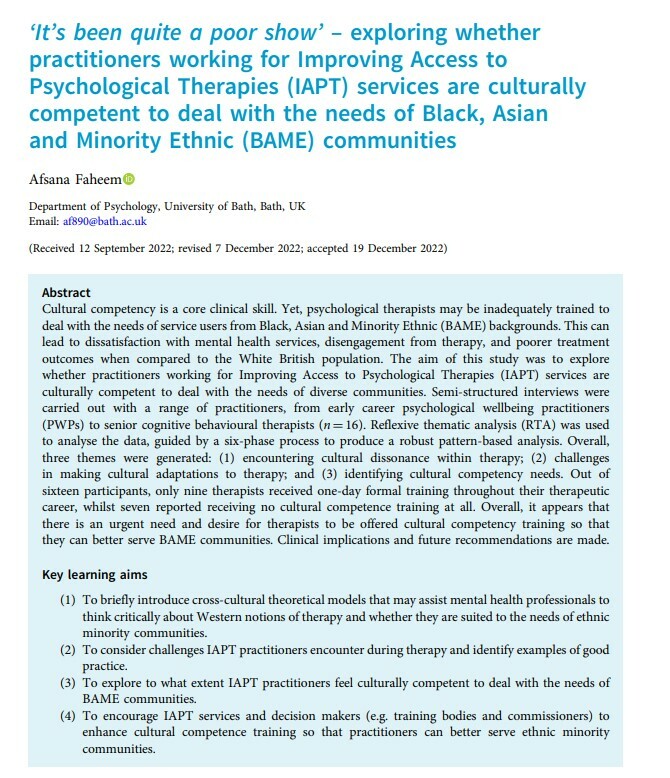
Researcher’s Corner: Recruiting for Cultural Competency
In this installment of Researcher’s Corner, Dawn Schmitz explores how to hire for the skill of cultural competency. I am grateful to Dawn for writing a thoughtful post that addresses not only the theory and practice of hiring, but how questions become research and subsequently, scholarly papers.
I think you will find the following post very interesting, and if you’d like to read more, see the following citation:
Smith, H. W., Schmitz, D., Shein, C., & Schmitz, with L. (2024). Recruiting for Cultural Competency: A Content Analysis of Archives Job Postings. American Archivist, 87(2), 438–465. https://doi-org.ezproxy.sfpl.org/10.17723/2327-9702-87.2.438
In 2018, I was working on a job posting for a new faculty position in our academic library: Community Engagement Archivist. How could we maximize our chances of recruiting and hiring a candidate who was capable of competently and ethically engaging with students, colleagues, and community partners? There is a wide range of cultural backgrounds represented on our campus and in our city of Charlotte, NC. We needed to be sure to carefully craft the required qualifications for this position.
For previous postings, we had used language like “Commitment to fostering an environment of mutual respect and inclusion in the classroom and workplace” (for an instruction archivist) or “Commitment to fostering an environment of multiculturalism and inclusion in the workplace” (for a digital archivist). But I wanted to move further in the direction of cultural competency as a requirement for this new position. In looking for language that would work, I perused other position postings in the field, but I didn’t find very much that helped.
After careful thought, we came up with two separate bullet points:
- Commitment to continuous personal and professional improvement in cultural diversity competence.
- Commitment to fostering an environment of mutual respect and inclusion in the community, reading room, classroom, and workplace.
Having these requirements for the position cleared the way for us to ask interview questions such as:
- “Tell us about a time when you have had the opportunity to play a role in making an organization, group, or environment more diverse, inclusive, or equitable. What steps did you take, and what was the result? This can relate to a workplace, educational or volunteer setting, social setting, or any other situation.”
- “If you were personally conducting an oral history interview with a member of an underrepresented community of which you yourself are not a member, what steps would you take to ensure you were honoring that community’s cultural values, ways of knowing, and perspectives?”
In the end, our search was successful, and I credit these interview questions with helping us discern which candidate would be most capable in the role. But I had a lingering concern: Since both the library and archives professions have institutionalized the value of cultural competency, then why don’t archivist job postings usually have anything related to cultural competency as a requirement?
But my sample was small. I decided it might be a good research project to look further into this: What is the commitment of the archives and library professions to cultural competency, and how common (or uncommon) is it for position announcements to reflect these values?
At the 2019 annual meeting of the Society of American Archivists, I caught up with Helen Wong Smith, who conducts workshops on cultural competency and has championed it in many other ways within the archives profession, and Cyndi Shein, whom I knew had done a lot of great work on DEI in recruitment. (I was fortunate to have shared with these two colleagues the experience of being part of the 2016 cohort of the Archives Leadership Institute.) We hatched a plan to systematically analyze postings for archives jobs and write about our results. We brought in Lisa Schmitz, a statistician (and my sister), to analyze our results. I knew she would help us make sense of the findings and write about them intelligently.
During three specified time periods between March and September of 2021, we downloaded all of the jobs posted by U.S. employers on the Archives Gig blog, a total of 499 postings after deduplication. We decided to manually code each one according to whether it called for cultural competency as a required or preferred qualification for the position.
First, we needed to write a code book to guide our discernment of what constitutes a cultural competency requirement in a job posting. We decided it was not necessary for the words “cultural competency” to appear (and we don’t necessarily endorse using that term, since not everyone is familiar with it). What should we look for?
We started with the basic concept that cultural competency is a framework used to advance one’s ability to function with awareness, knowledge, and interpersonal skills when engaging with people of different backgrounds, assumptions, beliefs, values, and behaviors.* Then, in order to further guide our understanding of how cultural competency is conceptualized within the LIS professions in particular, we conducted a literature review that looked at how the term was used and discussed by librarians and archivists.
We found that these writers viewed cultural competency as including elements of introspection and continual growth, and that it was not limited to the interpersonal realm but included an understanding of structural factors. So we derived a definition of cultural competency that included these concepts:
The capacity to continually improve one’s ability to function with self-awareness, open-mindedness, humility, respect, knowledge, and interpersonal skills when engaging people from all backgrounds and experiences. It involves an awareness and understanding of the significance of culture, beginning with one’s own, and an orientation of respectful curiosity towards the beliefs, values, and practices of others. A key component is the recognition of the structural, socioeconomic, and political factors that adversely affect diverse populations and the commitment to respond with policies or practices that recognize, affirm, and protect the dignity of individuals, families, and communities.
We determined that if any part of the above definition applied to a position, we would score it as requiring cultural competency. We also decided to look for language like “cultural awareness,” “cultural sensitivity,” “demonstrated ability working successfully with diverse cultures,” and “valuing differences.” We decided not to count postings that simply call for experience working in diverse environments or for candidates who will add to the diversity of the workplace.
With this guidance in hand, we completed the coding. When we had finished, we were stunned by our findings: only seven percent of job postings for archivists and related positions listed any knowledge, skills, or abilities relating to cultural competency among the requirements. We found this proportion was shockingly low, particularly since both the library and archives professions have made it a point to include cultural competency among their stated values for the past 15-20 years.
We also coded the job postings for several other factors, allowing us to discover some notable patterns. We found that ads for public-facing positions were much more likely to include cultural competency requirements than were those for technical service positions. While we understood why this was the case, we argue in the paper that every employee in the organization needs to be expected to strive for cultural competency. And those creating archival description and metadata have a unique responsibility to do so, given the need for responsible and, at times, reparative work in this area.
We also found that corporate employers were less likely to include cultural competency requirements than academic employers, and employers in the Midwest, Southeast, and Northeast regions of the U.S. were less likely to include them than those in the West.
With regard to the latter finding, given current political realities, it is likely that if this research were replicated today, this disparity would be even more stark and the Southeast would be even further behind the other regions. As an employee of a state university in the Southeast, I am acutely aware of how anti-DEI rules and regulations enacted at the state level can affect hiring practices, including how recruitment is now often circumscribed with respect to asking candidates about their views on diversity, equity, and inclusion. However, I would advise anyone who works at an institution that has enacted such anti-DEI provisions not to assume they cannot include a requirement that gets to cultural competency at some level.
While it may be forbidden to use a very strongly-worded requirement that gets at candidates’ personal values, it may be possible to include one that focuses on cultural competency as a basic job skill. For example, a strong statement such as this may not be allowed: “We are seeking professionals who enthusiastically embrace the empathy, courage, self-reflection, and respect of a multicultural, diverse, and inclusive workplace, and who strive to incorporate these values into their work and interactions.” However, the following may be allowed: “We are seeking candidates with a demonstrated commitment to continuous improvement in the ability to interact effectively with people from the full range of cultural backgrounds represented in our [company/campus/community].”
In my experience, it was worth asking for clarification on the guidance we received. I did so at my institution and confirmed that we are still allowed to include language such as the latter example above, despite the anti-DEI rules that have come down from the state level over the past few years. This paves the way for us to include cultural competency on our hiring matrices and ask interview questions pertaining to these important skills, thus enhancing our ability to recruit qualified candidates.
*(Mikel Hogan-Garcia, The Four Skills of Cultural Diversity Competence: A Process for Understanding and Practice (Belmont, CA: Brooks/Cole, 1999).)
Dawn Schmitz is the Curator of Rare Books and Manuscripts at the University of North Carolina at Charlotte, where she previously served as Associate Dean for Special Collections and University Archives. In these roles she has served on or chaired quite a few search committees for faculty and staff positions, continuously working with others to improve recruitment practices. She is an active member of the Society of American Archivists and a word nerd who served for 11 years on the committee that writes the Dictionary of Archives Terminology.
#culturalCompetency #librarians #libraries #libraryHiring #libraryInterview #LISCareers