
"[D]iscriminatory practices did not amount to active, targeted #persecution of the kind practiced throughout the #Christian West. As other #dhimmi were discriminated against in a similar manner, there was no specifically #antiJewish intent behind the #discrimination. Moreover, restrictions placed upon #Jews were often ignored by local #Muslim rulers. So long as #Jewish communities did their duty as dhimmi, above all by paying special poll taxes and accepting Muslim superiority, many of the restrictions placed upon them were often relaxed.
The mobility of Jews in the #Islamic world created ideal conditions for the dissemination of Jewish culture on a much wider scale than seen anywhere else. Jewish communities could share cultural developments, exchange goods, and teach each other about unique beliefs and practices.
#Jews were increasingly urban throughout the #IslamicGoldenAge..."










![The image depicts a coastal scene with the sea taking up most of the background, showing several ships at varying distances from each other. In the foreground and middle ground, there are structures that appear to be part of an old town or cityscape near the seaside. These include domed buildings possibly indicating historical architecture, which could suggest Islamic influences given their shape resembling those found in places like Jaffa in Israel.
The sky is clear with a hint of haze over one of the ships on the horizon, and there's visible activity at sea as indicated by splashes or waves near some boats. The color palette has an aged quality to it, which could be due to fading effects from age but also adds character to the photograph giving hints that this might not have been taken in recent times.
The photo seems to capture a moment of daily life and commerce along what appears to be Jaffa's coastline, as mentioned in its caption. This scene is rich with historical connotations, suggesting it could serve as an important cultural or educational reference point for understanding the maritime activities and urban landscape around this specific location during mid-20th-century period.
The photograph has a size specification of 2 x 2 inches, implying that while it may have been taken on film given its age indicated by color saturation and clarity, such photographs we [...]](https://files.mastodon.social/cache/media_attachments/files/115/701/565/239/808/094/original/d8e696494530e466.jpeg)



![The image is a black and white photograph capturing a bustling street scene. In the foreground, there are several individuals in traditional Arab dress, including headscarves and robes, walking or standing near an older model car with chrome details. One man stands prominently beside the vehicle, holding onto its door handle; he's dressed formally in a light-colored suit jacket, dark trousers, white shirt, and hat, indicating possible official status.
Behind this group of people is a large crowd dispersed across the street, suggesting some sort of public event or gathering. The background features buildings with various architectural designs, including balconies and windows that suggest urban surroundings. Some individuals in the crowd are wearing headgear indicative of Islamic culture, while others have different styles, hinting at diverse cultural influences.
A notable figure is a man seated on what appears to be a cart attached to the car; he's dressed distinctively with an ornate scarf around his neck and holds a cane or walking stick. His relaxed posture contrasts with the movement in the crowd behind him. The overall atmosphere seems lively, possibly celebrating a significant event as suggested by captions mentioning King Hussein, Glubb Pasha (likely a reference to T. E. Lawrence), and Arab revolt anniversaries.
The photograph carries historical context and is credited to Matson Photo Service, likely indicating [...]](https://files.mastodon.social/cache/media_attachments/files/115/649/128/330/855/789/original/3783b8a4f73b83e3.jpeg)

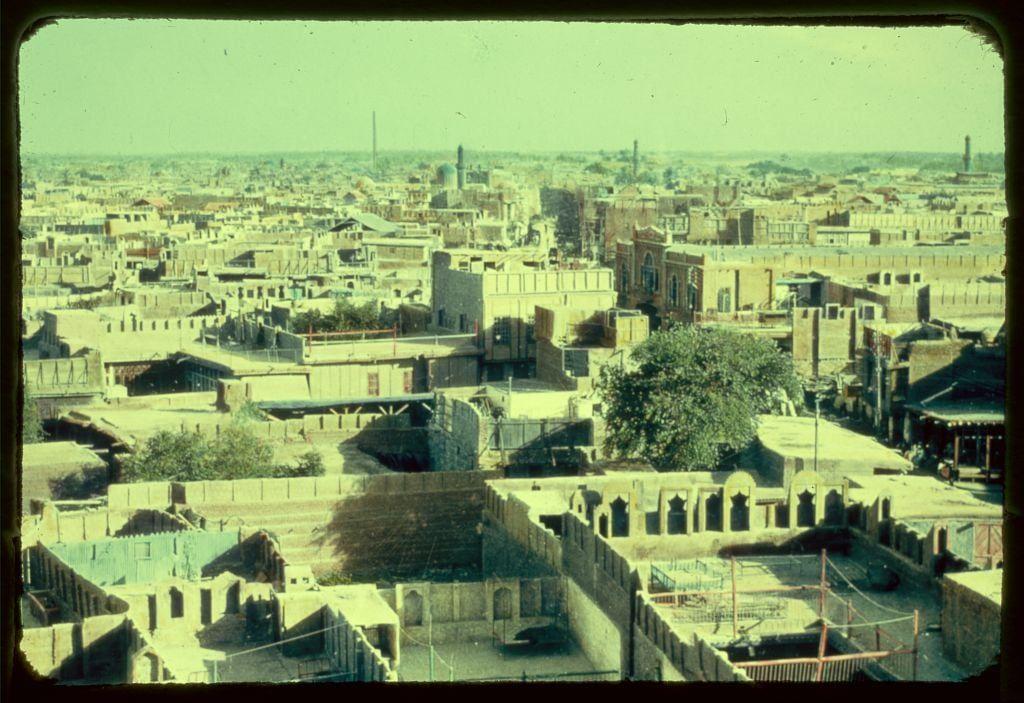
![The image depicts an architectural structure with a blend of historical and religious significance. In the foreground, there is an open courtyard paved with stone slabs, showcasing signs of wear which suggests age or heavy use over time.
Two prominent domed structures rise from either end of what appears to be a large rectangular building constructed with dark brown brickwork. These domes have iron grills on their top and small windows at the base level, possibly serving as ventilation for storage below or simply decorative elements typical in Islamic architecture.
The central focus is an older stone minaret tower, featuring weathered stonework indicative of considerable age, likely centuries old. The design includes a pyramidal roof with a weathervane on top and smaller dome-like structures at the base, characteristic of many historic mosques or religious institutions found across the Middle East.
The background shows part of another stone structure with similar architectural style to that in the foreground, suggesting this could be within a walled complex like an old city's fortress. The sky is overcast with white clouds against a pale blue backdrop and there are modern street lamps visible on the left side, indicating contemporary maintenance or use of these historic sites.
The image appears aged as if taken several decades ago based on its graininess and color saturation; it carries historical weight, likely dati [...]](https://files.mastodon.social/cache/media_attachments/files/115/628/783/314/404/663/original/b14f81d3e7c29fe7.jpeg)