Principles of Managerial Finance 16th Edition focuses on essential knowledge for making effective financial decisions in a competitive business environment.
Read more, free from restrictions 👉 https://lttr.ai/AoqPO
Principles of Managerial Finance 16th Edition focuses on essential knowledge for making effective financial decisions in a competitive business environment.
Read more, free from restrictions 👉 https://lttr.ai/AoqPO

Please boost
Hey fedi, to people who are okay with pirating school textbooks, can you help me find this outrageously priced essential book for IB teachers?
ISBN: 978-1382048538
Amazon Link:
It has to be grade 4-5 as I tutor a 5th grade student soon and need to learn how IB board assesses its students, thank you!
Tags: #TextBook #TextBooks #boost #AskFedi #piracy #IBboard #IB #tutoring #edutooters
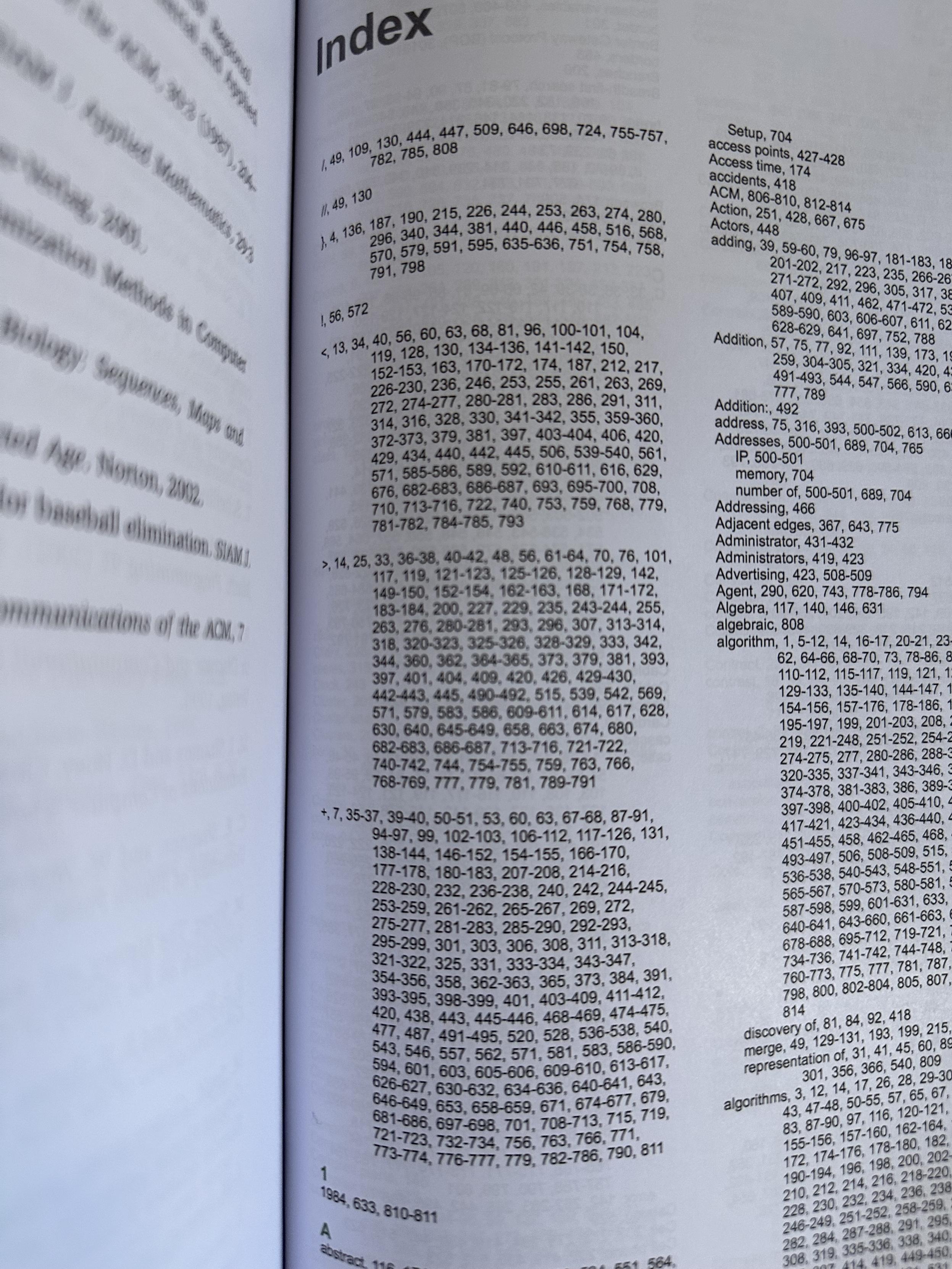
Incredible dedication to indexing in Kleinberg & Tardos.
#Algorithms #Algorithmics #ComputerScience #Books #ProfessorLife #Textbook #AcademicMastodon #AcademicChatter
Keeping busy with Sudoku, Wordle, Crosswords, and mining textbooks for statements to practice proving in #Metamath ...
Inspired by this video playlist on #RealAnalysis #Math
https://www.youtube.com/playlist?list=PLYPU-RArkLZNwMZ55-y8FZZEeY7zCJX59
Which was created from https://www.jirka.org/ra/ _Basic Analysis:
Introduction to Real Analysis_ by Jiří Lebl. #JiříLebl a #CreativeCommons (4.0) free #math #textbook
In Metamath's compressed format, my proofs of strong induction over the natural numbers took 316 bytes, well-ordering of the natural numbers: 376 bytes, 2ⁿ⁻¹ ≤ n! : 1204 bytes, formula for finite sum of geometric series: 2566 bytes. The last has 147 steps, some of which are reused and some of which depend on up to 8 prior steps and on a truncated library of 30477 statements of syntax, axioms, definitions, and theorems from the wider world of Metamath.

@DeliaChristina just like Israel "ending the war" with Palestine so that they can continue their genocide with less media and public scrutiny. #textbook
Blocked by person refusing to believe a #Mathematics #textbook and #proofs because of a random #Wikipedia article that doesn't cite any Maths textbooks, and in fact has proofs in it that actually contradict the conclusion! (the series 0.1, 0.01, 0.001, 0.0001,... never reaches zero, even as the series approaches infinity - it's a hyperbola with an asymptote of 0 - which you think would be self-evident, and yet here we are) Welcome to the #disinformation age! 😡

RE: https://mathstodon.xyz/@oantolin/115956880232782872
this is the reason why i re-wrote the #differentialgeometry book of a course and gave it freely to anybody, the unavailability of exercises' solutions is really the worst thing a #textbook can show
Sarah’s research examines how psychological research can be applied to learning and teaching.
Read more 👉 https://lttr.ai/AneAZ
Leanpub book LAUNCH 🚀 How to Build and Fine-Tune a Small Language Model: A Step-by-Step Guide for Beginners, Researchers, and Non-Programmers by Professor J. Paul Liu
Watch here: https://youtu.be/DehQnqj2CJY
#books #leanpublishing #selfpublishing #booklaunch #technology #ai #learning #textbook #llm #student #career
Arm Angles in American Sign Language: The Textbook That Teaches What Other Textbooks Ignore
Watch any native signer and then watch an intermediate student. The difference is not in the handshapes. It is not in the facial expressions, though those matter. The difference lives in the arms. The native signer’s shoulders engage when emphasis requires it. The elbows extend and contract with meaning. The signing space expands for formal address and contracts for intimacy. The student, trained to focus on hands and face, moves through space as if the arms were merely transportation for the fingers. This is the gap that Arm Angles in American Sign Language addresses. It is the textbook we wished existed twenty years ago.
Most ASL instruction concentrates on the parameters everyone agrees matter: handshape, location, movement, palm orientation, non-manual markers. These are the building blocks, the phonological primitives that distinguish one sign from another. What gets lost in this necessary attention to fundamentals is the architecture that supports everything else. The arm is not merely a delivery system for the hand. It is an articulator in its own right, and its positioning carries semantic weight that affects meaning, register, and comprehension in ways that intermediate and advanced learners rarely understand explicitly.
ASL Linguistics SeriesConsider the sign UNDERSTAND. In citation form, the index finger flicks upward near the forehead with a wrist movement. The arm positions the hand, but the movement itself is distal, located at the wrist and fingers. Now consider the same sign in emphatic use: the forearm moves, the signing space expands, the shoulder engages. The handshape has not changed. The location has not changed. What has changed is proximal articulation, the engagement of shoulder and elbow and upper arm in the production. That engagement signals emphasis, formality, certainty. Reduce the arm involvement further than citation form and the sign reads as casual, rapid, intimate. The same lexical item carries different pragmatic meaning depending on how the arm participates.
This is what we mean by proximal articulation, and this is what the textbook examines across twelve chapters and comprehensive supplementary materials.
The Collaboration
Janna Sweenie has taught American Sign Language at New York University for over thirty-five years. She created the ASL 5 course for the NYU minor, served as Program Coordinator from 2017 to 2020, and has worked as a consultant for Microsoft, Google, and New York City museums. She is a two-time recipient of the NYU Steinhardt School Administrator Award. She was born Deaf in Council Bluffs, Iowa, and graduated from the Iowa School for the Deaf. For eighteen years she has served as a Vocational Rehabilitation Counselor for the Deaf in the State of New York Department of Education.
David Boles has taught American Sign Language at NYU and other institutions for over two decades. He holds an MFA from Columbia University and founded David Boles Books Writing and Publishing in 1975. His background in dramatic literature informs the textbook’s attention to register, performance, and the expressive possibilities of signed discourse.
Together we have written Hand Jive: American Sign Language for Real Life, Picture Yourself Learning American Sign Language, Level 1, Day One: Learning American Sign Language in 24 Hours, Hardcore ASL Textbook for Levels 1-7, and American Sign Language Level 5. Our work spans beginning to advanced instruction, print and video, classroom and self-study. What we have not done until now is write the book that addresses what we kept having to explain in person: why the arms matter, how they function, and what happens when you get them wrong.
What the Textbook Contains
The book opens with anatomy. Not because anatomy is inherently interesting, though it is, but because understanding the skeletal framework, joint system, and muscular apparatus of the signing arm clarifies everything that follows. Why can the shoulder rotate in ways the elbow cannot? Why do certain sign movements fatigue the arm while others remain sustainable? What does neutral position mean anatomically, and why does departure from neutral carry meaning?
From there the textbook moves through the three spatial dimensions of signing space: vertical (height carries semantic information distinguishing verb tenses and marking formality), horizontal (enabling reference establishment and tracking), and sagittal (the temporal plane that maps time onto space, with forward movement indicating future and backward movement indicating past). Each dimension involves arm positioning. Each dimension affects meaning in ways that isolated attention to handshapes cannot capture.
The core theoretical concept is the proximal/distal distinction. Signs produced with more proximal involvement, engaging the shoulder and upper arm as primary articulators, tend to read as more emphatic, more formal, more careful, more public. Signs produced with more distal involvement, wrist and finger movements, tend to read as more casual, more rapid, more intimate, more efficient. This is not absolute. Sign-specific conventions override general tendencies. But the correlation provides a heuristic that helps learners understand how arm engagement affects the social and pragmatic meaning of what they sign.
Subsequent chapters address classifier predicates and arm-as-referent, two-handed coordination and symmetry constraints, elbow mechanics and sign modification, non-manual marker integration with arm positioning, biomechanics and signing health, acquisition and pedagogy, and variation across dialect, generation, and individual style. The final chapter considers future directions in ASL research, including technological developments in sign language recognition and the evolving landscape of ASL instruction.
For Whom This Book Is Written
This is not a beginning textbook. Readers should have completed at least intermediate ASL coursework or possess equivalent proficiency. The book assumes familiarity with basic phonology, parametric structure, and glossing conventions. It is written for advanced students preparing for interpreter certification, working interpreters seeking to refine their skills, ASL instructors developing curriculum for upper-level courses, Deaf education professionals, and researchers in sign language linguistics. It is also appropriate for mature signers who want to understand the theoretical foundations of what they do intuitively.
The supplementary materials include a comprehensive glossary, notation guide for representing arm angles in written form, practical exercises for each chapter progressing from observation to production, self-assessment checklists, and additional resources pointing to video materials and research literature. Instructor materials include lesson plans, syllabus templates, frequently asked questions, observation guides, and assessment rubrics. The book is designed for both independent learners and classroom adoption.
The Problem This Book Addresses
ASL instruction in the United States has improved dramatically over the past four decades. Recognition of ASL as a legitimate language with its own grammar and syntax, rather than a simplified gestural system for the hearing impaired, has transformed both research and pedagogy. Yet instructional materials continue to treat arm positioning as secondary, intuitive, something that will come naturally with exposure. It does come naturally for some learners. For others it does not, and they plateau at a level of competence that never quite reads as fluent even though their vocabulary and grammar are technically correct.
The plateau is not a vocabulary problem. It is not a grammar problem. It is a register problem, a prosodic problem, a spatial problem that lives in the arms. The signer who never learns to modulate proximal and distal articulation across contexts will sign like someone reading aloud from a phrasebook: comprehensible but mechanical, correct but not native. This textbook addresses that gap directly, providing the explicit instruction and theoretical framework that allows learners to understand what they need to practice and why it matters.
Getting the Book
Arm Angles in American Sign Language: A Study of Proximal Articulation in Signed Discourse is available now as a Kindle edition for $14.99 at Amazon and paperback version for $19.99. A free PDF is available at David Boles Books for those who prefer that format or who want to evaluate the textbook before classroom adoption. Additional materials are available at HardcoreASL.com.
The arms have always mattered. Now there is a textbook that explains why, that teaches how, and that gives learners and instructors the tools they need to address what other materials ignore. This is the book we wished we had when we started teaching. We are glad to finally offer it to everyone else.
#angle #armAngles #armMovement #articulation #asl #bolesBooks #davidBoles #direction #iowaSchoolForTheDeaf #jannaSweenie #language #learning #linguistics #medical #proximity #teaching #textbook
Basic Conversational Spanish by Gregory Gough La Grone, Harold C. Snyder https://hokkaidomarket.net/books-info.php?item=1544 #REFERENCE #BOOKS #BOOKSHOP #TEXTBOOK #bookstodon

Bộ Giáo dục và Đào tạo vừa chính thức đề nghị cơ quan công an vào cuộc xác minh, xử lý các hành vi xuyên tạc nội dung lịch sử trong bộ sách giáo khoa "Kết nối tri thức với cuộc sống". Động thái này nhằm bảo vệ tính chính xác của chương trình giáo dục và ngăn chặn các thông tin sai lệch gây hoang mang dư luận.
#BoGiaoDuc #GiaoDuc #SachGiao Khoa #TinTuc #VietNam #Education #Textbook #News #FactCheck
https://vtcnews.vn/bo-gd-dt-de-nghi-cong-an-xac-minh-hanh-vi-xuyen-tac-noi-dung-sach-giao-khoa-ar
👨🔬📚 Dr. Marc Lichtman has unveiled his magnum opus on #SDR and #DSP using #Python, where he generously offers amateur radio enthusiasts the chance to have their names immortalized in the hallowed e-pages of his Patreon-funded #textbook. 🎉📖 Because nothing screams cutting-edge tech like a digital autograph in the bottom left corner! 🖊️💾
https://pysdr.org/content/intro.html #DrMarcLichtman #AmateurRadio #HackerNews #ngated
Mein Namensvetter-Portal #Textbook.World versammelt mehr und mehr coole Autoren:
https://phenixxenia.org/wiki/Hannes_Hofbauer_am_12.12.2025:Inhalt

Analysis of 18th- and 19th-Century Musical Works in the Classical Tradition by David Beach & Ryan McClelland, 2012
Analysis of 18th- and 19th-Century Musical Works in the Classical Tradition is a textbook for upper-level undergraduate and graduate courses in music analysis.

Online Textbook for Braid groups and knots and tangles
https://matthematics.com/redoak/redoak.html
#HackerNews #Online #Textbook #for #Braid #groups #and #knots #and #tangles #mathematics #education #braids #knots #tangles #online #learning
Nutrition: Concepts and Controversies 16e by Frances Sizer & Ellie Whitney, 2018
More conversational than a pure-science text, this book explores the essentials of nutrition--including how the body breaks down and uses food, food safety, sports nutrition and special nutritional needs throughout the human life cycle--and asks you to weigh in on relevant debates, such as world hunger, chronic diseases, dietary guidelines and eating patterns.

Gardner’s Art through the Ages: The Western Perspective 14e Volume 2