Morning sunrise between apple trees covered in hoarfrost
#winter #winterscape #frost #appletree #landscape #germany #dreieich #sunrise #sunrisephotography #landscapephotography
Choral music by Lūcija Garūta: from sweet-voiced to incendiary
Thanks to the boom in female composers being rescued from oblivion lately, I was sent a CD by Latvian Lūcija Garūta (1902-1977). The album is entirely dedicated to her choral music and named after the opening song Apple Tree, which she composed in 1956. A number of pieces have their premieres on this album.
Lūcija Garūta was a celebrated song composer in Latvia in the early 20th century. During recitals, the halls were full, where she was praised not only for her beautiful songs but also for her delicate piano accompaniment. She studied in Riga with Jāzeps Vītols, among others, and in Paris with Alfred Cortot and Paul Dukas. She was attracted to the aesthetics of the Groupe des Six, but also incorporated elements of Latvian folk music.
In the CD booklet we read that her work – as was the case with many composers from the former Soviet Bloc – can be divided into roughly two periods, before and after WWII. In Latvia great social and cultural freedom prevailed until 1940, when Russia annexed the three Baltic states and a period of repression and Russification began. Anything that even hinted at modernity was banned.
The apparatchiks demanded large-scale choral works in major keys that celebrated the Soviet state. Up to then, Garūta had written little for large choirs and she seemingly accommodated to the new cultural climate. Yet she managed to subtly maintain her own voice within the frameworks imposed by the Soviets.
The Latvian Radio Choir collected material from both public and private collections, but unfortunately compositions from the early period are missing, so we cannot form a picture of her development. Influences of the Groupe des Six are not really discernible in the 21 recorded choral songs, but her music is appealing and heartfelt, and displays a great love for her homeland.
Apple Tree, for instance, is a disguised ode to the fortitude of the Latvian people. This is symbolised by an apple tree on the banks of the Daugava, the longest river in the Baltic States. The water ‘sighs in restlessness, but the apple tree – your people – will never die’. The harmonies of the beautifully alternating male and female choir switch between sweet-voiced euphony and wistful lamentation, with a slightly dissonant touch.
This is even more true for May we Latvians forever be free to a poem of herself, which Garūta probably composed in 1940. With its sing-along melodies, this breathes the atmosphere of folk music, while uncouth, Russian-sounding basses seem to allude to the ruthless scourge of the occupying forces.
With its sudden changes between major and minor, extreme dynamics and highly dissonant exclamations, The Voice of Peace is one great indictment of war: ‘man was not born to be mowed down in senseless death’. – Not surprisingly, Garūta’s work faded into the background at the time of Soviet domination.
The performance by the Latvian Radio Choir is outstanding and soulful. Conductor Sigvards Kļava and his singers deserve credit for bringing these compelling songs out from under the dust.
https://www.youtube.com/watch?v=ajwcDD7lIqo&ab_channel=SKANI
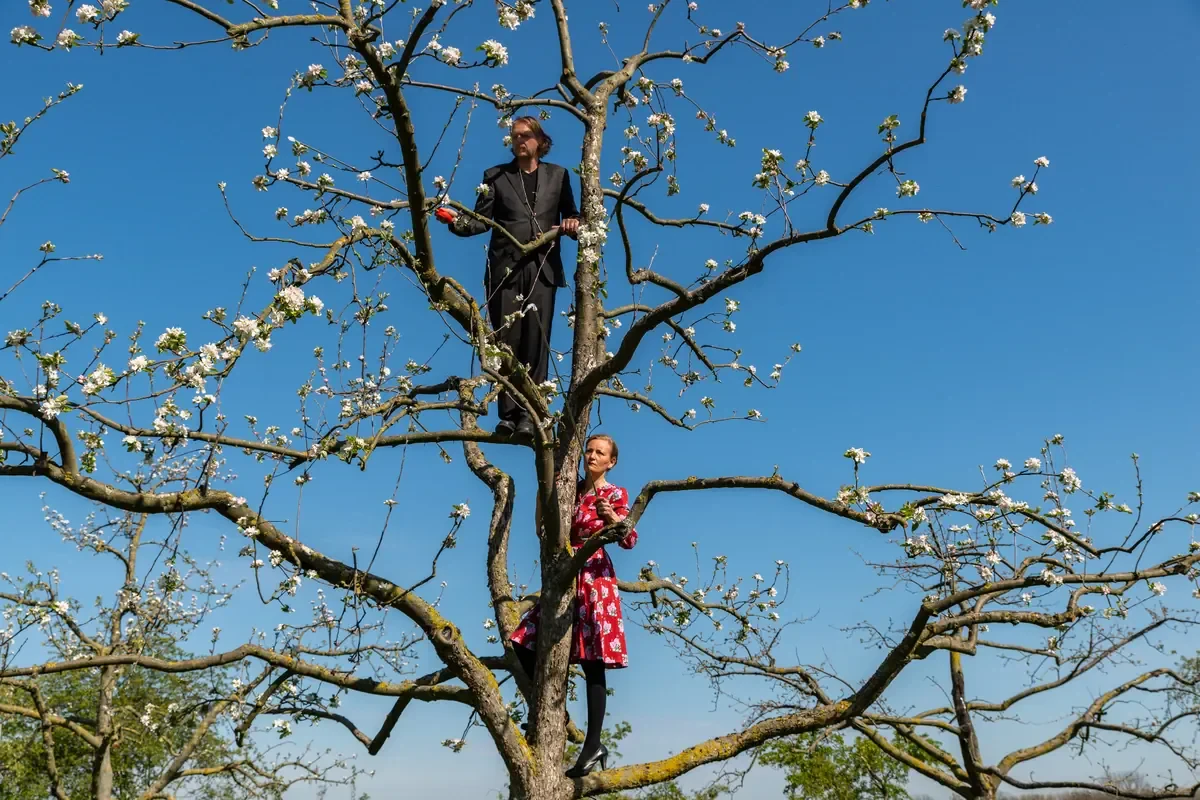
Bizarre. It's mid-December in the Netherlands and the pruned apple tree is already sprouting again. #climatechange #appletree #blossom
These are most of what remains of this year’s #Harvest of #Apples from our #AppleTree. I only really like green apples which are crispy and sour. These are of the #GrannySmith variety and they taste fantastic.
Äpfel im Garten
bunte Flecken, verloren
im Herbstwind
#DailyHaikuPrompt - Apple
#Haiku #Poetry #Äpfel #AppleTree #Garten #Herbst #Aurumn #Fall
Apples came in on the most dead looking branches.
St. Dorothy/Dorothea of Caesarea
St. Dorothy is a 4th century virgin martyr who was executed at Caesarea Mazaca. She’s called a martyr of the late Diocletianic Persecution. Although her death happened after the resignation of Diocletian himself.
Dorothea & her companion, Theophilus, are mentioned in the Roman Martyrology as martyrs of Caesarea in Cappadocia. Her feast day is on February 6. She’s officially recognized as a virgin martyr.
She was removed from the General Roman Calendar by Pope Paul VI’s motu proprio Mysterii Paschalis, being judged as not having “universal significance.” Her feast day does still remain in some regional calendars & the Tridentine Calendar.
Her early life is unknown. The first record of her, Martyrologium Hieronymianum, only has 3 basic facts: her day of martyrdom, the place where it happened, & her name & Theophilus’ name.
Dorothea of Caesarea, virgin & martyr, was persecuted during the persecution of Diocletian on February 6, 311 at Caesarea in Cappadocia. She was brought before the prefect Sapricius, tried, tortured, & sentenced to death. On the way to the place of execution, the pagan lawyer, Theophilus said, mockingly, “Bride of Christ, send me some fruits from your bridegroom’s garden.”
Before she was executed, she sent him, by a 6 year old boy, her headdress which was found to be filled with a heavenly fragrance of roses & fruits. Theophilus at once confessed himself a Christian, was put on the rack, & suffered death. This is the oldest version of the legend.
In the Western church, Dorothy of Caesarea has been venerated since the 7th century. In the late medieval Sweden, St. Dorothy was considered to be the 15th of the Holy Helpers.
In art, she’s accompanied with Saints Barbara, Catherine, & Margaret. They form a quartet of female virgin martyrs called Quattuor Virgines Capitales, meaning, “The Four Capital Virgins.”
She’s the patroness of gardeners. Because of her virginal attribute of a wreath of roses. On her feast day (February 6), trees are blessed. She’s also the patroness of brewers, brides, florists, midwives, newlyweds, & the village of Pescia, Italy. The Sisters of St. Dorothy is a congregation of sisters/nuns, who are occupied with teaching.
St. Dorothy is often pictured as a virgin carrying a basket of flowers, sometimes with fruit, & also wearing a crown of roses. She has also been pictured as being surrounded by stars as she kneels before an executioner; crowned with palm, referring to the martyr’s palm; in an enclosed garden or an orchard with the Christ Child in an apple tree; leading the Christ Child by the hand; veiled with flowers in her lap; & holding apples from Heaven.
One-Time Monthly YearlyMake a one-time donation
Make a monthly donation
Make a yearly donation
Choose an amount
$1.00 $5.00 $10.00 $1.00 $5.00 $10.00 $5.00 $10.00 $15.00Or enter a custom amount
$Your contribution is appreciated.
Your contribution is appreciated.
DonateDonate monthlyDonate yearly
#4thCentury #6February311 #7thCentury #AppleTree #Brewers #BrideOfChrist #Bridegroom #Brides #Caesarea #CaesareaMazarca #Cappadocia #ChristChild #Christian #DiocletianicPersecution #DorotheaOfCaesarea #EmperorDiocletian #February6 #Florists #FourCapitalVirgins #Gardeners #GeneralRomanCalendar #Heaven #HolyHelpers #Italy #Martyr #MartyrSPalm #Martyrdom #MartyrologiumHieronymianum #Midwives #MotuProprio #MysteriiPaschalis #Newlyweds #Nuns #Pescia #PopePaulVI #QuattuorVirginesCapitales #RomanMartyrology #Roses #Sapricius #SistersOfStDorothy #StBarbara #StCatherine #StDorothy #StMargaret #Sweden #Theophilus #TridentineCalendar #Virgin #VirginMartyr #WesternChurch #WreathOfRoses