#geometry

2026-02-07

Saturday, February 7, 2026

Russia launches Friday morning rush hour missile, drone attack on Ukraine -- Drone discovered on Moldovan territory near Ukraine border -- 18 prisoners in 24 hours: Ukraine's Azov International reveals video of Dobropillia clearing operation -- Canadian female fighter at the forefront of Ukraine's drone war ... and more

activitypub.writeworks.uk/2026

Pictured is the drone found in the village of Sofia, in the Drochia District of Moldova on Feb. 6, 2026. (Moldova's National Police)
Matthew Malthousecalmeilles@mstdn.social
2026-02-07
2026-02-07
ƧƿѦςɛ♏ѦਹѤʞspacemagick
2026-02-06
Public Domain Image Archivepdimagearchive
2026-02-06

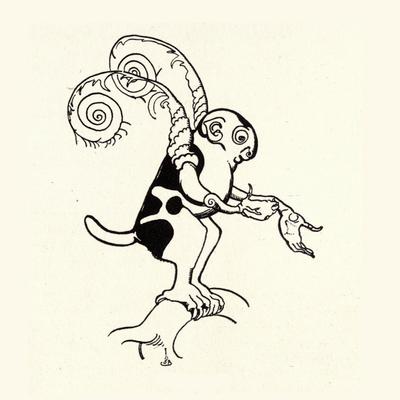
Illustration by Charles Hinton, from The Fourth Dimension (1904).

Source: University of Toronto Libraries / Internet Archive

pdimagearchive.org/images/98c4

2026-02-06

According to the biography by Diogenes Laertius, Pythagoras (c.570–c.490 BCE) ‘held that the most beautiful figure is the sphere among solids, and the circle among plane figures’.

This aesthetic preference for the circle and sphere can be traced through thinkers like Plato (who, according to later writers, set the problem of describing the movements of the heavens using uniform circular motions), Cicero (106–43 BCE), and Proclus (410/12–485 CE), and into the middle ages.

Thomas Bradwardine (1290/1300–1349), one of the mediaeval ‘Oxford calculators’, was obviously influenced by this tradition when he wrote that the circle ‘is the first and most perfect of figures, the simplest and most regular, the most capacious and the most beautiful of figures’.

But Bradwardine then presented evidence that he saw as attesting to the beauty and perfection of the circle: (1) the construction to find the centre of a circle by bisecting a diameter found as the perpendicular bisector of a chord; (2) that the intersections of six equally-spaced radii with the circumference define a regular hexagon; (3) that exactly six circles of equal size can touch a given circle (see attached image).

For Bradwardine, the perfection of the circle was thus linked to the perfection of the number 6 = 1+2+3: the construction involves six intersections with the circle; the hexagon is made up of six lines; the third result involves six outer circles.

1/2

#MathematicalBeauty #HistMath #Pythagoras #Bradwardine #geometry #aesthetics #PerfectNumber

Three diagrams illustrating Bradwardine's evidence for the beauty and perfection of the circle. The first shows how to find the centre of a circle by bisecting a diameter which is itself found by bisecting a chord, and shows how the chord, diameter, and bisector together produce six intersections with the circumference. The second shows how the intersections of six equally-spaced radii with the circumference form a regular hexagon. The third illustrates how exactly six circles of equal size can touch a given circle.
2026-02-05

Two ways of cutting an infinite 3-periodic heptagonal tiling along higher order modules.

Module 1 of 2.

#tiling #geometry #math #3d #combinatorics

dr 🛠️🛰️📡🎧:blobfoxcomputer:davidr@hachyderm.io
2026-02-05

#inkscape is still working perfectly with the Brother #scanncut. No real software/format issues which is surprising and pleasant. (Although to re-iterate, text needs to be converted to path. But that's true in (almost?) all vector graphics-processing toolchains)

That said, my particular project is having some hiccups

Workflow: My client/wife wants #Galentines shotglasses. I made a single "blank" and then added alternate designs as layers. But when you load that in the machine all the layers are still obviously there right on top of each other

I messed a little Inkscape's "export only selected layers" but that didn't seem to do what I expected for unclear reasons. In any case, it really makes more sense to have alternate designs spread around a page to view all at once. That makes them easier to view and is how I'll want to print the final job anyway.

#3D #Geometry: The shotglasses are heart-shaped and also have some curvature from top to bottom. There's just no way to wrap a flat piece of vinyl around a positive-curvature item without wrinkles.

I think I've got the design small enough and with gaps in the right places that I can make it work. It also helps a lot to remove the transfer sheet early and just lightly deform only the vinyl itself until it is flat.

I mocked up one shotglass last night as a design review for the client but haven't heard back. Final product is due on Tuesday.

2026-02-05
Fassade #3
Facade #3

LeopoldTower Wohnhochhaus, Vienna, querkraft Architects
#photography #photo #Fotografie #UrbanArchitecture #urban #architecture #AbstractPhotography #bwPhoto #bw #BlackAndWhite #geometry
Das Foto zeigt eine schwarze, weiße Gebäude-Fassade mit wiederkehrenden geometrischen Mustern. Horizontale Linien und schräge Flächen erzeugen einen 3D-Effekt. Die Struktur wirkt dynamisch und täuscht Tiefe und Bewegung vor. Der Kontrast zwischen hellen und dunklen Flächen verstärkt diesen Effekt. Ein abstraktes, künstlerisches Foto, das die Ästhetik moderner Architektur betont.
 ---- 
The photo shows a black and white building facade with recurring geometric patterns. Horizontal lines and sloping surfaces create a 3D effect. The structure appears dynamic and simulates depth and movement. The contrast between light and dark areas enhances this effect. An abstract, artistic photo that emphasizes the aesthetics of modern architecture.
WIRED - The Latest in Technology, Science, Culture and Businesswired.com@web.brid.gy
2026-02-04
2026-02-04

As noted in a previous post, Archimedes thought highly of the result that the ratio of either the volumes or surface areas of a cone, a sphere, and a cylinder exactly circumscribing them is $1:2:3$.

So did others: three centuries later, the architect Nicon (d.149/50 CE), father of the philosopher and physician Galen (129–c.210/217 CE), thought it fitting to point out the ratio of the configuration in a public inscription in his city, Pergamon:

‘the cone, the sphere, the cylinder.
If a cylinder encloses the other two shapes,
[...]
Competition the principle and in solids
the progression $1 ∶ 2 ∶ 3$,
a noble, divine equalization,
but also mutual interdependence
of the solids, always in the ratio $1 ∶ 2 ∶ 3$.
They should be beautiful and wonderful,
the three solid shapes’

Nicon doubtless admired these ratios as an architect: a sphere inside a cylinder brings to mind the Pantheon at Rome, of which the Temple of Zeus Asclepius Soter in Pergamon was a half-scale copy. These buildings were designed so that a basically cylindrical rotunda was crowned with a hemispherical dome under which a sphere would fit (see attached image).

[Each day of February, I am posting a story/image/fact/anecdote related to the aesthetics of mathematics.]

1/2

#MathematicalBeauty #HistMath #Archimedes #geometry #architecture #aesthetics

Diagram showing a cross-section of the Pantheon at Rome and how a sphere would fit under its dome.
2026-02-04

I've become interested in polyominoes recently and have had a few questions about them I couldn't easily find answers to. Here's one:

Let's call an n-omino "balanced" if its 2 colouring has \(\lfloor\frac{n}{2}\rfloor\) cells of one colour and \(\lceil\frac{n}{2}\rceil\) cells of the other colour. Is there a nice structural characterisation of balanced n-ominoes?

I am looking at tilings of a certain kind and I can rule out unbalanced n-ominoes and non-trees. So I am particularly interested in what balanced trees look like.

Follow up: is every 2-connected n-omino balanced?

#math #mathematics #geometry

2026-02-04

How can angle BPC (labelled x) be found using basic circle theorems/geometry?

Do I need some construction lines to unlock the problem, perhaps through the use of similar triangles APC and BPD?

Thank you in advance for any help offered.

#maths #mathematics #geometry

A circle with two chords (AB and CD) intersecting at point P. CD is a diameter measuring 24, with P splitting it into lengths of 20 and 4. AB measures 21 and P splits this into lengths of 16 and 5. The obtuse angle BPC is marked in red and labelled x.
2026-02-03

#TilingTuesday Just the triangles of 27 Snub Cubes

#Tiling #Math #MathArt #Geometry #Art

꧁ᐊ𰻞ᵕ̣̣̣̣̣̣́́♛ᵕ̣̣̣̣̣̣́́𰻞ᐅ꧂idontlikenames@mastodon.gamedev.place
2026-02-03
2026-02-03
A horseshoe arch of of pale yellow stone contains an intricate zellij tiling of green, turquoise, blue, white and golden brown tiles. Interlaced lines form sixteen-pointed rosettes of two kinds. The symmetrical design has several types of geometric shapes.
2026-02-03

Max Dehn (1878–1952) said that Archimedes’ (c.287–212 BCE) discovery that the surface area of a sphere was four times its great circle was the one of the most beautiful results of Greek mathematics.

Archimedes himself had a high opinion of this result and two others in his two books ‘On the Sphere and the Cylinder’: that the volume and surface area of a sphere and a cylinder exactly circumscribing it are in the ratio $2 : 3$. One can add a cone fitting inside the cylinder to have ratios $1 : 2 : 3$ (see 1st attached image).

It has been suggested that Archimedes’ conjectures for these ratios may have been guided by a conscious or unconscious search for beautiful integer ratios between geometric configurations. There is no direct evidence for this motivation, but Archimedes’ work seems to exhibit a preference for small integer ratios.

According to Plutarch, Archimedes desired that his tomb should be marked by a cylinder enclosing a sphere and an inscription of the ratio of the one to the other; Cicero related how he had sought out Archimedes’ tomb and found a column just so inscribed (see 2nd attached image).

[Each day of February, I intend to post an interesting story/image/fact/anecdote related to the aesthetics of mathematics.]

1/2

#MathematicalBeauty #HistMath #Archimedes #Plutarch #Cicero #geometry #aesthetics

Diagram showing a cylinder circumscribing a sphere and a cone. The base of the cone is the base of the cylinder, and their heights are equal.Paolo Barbotti's painting ‘Cicero discovering the tomb of Archimedes’ (1853). Cicero is depicted with a group of other people, old and young. He is gesturing towards a square pillar marking the tomb of Archimedes, near the top of which is carved a diagram showing a cylinder circumscribing a sphere and a cone.

Client Info

Server: https://mastodon.social
Version: 2025.07
Repository: https://github.com/cyevgeniy/lmst