#middleEnglish

John Wycliffe

His last name is also spelled: Wyclif, Wickliffe, & Wicklyf.

He’s an English scholastic philosopher, Christian reformer, Catholic priest, & a theology professor at the University of Oxford. He’s often called the “Morning Star of the Reformation.”

He made radical challenges to the Roman Catholic Church like advocating for or made a vernacular translation of the Vulgate Bible into Middle English. He paved the way for the Protestant Reformation nearly 200 years before Martin Luther.

Before he was a reformer, Wycliffe was a titan of Scholasticism at Oxford. At the time, the intellectual world was divided between Realist & Norminalists. The Norminalists, like William of Ockham, argued that “universals” (like the concept of “justice” or “humanity”) were just names (nomina) we give to groups of individual things.

John was a fierce Realist. He believed that universals were real entities that existed in the mind of God. For Wycliffe, everything in the physical world was a direct reflection of a divine archetype.

Wycliffe’s most radical political theory was the Dominion of Grace. He argued that all authority (dominium) is a gift from God. Which meant that the church wasn’t allowed to own property or have ecclesiastic courts, & men in mortal sin weren’t entitled to exercise authority in the church or state, nor to own property. He added a dangerous caveat: only those in a state of grace have a right to exercise authority.

Wycliffe’s later followers (derogatorily called Lollards by their orthodox contemporaries in the 15th & 16th centuries. Lollards meaning “mumblers” or “idlers.”) adopted a number of the beliefs attributed to Wycliff such as theological virtues, predestination, iconoclasm, & the notion of caesaropapism, with some questioning the veneration of saints, the sacraments, requiem masses, transubstantiation, monasticism, & the legitimacy/role of the Papacy.

Wycliffe was born in the village of Hipswell, near Richmond in the North Riding of Yorkshire, England. In 1356, Wycliffe completed his bachelor of arts degree at Merton College as a junior fellow. That same year, he produced a small treatise, The Last Age of the Church.

In 1361, he was Master of Balliol College in Oxford. That year, he was presented by the college to the parish of Fillingham in Lincolnshire. For this, he had to give up the headship of Balliol College, though he could continue to live at Oxford.

Wycliffe’s greatest legacy is his role in the 1st complete translation of the Bible into Middle English (circa 1382). At the time, the Bible was only available in the Latin Vulgate. This was accessible solely to the educated clergy.

Wycliffe believed that the Bible was the ultimate authority. Then every person (from the King to the “plowman”), needed to be able to read it.

Wycliffe didn’t just translate words. He helped create the English language. He’s credited with introducing, or popularizing, over 1,000 words into English, including: female, justice, communication, treasure, & glory.

His “potent” ideas were blamed for the Peasants’ Revolt of 1381. Wycliffe didn’t endorse the violence, however the rebels used his discourse of “equality before God” & Wycliffe’s critiques of Church wealth to justify their demands.

In the U.S. culture, Wycliffe’s legacy is preserved in 2 distinct ways:

  • The Democratic Spirit of the Bible: The American religious tradition of individual Bible interpretation & the rejection of centralized ecclesiastical authority can be traced directly back to Wycliffe’s “priesthood of all believers.”
  • Wycliffe Bible Translators: Founded in 1942 in California by William Cameron Townsend. This organization (now 1 of the largest of its kind in the world) was named in honor of John Wycliffe. It carries on his mission by translating the Bible into thousands of indigenous languages worldwide.

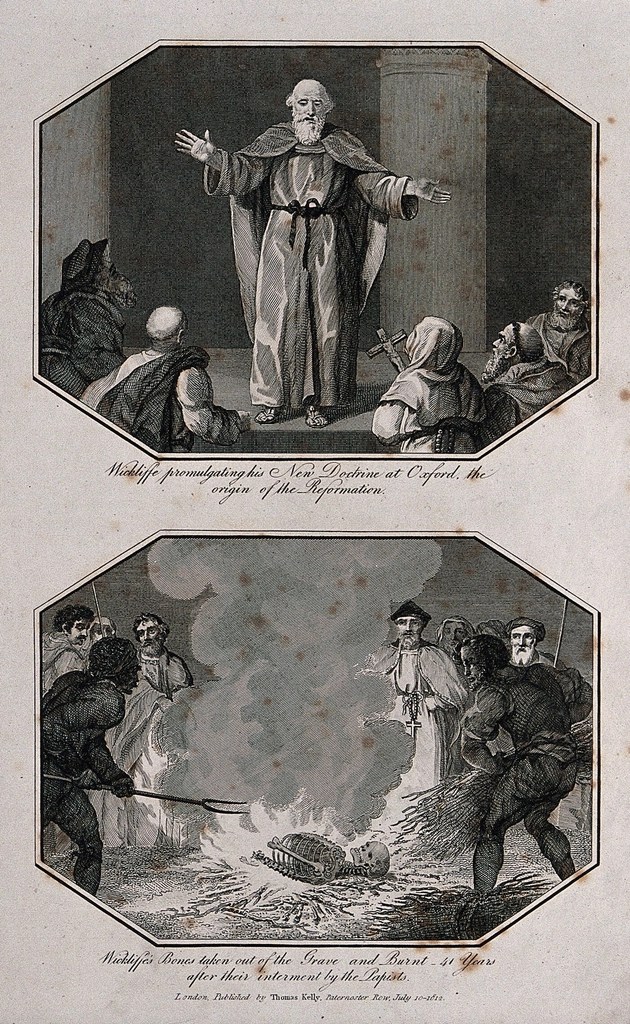
Wycliffe passed away from a stroke, during a Mass, in 1834. In 1415, the Council of Constance declared him a heretic. In 1428, by order of Pope Martin V, his remains were exhumed from his grave in Lutterworth, burned to ashes, & cast into the River Swift.

Make a one-time donation

Your contribution is appreciated.

Donate

Make a monthly donation

Your contribution is appreciated.

Donate monthly

Make a yearly donation

Your contribution is appreciated.

Donate yearly

#1356 #1361 #1382 #1415 #1428 #15thCentury #16thCentury #1834 #1842 #BalliolCollege #bible #Caesaropapism #California #Catholic #DominionOfGrace #Dominium #England #Fillingham #Hipswell #Iconoclasm #IndigenousLanguages #JohnWycliffe #LatinVulgate #Lincolnshire #Lollards #MartinLuther #Mass #MertonCollege #MiddleEnglish #Monasticism #MorningStarOfTheReformation #Nomina #Norminalists #NorthRiding #Oxford #Papacy #PeasantsRevoltOf1381 #Pope #PopeMartinV #Predestination #ProtestantReformation #Realists #RequiemMasses #Richmond #RiverSwift #RomanCatholicChurch #Sacraments #Scholasticism #TheLastAgeOfTheChurch #Translate #Transubstantiation #Universals #UniversityOfOxford #VulgateBible #WilliamCameronTownsend #WilliamOfOckham #WycliffeBibleTranslators #WycliffeSBible #Yorkshire

Tim Jtimtfj
2025-12-13
2025-11-19

This has gotta be one of the nerdiest things I have come across in quite a while. Hugely amusing and well done, too.

Where's the #OldEnglish Version?

#MiddleEnglish

youtube.com/watch?v=vBa5nN_JyP

2025-11-19

@ukdamo We in the US shall soon find out what it’s like to sit here with no pennys. #MiddleEnglish

2025-11-07

In one of the word games I played this morning I learned that the word "girl" stems originally from Old English "gyrele, gyrle" and from Middle English gerle, girle, gyrle, all of which meant a “young person of any gender”.

Court Cantrell does not complycourtcan
2025-10-31

something about the word "parlous."

I already knew "parlous" as a form of the word "perilous" associated with English spoken in the western and mid-western USA. Most likely, I got that from Western films or maybe cartoons of Yosemite Sam & Bugs Bunny. Who knows. The phrase that sticks in my head is: "I'm parlous thirsty, ma'am."

But today, I learned that "parlous" was used in , so possibly as far back as the 1100s! 😮 Def not the !


Court Cantrell does not complycourtcan
2025-10-21

Typed "I'm delighted" in a text to a friend -- and stopped short, looking at the word "delighted."

I used "delighted" to mean that I am pleased, joyful, content, happy.

But delighted. De-lighted.
Wouldn't that mean "darkened"? Illumination removed?

If "de-" indicates that "light" is removed, how does that jive with the emotions of pleased, happy, or content?

Looked up the .

And voilà.

"light" <-- leoht () <-- lēoht () <-- *leuhtą ()

1/

2025-10-05

Just started reading a parallel text edition of Sir Gawain and the Green Knight. Loving it so far. If you know bits of German and French, and can mentally vocalize different pronunciations for the unfamiliar spellings (and two obsolete letters) the #MiddleEnglish is quite enjoyable to decipher before reading the parallel modern English.

This word still exists in #Dublin, as handsel:

And sythen riche forth runnen to reche hondeselle
(And then nobles came forward to offer good-luck tokens)

2025-08-29

The Middle English Text Society, which publishes excellent online editions of medieval literature, needs financial help due to the funding cuts south of the 49th parallel metseditions.org/ #histodons #philology #medieval #middleEnglish

I fear I'd be pretty lost in the 1390s. I understand some, but nowhere near enough! Wonder what our descendants will sound like 630 years from now (if there are any). 🫠

youtu.be/PqxbQy-kTHc

#Linguistics #MiddleEnglish #SimonRoper #Language #xl8

NaraMoore ⛩️👻八尺様👻⛩️ at FediNaraMoore@sakurajima.moe
2025-05-19

#wss366 #Scout 5/19 (#TimeManager Part 11)

A “man” walked up to Poe on his hands. His feet straight up in the air and head protruding from his ass.

“Ich seche faces as wex, wroght to be wondred at,” As the man spoke, a long forked tongue shot out of his mouth holding a contract.

Poe stared at the contract the “person” thrust at him, saying, “I’m not signing my soul away!”

Raven cackled, “He’s a talent SCOUT.”

“For what? I can’t sing, dance, or act.”

Raven spoke to the “man,” “He desireth to witen wherfore.”

The man replied, “For Sire Alfrede’s Fyneste Fendes Melle. He sholde winne muchel worship.”

Raven translated, “For Sir Alfred’s Ultimate Freak Show. He would be a great success.” Raven began cackling again. “Worship! That be rich.”

“Me? Not the talking raven?” Poe was astonished.

“Yes, you. The man who writes poems to dead women and talks to ravens at midnight.”

Poe flicked Raven.

“I’ll tell him,” Raven said indignantly.

“Nay. His wille ne draweth thider.”

“Meetes and herberwe yiven. Haluepeni the mone. Ne shalt do bettre þan þat,” the man replied.

Raven translated, “Meals and lodging provided. Halfpenny a month. Won’t do better than that.”

“He’s crazy. I’m not a freak and a halfpenny a month! He can stick it up his ass!” Poe was bristling.

“His ass is in use, and I am not translating,” Raven said.

Poe shook his head vigorously.

The man shrugged and walked off, muttering, “Warlockes ben wondere wights. Were he min, ich wolde wasshen his muð mid sape.”

“He says, ‘Warlocks are weird creatures, and he would wash your mouth out with soap if you were his kid.’”

#MiddleEnglish
#MicroFiction #NMPrompts #NMV366 #NotDrabble #TimeTravelAuthors #NMTTA

NaraMoore ⛩️👻八尺様👻⛩️ at FediNaraMoore@sakurajima.moe
2025-05-17

#wss366 #Lick 5/16 #Easy 6/17 (#TimeManager Part 10)

Poe awoke, clutching his head, thinking, “EASY on the cocktails next time.”

Around a bonfire pranced lizards, toads, stags, and creatures more grotesque.

“Where the hell!?”

TM answered, “A smal wicche bad us hoom, 1150.”

Poe’s bedraggled raven added, “Þis is BYFAR þe wierdeste þing þat ich evere seye.”

“You’re not making a LICK of sense,” Poe said. “Translate!”

Raven obliged. “A wee witch invited us home to 1150.” I said, “This is EASILY the weirdest thing I’ve ever seen.”

“A witches’ Sabbath!!!” Poe exclaimed.

“Nay, a fest of disgisynges,” a goat-footed man explained.

Raven translated, “Nay, a costume party.”

#MiddleEnglish

#MicroFiction #NMPrompts #NMV366 #Drabble #TimeTravel #TimeTravelAuthors #NMTTA @QuasiTemporal

2025-04-27

Sumer is icumen in
Lhude sing GQuuuuuuX
#GQuuuuuuX #gundam #anime #MiddleEnglish #SummerCanon #ReadingRota

N-gated Hacker Newsngate
2025-04-15

🤔 Oh joy, another thrilling adventure into the world of Middle English texts – because who doesn't want to read without footnotes? 📜 Apparently, the bold and daring mission to bring ye olde texts to the masses can only be sustained if everyone empties their wallets now that has bounced, because nothing says "medieval" quite like . 🤑
metseditions.org

Mark Darbyshiremarkdarb
2024-10-20

Grandma used the word “whatsome” a lot. I've never heard anyone else say it. I often wonder where it came from.

Curiously, the Oxford Dictionary defines it as an obsolete word meaning “whatever” that hasn't been used in over 500 years.

“Whatsome” was Grandma's “whatchamacallit”. She could also say “and whatsome” in the sense of “and so on”.

Incidentally, Oxford recognises “whatsomever” as a surviving word.

Ross A. Bakerross@rossabaker.com
2024-10-11

When my wife brings home slang from middle school and speaks to the kids, I realize my own dialect might as well be Chaucer's.

> Hwæt! We Gardena in geardagum,
> þeod-cyninga þrym gefrunon,
> hu ða æþelingas ellen fremedon
> Skibidi bop, þæt was þe vybe.

#MiddleEnglish #GenAlpha

2024-10-01

I am still cry-laughing at this screenshot of my medical clinic's portal, they are REALLY dedicated to accessibility

#AncientEgyptian #MiddleEnglish #OldEnglish #ThisIsReal #LinguisticsHumor #LanguageNerd #Languages

A screenshot of a medical site portal with the "language" drop-down selected, and there are lots of languages visible, including "Egyptian (Ancient)" and "English, Middle (1100-1500)" and "English, Old (ca 450 - 1100)"

Client Info

Server: https://mastodon.social
Version: 2025.07
Repository: https://github.com/cyevgeniy/lmst