
I know I am 10 years late, but I find it wild that you can install a software on a 16,5 MHz Microcontroller, that absolutely does not have USB, and then you have an USB capable device.
#ATtiny


Found another area where the #Microchip #Attiny #AVR uCs have an edge over most of their #ARM counterparts: in rough conditions where you get lots of ripple on yout VDD.
While the ARMs have an internal voltage reference (most times 1.2V), they cannot use this vref as reference for their ADC. The ADC always uses VDDA, which is almost always internally tied to VDD.
In comparison the ATtiny402 can select VDD, 4.3V, 2.5V, 1.5V, 1.1V and 0.55V as vref.
Ofc the DMA mode on the ARMs is really nice

I designed another PCB... Small preview without revealing what it will be. It'll arrive mid January, though.
They will be manufactured by @aislerhq again, using the 20% December discount for using their #KiCad plugin.
It'll have the option to use an AVR DA compatible #microcontroller or a #tinyAVR one - I added options for both that I have in stock (AVR32DA32 and ATtiny814). Since it won't use many pins, I could have used smaller variants, too.
#AVR #AVRDA #ATtiny #pcbdesign #kicad #aisler #pcbdesign

One of the areas where #Atmel #Attiny really shine is the power consumption in stop mode. When everything is off and the mcu is waiting for an external interrupt to wake up again.
On the ATtiny402 I constantly get around 135nA.
While the STM32 and other ARM consume less than the AVRs under steam, they only can get down to around 4..5µA in stop mode.
That doesn't sound much, but it means 30 times more battery life. With a LIR2032 this means 1 year vs 30 years standby.


Falls ihr auch mal einen billigen #USBTinyISP verwendet, um #ATTiny 's zu programmieren, hilft euch evtl. diese "quick and dirty" udev-Regel weiter:/etc/udev/rules.d/50-usb-isp.rules
SUBSYSTEM=="usb", ATTR{idVendor}=="1781", ATTR{idProduct}=="0c9f", MODE="0666"
Trying to simulate a 1-bit saw wave with 8-bit PWM on the attiny85. A first glance of the wave form looks OK. Take a zoom and there's some strange high-frequency artifacts.



@r @fluffykittycat @flower Obviously people have used the #RP2040 for many projects and given it's ease of programming, low price, excellent documentation and easy availability it's no wounder it does put pressue on #ATmega / #ATtiny, #Arduino, #Teensy, etc.
- At least for low volume productions and prototypes as proof of concept.
#RaspberryPi shure are more and more targeting #embedded & #industrial clients given they do in fact disrupt the market as one can get proper #documentation and #tools without paying $$$$ upfront (AND sign NDAs) just to be able to boot #Linux on it.
- And competitors fail at understanding that this makes #Broadcom look good and is their entry-way into acquiring new clients. Because selling hardware purely off specs may work in #amd64 land where shit's legacy and the way things work is so entrenched that basic stuff just works as in booting. #ARM and even #ARM64 fail at having that level of #standardization.
OFC the #Pi0 / #Pi0W / #Pi0W2 doesn't need to innovate since every competitor isn't even trying to compete but merely farting out boards with 0 documentation and some halfassed boot images and no post-sales support so they keep dominating by virtue of being the only ones that just work...

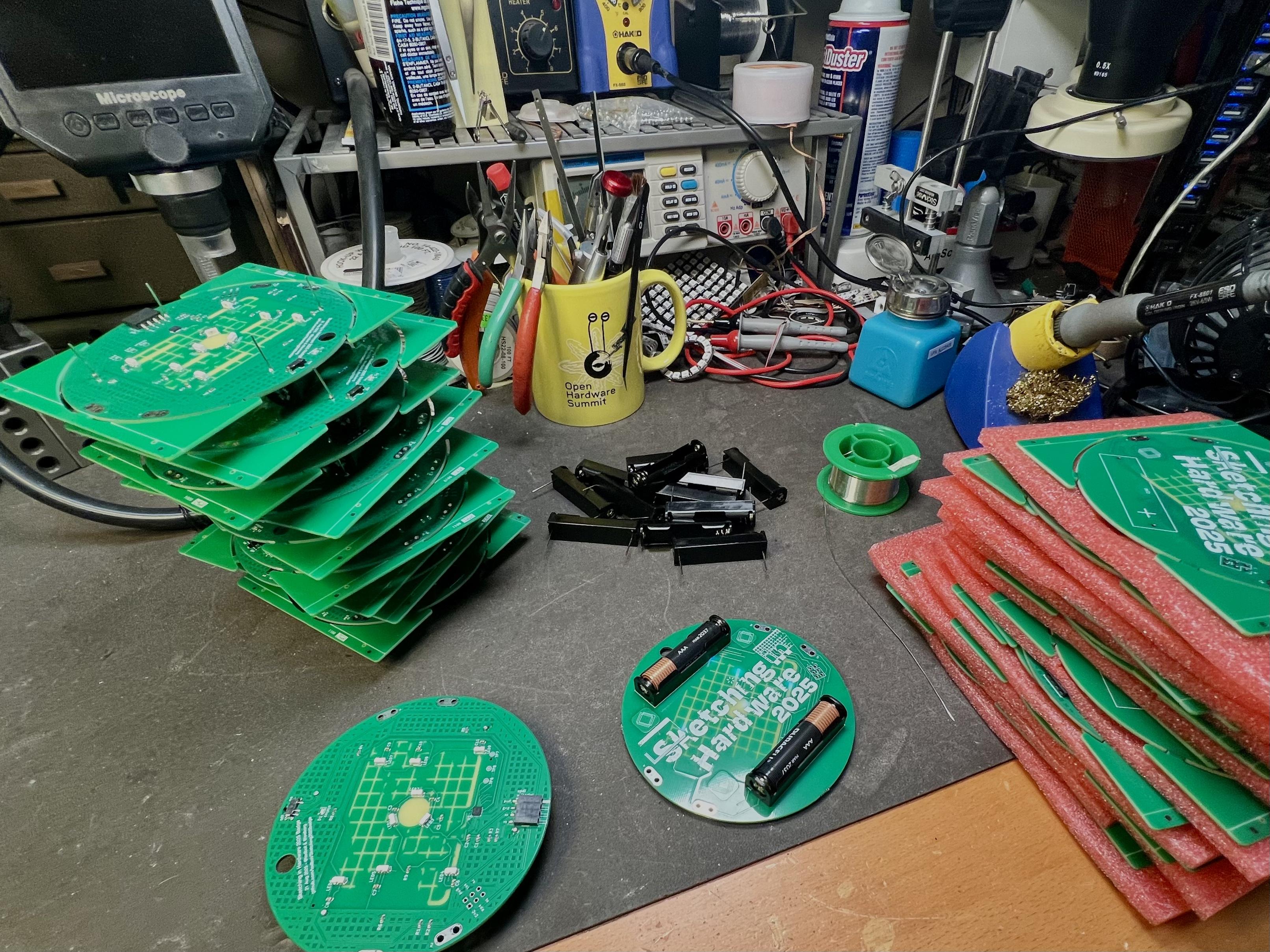
Finishing up the first ever electronic badge for our Sketching In Hardware conference (the 18th!)
They just need battery holders soldered & programming. A simple but fun design. Designed w/ @Leeborg #badgelife #attiny #avr #sketching2025 #sketchinginhardware

New here on techhub.social.
Rebooting my hobby: RF, analog, sensors, ATtiny. Back to the bench after decades in semiconductor maintenance. Full intro: https://togo-lab.io/?p=72
#Introductions #Electronics #RF #Analog #ATtiny #DIY #Sensors

here's a real chiptune: Fly Me to the Moon by Bart Howard, arranged for ATtiny85 microcontroller by PROTODOME, 2020.
This was recorded from a tiny 8-pin micro-controller powered by a coin cell battery.

Open Lab Starter Kit Small Laser V2 - An #OpenSource #FabLab produced #LaserCutter:
- 40 W CO2 #laser cutter
- materials: plywood, acrylics & MFD
- cutting area of 400 mm x 600 mm
- #ATtiny / #Teensy -controlled
https://doi.org/10.1016/j.ohx.2025.e00664
#OLSK #DIYbio #lab #instruments #Maker #hackerspace #DIYtech #DIY



K3 ist Feuerwehrfan und startet in die #Makerszene. Mit einem #attiny hat er an den letzten 4 oder 5 #PapaKindAbend en ein kleines Feuerwehrauto gebastelt.
Bitte bestaunt es:

Измерение собственного напряжения питания микроконтроллера
Началось все с того, что при проектировании своего устройства на микроконтроллере ATtiny 85 , которое должно было работать от встроенного li‑ion аккумулятора, я изначально не задавался целью измерения заряда АКБ, поскольку в этом не было необходимости. Однако, собрав все устройство на печатной плате, я подумал над тем, почему бы не добавить такую возможность. Прочитав в Интернете, как это можно было реализовать, стало ясно, что сделать это вряд ли удастся, поскольку все порты PB[0:5] уже были заняты и, следовательно, не было возможности применения АЦП с аналогового пина (при чем порт PB0 я не мог настроить на вход опорного напряжения AREF - он должен был использоваться как управляющий выход). Долгое изучение состояния регистров АЦП в datasheet на ATTiny 85 привело меня к следующей идее: в качестве опорного напряжения может быть выбрано само напряжение питания VCC (биты REFS [0:2] регистра ADMUX установлены в 0), а в качестве измеряемого ‑ напряжение VBG с внутреннего стабилизатора в 1.1В (биты MUX [3:0] регистра ADMUX установлены соответственно в 1100). То есть, для измерения напряжения питания не нужно ничего, кроме, собственно, самого питания VCC!
https://habr.com/ru/articles/907954/
#программирование #микроконтроллеры #c++ #программирование_микроконтроллеров #avr #attiny85 #attiny #ацп

Измерение собственного напряжения питания микроконтроллера
Началось все с того, что при проектировании своего устройства на микроконтроллере ATtiny 85 , которое должно было работать от встроенного li‑ion аккумулятора, я изначально не задавался целью измерения заряда АКБ, поскольку в этом не было необходимости. Однако, собрав все устройство на печатной плате, я подумал над тем, почему бы не добавить такую возможность. Прочитав в Интернете, как это можно было реализовать, стало ясно, что сделать это вряд ли удастся, поскольку все порты PB[0:5] уже были заняты и, следовательно, не было возможности применения АЦП с аналогового пина (при чем порт PB0 я не мог настроить на вход опорного напряжения AREF - он должен был использоваться как управляющий выход). Долгое изучение состояния регистров АЦП в datasheet на ATTiny 85 привело меня к следующей идее: в качестве опорного напряжения может быть выбрано само напряжение питания VCC (биты REFS [0:2] регистра ADMUX установлены в 0), а в качестве измеряемого ‑ напряжение VBG с внутреннего стабилизатора в 1.1В (биты MUX [3:0] регистра ADMUX установлены соответственно в 1100). То есть, для измерения напряжения питания не нужно ничего, кроме, собственно, самого питания VCC!
https://habr.com/ru/articles/907954/
#программирование #микроконтроллеры #c++ #программирование_микроконтроллеров #avr #attiny85 #attiny #ацп

Explore the ATtiny 1 Series #TindieBlog #AVR #ATtiny #ATtuno #Wago #DevelopmentBoard
https://blog.tindie.com/2025/03/explore-the-attiny-1-series/


Löt-Workshop mit Steffen Koritsch a.k.a noisio! 🎧
Wann: 02.04.2025, 16:00-19:00 anschließende Jam-Session von 20:00-21:00
Wo: Schanzenstr. 22, 1 OG, 51063 Köln-Mülheim
Baue dir beim noisio Löt-Workshop einen eigenen 8-Bit Mini-Synthesizer. Special Workshop Preise! Weitere Details zu den Kits unter https://noisio.de
Anmeldung per Mail an christian.faubel@th-koeln.de - max Teilnehmer*innen 20, first come first serve!
#diy #synth #workshop #drone #attiny #codeandcontext #thköln #noisio
I made a PS/2 adapter for an old IBM terminal #keyboard: https://txmn.tk/blog/ibm-keyboard/
#arduino #attiny

Stepper595 (1.1.0) for avr/attiny/esp32 by Kendall Daniels
➡️ https://github.com/KDaniels-dev/Stepper595
Quick and easy control of stepper motors through SPI and a shift register.
Stepper595 (1.0.4) for avr/attiny/esp32 by Kendall Daniels
➡️ https://github.com/KDaniels-dev/Stepper595
Quick and easy control of stepper motors through SPI and a shift register.
Stepper595 (1.0.3) for avr/attiny/esp32 by Kendall Daniels
➡️ https://github.com/KDaniels-dev/Stepper595
Quick and easy control of stepper motors through SPI and a shift register.
Client Info
Server: https://mastodon.social
Version: 2025.07
Repository: https://github.com/cyevgeniy/lmst