
Après que nous avons #réalisé un #compteur #binaire avec deux #diodes #LED, une #jaune et une #rouge qui nous #compte de 0 à 3, #Electro-robot vous #propose de #compléter ce premier #circuit #séquentiel en ajoutant un #décodeur #BCD à base du #circuit #intégré #74LS48 et un #afficheur 7 #segments pour réaliser un #compteur #decimal au final. Alors on commence ?
#diodes
Réalisons notre premier #compteur #binaire à 2 bits sur une #plaque d’#essai avec un #circuit #intégré #74ls74 et deux #diodes #LED! Une belle #activité pour vous faire #découvrir le monde du #numérique #séquentielle. Alors on fonce ?

Alright, electrical engineer friends... I'm trying to figure out why my drawing tablet's display broke. I was able to pry it open, and found a cracked diode, but I can't identify it. A bit of searching makes me think it's a tvs diode, but I've no idea what it specifically is (or what an appropriate replacement might be). It looks like it's marked "XM", and I can't identify the logo beneath it (thought it was ST, but that doesn't match their logo)


#Connaissez-vous les #diodes ? Saviez-vous qu'une #diode est #composé de deux #dipôles : #l'anode et la #cathode et qu'elle ne #laisse #passer le #courant #électrique que dans un #seul #sens ? Alors quel est ce #sens de #circulation? dites-nous dans un #commentaire quel est ce #sens de #circulation et découvrez avec #electro-robot d'autres #types de #diodes telles que les #diodes à #Zener, les #diodes #LED, ...
https://electro-robot.com/electronique/composants/les-diodes

"Try our new deodorant smell, Diode! You, too, can attract the ladies by smelling like a diode!"
"Is it a diode I smell, or are you happy to see me?"

So after figuring out which bits to remove, I set about building it. I first tried laying it out on a single one of my custom #protoboards I posted about before. It gets very dense, and would require cutting / splitting a whole lot more of the 6-hole #pad #strips than I really wanted to do. So I built it on two boards, using the same modular connection between them that I use for the rest of my effects boards.
Even the original Boss pedal used 2 separate boards, so I don't feel too badly about it.
Anyway... it took a while to fiddle with the layouts to get something I like, then document my parts placement, remove all the parts and start re-populating and #soldering them into place. But I got that done this evening.
I did a little meter #probing of the results to find any obvious missing connections or such, and fixed a couple. Then I plugged in my guitar, and ...
It #worked, perfectly, the first time. I believe that's the first time any of my effects have not required any #debugging at all. I'm #chuffed .
And it sounds *fantastic*.
The originally-called-for #transistors and #diodes are mostly #obsolete and hard to find. I dug through datasheets to find ones I thought would (a) be acceptable substitutes, and (b) I already had in my parts bins. Frankly, given the nature of the effect, I doubt the selections are too critical, but I'll include what I used for completeness, in case anyone else wants to make one of these.
#maker #components #substitute
4/x

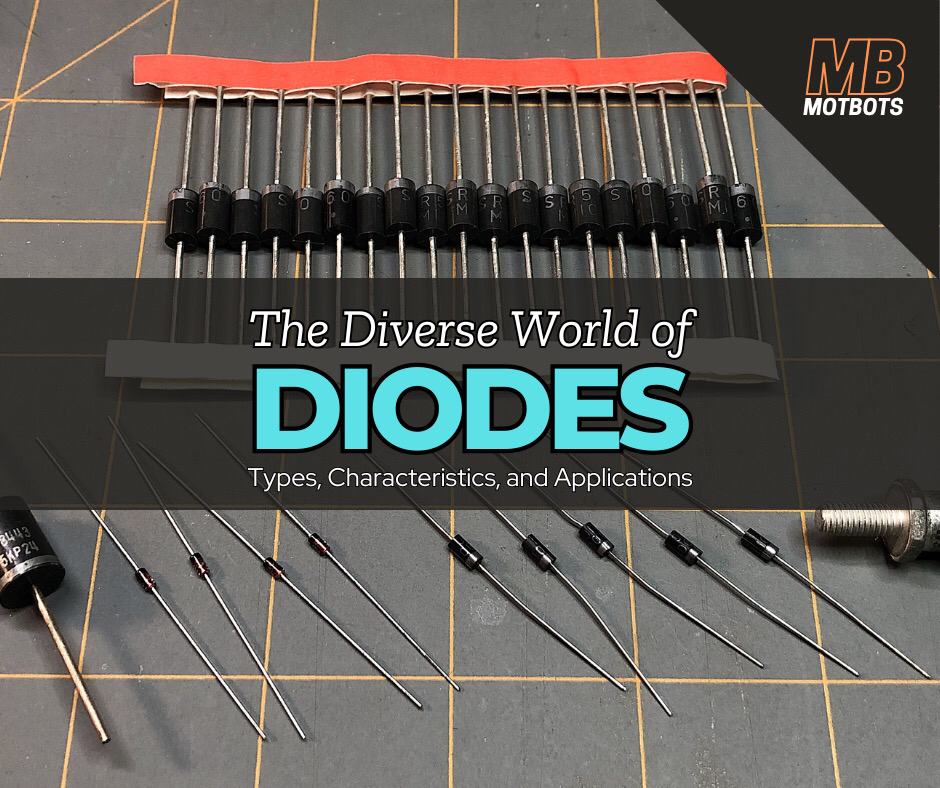
Needing to understand the diode a little more? Want to know what it does and how to use them in circuits? Check out our post titled "The Diverse World of Diodes: Types, Characteristics, and Applications" via our link below:
The Diverse World of Diodes: Types, Characteristics, and Applications
➡️ https://motbots.com/the-diverse-world-of-diodes/

Avez-vous essayé de #modéliser une porte #logique OU avec des #diodes de #commutations ? Electro-robot vous propose un TP pour découvrir le monde de l’électronique #numérique : https://electro-robot.com/les-activites/travaux-diriges-la-porte-logique-ou

Basic Electronics for the Amateur Radio Operator: What You Need to Know for Your Technician License
1,003 words, 5 minutes read time.
If you’re preparing for the Amateur Radio Technician License Exam, understanding basic electronics is a must. While you don’t need to be an electrical engineer, the exam includes fundamental concepts like Ohm’s Law, circuits, components, and RF safety. This guide will walk you through the essential topics, ensuring you’re ready for the test and your first steps as a ham radio operator.
Understanding Electricity: The Basics for Amateur Radio
Electricity is the movement of electrons through a conductor, like a wire. Three key electrical properties define how electricity behaves:
- Voltage (V) is the force that pushes electrons through a circuit. It’s measured in volts (V).
- Current (I) is the flow of electrons, measured in amperes (A).
- Resistance (R) opposes the flow of electricity and is measured in ohms (Ω).
These three are tied together by Ohm’s Law, a fundamental equation in electronics:
V=I×R
This means if you know any two values, you can calculate the third. Understanding this equation is critical for both the exam and real-world troubleshooting.
Direct Current (DC) vs. Alternating Current (AC)
Electricity comes in two forms:
- Direct Current (DC) flows in one direction. Batteries and solar panels produce DC.
- Alternating Current (AC) changes direction many times per second. Household electricity is AC because it’s more efficient for transmission over long distances.
For amateur radio, most equipment runs on DC power, but you’ll also need to understand AC because radio signals are alternating currents that oscillate at high frequencies.
Essential Electronic Components and Their Functions
Several key electronic components appear on the Technician Exam. Here’s what they do:
- Resistors limit current flow.
- Capacitors store and release energy, often used in filtering circuits.
- Inductors store energy in magnetic fields and are important in tuning circuits.
- Diodes allow current to flow in only one direction, useful in rectifier circuits that convert AC to DC.
- Transistors act as switches and amplifiers in radio circuits.
Understanding these basics helps you answer questions about circuit behavior and troubleshooting.
Series and Parallel Circuits
Circuits are made up of components arranged in either series or parallel:
- In a series circuit, current flows through all components one after another. The same current passes through each, but the voltage is divided.
- In a parallel circuit, components share the same voltage, but the current divides among them.
For the exam, you should know how voltage, current, and resistance behave in each type of circuit. For example, total resistance in a series circuit is the sum of all resistances, while in parallel circuits, total resistance is lower than the smallest individual resistor.
Basic AC Concepts and Frequency
Radio waves are AC signals that oscillate at different frequencies. Frequency (f) is measured in hertz (Hz) and tells us how many times per second the wave changes direction. One kilohertz (kHz) is 1,000 Hz, and one megahertz (MHz) is 1,000,000 Hz.
Ham radios operate in different frequency bands, such as:
- VHF (Very High Frequency): 30 MHz – 300 MHz (e.g., 2-meter band)
- UHF (Ultra High Frequency): 300 MHz – 3 GHz (e.g., 70-centimeter band)
Higher frequencies allow for shorter antennas and are good for local communication, while lower frequencies travel further.
Modulation: How We Send Information Over Radio Waves
Modulation is how a radio wave (carrier wave) carries information. The Technician Exam covers three main types:
- Amplitude Modulation (AM): The signal strength (amplitude) changes with the voice signal.
- Frequency Modulation (FM): The frequency of the wave changes to encode information. FM is more resistant to noise and is commonly used in VHF and UHF bands.
- Single Sideband (SSB): A variation of AM that uses less bandwidth and is more efficient for long-distance communication.
Knowing these helps when selecting modes for different types of contacts.
Power, Batteries, and Safety
Most ham radios run on 12V DC power sources, such as batteries or regulated power supplies. It’s important to understand:
- Battery safety: Overcharging or short-circuiting batteries (especially lithium-ion) can be dangerous.
- Fuse protection: Many radios have built-in fuses to prevent excessive current draw.
Another key topic on the test is RF exposure safety. High-power transmissions can generate strong radio frequency (RF) radiation, which may cause health risks. To minimize exposure:
- Maintain a safe distance from transmitting antennas.
- Use the lowest power necessary for effective communication.
- Follow FCC RF exposure limits for your frequency and power level.
Ohm’s Law in Real-World Ham Radio Applications
A common exam question might involve calculating current or voltage using Ohm’s Law. For example:
Question: If a radio operates at 12V and draws 2A of current, what is the resistance?
Using Ohm’s Law:
Understanding these calculations can help with troubleshooting and designing circuits.
Final Thoughts: Studying for the Exam and Beyond
The Technician License Exam covers these topics, but learning electronics doesn’t stop there. Once licensed, you’ll continue exploring concepts like antenna design, signal propagation, and digital communication.
Great resources for studying include:
- ARRL’s Technician Class License Manual: The official guide with explanations and practice questions.
- HamStudy.org: Free practice tests and flashcards.
- QRZ.com Practice Exams: Simulated tests with real exam questions.
By mastering these basic electronics concepts, you’ll be well on your way to passing the exam and starting your journey in amateur radio. Keep practicing, get hands-on experience, and soon, you’ll be making contacts on the air!
D. Bryan King
Sources
- American Radio Relay League (ARRL) – Official Site
- FCC Amateur Radio Service – Licensing and Regulations
- QRZ.com – Amateur Radio Callsign Database
- HamStudy.org – Exam Prep and Study Tools
- Electronics Tutorials – Basic Circuit Theory
- RadioReference.com – Frequency Database and Scanner Information
- AMSAT – Amateur Radio Satellites and Space Communications
- DX Engineering – Ham Radio Equipment and Resources
- MikroE Learn – Electronics and Circuit Design Tutorials
- Radio Society of Great Britain (RSGB) – Ham Radio Resources
- Arduino – Microcontrollers and DIY Electronics for Ham Radio
- eHam.net – Amateur Radio News, Reviews, and Forums
Disclaimer:
The views and opinions expressed in this post are solely those of the author. The information provided is based on personal research, experience, and understanding of the subject matter at the time of writing. Readers should consult relevant experts or authorities for specific guidance related to their unique situations.
Related Posts
Rate this:
#ACVsDC #am #AmateurRadio #amateurRadioEducation #amateurRadioTraining #antennaTheory #ARRLStudyGuide #basicElectronics #beginnerHamRadio #capacitors #circuits #current #diodes #electricalComponents #electronicsBasics #examPrep #FCCExam #FM #hamExam #hamLicense #hamOperator #hamRadio #hamRadioBands #hamRadioBeginner #hamRadioComponents #hamRadioEquipment #hamRadioOperator #hamRadioStudy #HamRadioStudyGuide #HamRadioTraining #hamStudyGuide #inductors #modulation #OhmSLaw #powerSupply #radioBroadcasting #radioCommunication #radioFrequencies #radioFrequency #radioFundamentals #RadioLicensing #radioSignals #RadioTechnology #radioTransmission #radioWaves #resistance #resistors #RFExposure #RFSafety #SSB #technicianClass #TechnicianLicense #transistors #UHF #VHF #voltage



The message on the back asked about how to build a #XOR gate out of #diodes. The answer was too big to fit on a postcard, but see https://electronics.stackexchange.com/a/322168

Because I have some background in electrical and electronics engineering back in college, I was already somewhat familiar with Nakamura’s work in inventing the blue LED. But this Veritasium video is really excellent in explaining how wonderful this invention was. Plus, the animations are so good that I wish we had these back when we were learning how semiconductors and diodes work.
#physics #semiconductors #diodes #LEDs #BlueLEDs #ShujiNakamura
We were poor students. Electronics were still quite #expensive (it's a long time ago ... mumblety-five years or more...). I needed #transistors and 10W power #resistors and 1/4W resistors and #diodes and I don't know what else, and most of them besides the 1/4W resistors were a dollar or more each. Even plain resistors were 20 or 30 cents.
By splitting the shipping charge between us and buying common parts so we got the #price #break at 10, or 100, or whatever units, we saved a bunch.
3/x

For the longest time I thought it was scott-y not shot-key #diodes lol
Here's another power project, it's actually a copy of something I posted a while back. It's another diode OR UPS, this time meant to power a Raspberry Pi (or something else that takes 5 volts).
I found some cheap adjustable #buck converters on Amazon. The idea is to step down 12 V nominal, either from another battery, a power supply, or perhaps a solar panel, to about 7 V or so - this is labeled Vbuck in the schematic. From there current can flow into the battery, a 6 V gel cell lead acid in this case, via D1 and Rch. It can also flow through D3 into the 7805 regulator, which puts out 5 volts. If the input power to the buck converter is taken away, power flows from the battery to the 7805 through D2.
It's dirt simple, and my intent is to keep the 6 volt battery floated. Basically, pick the float voltage you want (say 6.6 V), and add the diode drop to it. This is about what you set the output of the buck converter to. The resistor Rch is just there to limit the current in case the battery gets significantly discharged - once it hits the float voltage you want, very little current will flow. Pick a low end voltage, maybe 5.5 V, and set the resistor such that the voltage drop gives you the current you want: (7-0.4-5.5)/Rch
I just used a 3.9 ohm resistor since I had it. Don't forget to make sure it can take the power, but in my case it should be around a quarter of a watt (it's a 2 watt resistor). You can also bump the voltage up of the buck converter to get a little more current if you want some more granularity.
The key is to have a buck converter you can adjust. The diodes here are big for what I'm using them for, but I had a tube of them from past dumpster diving. You could probably come up with a better circuit, utilizing a specially-designed switching supply, but this is quick and dirty and should work.
I checked voltages tonight, but may get around to trying it with an actual Pi tomorrow.
#power #electronics #UPS #backup #RaspberryPi #diodes #DiodeOr #5v

Almost ten years ago, I bought this little item from Amazon:
Yosoo GM328 LCD Display... https://www.amazon.com/dp/B00OOQC2E8?ref=ppx_pop_mob_ap_share
It has been a brilliant investment. Identifies #resistors, #capacitors, #FETs, #MOSFETs, #diodes, ... Just about any kind of simple #electronic #component, including bi- and unipolar #semiconductors, I've plugged into it.
@foone

Two cathodes but no soldering wires. No wonder the thing doesn't work.

Started to build the #crowboard and took pictures as I progressed. Did not take long... A very rewarding, zen-like process for me. Pure joy soldering the components... First, #smd #diodes for the #keyboard.



Referenced link: https://techxplore.com/news/2022-11-material-locally-flexible-diodes.html
Discuss on https://discu.eu/q/https://techxplore.com/news/2022-11-material-locally-flexible-diodes.html
Originally posted by Phys.org / @physorg_com@twitter.com: https://twitter.com/TechXplore_com/status/1588220672928788482#m
RT by @physorg_com: New material will make locally flexible #diodes possible @TU_Muenchen @advmater https://onlinelibrary.wiley.com/doi/10.1002/adma.202208698 https://techxplore.com/news/2022-11-material-locally-flexible-diodes.html

How to use #diodes in quantum technologies?
⚡ Diodes are electronic components that can be found in many devices we use today. Frasesca Giazotto from @CNRsocial_ found a way to form a diode-like feature, usuful for quantum technologies.
#EUfunded 🇪🇺
🐦🔗: https://nitter.eu/ERC_Research/status/1550390220465397761
Client Info
Server: https://mastodon.social
Version: 2025.07
Repository: https://github.com/cyevgeniy/lmst