
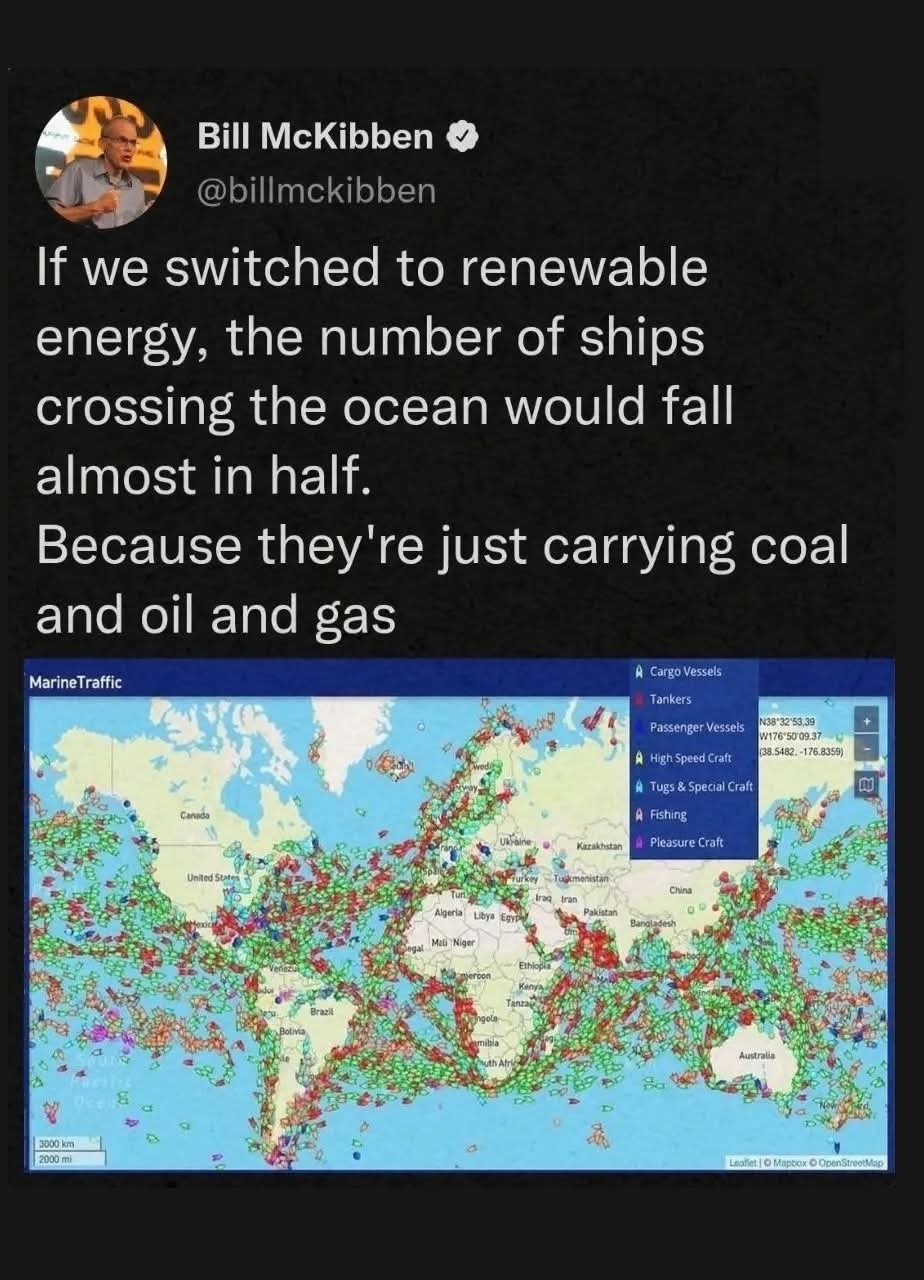
McKibben’s point is directionally right, even if simplified. Fossil fuels dominate global shipping ton-miles. Electrification + renewables don’t just cut CO₂ — they collapse fuel logistics chains. Energy becomes local. Trade shifts, ships don’t vanish — but power does.⚡ #disruption #EnergyTransition
#disruption

#SupplyChainDisruption: 3 Key Takeaways from Kai, Claudio & Albert 💡 #supplychain #disruption #insights


“Your brain is built for addition. The future is built on multiplication.” - Futurist Jim Carroll
---
Futurist Jim Carroll is writing his end-of-2025 / introduction-to-2026 series, 26 Principles for 2026. You can follow along at 2026.jimcarroll.com. He welcomes your comments.
---
When exponential change arrives, it never goes well.
That's because most people fail to understand what it means and don't act, which is a problem. After all, there is a remarkably narrow window between "this will never work" and "how did we miss this?"
We are on Day 16. Earlier in this series (go back to Day 2), we confronted the staggering velocity of change—the doubling of scientific knowledge, the acceleration of technological breakthroughs.
But there is a massive, invisible chasm we have not yet crossed:
It is the gap between intellectually knowing the numbers and viscerally comprehending what they mean for your reality in 36 months. It's called the scale-blindness epidemic, and why your brain cannot comprehend what is coming.
Consider this: you can read the reports on AI growth, computing power, or synthetic biology until your eyes bleed. You can nod your head and agree that things are moving fast.
But deep down, you don't believe it.
Why? Because you are a human being. We are linearly wired creatures living in an exponential world. Our brains evolved to track linear threats—a lion moving across the savannah at a constant speed. We understand “1, 2, 3, 4, 5.” Slow, linear growth.
But it seems we are biologically incapable of intuitively grasping “1, 2, 4, 8, 16, 32.” Wildly fast exponential growth.
Because of this evolutionary flaw, the vast majority of leaders suffer from "Scale-Blindness." When we look at an emerging exponential technology, our brains instinctively project its growth linearly. We do a 1-2-3-4-5 - not a 1-2-4-8-16-32. We look at what it can do today—which is usually underwhelming—and assume next year it will be maybe 10% better. And the fact is, it could be 100% better, or 1,000%, or maybe even 10,000%
And because of our blindness, we fail to miss out on the significance of the trend.
Think about it another way - if we see a 10-foot wave coming and prepare accordingly, completely blind to the fact that the exponential function will turn it into a 100-foot tsunami by the time it reaches shore.
That's why principle **#16** in this series isn't about learning more facts; it's about forcing your brain to undergo a sort of exponential shock therapy so you can cure this blindness before it's too late. That's because there is comfort in incremental thinking!
----
**#ScaleBlindness** **#Exponential** **#Velocity** **#Disruption** **#Innovation** **#Acceleration** **#Linear**
Futurist Jim Carroll believes that most organizations are falling way behind when it comes to the 'acceleration gap.'


A ce stade, on a pas mal parlé de licences (données et code sources, j'avais l'impression d'être au boulot) ; On s'est mis d'accord sur l'idée que le numérique doit être largement plus réglementé qu'il ne l'est et qu'il faut rompre avec cette politique imposée par les GAFAM qui transforme le fait accompli en droit (#disruption) ; la question restée en suspens est "avec quelles forces ?"
"Scale immediately or fail slowly. There is no middle ground."- Futurist Jim Carroll
---
Futurist Jim Carroll is writing his end-of-2025 / introduction-to-2026 series, 26 Principles for 2026. You can follow along at 2026.jimcarroll.com. He welcomes your comments.
--
We are on Day 15!
You’ve listened to the edge (Day 13) and filtered out the hype to find a real structural signal (Day 14).
You have identified a real trend!
Now, you face the moment where most legacy organizations fail.
People often talk about something called "pilot purgatory," and the fact that people and organizations get stuck there. It's the tendency to test or trial a new idea - and then get stuck there, never moving beyond the testing or 'pilot' phase. Yup, it's a form of purgatory!
Let's put the challenge in context. For years, I have advised leaders to follow a simple, powerful mantra for innovation in a fast world: Think Big, Start Small, Scale Fast.
Most organizations are pretty good at the first two. They "think big" in strategy sessions. They "start small" with innovation labs and proofs-of-concept.
But they completely fail at the third and most critical step: scale fast. They end in a state of perpetual experimentation where they run dozens of small, safe tests that generate interesting things - but never make it out of the starting gate. And in doing so, they mistake motion for progress - they believe that the mere fact that they are testing a bunch of things means they are making progress.
They aren't.
Here's the problem - in a linear world, you could slowly roll out a new initiative over two or three years. You had the luxury of all the time in the world.
But in an exponential world, that doesn't work. You are surrounded by the problem of legacy - existing processes, IT systems, organizational sclerosis, and bureaucratic inertia designed to keep doing things the same way. That means to move fast, you need more effort than ever before - because in this new fast world, you need to move instantly from a "safe experiment" to "massive deployment."
The discipline to do that? Let's call it! Escape Velocity.
I have been covering the issue of velocity and scale for years. When I look back through my own archive of blog posts, keynotes, and Daily Inspirations, I see a clear pattern of organizations that understood how to achieve this momentum. But some did.
Learn what they did differently!
----
**#EscapeVelocity** **#Scale** **#Innovation** **#Momentum** **#Exponential** **#Leadership** **#Legacy** **#Disruption** **#Speed** **#Deployment**
Futurist Jim Carroll has seen way too many organizations stuck in a state of perpetual pilot purgatory.
Original post: https://jimcarroll.com/2025/12/decoding-tomorrow-mastering-2026-15-scale-immediately-or-fail-slowly-there-is-no-middle-ground/

"Leadership today isn't about what you chase. It's about what you ignore." - Futurist Jim Carroll
----
Futurist Jim Carroll is writing his end-of-2025 / introduction-to-2026 series, 26 Principles for 2026. You can follow along at 2026.jimcarroll.com.
----
We are on Day 14 of my 26 Principles for 2026 - guidance to guide you through a world of exponential change. If you don't remember why this is so critical, go back and read the intro!
Recently,? You’ve humbled your ego (Day 12) and opened your ears to the young (Day 13).
You are ready to listen to the future.
But suddenly, you have a new problem. You can't hear anything but noise.
Have you noticed how much hype is out there these days?
Separating reality from hype has always been a challenge - I've certainly been covering that issue for a long time. You can't speak and write about the future without giving people advice and guidance about what's going on out there, and separating the real from the noise.
But there is more hype than ever before - and so on Day 14, I want you to think about the importance of developing what I call Hype Immunity - aka the discipline of ignoring almost everything.
Think about it: In our old, slow, linear world, change happened slowly enough that you could evaluate new technologies, disruptive trends, new products, and new innovation opportunities, one at a time. You had the luxury of waiting to see what settled, what was real, and what you really needed to worry about.
That luxury of time is gone. Forever. In an exponential world, you are bombarded daily with "game-changing" breakthroughs. There is just so much to keep track of! AI agents today, spatial computing tomorrow, quantum adoption next week. .
For a long time, folks like me have been talking about the tendency of people to chase 'shiny new objects."
Remember the 'metaverse '? Wasn't it the hottest thing on the planet just a few years ago ? It was just reported that Facebook lost almost $100 billion in its ill-fated efforts to drag everyone into some weird new virtual world. Companies that followed the shiny object that it represented probably wasted as much.
Here's the thing - If you chase every shiny object, you will exhaust your organization and achieve nothing. That's why the critical leadership skill in 2026 is no longer just spotting trends—that’s easy. The critical skill is rapidly filtering the 99% marketing hype to find the 1% structural shift that actually matters to your business model.
The discipline you must master is Hype Immunity.
---
Futurist Jim Carroll believes that his hype-filter is one of the most important skilsl he has developed — and one that differentiates him from most of his peers!
**#HypeImmunity** **#Leadership** **#Innovation** **#FOMO** **#Strategy** **#Exponential** **#Trends** **#Disruption** **#Focus** **#Future**


GitHub decided that annoying pop-up #notifications are *so* 2019 🥴. Now, instead of toasty disruptions, expect a deluge of emails you never signed up for 📬. #Accessibility concern or just an excuse to ditch something everyone hated anyway? 🤔
https://primer.style/accessibility/toasts/ #GitHub #Email #Overload #Debate #Disruption #HackerNews #ngated

Helpful explanation of how AI is fracturing society by an AI expert...
#AI #choose #disruption #SocialCollapse #energy
https://www.youtube.com/watch?v=x4ZY25OU4Ys

In a plutocracy like the currently-occupying US administration, Democracy is always the first casualty: Its dismantlement - whether through #Zoneflooding or any other form of misdirection & #disruption -- to ensure the plunder at the EXPENSE of #natsec #globalsec #humansec -- is #thePoint. And it is being aggressively globalized. Security, mafiaized.

Read American Science, Shattered
A multipart series on how the Trump administration has disrupted labs, upended lives, and delayed discoveries
Trump has ‘shaken the hell’ out of the 80-year research pact between the government and universities. What now?
The American research enterprise has proven to be much more brittle than expected

Hold up, Amazon might just launch its *own* postal service? This isn't just about packages anymore, it's about owning the entire supply chain, down to the last mile. Who needs the post office when you have Bezos-Barges? What are your predictions for their delivery drones?

Widespread service disruption leaves users locked out of their Venmo accounts during critical payment hours
#Venmo #Disruption
Read More: https://www.ibtimes.co.uk/venmo-down-panic-thousands-cant-pay-rent-groceries-am-i-only-one-1760188


To What Extent Will AI Damage the UK Recruitment Industry in the Next Five Years?
The United Kingdom’s recruitment industry is no stranger to disruption. Over the decades it has survived recessions, regulatory upheaval, the rise of the gig economy, the emergence of LinkedIn, and—perhaps most traumatically of all—the period when every office in Britain seemed determined to call itself “an agile talent solutions hub” rather than simply “a recruitment agency.” But artificial intelligence (AI) arrives not merely as another technological twist in the tale; rather, it is a potentially existential challenge that touches every stage of the hiring lifecycle.
Whether AI ultimately damages the industry, reshapes it, or perhaps even improves it depends largely on the extent to which current trends accelerate, how both clients and candidates react, and how well recruitment firms adapt. Over the next five years, AI will undoubtedly transform the recruitment ecosystem. The question is not if, but how much, and what kind of damage—temporary disruption, structural change, or outright displacement—will occur.
This essay explores that question in depth, analysing the functions of the UK recruitment industry, the present capabilities and limitations of AI, the economic and regulatory context in which recruitment firms operate, and the plausible evolution of the sector from now until the end of the decade. A small portion of humour is included, as instructed—just enough to lighten the mood without turning the UK’s £40-billion talent acquisition industry into slapstick.
1. The Recruitment Industry: A Brief Character Sketch
Before assessing the impact of AI, it is important to understand the nature of the industry under threat. The UK recruitment industry is broad, fragmented, and profoundly human-dependent. It is also—let’s be honest—an industry with mixed public relations. To some businesses, recruiters are essential partners who locate rare skills, navigate complex labour markets, and reduce hiring friction. To some candidates, they are helpful career sherpas. To others, they are the people who ring at 7:02 a.m. claiming to have “the perfect role” that later turns out to be a three-month contract in Slough for 40p more per hour.
The industry performs several core functions:
- Sourcing – finding candidates through databases, job boards, networking, social platforms, and direct outreach.
- Screening – reviewing CVs, conducting interviews, and filtering talent.
- Matching – pairing the right candidate with the right role; sometimes more art than science.
- Process coordination – scheduling interviews, chasing feedback, managing offers, and doing all the administrative labour clients loathe.
- Advisory work – market insights, salary benchmarking, helping candidates and employers refine expectations.
- Human rapport – building trust, coaching, reassuring, persuading, and occasionally talking a panicked candidate down from withdrawing their application 12 minutes before signing the offer letter.
These elements vary in how easily AI can replicate or replace them. Sourcing and screening, for example, are highly automatable. But persuasion, emotional intelligence, and interpersonal negotiation are—at least for now—areas where human recruiters retain a strong comparative advantage.
Over the next five years, the question is not whether AI can do something in recruitment (it already does), but the degree to which it undermines the value proposition of traditional agencies.
2. Which AI Capabilities Threaten the Recruitment Status Quo?
AI is often spoken of as a monolith, but it consists of multiple interacting tools and techniques. Several of these have direct implications for the recruitment industry.
2.1 Large Language Models (LLMs)
These models can already analyse CVs, summarise job descriptions, propose salary bands, draft outreach messages, generate job adverts, and even simulate interview responses. In many agencies, this work consumes more than half of the billable hours. AI does it instantly, without needing lunch breaks or complaining about the number of unqualified applicants.
2.2 Predictive Matching Algorithms
Tools already exist that match candidates to roles with increasing accuracy by analysing skills, experience, career trajectories, and cultural fit indicators. In theory, they remove the need for armies of sourcers. In practice, these tools will only become more accurate as they learn from larger datasets.
2.3 Automated First-Round Interviews
Video-based AI interviewers are now capable of evaluating communication, problem-solving skills, and role-specific knowledge. Some even analyse facial expressions and vocal patterns, though the ethical issues hovering around these systems are large enough to need their own postcode.
2.4 Intelligent Workflows
AI can automate everything from interview scheduling and reminder emails to background checks and onboarding paperwork. These workflow optimisations reduce the necessity for back-office recruitment staff.
2.5 Chatbots and Candidate Assistants
Candidates can interact with AI systems that answer questions, prepare interview notes, suggest career paths, and even guide them through application processes. Recruiters once held a monopoly on this “support function”; that monopoly is now evaporating.
Each capability alone disrupts a slice of the industry. Combined, they create the most significant challenge to the traditional recruitment model since the invention of the CV.
3. Areas of the Industry Most at Risk
The impact of AI will not be evenly distributed. Some segments of recruitment are more vulnerable to disruption than others.
3.1 High-Volume, Low-Skill Recruitment
This segment—warehouse operatives, hospitality workers, customer service representatives, and so on—relies heavily on process efficiency rather than nuanced candidate relationships. AI is ideally suited to automating repetitive tasks:
- CV review
- Applicant tracking
- Skills testing
- Scheduling
- Offer generation
Large employers increasingly adopt end-to-end AI-driven hiring platforms. For example, a major retailer might accept applications via chatbot, evaluate applicants through automated questions, and schedule interviews without a human recruiter lifting a finger. Agencies operating in this space are therefore at high risk of revenue erosion as clients move in-house with AI-enabled systems.
3.2 Contract Recruitment
Contract recruitment is driven by speed. The fastest agency often wins, not necessarily the best. AI-powered search and matching tools introduce a major advantage for large firms capable of leveraging scale. Smaller agencies dependent on manual search will struggle to compete.
Imagine two recruiters:
- Recruiter A, with an AI assistant that screens 10,000 CVs in one minute.
- Recruiter B, who insists on manually opening each CV in Microsoft Word and reading it aloud while sipping tea.
One of these recruiters is unlikely to remain employed for long.
3.3 Internal Talent Acquisition Teams
Many employers have built in-house recruitment teams over the last decade to reduce agency reliance. AI further strengthens this trend. With AI:
- internal teams can match external agency productivity at lower cost,
- hiring managers can run AI-assisted sourcing themselves,
- HR can centralise workflows, reducing bottlenecks.
This means that agencies may lose clients not because of poor performance, but because AI makes self-sufficiency more attractive to businesses.
4. Areas Likely to Survive (At Least in the Medium Term)
Despite the risks, several niches in the recruitment industry will remain resilient over the next five years.
4.1 Executive Search (Head-Hunting)
At senior levels, recruitment becomes less about CVs and more about subtle dynamics—politics, trust, negotiation, and personal chemistry. AI may suggest suitable executives, but persuading a CFO to defect from her stable multinational role to join a high-risk start-up with a charismatic but chaotic founder is a delicate art. Machines can identify talent, but they cannot yet handle confidential coffees, quiet persuasion, or reading a room that includes three board directors and an agitated chairman.
4.2 Highly Specialised Technical Roles
Some sectors require domain expertise so specialist that AI cannot easily discern genuine capability from buzzword addiction. For example:
- Defence engineering
- Niche scientific roles
- Deep technical cybersecurity
- Heritage systems programming (COBOL programmers do still exist)
Recruiters with deep networks and longstanding personal relationships retain an advantage.
4.3 Relationship-Based Recruitment
Where long-term rapport matters—such as creative industries, boutique agencies, or markets where trust and reputation are paramount—humans remain indispensable. AI can automate tasks, but it cannot replace the recruiter who knows that a candidate will thrive in a certain team because “their humour matches the manager’s sarcasm levels perfectly.”
4.4 Roles Subject to High Regulatory Scrutiny
Some positions require not only vetting but also complex judgement calls that AI may not be legally permitted to make, such as childcare roles, certain government positions, and placements requiring intricate compliance oversight.
These pockets of resilience will shrink over time, but over the next five years they will provide safe havens for recruiters who adapt intelligently.
5. The “Damage”: What AI Is Likely to Do to the Industry
The recruitment industry will not collapse, but it will contract, consolidate, and transform. The damage will manifest in several ways.
5.1 Reduction in Agency Revenues
As clients automate internal processes, the volume of outsourced recruitment will decline. Smaller firms will struggle to keep pace with AI investment and may shut down or be absorbed by larger players. Fee compression is inevitable: when AI does much of the sourcing and screening, clients will argue—often correctly—that agency mark-ups should fall.
5.2 Fewer Administrative and Junior Roles
The first casualties will be resourcers, administrators, and junior recruiters. AI tools can already generate shortlists faster than humans. In five years, the number of entry-level recruitment positions could fall substantially. Recruitment may become a profession where fewer people earn more money by handling only the hardest, most nuanced parts of the job.
5.3 The Rise of Hybrid Recruiters
Recruiters who survive will be those who embrace AI as a partner, not an adversary. They will:
- automate tedious tasks,
- use predictive analytics to guide clients,
- harness AI to produce better job adverts and outreach messages,
- maintain the human relationship element.
Recruitment will shift from task execution to strategic talent advisory. The human recruiter becomes less of a CV-shuffler and more of a consultant who understands talent markets, employer branding, and human psychology.
5.4 Increased Competition from AI-Driven Platforms
AI-native recruitment platforms will appear—some already exist. These platforms reduce friction, lower cost, and provide near-instant candidate matching. Agencies unable to differentiate on service or niche expertise will be vulnerable.
5.5 Algorithmic Bias and Compliance Risks
Ironically, AI may also damage the recruitment industry indirectly through new liabilities. If AI screening tools display bias, discrimination cases may target both employers and agencies. Regulatory scrutiny is increasing, and recruiters reliant on AI tools will need to demonstrate fairness, auditability, and transparency—terms not traditionally associated with the average recruiter’s inbox.
5.6 The Commoditisation of Sourcing
Perhaps the most significant damage will be the loss of sourcing as a value proposition. Historically, agencies justified fees through superior candidate access. AI erodes this advantage by democratising search. A hiring manager equipped with an AI-powered tool can, in theory, produce the same shortlist that once required three recruiters, two job boards, and a motivational poster reading “TEAMWORK MAKES THE DREAM WORK.”
6. Counterarguments: Why AI Won’t Destroy Recruitment Completely
Despite the doom-laden predictions, AI will not completely obliterate the UK recruitment industry. Several forces will act as counterweights.
6.1 Human Behaviour Rarely Changes as Fast as Technology
Even if AI tools become technically capable, adoption is another matter. Many hiring managers:
- lack time,
- dislike complex software,
- fear compliance missteps,
- prefer human reassurance,
or simply - cannot be bothered to learn a new system.
Technology advances rapidly; human laziness remains consistently robust.
6.2 Trust Is a Human Commodity
When a business risks hiring the wrong person—especially for senior or sensitive roles—trust in human judgement becomes critical. Recruiters often act as:
- mediators,
- translators of corporate culture,
- negotiators,
- psychologists,
- and occasionally emergency therapists for anxious candidates.
AI can support these functions, but it cannot genuinely replicate them.
6.3 Regulatory Resistance
The UK government is relatively cautious about heavy-handed AI deployment. Rules around bias, fairness, and automated decision-making may restrict how aggressively AI is used in recruitment. Some roles may legally require human oversight.
6.4 The Candidate Experience Problem
Candidates repeatedly complain that recruitment processes are already impersonal. A system that includes:
- AI chatbots,
- AI interviewers,
- AI-generated rejections,
- AI-driven scheduling,
may lead to a backlash. Human recruiters may become valuable simply because they are human. A candidate who has spent 45 minutes talking to an AI avatar that looks like a floating orb may find enormous comfort in hearing a real voice say, “Don’t worry, I’ve seen far worse interviews.”
6.5 AI’s Blind Spots
AI has limitations:
- It struggles with context that humans consider obvious.
- It cannot always distinguish genuinely talented candidates from those who write extremely flattering CVs with the help of—ironically—AI.
- It can misinterpret nuance in career history, motivation, or cultural fit.
These weaknesses ensure that humans remain part of the process, even if in reduced numbers.
7. The Most Likely Scenario for the Next Five Years
A balanced view suggests the following:
7.1 The Recruitment Industry Shrinks, Not Collapses
Revenue may fall by 10–25% across some segments, particularly high-volume sectors. Firms reliant on manual processes will struggle; those investing in AI will consolidate market share.
7.2 The Role of the Recruiter Evolves
Recruiters become:
- advisors,
- negotiators,
- brand ambassadors,
- candidate experience specialists.
Transactional tasks automated by AI will be replaced with human-centric responsibilities that add real value.
7.3 A Two-Tier Market Emerges
Tier 1: AI-Heavy, Transactional Recruitment
Cheap, efficient, high-volume, mostly automated.
Tier 2: High-Touch Human Recruitment
Premium services for roles where relationships and judgement matter.
7.4 Candidates Use AI to Level the Playing Field
Candidates will increasingly use AI to:
- refine CVs,
- prepare interview responses,
- tailor applications,
- identify ideal roles.
This creates an arms race between AI-enabled applicants and AI-driven screening systems. Recruiters may find themselves acting as referees rather than gatekeepers.
7.5 Consolidation in the Agency Market
Large agencies with AI investment capacity will acquire smaller firms. Boutique agencies specialising in niche expertise will endure. Middle-market generalists will be squeezed from both sides.
8. Will AI Damage the Industry? Yes—But Not Fatally
To return to the essay question: To what extent will AI damage the UK recruitment industry in the next five years?
8.1 The Damage Will Be Significant but Not Terminal
AI will:
- eliminate many back-office roles,
- suppress agency fees,
- reduce reliance on human sourcers,
- push clients toward internal AI-driven hiring,
- commoditise parts of the process,
- increase competitive pressure, and
- cause consolidation and contraction.
However, AI will not:
- fully replace relationship-driven consulting,
- take over senior hiring,
- completely eliminate human judgement,
- eradicate specialist recruitment firms, or
- satisfy candidates’ need for empathy and guidance.
8.2 The Industry Will Adapt (Mostly)
Recruiters have historically adapted to every technological shift, even if some complained loudly along the way. The ones who refuse to adapt will indeed be damaged—perhaps to the extent of early retirement, career change, or pursuing a dream of opening a craft gin distillery. But the industry as a whole will survive, in leaner and more modern form.
8.3 Damage May Be Overstated
A final point: industries often overestimate the destructive potential of new technology in the short term and underestimate it in the long term. Over five years, AI will cause disruption; over ten years, it may cause transformation. The real existential threat may lie beyond the five-year horizon.
9. Conclusion
AI will undoubtedly reshape the UK recruitment industry, but the narrative of total destruction is overstated. The damage will be significant, especially for high-volume and generalist segments, with automation eroding labour-intensive processes. Revenues may fall, roles will disappear, and the value proposition of traditional recruitment will be contested by AI-driven platforms.
Yet recruitment is not merely a process—it is a human interaction, a negotiation of expectations, emotions, egos, risk, and aspiration. AI can enhance, accelerate, and optimise, but it cannot replace the human art of understanding people. Those recruiters who embrace AI as a tool rather than an enemy will thrive in a transformed industry. Those who resist may find their business model fading into irrelevance.
So will AI damage the UK recruitment industry in the next five years?
Yes—substantially.
But destroy it? Not even close.
The future recruiter will be part technologist, part psychologist, part market analyst—and, ideally, still capable of answering the phone before lunchtime.
#ai #analysis #change #disruption #industry #recruitment #shrinkage

EV/NEV share in China is already 50%+ — not 40. And exports? China sent 6.4m cars abroad in 2024, crushing Japan’s 4.2m and Germany’s 3.2m. Domestic dominance + an export explosion = the #lithium demand inflection. 2025–2030 is about to vaporise every outdated forecast. 🔋🌏 #LFP #EVS #BEV #Disruption

Festive disruption for Transpennine Route Upgrade works between Leeds and York http://dlvr.it/TPX69K #Christmas #ChurchFenton #ColtonJunction #Disruption


Festive disruption for Transpennine Route Upgrade works between Leeds and York http://dlvr.it/TPX5jF #Christmas #ChurchFenton #ColtonJunction #Disruption

China’s BEV trucks are breaking the freight economy: $63k–$92k USD for a purpose-built electric heavy truck — each one a lithium vacuum. BEVs now ~22% of China’s heavy-truck sales as diesel falls. The freight S-curve is igniting, & LFP/LMFP demand is about to explode. #Lithium #LFP #LFMP #Disruption
RE: https://bsky.app/profile/did:plc:7d36kzszvmgpsyjs6nwoeqmn/post/3m6qp2iv52s2f

Replace your boss before they replace you
#HackerNews #ReplaceYourBoss #AI #Disruption #CareerAdvice #JobSecurity
Rooftop solar in Pakistan is growing so fast some hubs will have negative daytime grid demand next year. 🔆
When rooftop hits this scale, there’s only one direction the curve goes next: BESS inevitably follows. Solar builds the wave, storage turns it into a system. ⚡️🚀 #Renewables #Disruption #BESS
Pakistan says rooftop solar ou...

5 days disruption to services in West Cornwall http://dlvr.it/TPTCJQ #Camborne #Cornwall #CrossCountry #Disruption

Client Info
Server: https://mastodon.social
Version: 2025.07
Repository: https://github.com/cyevgeniy/lmst