I feel like the character #Rizzo in the opening of The #Muppets #Christmas Carol has a name that takes on a different meaning these days.
#languagechange

Interesting piece on why accents can change in adulthood, touching on geography, identity, prestige, intelligibility, professional status, and other social forces [gift link]
https://www.theatlantic.com/family/2025/12/accent-dialect-acquisition/685124/?gift=V3O2UvvjYxV4cxnKzA_IbBDJc5q7hrirBd06BY_HL7E
#language #sociolinguistics #accents #dialect #LanguageChange #linguistics #TaylorSwift

And I’m like, Quotative ‘like’ isn’t just for quoting
One of the most noticeable changes in modern everyday English usage is the ascent of like in its various guises. Last week Michael Rundell at Macmillan Dictionary Blog briefly surveyed the development, noting that the word’s relatively recent use in reporting direct speech – known as quotative like – is “widely disliked by traditionalists”.
There are various reasons for the aversion. Any usage that becomes suddenly popular will attract criticism. Frequent use of like is also perceived as lazy, or associated with triviality. Facebook likes, filler likes (So, like, OK), and hedging or approximating likes (He was like six feet) serve only to underline how ubiquitous the word has become.
Some, like the Acadamy of Linguistic Awarness [sic], revile this state of affairs:
Others take pride in it:
Like is like soooo divisive, and quotative like in particular is often misunderstood. If you search online for hate the word like or some such string, you’ll find plenty of knee-jerk antipathy to it that largely assumes its synonymity with said. That is, there’s a common misconception that I was like, [X] = I said, [X]. But often this is not the case, about which more shortly.
First, it’s worth noting that those of us who use quotative like use it in a range of tenses, for example past (She was like, “Let me know”), historical present (So last week he’s like, “Are we ready yet?” and we’re all like, “Yes!”), and future (If that happens I’ll be like, “Uh-oh.”).
This use of like, reporting direct speech more or less, became very popular in recent times with young people especially, though far from exclusively, establishing itself as a normal usage – even a dominant one in some groups. But with quotative like we can do more than simply report speech: we may convey an interaction with expansive social and performative detail.
As Jessica Love observed in the American Scholar a couple of years ago, quotative like
encourages a speaker to embody the participants in a conversation. Thus, the speaker vocalizes the contents of participants’ utterances, but also her attitudes toward those utterances. She can dramatize multiple viewpoints, one after another, making it perfectly clear all the while which views she sympathizes with and which she does not.
Quotative like has also undergone striking developments on the internet. Some users of social media are typing “I’m like” (or “I’m all like”, etc.) and following it with an image or image macro. It’s a meme-friendly playground of creativity in which the images themselves are being embedded in the syntax.
Here are some examples with text:
And some without text:
Offline we might say I’m like and make a caricatured facial expression; online, we use images instead to communicate those staged reactions. These funny, often self-deprecating tweets use instantly interpretable images to substitute for (and expand upon) those physical gestures, expressions, and body language that accompany ordinary speech but are difficult or impossible to replicate online.
Last month the NY Times quoted Robin Kelsey, a professor of photography at Harvard, who believes
This is a watershed time where we are moving away from photography as a way of recording and storing a past moment . . . [and] turning photography into a communication medium.
And not just photography but image macros, TV and film stills, comics, animated gifs, the whole gamut of shortform visual data we’ve been incorporating into online discourse. (Jessica Love has also pondered the possibilities of a language based on real-time images.) Who’s to say what will emerge from this hybrid domain?
Quotative like can set up a whole miniature drama, with visual content contributing to a richer vocabulary than words alone could license. Online and off, used with images or micro-performances, quotative like is not a lazy crutch of semi-literate teens but a handy and highly functional addition to our lexicon – and to our paralinguistic repertoire. No wonder it has caught on.
And I’m all like
Updates:
In ‘The Internet is a James Joyce Novel‘, Jessica Love at the American Scholar picks up on this post and ponders the spread of captioned images qua memes and their communicative uses:
[L]ike it or not, memes are playing an increasingly prominent role in public discourse. . . . The increasing ease with which we can combine language and pictures will only lead to further innovations.
From an excellent post by Arnold Zwicky on Language Log, December 2006:
[T]eenagers have been fond of discourse-particle uses of like for quite some time, at least 50 years; some people now in their 50s and 60s still use like this way. Meanwhile, quotative like has risen in 25 or 30 years to become the dominant quotative in the speech of young people (and some older speakers use it too). The result is that some young people are indeed heavy users of like in functions that some of their elders do not use it in. And many of these older speakers are annoyed as hell about that.
Zwicky further explores the sociolinguistic aspects of like, confirming its usefulness and examining why exactly some people dislike it so much. He finds that:
discourse-particle and quotative like have both linguistic value (they can be used to convey nuances of meaning) and social value (they’re part of the way personas and social-group memberships are projected).
Steven Poole reminded me of his post at Unspeak a few years ago taking Christopher Hitchens to task for a shallow denigration of quotative like:
he was like and he said do not actually mean the same thing; and Hitchens is like, I do not approve of this youthspeak that I have not made sufficient efforts to understand?
Mercedes Durham told me of research she and colleagues did on the “Constant linguistic effects in the diffusion of ‘be like’” (PDF).
They report on two studies of “change in social and linguistic effects on be like usage and acceptability”, and find “no evidence of change in linguistic constraints on be like [e.g., speaker age, tense, quote content] as it has diffused into U.K. and U.S. Englishes”.
Another development: ‘Like’ is an infix now, which is un-like-believably innovative.
#electronicCommunication #grammar #imageMacros #internet #internetCulture #language #languageChange #like #linguistics #memes #photography #pragmatics #slang #speech #syntax #twitter #wordplay #words
Did people notice the Great Vowel Shift? (23 mins.) https://www.youtube.com/watch?v=i8SD60KpJvA
#language #phonology #history #phonetics #speech #linguistics #accents #LanguageChange
I wrote a little about Agatha Christie – as a verb
https://stancarey.wordpress.com/2025/10/11/to-agatha-christie-v-tr/
#language #AlienEarth #AgathaChristie #slang #writing #blog #verbs #verbing #LanguageChange #pragmatics
to Agatha Christie (v.tr.)
The conversion of nouns to verbs (to impact, to medal, to leverage, to architect) is a continual object of criticism and word rage. But language has been verbing for as long as it has languaged. In fact, there’s nothing that can’t be verbed if you put your mind to it.
‘What about someone’s name?’ you might ask. ‘What about Agatha Christie?’
I’m glad you picked that example. Because the new FX series Alien: Earth offers this great line in its second episode, ‘Mr. October’ (a mild swear word follows):
Context, with a tiny spoiler in the first line:
In the year 2120, a military search-and-rescue team are investigating a spaceship that has crashed to Earth. When a grisly but intriguing discovery threatens to detain them unduly, Siberian (played by Diêm Camille) makes the call to keep moving:
Okay, come on. We’re search and rescue. Let forensics Agatha Christie this shit.
To Agatha Christie something, then, is to figure it out; to investigate and solve a puzzling problem in the manner of Miss Marple or Hercule Poirot, Christie’s fictional detectives.
I like this verbing because it reads like improvised slang. There’s no suggestion that the phrase has currency as a verbal eponym, whether broadly in-world or more specifically in Siberian’s own usage or that of one of her speech communities. Rather, it’s an impromptu linguistic innovation that’s both playful and bookish.
It also celebrates Christie’s enduring popularity as a mystery author. What other name could fit in this semantic slot? Only a fictional one, I think: Sherlock Holmes, Philip Marlowe, or Sam Spade – but not Arthur Conan Doyle, Raymond Chandler, or Dashiell Hammett.
Other contenders include Jessica Fletcher, Perry Mason, Columbo, Jules Maigret, Nancy Drew, Inspector Morse, and Special Agent Dale Cooper. But it’s more of a stretch to imagine them being so culturally salient in a century’s time.
Alien: Earth was created by Noah Hawley, who also has the writing credit on the episode. He’s probably not even the first person to verb Agatha Christie, but for once I didn’t bother trying to Agatha Christie it.
Updates:
A couple of nice examples from Bluesky: @iucounu tells me his wife uses Poirot as a verb: ‘”Don’t worry, I’ll Poirot that,” she says, when she’s going to ferret out some bit of gossip’.
And Jesse Sheidlower sent me this verbing of Agatha Christie in Ryan Rayston’s novel The Quiet Sound of Disappearing (2011):
*
Further reading:
In my A–Z of English usage myths, I wrote that peevers hate verbing, but only when they think it’s new – they constantly use verbings that were established earlier. Who remembers all the yelling and wailing over contact (v.)? Who would believe there even was such a controversy?
See also: ‘Verb all the things’; ‘Verbing weirds language – but in a good way’; and ‘Verbing and nouning are fine and here’s a quiz‘. And a few other posts about detective fiction.
#AgathaChristie #AlienEarth #conversion #detective #detectiveFiction #eponyms #humour #language #languageChange #NoahHawley #pragmatics #screenwriting #semantics #slang #TV #verbing #verbs #writing



Next week on #ThatWordChat, Stefan Fatsis talks about “Unabridged,” his upcoming book about the state of dictionaries, what it means to define language today, and what he learned as a lexicographer-in-training at Merriam-Webster.
Tuesday, Oct. 7
4:30 p.m. EDT | 20:30 UTC
Register here: ThatWordChat.com
#Lexicography #LanguageChange #Editing #Publishing #Unabridged #WordNerd

Everything has a core now.
Bardcore, naturecore, cottagecore, fairycore, pixiecore, goblincore...
Perhaps the most peculiar I’ve seen is upcyclecore.
(Not judging, just pondering.)

Surely, I can't be the first person to have made this pun.
I'm sure language change will do it's thing and it will soon be 'The Marr the Marrier'.
#Marr #cognition #cogneuro #Marrslevels #languagechange #historicallinguistics


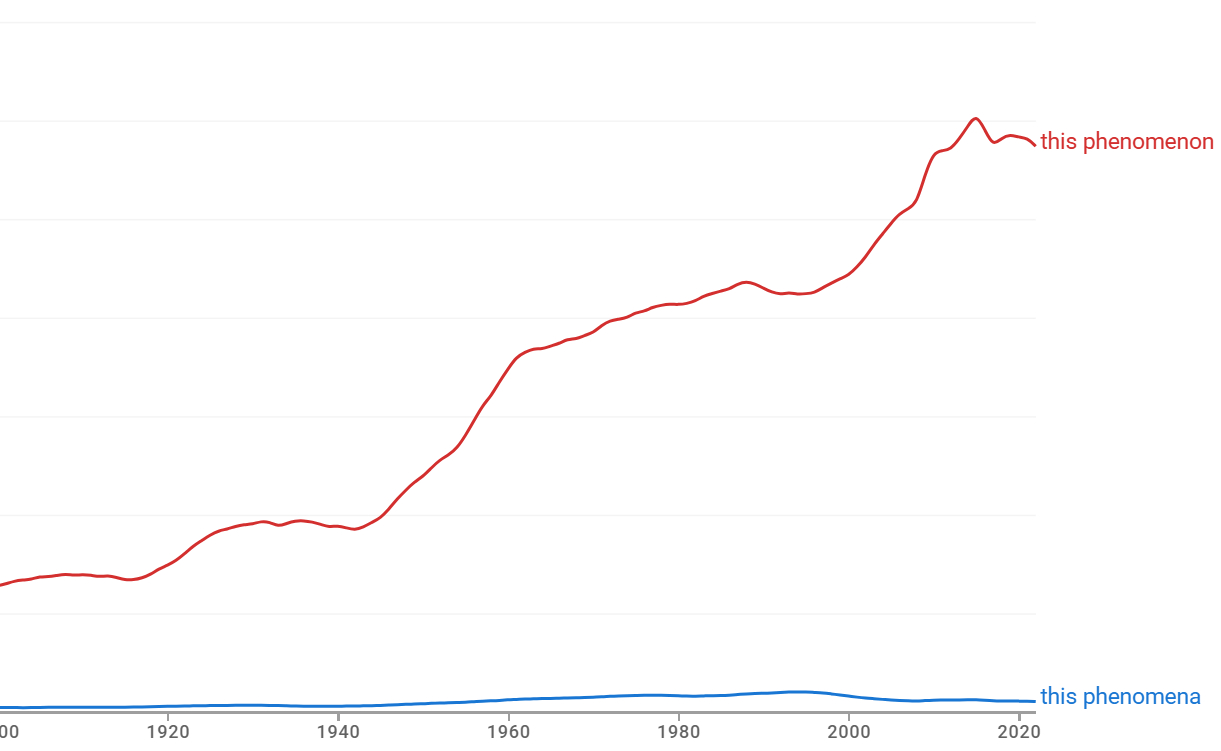
I keep hearing tech people in podcasts consistently using "phenomena" as the singular. ngram (below) shows it's marginal. any idea how that happened? #langsky #etymology #languagechange

Archaeoethnologica: Approches to Celtic Linguistics - Book / Abordagens da Linguística Céltica - Livro
+INFO in: https://archaeoethnologica.blogspot.com/2025/07/abordagens-da-linguistica-celtica-livro.html
#Linguistics #celticstudies #celticlinguistics #philology #celticlanguages #languagechange #palaeolinguistics #books #openaccess

Archaeoethnologica: Approches to Celtic Linguistics - Book / Abordagens da Linguística Céltica - Livro
+INFO in: https://archaeoethnologica.blogspot.com/2025/07/abordagens-da-linguistica-celtica-livro.html
#Linguistics #celticstudies #celticlinguistics #philology #celticlanguages #languagechange #palaeolinguistics #books #openaccess

Archaeoethnologica: Approches to Celtic Linguistics - Book / Abordagens da Linguística Céltica - Livro
+INFO in: https://archaeoethnologica.blogspot.com/2025/07/abordagens-da-linguistica-celtica-livro.html
#Linguistics #celticstudies #celticlinguistics #philology #celticlanguages #languagechange #palaeolinguistics #books #openaccess


Archaeoethnologica: Approches to Celtic Linguistics - Book / Abordagens da Linguística Céltica - Livro
+INFO in: https://archaeoethnologica.blogspot.com/2025/07/abordagens-da-linguistica-celtica-livro.html
#Linguistics #celticstudies #celticlinguistics #philology #celticlanguages #languagechange #palaeolinguistics #books #openaccess

Archaeoethnologica: Approches to Celtic Linguistics - Book / Abordagens da Linguística Céltica - Livro
+INFO in: https://archaeoethnologica.blogspot.com/2025/07/abordagens-da-linguistica-celtica-livro.html
#Linguistics #celticstudies #celticlinguistics #philology #celticlanguages #languagechange #palaeolinguistics #books #openaccess

Archaeoethnologica: Approches to Celtic Linguistics - Book / Abordagens da Linguística Céltica - Livro
+INFO in: https://archaeoethnologica.blogspot.com/2025/07/abordagens-da-linguistica-celtica-livro.html
#Linguistics #celticstudies #celticlinguistics #philology #celticlanguages #languagechange #palaeolinguistics #books #openaccess

Watching a discussion (https://lgbtqia.space/@alice/114741495804033479) about the usage of the word "guy" and I have pointed out that language change can be... rapid nowadays.
So this got me curious:
New eggcorn spotted in the wild: "sure up" instead of "shore up"
#eggcorn #linguistics #language #EnglishUsage #words #LanguageChange

Shopping websites translating item titles and descriptions automatically could be a new vector of language change as I now see "booster" (a small pack of trading card games) translated into Polish as "dopalacz" (that I have only ever seen used with the meaning "designer drug"). I'm curious if people will catch on.
A retro verbing from Torrey Peters:
"The car travels slowly, block by block through traffic. Tourists and a few groups of teenagers Frogger their way across the streets."
#books #reading #TorreyPeters #LanguageChange #verbing #videogames #RetroGaming
Client Info
Server: https://mastodon.social
Version: 2025.07
Repository: https://github.com/cyevgeniy/lmst