#plasmaphysics

2025-10-17

Vera Chernogorova – Conversations About The Atomic Nucleus (Eureka Series)

The book discusses issues related to the study of the atomic nucleus and its structure, nuclear forces, and the components of the nucleus. It also describes the achievements of Soviet scientists in the field of nuclear energy.

About the Author

After graduating from the Faculty of Physics and Mathematics at university, Vera Aleksandrovna entered postgraduate studies and later became a research fellow at the Joint Institute for Nuclear Research in the town of Dubna. For nearly twelve years, she participated in experiments conducted on a particle accelerator — the synchrocyclotron. Vera Aleksandrovna is a co-author of many scientifi c papers on the study of the properties of mu-mesons.

In recent years, she has published over ten articles in journals such as Znanie — Sila (Knowledge Is Power), Science and Life, Technology for the Youth, and others.

The topics of these articles include problems in nuclear physics, high-energy physics, astrophysics, controlled thermonuclear fusion, the application of scientific achievements in The human practice, and the future of science. Many of these articles have been reprinted in foreign journals.

In 1973, our publishing house released her book Mysteries of the Microworld, which discussed some current problems in the physics of elementary particles. Conversations About the Atomic Nucleus is the author’s second book to appear in the Eureka series.

Illustrations: K. Moshkin
Translated from the Russian & typeset in LaTeX by Damitr Mazanav

You can get the book here and here

This book is an Open Educational Resource (OER).

Released under Creative Commons by ShareAlike 4.0


Twitter: @MirTitles
Mastodon: @mirtitles@mastodon.world
Mastodon: @mirtitles@mastodon.social
Bluesky: mirtitles.bsky.social

#Ccbysa #Oer #elementaryParticles #eurekaSeries #nuclearPhysics #physics #plasmaPhysics #popsci #popularScience #scipop #structureOfMatter


M. L.theophy
2025-09-19

🚀 Exciting news! I’m thrilled to share that my latest research article, "Cylindrical Dust Acoustic Shock Waves in a Self‐Gravitational Magnetized Dusty Plasma Compared With Black‐Hole Plasma," has been published!

🔗 Read it here:
doi.org/10.1002/mma.

researchgate.net/publication/3

I’d love to hear your thoughts and discuss the implications of these findings! 🌌

2025-08-28

#Zoomposium with Prof. Dr. #Thomas #Klinger: “The sun on earth - #nuclearfusion as an #energy source”

This time we talk with Thomas Klinger, who has been a “Scientific Member” of the #MaxPlanckSociety since 2001 and is Director of the “#Stellarator #Dynamics and #Transport” division at the Institute for #PlasmaPhysics in Greifswald. There he heads the highly successful #Wendelstein7X project.

Podcast: open.spotify.com/episode/6tMyM

Blog: philosophies.de/index.php/2024

Thumbnail Zoomposium with Thomas Klinger
2025-08-09

Les électrons proches des trous noirs sont étonnamment froids. Et bien ça remet en cause nos idées sur leur environnement extrême.
techno-science.net/actualite/c

2025-07-13

Juno détecte un type inédit d’onde plasma près des pôles de Jupiter, mix d’Alfvén et de Langmuir : la magnétosphère révèle ses secrets !
issues.fr/les-astronomes-ont-t


2025-05-19

How do scientists make sense of complex #ResearchData? 🔬

Scientists in low-temperature #PlasmaPhysics, supported by @nfdi4bioimage are developing a domain-specific #ontology and #terminology service to standardize their (meta)data and establish a common technical language. This not only improves data discoverability but also enables the integration and analysis of heterogeneous datasets.

👉 Markus Becker’s presentation slides: zenodo.org/records/14381522

👉 The new paper: doi.org/10.1088/1361-6463/add7

2025-05-06

#Zoomposium with Prof. Dr. #Thomas #Klinger: “The sun on earth - #nuclearfusion as an #energy source”

This time we talk with Thomas Klinger, who has been a “Scientific Member” of the #MaxPlanckSociety since 2001 and is Director of the “#Stellarator #Dynamics and #Transport” division at the Institute for #PlasmaPhysics in Greifswald. There he heads the highly successful #Wendelstein7X project.

youtu.be/8bNqFmmXebk

More at: philosophies.de/index.php/2024

Portrait of Thomas Klinger
2025-05-05

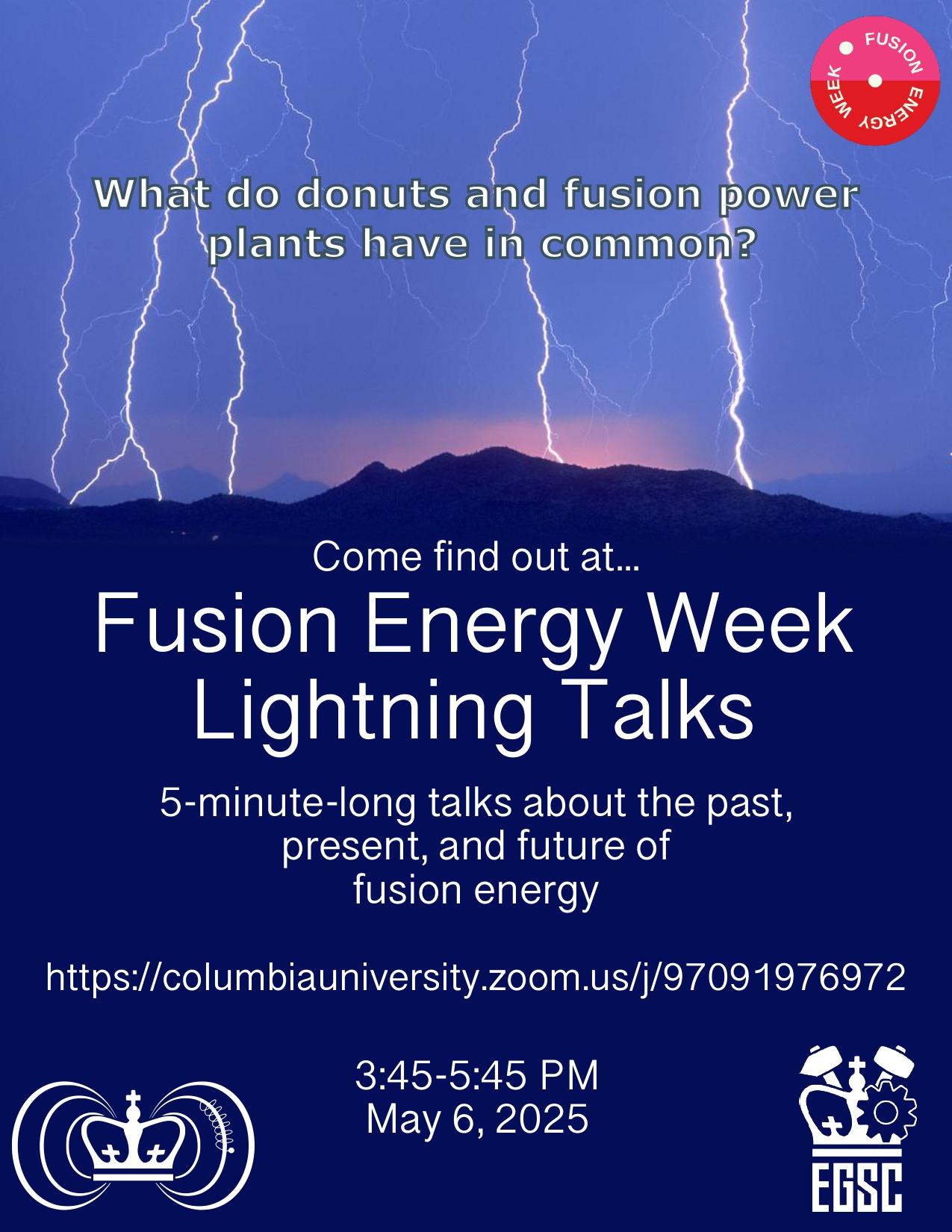
Hello! This week is nuclear fusion week (see link: usfusionenergy.org/fusion-ener). Some grad students of ours will be having lightning talks that the public can attend online. Feel free to attend tomorrow May 6th at 3:45 PM EST, at this zoom link : columbiauniversity.zoom.us/j/9

Poster that states "What do donuts and fusion power plants have in common? Come find out at Fusion Energy Week Lightning Talks, 5-minute-long talks about the past, present, and future of fusion energy" follower by a zoom link. Underneath that it states "3:45-5:45 PM May 6th, 2025". There is a logo for fusion energy week in the upper right hand corner,  in the bottom left a logo of a crown with magnetic field lines coming from it, and in the bottom right a logo of a crown with hammers. The background features a blue mountain landscape with lightning.
2025-04-30

Hey everyone! Next week is Fusion Energy Week (May 5-9). There will be events happening online and in person, in the US and in Europe. Check it out!

usfusionenergy.org/fusion-ener

2025-04-23

Hey Fediverse! Plasma physics grad students have just landed. Dropping some MHD ^-^

The momentum balance mhd equation rho*(partial with respect to t + v dotted with grad)*v = J cross B - grad pressure
Fabrizio BenedettiscienceFab@mstdn.science
2025-03-11

Hydrogen plasma breakthrough could trigger emission-free metal production
In this superheated state, hydrogen becomes much more effective at stripping oxygen from metal ores than traditional methods allow.
interestingengineering.com/sci
#plasmaphysics #metallurgy #co2emissions

spmatich vk3spm :blobcoffee:spmatich@ioc.exchange
2025-01-28

A succinct summary of the significant challenges to nuclear fusion as a power source.
When I studied plasma physics as a graduate student 35 years ago, plasma confinement and instabilities were the main challenges being investigated. At that time research was nowhere near close to addressing the materials challenges for a working fusion reactor.
My physics mentor Prof Bruce Liley said at that time, stability would likely just be a matter of scaling the reactor to be large enough. That might turn out to be true. In the meantime the significant materials challenges remain. When a plasma is hot enough to smash nuclei together, and fuse them, any solid structures even several metres away with be subject to intense ablation. The “wall” of such reactor will constantly be eroded and have to be replaced frequently. This replacement will have to be done by robots, because of the radioactivity emitted from any remaining material due to intense neutron bombardment. Every component near the reactor will have to somehow keep working as it’s being attacked by energetic neutrons. We can’t confine neutrons with a magnetic field because they have no charge.
That’s not to say that it can’t be done, but it remains a very significant challenge. It also means it’s not going to be anywhere near as cheap an energy source as we have by capturing Solar photons from the big fusion reactor in the sky that nature has already created for us.
#PlasmaPhysics #fusion #TheGuardian
theguardian.com/science/2025/j

Max Planck Plasmaphysik (IPP)plasmaphysik@wisskomm.social
2024-12-02

Wie erreicht man Temperaturen von 100 Millionen Grad im Plasma? Welcher Trick muss angewendet werden, um so hohe Temperaturen erreichen zu können? Wie ist der neue Rekord einer Plasmaheizung von 1,3 Megawatt Leistung über sechs Minuten für das Fusionsexperiment Wendelstein 7-X einzuordnen? Wie funktioniert diese Heizung genau, und welche Rolle spielt sie für die Fusionsforschung? Prof. Hartmut Zohm erklärt es euch im Video auf Youtube.
youtube.com/watch?v=YgASMw6cba
#Kernfusion #science #plasmaphysics

https://www.youtube.com/watch?v=YgASMw6cbaM
2024-09-14

Once again, it’s time for a quick update of activity at the Open Journal of Astrophysics. This week we have published another batch of four papers which takes the count in Volume 7 (2024) up to 77 and the total published altogether by OJAp up to 192. Things are picking up again after the summer lull, and we’re moving towards a double century. If we keep up a steady average of four per week we’ll be at 200 per year.

In chronological order, the four papers published this week, with their overlays, are as follows. You can click on the images of the overlays to make them larger should you wish to do so.

First one up is “Quasi-two-dimensionality of three-dimensional, magnetically dominated, decaying turbulence” by Shreya Dwivedi, Chandranathan Anandavijayan, and Pallavi Bhat of TIFR, Bangalore, India. The paper presents an analysis of numerical simulations of MHD turbulence using Minkowski Functionals, with implications for local anisotropies revealed therein. It was published on 9th September 2024 and is in the folder marked High-Energy Astrophysical Phenomena.

Here is a screen grab of the overlay, which includes the abstract:


You can find the officially accepted version of the paper on the arXiv here.

The second paper to announce, also published on 9th September 2024, is “mochi_class: Modelling Optimisation to Compute Horndeski In class” by  Matteo Cataneo (Universität Bonn, Germany) and Emilio Bellini (SISSA, Trieste, Italy). This article presents a cosmological Einstein-Boltzmann solver adapted to work with Horndeski gravity, together with validation tests. It is in the folder Cosmology and NonGalactic Astrophysics.

You can see the overlay here:


The accepted version of this paper can be found on the arXiv here.

The third paper, published on 11th September 2024 in the folder marked High-Energy Astrophysical Phenomena, is by Jonathan Katz of Washington University, St Louis, USA. The title is “The Sources of Fast Radio Bursts” and it presents a discussion of the possible physical origin of Fast Radio Bursts, arguing that they fall into two distinct groups.


The final version accepted on arXiv is here.

Last in this batch, but by no means least, is “RMS asymmetry: a robust metric of galaxy shapes in images with varied depth and resolution” by Elizaveta Sazonova (U. Waterloo, Canada) with 15 other authors spread around the world (in Canada, USA, Australia, Italy, Chile, UK, Poland, Mexico, Germany, and Spain). This paper presents a method of quantifying distortion of galaxy images connected with mergers or other instabilities. It is in the folder marked Astrophysics of Galaxies and was published on September 12th 2024 with this overlay:


You can find the official accepted version on the arXiv here.

That’s all for now. I will post another update in a week.

https://telescoper.blog/2024/09/14/four-new-publications-at-the-open-journal-of-astrophysics-7/

#arXiv220713241v4 #arXiv240101965v2 #arXiv240405792v2 #arXiv240711968v2 #AstrophysicsOfGalaxies #CosmologyAndNonGalacticAstrophysics #EinsteinBoltzmannEquations #fastRadioBursts #galaxies #galaxyMergers #GalaxyShapes #HighEnergyAstrophysicalPhenomena #HorndeskiGravity #magnetohydrodynamics #MHD #MinkowskiFunctionals #OpenJournalOfAstrophysics #PlasmaPhysics #plasmaTurbulence #TheOpenJournalOfAstrophysics

2024-05-17

Artificial intelligence is currently being utilized to expedite and improve plasma physics research, which plays a crucial role in the advancement of fusion energy. This research involves the examination of atomic fusion processes and has the potential to contribute to more efficient energy production.

#AI #PlasmaPhysics #FusionEnergy

phys.org/news/2024-05-scientis

2024-04-16

Another gem from the Intercontinental Seminars on Gravity and Cosmology: Zoom in Wednesday, 17th, 1pm CET to listen to Volker Perlick's talk "Light propagation in a plasma on Kerr spacetime": sites.google.com/view/intersgc
#gravity #BlackHoles #plasmaphysics #cosmology #astronomy

TryCatchDebug.nettrycatchdebug
2023-12-23

trycatchdebug.net/news/1082656
Nuclear fusion has been a topic of interest for physicists and engineers for decades due to its potential to provide a commercially viable source of energy. The International Thermonuclear Experimental Reactor (ITER), an experimental fusion reactor being built in Cadarache, France, is expected to bring commercial fusion energy within the next 60 years. However, the challen

Client Info

Server: https://mastodon.social
Version: 2025.07
Repository: https://github.com/cyevgeniy/lmst