
In https://pixelfed.social/p/Splines/803615973439041638, we saw #Arcade #Intercolumniation without #Pedestal. Here we see it with pedestals. The previous post was missing #dentils but they are included here.
Arches are made up of wedge-shaped blocks known as #voussoir. The middle one at the top of the arch has a special name — #keystone — and it is the stone that supports the most vulnerable part of the beam above and distributes its load to the adjacent blocks, which, in turn, do the same to the next lower block until the load is transferred to the #impost above a #pier.
When the arch does not include a pedestal, the arch opening is closer to the entablature, and there is no special decoration on the keystone. When there are pedestals, they add 6µ (864 units) to the total height, but the height of the opening goes up only by 5µ. So there is greater separation between the entablature and the top of the arch. In that case, there is a decoration on top of the arch to close the gap.
With pedestals, everything added for the arch has different measurement. Because of the increased height, the whole wall behind the columns is thicker — 2µ instead of 1.5µ when there is no pedestal. The pier is also wider, but its base molding is shorter. The impost profile is same, but it is wider because the pier is wider. The #archivolt is also wider, almost reaching the column shaft.
#Scarlata's book https://babel.hathitrust.org/cgi/pt?id=mdp.39015031201190&view=1up&seq=47 has all the measurements. So, I won't repeat them here.
In this post as well as in the previous one, I showed only a single arch on a flat wall with two columns half buried in the wall. When there are multiple arches running along a curve, the wall, entablature, archivolt, impost, pier, and its base are flexible and bend along the curve, but the column and pedestal are rigid. Most #CAD tools offer the option of flowing rigid bodies along a curve or curved surface — Just flow the columns and pedestals separately.
#intercolumniation

#Arcade #Intercolumniation without #Pedestal
In https://pixelfed.social/p/Splines/803089629244302486, we saw #simpleIntercolumniation, also known as #Architravato.
Roman architects combined columns with walls thick enough to bury half of the column width inside the walls and added arches to them for better load distribution. An arcade (multiple arches) can be run in series along a single wall, or in parallel to form a walkway. They can also be combined in both series and parallel configurations, perhaps the most famous of which is the #Colosseum in Rome.
In the Colosseum, the outer walls follow an elliptical curve (even though it looks circular from the outside), and it has multiple tiers of arches in series. The interior has arches in concentric passageways in the lower tiers giving it a lattice-like design.
Because arches distribute the load from above, they allow for wider intercolumniation. The rules for #ArcadeIntercolumniation differ depending on whether the columns have pedestals or not.
Besides the arch itself, which is part of the wall, the figure shows some new architectural elements.
The narrow part of the wall immediately behind a column is known as a #pier. The visible face of a pier between a column and the opening under the arch is known as #alette. The base of the pier has a molding, the flat part of which has the same height as the column base (µ) while the rest follows the #fillet and #cavetto or #conge of the #shaft.
As we move up the pier, there is a horizontal molding known as #impost just below where the arc of the arch starts. The impost wraps around on the sides of the pier.
Around the arc is a circular molding known as #archivolt, the bottom portion of which has a #fascia that is aligned with the face of the wall.
The wall itself extends all the way to the top of the #entablature. It is worth noting that the entablature is repeated on the wall. It doesn't end at the columns and has two "outside" corners and one "inside" corner.
In https://pixelfed.social/p/Splines/803089629244302486, we saw #simpleIntercolumniation, also known as #Architravato.
Roman architects combined columns with walls thick enough to bury half of the column width inside the walls and added arches to them for better load distribution. An arcade (multiple arches) can be run in series along a single wall, or in parallel to form a walkway. They can also be combined in both series and parallel configurations, perhaps the most famous of which is the #Colosseum in Rome.
In the Colosseum, the outer walls follow an elliptical curve (even though it looks circular from the outside), and it has multiple tiers of arches in series. The interior has arches in concentric passageways in the lower tiers giving it a lattice-like design.
Because arches distribute the load from above, they allow for wider intercolumniation. The rules for #ArcadeIntercolumniation differ depending on whether the columns have pedestals or not.
Besides the arch itself, which is part of the wall, the figure shows some new architectural elements.
The narrow part of the wall immediately behind a column is known as a #pier. The visible face of a pier between a column and the opening under the arch is known as #alette. The base of the pier has a molding, the flat part of which has the same height as the column base (µ) while the rest follows the #fillet and #cavetto or #conge of the #shaft.
As we move up the pier, there is a horizontal molding known as #impost just below where the arc of the arch starts. The impost wraps around on the sides of the pier.
Around the arc is a circular molding known as #archivolt, the bottom portion of which has a #fascia that is aligned with the face of the wall.
The wall itself extends all the way to the top of the #entablature. It is worth noting that the entablature is repeated on the wall. It doesn't end at the columns and has two "outside" corners and one "inside" corner.

#Milestone8 - #SimpleIntercolumniation
Floor Plan of archetypal Greek Temple https://pixelfed.social/p/Splines/803021258359555093
Front and back #intercolumniation https://pixelfed.social/p/Splines/803076419096100108
Side intercolumniation https://pixelfed.social/p/Splines/803089629244302486
#Milestone7 - Complete #IonicOrder https://pixelfed.social/p/Splines/800050647761776920
#Milestone6 — #Braids #3StrandBraids https://pixelfed.social/p/Splines/799602946527813102
#Milestone5 — #EggsAndDarts https://pixelfed.social/p/Splines/797069447808333887
#Milestone4 — #IonicScroll https://pixelfed.social/p/Splines/795361973789834465
#Milestone3 — #IonicColumn https://pixelfed.social/p/Splines/792803978865652429
#Milestone2 — Classic #IonicEntablature https://pixelfed.social/p/Splines/791021871062069787
#Milestone1 — #IonicPedestal https://pixelfed.social/p/Splines/790752092700055739
Floor Plan of archetypal Greek Temple https://pixelfed.social/p/Splines/803021258359555093
Front and back #intercolumniation https://pixelfed.social/p/Splines/803076419096100108
Side intercolumniation https://pixelfed.social/p/Splines/803089629244302486
#Milestone7 - Complete #IonicOrder https://pixelfed.social/p/Splines/800050647761776920
#Milestone6 — #Braids #3StrandBraids https://pixelfed.social/p/Splines/799602946527813102
#Milestone5 — #EggsAndDarts https://pixelfed.social/p/Splines/797069447808333887
#Milestone4 — #IonicScroll https://pixelfed.social/p/Splines/795361973789834465
#Milestone3 — #IonicColumn https://pixelfed.social/p/Splines/792803978865652429
#Milestone2 — Classic #IonicEntablature https://pixelfed.social/p/Splines/791021871062069787
#Milestone1 — #IonicPedestal https://pixelfed.social/p/Splines/790752092700055739

Floor Plan of https://pixelfed.social/p/Splines/802974815166948953 showing #intercolumniation.
Greek architects classified temples and public buildings based on number of columns in front, number of columns in both front and rear, as well as interior columns.
The simplest buildings are those with walls on three sides, and partial walls called #antae (singular #antis) in front, flanked by just two columns.
Buildings with 2 columns in front are #distyle, 4 columns are #tetrastyle, 6 are #sexastyle, 8 #octastyle, 10 #decastyle, and those with 12 columns would be #dodecastyle.
The classifications are refined further. Those with 2 columns flanked by antae are called #inAntis. These never have any columns in the back or sides.
Tetrastyle buildings with 4 columns only in the front are #prostyle, and those with 4 columns in both front and back are #amphiProstyle.
Sexastyle buildings like those in the previous post are called #peripteral.
Octastyle buildings with densely arranged internal rows are called #dipteral, and when some internal columns are removed, the sparse structure is called #pseudoDipteral.
Decastyle buildings are also called #hypaethral. With 10 columns in front and rear, these are noteworthy for their width. In fact, they are so wide that they don't have a roof in the middle, which is open to the sky. Only the four sides have roofs supported by columns.
In addition to the number columns, there is a further classification based on #intercolumniation. #Vitruvius described five classes of temples, designated as follows: "#pycnostyle, with the columns close together; #systyle, with the intercolumniations a little wider; #diastyle, more open still; #araeostyle, farther apart than they ought to be; #eustyle, with the intervals apportioned just right."
The building in my previous post (shown without walls) has 6 columns in front and back — so, it is sexastyle. It is also known as a "Peripteral Eustyle," with column "intervals apportioned just right."
Greek architects classified temples and public buildings based on number of columns in front, number of columns in both front and rear, as well as interior columns.
The simplest buildings are those with walls on three sides, and partial walls called #antae (singular #antis) in front, flanked by just two columns.
Buildings with 2 columns in front are #distyle, 4 columns are #tetrastyle, 6 are #sexastyle, 8 #octastyle, 10 #decastyle, and those with 12 columns would be #dodecastyle.
The classifications are refined further. Those with 2 columns flanked by antae are called #inAntis. These never have any columns in the back or sides.
Tetrastyle buildings with 4 columns only in the front are #prostyle, and those with 4 columns in both front and back are #amphiProstyle.
Sexastyle buildings like those in the previous post are called #peripteral.
Octastyle buildings with densely arranged internal rows are called #dipteral, and when some internal columns are removed, the sparse structure is called #pseudoDipteral.
Decastyle buildings are also called #hypaethral. With 10 columns in front and rear, these are noteworthy for their width. In fact, they are so wide that they don't have a roof in the middle, which is open to the sky. Only the four sides have roofs supported by columns.
In addition to the number columns, there is a further classification based on #intercolumniation. #Vitruvius described five classes of temples, designated as follows: "#pycnostyle, with the columns close together; #systyle, with the intercolumniations a little wider; #diastyle, more open still; #araeostyle, farther apart than they ought to be; #eustyle, with the intervals apportioned just right."
The building in my previous post (shown without walls) has 6 columns in front and back — so, it is sexastyle. It is also known as a "Peripteral Eustyle," with column "intervals apportioned just right."

Classical #Intercolumniation is a complex topic with myriad rules that were developed after lots of experimentation by Greek as well as Roman architects.
The primary purpose of #colonnades or multiple columns was both practical (to support heavy weight) and aesthetic ("imposing effect of high relief" as #Vitruvious wrote in https://www.gutenberg.org/files/20239/20239-h/20239-h.htm#Page_78).
The architects paid keen attention to the thickness of columns as well as the spacing between them. They experimented with "columns close together, … with intercolumniations a little wider, … more open still, … and farther apart than they ought to be," until they settled on column spacing "with the intervals apportioned just right."
With variable spacing came the need for adjusting thickness of shafts which had to be "enlarged in proportion to the increase of the distance between the columns," without which, "the column will look thin and mean, because the width of the intercolumniations is such that the air seems to eat away and diminish the thickness of such shafts." They also wanted to avoid proportions that would make the "shaft look swollen and ungraceful, because the intercolumniations are so close to each other and so narrow." So, it wasn't just the design of an individual column that was parameterized with the single parameter µ, first mentioned in https://pixelfed.social/p/Splines/790357912719769731 and further described in https://pixelfed.social/p/Splines/790417950261292263. Intercolumniation was also codified in terms of column width (effectively parameterized by µ).
Beyond the appearance, there were practical considerations. While walls (which came before columns) were made of bricks, the dominant material for columns and entablatures were stone. As such, regardless of the width of individual columns, the gap could not be increased beyond certain limits, for the spans above the column could break.
Materials such as timber for beams allowed more experimentation.
The primary purpose of #colonnades or multiple columns was both practical (to support heavy weight) and aesthetic ("imposing effect of high relief" as #Vitruvious wrote in https://www.gutenberg.org/files/20239/20239-h/20239-h.htm#Page_78).
The architects paid keen attention to the thickness of columns as well as the spacing between them. They experimented with "columns close together, … with intercolumniations a little wider, … more open still, … and farther apart than they ought to be," until they settled on column spacing "with the intervals apportioned just right."
With variable spacing came the need for adjusting thickness of shafts which had to be "enlarged in proportion to the increase of the distance between the columns," without which, "the column will look thin and mean, because the width of the intercolumniations is such that the air seems to eat away and diminish the thickness of such shafts." They also wanted to avoid proportions that would make the "shaft look swollen and ungraceful, because the intercolumniations are so close to each other and so narrow." So, it wasn't just the design of an individual column that was parameterized with the single parameter µ, first mentioned in https://pixelfed.social/p/Splines/790357912719769731 and further described in https://pixelfed.social/p/Splines/790417950261292263. Intercolumniation was also codified in terms of column width (effectively parameterized by µ).
Beyond the appearance, there were practical considerations. While walls (which came before columns) were made of bricks, the dominant material for columns and entablatures were stone. As such, regardless of the width of individual columns, the gap could not be increased beyond certain limits, for the spans above the column could break.
Materials such as timber for beams allowed more experimentation.
We have now looked at every nook and cranny of the complete #IonicOrder in microscopic detail.
Here is one more look at the underside of the #ovolo to revel in the splendor before we move on to the macro level, the first step of which is arranging columns in a row to create a #colonnade according to spacing rules known as #intercolumniation.
Colonnades need not be straight and can follow arcs or other (preferably loose) sweeping curves.
As mentioned in https://pixelfed.social/p/Splines/790357912719769731, a #pedestal is always optional.
Greek designers designed the Ionic Order with full columns. The Romans introduced half columns on surfaces of walls, with or without arches. Multiple columns with arches, whether in series or in parallel, are called #arcades.
The rules for #arcade intercolumniation are different from those for simple intercolumniation, varying even by whether pedestals are present or not.
Here is one more look at the underside of the #ovolo to revel in the splendor before we move on to the macro level, the first step of which is arranging columns in a row to create a #colonnade according to spacing rules known as #intercolumniation.
Colonnades need not be straight and can follow arcs or other (preferably loose) sweeping curves.
As mentioned in https://pixelfed.social/p/Splines/790357912719769731, a #pedestal is always optional.
Greek designers designed the Ionic Order with full columns. The Romans introduced half columns on surfaces of walls, with or without arches. Multiple columns with arches, whether in series or in parallel, are called #arcades.
The rules for #arcade intercolumniation are different from those for simple intercolumniation, varying even by whether pedestals are present or not.

#IonicColumn #Flutes
In https://pixelfed.social/p/Splines/799864068250003272 I mentioned rounding off the radius of the bottom circle, but you don't have to. #CAD tools are perfectly happy working with 15.0728 or even higher precision as they are with 15.
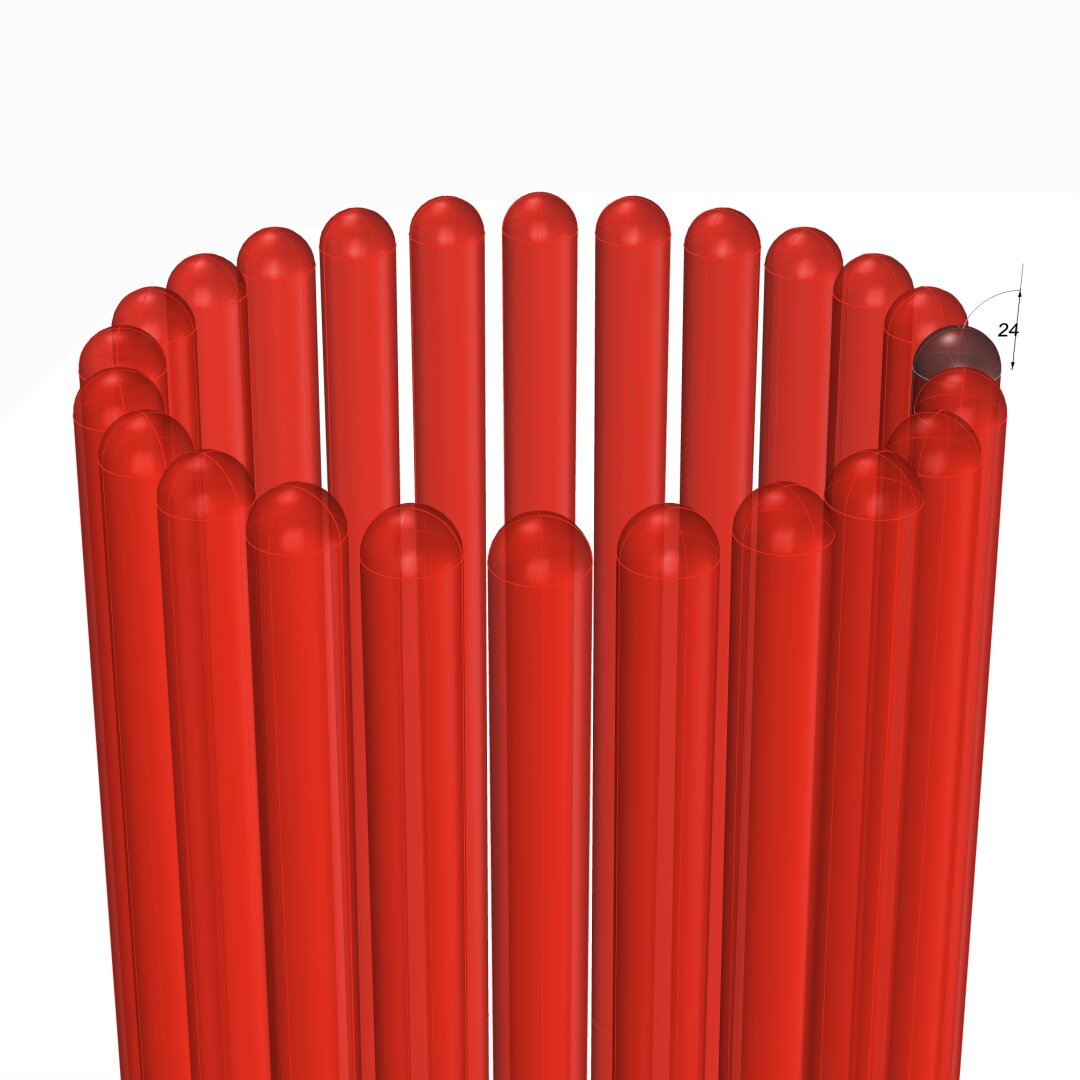
After placing the two circles as described in that post, use the full #primaryProfileCurve of the shaft from https://pixelfed.social/p/Splines/791794072490907090 as a #sweepingRail and the two circles for the flutes as the #sweepingCurves, and #sweepOneRail for the body of a single flute. Close #planarHoles on both ends to get an #airtight solid.
Then draw a sphere at the center of the top circle using the same radius as the circle, and perform a #booleanUnion between the sphere and the flute body.
If you want a round bottom for the flute, repeat the sphere at the center of the larger circle using the same radius (15.0 or 15.0728) and perform another boolean union to get one flute.
Switch to the top view and make 24 copies of the flute (including the original) centered at the column axis and #group the 24 flutes.
Finally, perform a #booleanDifference with the flutes group on a copy of the solid #unadornedShaft to get a fluted variant.
The result is a column shaft with flutes carved out. Save the flutes separately for future reuse.
This concludes the entire #IonicOrder, including all #decorativeElements.
Now we pause and reflect: The whole exercise seemed like one of #art and #sculpture. Where is the #architecture in all of this?
Without a ceiling or a roof, there is no building. Without additional columns or walls, there is no ceiling. So, while we have completed the Ionic Order itself, we only have the first #buildingBlock — a single column.
Next step is to repeat the columns to create a #colonnade, which together with supporting walls or additional colonnades can support a ceiling.
Just like with everything else in design, there are rules of proportion for #intercolumniation, or space between columns.
In https://pixelfed.social/p/Splines/799864068250003272 I mentioned rounding off the radius of the bottom circle, but you don't have to. #CAD tools are perfectly happy working with 15.0728 or even higher precision as they are with 15.
After placing the two circles as described in that post, use the full #primaryProfileCurve of the shaft from https://pixelfed.social/p/Splines/791794072490907090 as a #sweepingRail and the two circles for the flutes as the #sweepingCurves, and #sweepOneRail for the body of a single flute. Close #planarHoles on both ends to get an #airtight solid.
Then draw a sphere at the center of the top circle using the same radius as the circle, and perform a #booleanUnion between the sphere and the flute body.
If you want a round bottom for the flute, repeat the sphere at the center of the larger circle using the same radius (15.0 or 15.0728) and perform another boolean union to get one flute.
Switch to the top view and make 24 copies of the flute (including the original) centered at the column axis and #group the 24 flutes.
Finally, perform a #booleanDifference with the flutes group on a copy of the solid #unadornedShaft to get a fluted variant.
The result is a column shaft with flutes carved out. Save the flutes separately for future reuse.
This concludes the entire #IonicOrder, including all #decorativeElements.
Now we pause and reflect: The whole exercise seemed like one of #art and #sculpture. Where is the #architecture in all of this?
Without a ceiling or a roof, there is no building. Without additional columns or walls, there is no ceiling. So, while we have completed the Ionic Order itself, we only have the first #buildingBlock — a single column.
Next step is to repeat the columns to create a #colonnade, which together with supporting walls or additional colonnades can support a ceiling.
Just like with everything else in design, there are rules of proportion for #intercolumniation, or space between columns.
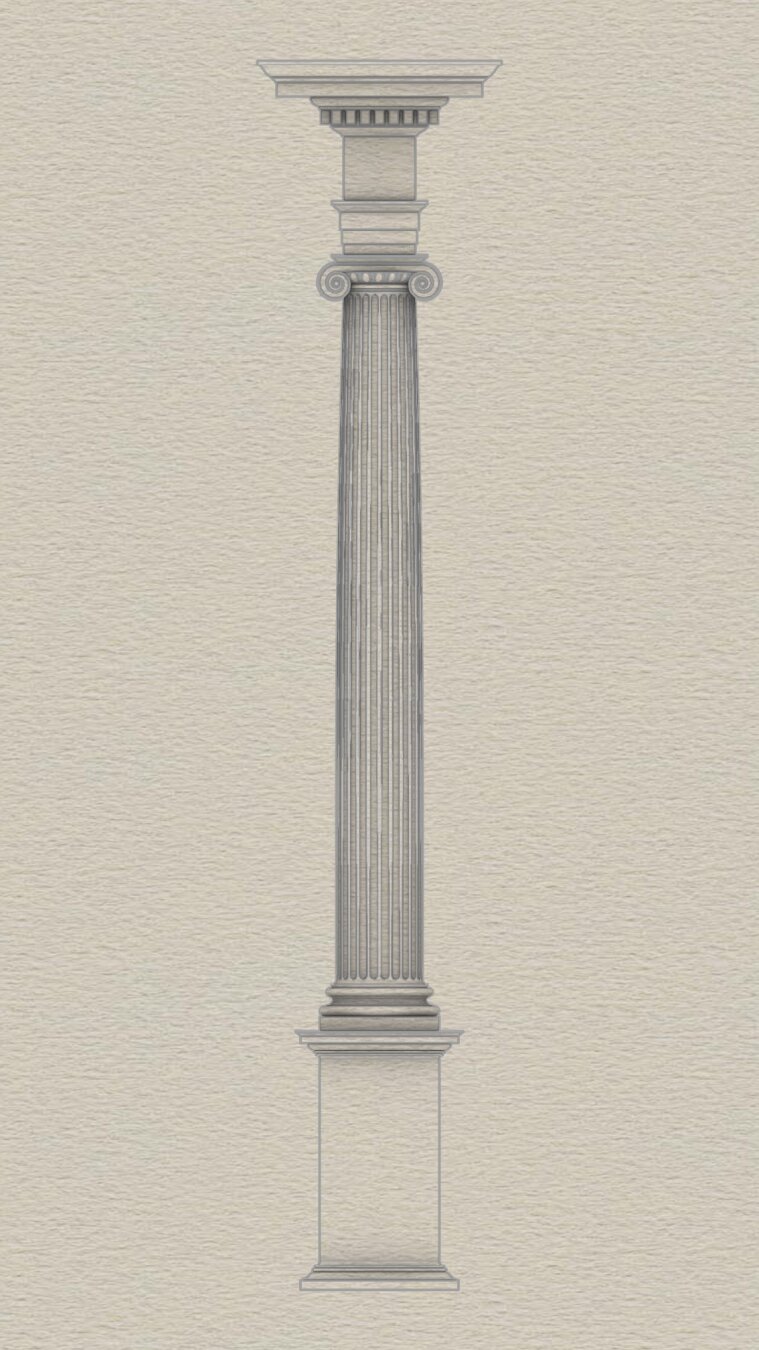
This is a sketch of the complete #IonicOrder, excluding #intercolumniation and #arches, which came later.
Different people have different abilities and different levels of mathematical knowledge. I make few assumptions about the minimum knowledge one must possess to follow my posts. At a minimum, one must understand ratio, proportion, similar, congruent triangles, Pythagoras, and basic properties of circles, including radius, diameter, circumference, tangents, secants, and chords.
No trigonometry or calculus is assumed, but people who have a knowledge of differentiable continuity, maxima, minima, and inflection points will have increased appreciation of the nuances of some designs featuring smooth curves and surfaces.
I start with first principles, even if it might be a little boring for people with advanced skills. The most basic requirement is that one must be able to mark points on a 3D grid, draw a straight line between two points, and draw a circle or arc from the center. The CAD tools should help with the rest, for example, to find a point of tangency, draw a circle through three arbitrary points, or tangential to three curves (if possible).
There are three components in the #Ionic order. Starting at the bottom is the #pedestal (which is optional), the #column, and the #entablature. Each of these three components has three subcomponents:
— Pedestal has #basement, #dado, and #cap.
— Column has #base, #shaft, and #capital.
— Entablature has #architrave, #frieze, and #cornice.
The pedestal, column, and entablature are always in 4:12:3 ratio. If all components are present, the total order height is divisible by 19. If there's no pedestal, the total height is divisible by 15.
The entire order is parameterized by a SINGLE parameter — the radius of the column at its base. #Vitruvius called the radius a "module" (µ) — an abstract unit of measure independent of physical units.
Components of Ionic column and entablature also have classic and modern variations.
Different people have different abilities and different levels of mathematical knowledge. I make few assumptions about the minimum knowledge one must possess to follow my posts. At a minimum, one must understand ratio, proportion, similar, congruent triangles, Pythagoras, and basic properties of circles, including radius, diameter, circumference, tangents, secants, and chords.
No trigonometry or calculus is assumed, but people who have a knowledge of differentiable continuity, maxima, minima, and inflection points will have increased appreciation of the nuances of some designs featuring smooth curves and surfaces.
I start with first principles, even if it might be a little boring for people with advanced skills. The most basic requirement is that one must be able to mark points on a 3D grid, draw a straight line between two points, and draw a circle or arc from the center. The CAD tools should help with the rest, for example, to find a point of tangency, draw a circle through three arbitrary points, or tangential to three curves (if possible).
There are three components in the #Ionic order. Starting at the bottom is the #pedestal (which is optional), the #column, and the #entablature. Each of these three components has three subcomponents:
— Pedestal has #basement, #dado, and #cap.
— Column has #base, #shaft, and #capital.
— Entablature has #architrave, #frieze, and #cornice.
The pedestal, column, and entablature are always in 4:12:3 ratio. If all components are present, the total order height is divisible by 19. If there's no pedestal, the total height is divisible by 15.
The entire order is parameterized by a SINGLE parameter — the radius of the column at its base. #Vitruvius called the radius a "module" (µ) — an abstract unit of measure independent of physical units.
Components of Ionic column and entablature also have classic and modern variations.
Client Info
Server: https://mastodon.social
Version: 2025.07
Repository: https://github.com/cyevgeniy/lmst