#dado

2026-01-14

Il global manga di Sio, Dado e Azzurro Chiara debutta con un primo volume simpatico e intrigante, seppur non originalissimo.

Recensione di Chirano

#gukken #manga #fumetti #scifi #fantascienza #starcomics #sio #dado #azzurrochiara

nerdevil.it/2026/01/12/gukken-

📰 «Physical Dice Roller es todo lo que Internet aún tiene de bueno» 🔗 proxy.jesusysustics.com/2026/0 Physical Dice Roller – Roll Physical Dice Online realdice.org/

Physical Dice Roller es un lanzador de dados real conectado a una webcam y con el que podemos interactuar pulsando un botón desde su web. Y con esto conseguimos puntos de estilo adicional, además de auténtico azar. Y es que la aleatoriedad en Informática se basa en algoritmos que generan números que simulan ser aleatorios.

Descubrí esta maravilla en el fediverso, gracias a Manu M (@manum@masto.es).

#️⃣ #aleatorio #curiosidad #dado #herramienta #juego #webSencilla #webapp
SESH.sxsesh_sx
2025-10-20
2025-02-02
The bottom 1/3 of the #columnShaft for an #IonicColumn is a perfect cylinder. So the line below point B is a straight line.

In https://pixelfed.social/p/Splines/791723063470910081, we blended the bottom end of the 60° arc and the top end of the long interpolated curve between points J and K. Now blend the bottom end of the interpolated curve and the top end of the straight line between points B and C to obtain the 3rd and final #NURBS segment for the #primaryProfileCurve of the shaft.

Just like there's a #cavetto and #fillet near the #neck of the shaft, there is a fillet and cavetto near the foot of the shaft. However, there is a subtle difference between the two. The cavetto near the neck is tangential to the blended #NURBS curve that is not a straight line. The profile curve for the cavetto near the foot is tangential to a straight line.

There is a special name for a cavetto that is tangential to a straight line or flat surface, like the two cavetto moldings in the #dado of the #pedestal. It's called a #conge. Another alternate name for the cavetto molding is #cove, which is evocative of "cave" because of its concave profile curve.

Above the neck is a fillet 8 units tall and an #astragal 16 units tall that #Scarlata puts in braces in the column shaft section within his tables of #VignolaProportions, with a note saying they are not counted as part of the shaft but are accounted for as part of the #capital.

I decided to include the top fillet as part of the shaft and keep the astragal with the capital. It does not change the design or alter the proportions in any way, but the inclusion of the fillet makes it more practical for #3DPrinting and #CNCMilling of the neck. This concludes the profile curve for the shaft with a height of 291 parts or 2328 units + 8 for fillet.

The column shaft is tapered in the upper 2/3 due to #entasis whose purpose is to make optical corrections to the shape of the column which, without correction, appeared concave near the top.
2025-01-30
If you've been longing for some 3D adventure, your wait is over. We have here some of the most basic 3D operations that you will use over and over.

First #join all #primaryProfileCurves into a single curve that has both straight lines and arcs. If you are unable to join them, look closely at the bottom #fillet of the #dado where it meets the top of the #reed of the #basement. There is a gap of 2 units between the fillet and the arc of the reed. Close the gap with a straight line and join the curves.

Switch from the front view to the right view, and #extrude the joined profile curves on both sides of the profile curve so that the full extrusion is a little over the total width of the pedestal. A good rule of thumb is to extrude at least 1/8th extra on both sides of the joined profile curve. This extrusion is shown in the attached image as the gray surface in perspective view.

Switch back to the front view and centered on the #columnAxis, draw a rectangle that is somewhat taller than the total pedestal height so that it extends past both the top and bottom of the pedestal extrusion from the previous step. The total width of this rectangle should be about 1.5 times the width of the pedestal. This is because we will create a cutting surface with this rectangle and rotate it 45° in the top view, and then rotate a copy of that another 90°, as shown by the flat red surfaces. The reason the width must be approximately 1.5 times (or larger) is because #Pythagoras told us that the hypotenuse of a unit square is 1.414 units. So 1.5 times should be enough.

Use the two cutting planes to cut, split, or trim the extruded surface (depending on the terminology of your CAD program). This is called #mitering. Discard the excess of the extruded surface from both ends. Also discard or hide the red mitering surfaces.

Switch to the top view and rotate the #mitered extrusion repeatedly at 90° about the column axis until you have all four sides, and join them all into an open surface.
2025-01-30
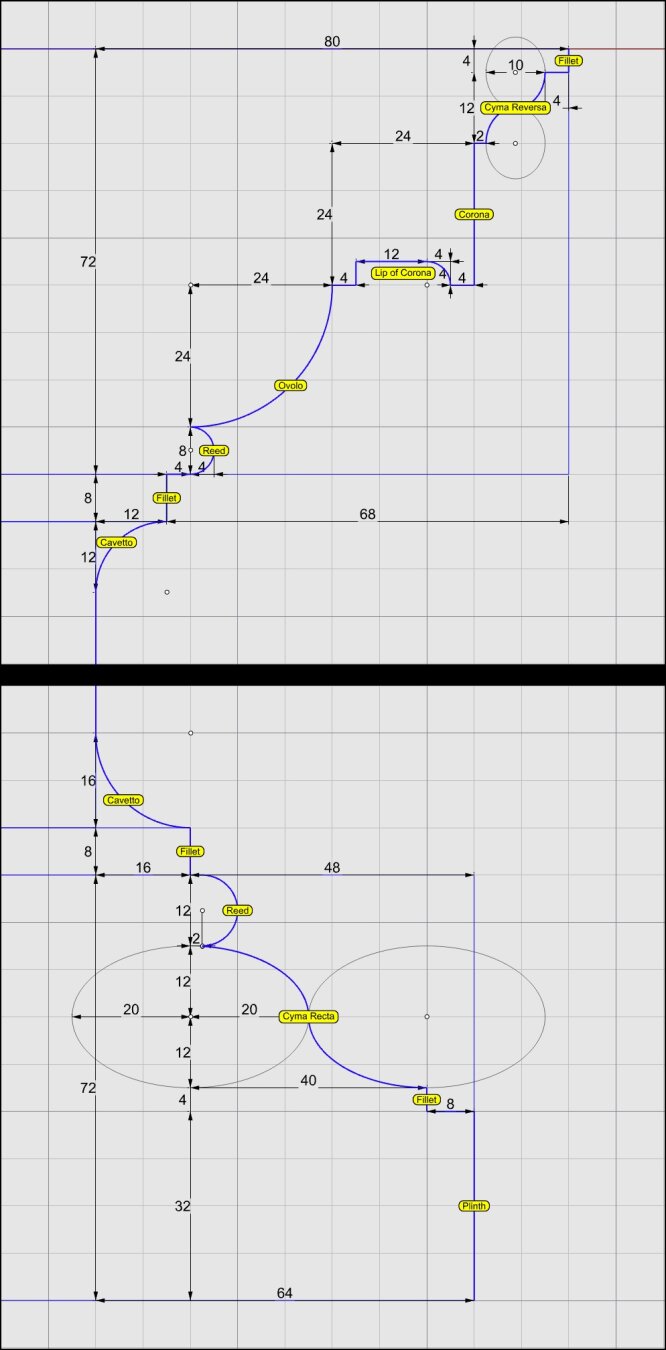
This shows the detailed measurements of the top and bottom portions of the #IonicPedestal. For macro-level measurements, see https://pixelfed.social/p/Splines/790571135473463588

Each of the blue curve segments (lines and arcs) that are marked with a yellow bubble is the #profileCurve for a #molding whose name is inside the bubble.

Starting at the bottom, we have a #plinth, a #fillet, a #cymaRecta, and a #reed as part of the #basement of an Ionic pedestal.

Next up, we have a #fillet and a #cavetto at the bottom of the #dado, and another cavetto and fillet at the top of the dado.

Moving higher up, a reed, an #ovolo, a #corona, a #cymaReversa, and a final fillet top off the cap of the pedestal.

They are called profile curves because each is the outline or silhouette of a 3D molding as seen from one side or in a cross section. In the case of a pedestal, these curves can be used directly to recreate the 3D shape of the pedestal. For this reason and in this case, I call them #primaryProfileCurves.

This is not always the case. For more complex shapes, such as the #scroll surface of an #IonicCapital shown in https://pixelfed.social/p/Splines/789956327130679640, the profile curves recovered by #reverseEngineering the image scans in #Vignola's book cannot be used directly to sweep the scroll surface because the scroll shape is not cylindrical. Like the inside of a rose, the scroll surface follows the outlines of spiral #volutes in the front and back, neither of which are circular. So, additional steps are necessary to derive the curves that we can actually use to reconstruct the surface.

In the case of the scroll surface, the derivation of these curves is not trivial and not obvious, but it is not difficult to understand, and no math is involved. There are multiple sets of curves, and each successive set is derived from a previous set. I call them secondary, tertiary, and quaternary curves.

For now, we stick with the primary profile curves for the pedestal.
2025-01-30
This shows macro-level measurements for the #IonicPedestal.

The key to #effectiveModeling is to simplify a complex shape into elementary components. Sometimes, this involves mentally flattening and reducing 3D shapes to 2D shapes, extracting elementary curves from them, and then recreating the 3D shapes from the extracted 2D curves.

This is not always easy for organic shapes (which can still be approximated by Bézier curves). I extracted the #primaryCurves for the #IonicScroll surface in https://pixelfed.social/p/Splines/789956327130679640 after a lengthy trial-and-error process that involved #curveFitting images from #Vignola’s book, #RegolaArchitettura. I had to #reverseEngineer the details because the measurements have either been lost, or are locked away in some library. Web search yields no details on these measurements.

Fortunately, for geometrical shapes like pedestals, this is very easy. Because of its square footprint, mentally slicing it through the middle from top to bottom, it is easy to “see” the outline. Another way to think about #curveExtraction is to shine an imaginary bright light on an object from behind in a dark room to reveal its silhouette.

For the pedestal, even this silhouette or outline can be further reduced because the shape is symmetrical about the #columnAxis. With this realization, we only need to focus on one half of the outline, and methodically proceed from bottom to top, marking every kink and inflection point on the outline.

Fortunately, the other authoritative book, #Scarlata’s #PracticalArchitecture, I mentioned in my introductory post already documents #VignolaProportions in tabular form. So we can skip everything else and go directly to that.

Total height of #IonicPedestal is 864 units (108 parts, or 6*µ) of which the #PedestalBasement and #PedestalCap are each 72 units (9 parts, or µ/2) and the #Dado is 720 units (90 parts, or µ*5) tall.
2025-01-29
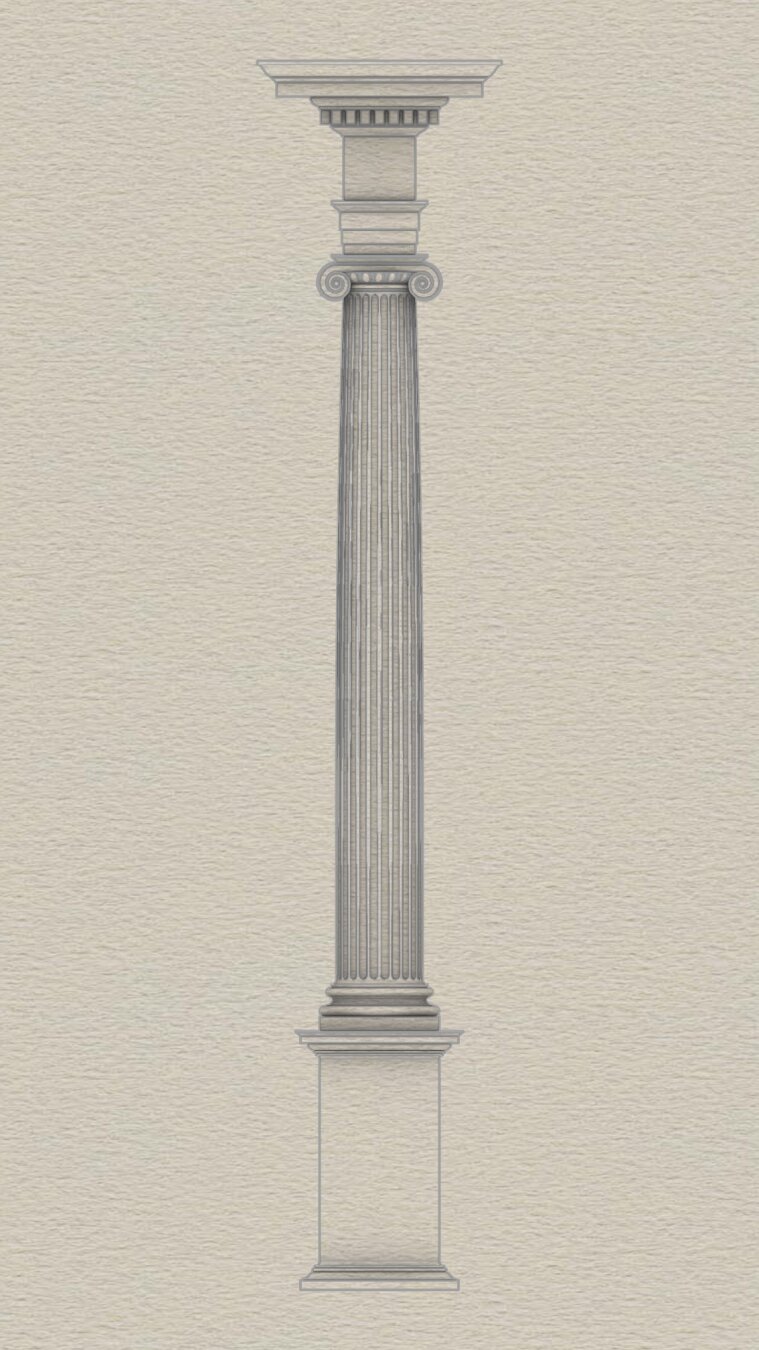
This is a sketch of the complete #IonicOrder, excluding #intercolumniation and #arches, which came later.

Different people have different abilities and different levels of mathematical knowledge. I make few assumptions about the minimum knowledge one must possess to follow my posts. At a minimum, one must understand ratio, proportion, similar, congruent triangles, Pythagoras, and basic properties of circles, including radius, diameter, circumference, tangents, secants, and chords.

No trigonometry or calculus is assumed, but people who have a knowledge of differentiable continuity, maxima, minima, and inflection points will have increased appreciation of the nuances of some designs featuring smooth curves and surfaces.

I start with first principles, even if it might be a little boring for people with advanced skills. The most basic requirement is that one must be able to mark points on a 3D grid, draw a straight line between two points, and draw a circle or arc from the center. The CAD tools should help with the rest, for example, to find a point of tangency, draw a circle through three arbitrary points, or tangential to three curves (if possible).

There are three components in the #Ionic order. Starting at the bottom is the #pedestal (which is optional), the #column, and the #entablature. Each of these three components has three subcomponents:
— Pedestal has #basement, #dado, and #cap.
— Column has #base, #shaft, and #capital.
— Entablature has #architrave, #frieze, and #cornice.

The pedestal, column, and entablature are always in 4:12:3 ratio. If all components are present, the total order height is divisible by 19. If there's no pedestal, the total height is divisible by 15.

The entire order is parameterized by a SINGLE parameter — the radius of the column at its base. #Vitruvius called the radius a "module" (µ) — an abstract unit of measure independent of physical units.

Components of Ionic column and entablature also have classic and modern variations.
2025-01-16

✨ Desvende o Poder dos Dados Estruturados em SEO!
📝 Aprenda como a implementação de dados estruturados pode transformar a visibilidade do seu site e impulsionar seu ranking nos motores de busca! Descubra dicas práticas e técnicas eficazes que podem fazer a diferença no seu desempenho online. Não perca a chance de otimizar sua estratégia de SEO! Clique no link e comece agora!
.
.
. ...
inkdesign.com.br/desvendando-a

2024-12-31

⬆️ #IonicPedestal #3DModeling #ProfileCurves

Top-right portion of profile curves for #Ionic Pedestal. Details in Alt text.

When µ = 288, the pedestal #Cap is 72 units tall. The #fillet and #cavetto below that are part of the #Dado.

The #Ovolo is convex (opposite of cavetto). Both Ovolo and #Corona are 24 units tall.

The corona has a lip that is not visible from front. The function of the lip is not to help you lift the pedestal and move it around but to dissipate water dripping from the top.

Top-right portion of profile curves for Ionic Pedestal.

When µ = 288, the pedestal Cap is 72 units tall. The fillet and cavetto below that are part of the Dado. 

Note that the top and bottom cavettos of the Dado are of different sizes.
2024-12-31

⬆️ #IonicPedestal #3DModeling #ProfileCurves

Bottom-right portion of profile curves for Ionic Pedestal. Details in Alt text.

Starting from bottom, the #plinth, #fillet, #CymaRecta, and #reed belong to the #Basement.

The fillet and #cavetto (circular arc) above those belong to the #Dado.

The cyma recta is 40 units wide and 24 tall. So the arcs for that are cut from ellipses.

A refined variation of cyma recta uses half turn of a helix instead of 2 elliptical arcs and will be presented later.

Zoomed-in view of bottom-right portion of the profile curve for Ionic pedestal showing curve shapes and measurement details.

The cavetto (concave circular arc) and fillet near the top belong to the #Dado. The reed below the fillet belongs to the basement.

A detail that is easy to miss is that the right edge of the reed is 8 units farther away from the column axis than the right edge of the fillet above it. But, the radius of the reed profile is 6 units (for reed height of 12). 

So there is a small gap of 2 units at the foot of the fillet and top of the reed that must be closed with a straight horizontal line of 2 units.

There's a similar gap of 2 units at the bottom of the reed and top of the cyma recta that must also be closed with a straight horizontal line.

All of the individual shapes must be joined to form a single profile curve that is flat on the XY plane (Front view).
2024-12-31

⬆️ #IonicPedestal #3DModeling

>> Using µ = 288… pedestal height would be… 864 units.

The #Basement and #Cap are each 72 units tall, and the #Dado is 720 units tall, totaling 864 units. Details in Alt text.

Many reference sources will give these measurements in "parts". Remember, in #Tuscan and #Doric, a part is µ/12. In #Ionic and #Corinthian, a part is µ/18. When µ = 288, an Ionic part is 16. With this in mind, you can convert in either direction.

Total height of Ionic pedestal is 54 parts.

Shows measurements of Basement, Dado, and Cap of Ionic pedestal on a grid with minor ticks 8 units apart and major ticks 32 units apart.

When module size µ = 288, the Basement projects 264 units from column axis and is 72 units tall.

The total height of the Dado including the filets at top and bottom is 720 units. Each filet is 8 units tall. So the height of the Dado excluding filets is 704 units and it's flat wall projects 200 units from the column axis.

The Cap, like the Basement, is also 72 units tall, but it projects 280 units from column axis.
2024-12-30

⬆️ #CAD #3DModeling

>> #IonicOrder is medium in complexity

There are 3 components in the #Ionic order. Starting at the bottom is the #pedestal (which is optional), the #column, and the #entablature.

Each of the 3 components has 3 subcomponents.

Pedestal has #basement, #dado, and #cap.

Column has #base, #shaft, and #capital.

Entablature has #architrave, #frieze, and #cornice.

Components of Ionic column and entablature also have classic and modern variations.

2024-08-09

Woodworking tools:

The dado-cutting tool I’ve been seeing used in a video series is the Mafell NFU Groove Cutter.

It’s basically a portable track saw loaded with a single-piece dado blade.

For those unfamiliar, commonly-available dado blades in the US are positively Rube Goldberg designs, comprised of two sawblades sandwiching separate and sharp and fast-whirling blades.

This Mafell brings the table saw to the timber, and with what looks to be a decidedly better (and seemingly safer) blade design than most of the US table saw dado blades I’ve worked with.

Not a cheap power tool, though.

produkte.mafell.de/usa/mortisi

#woodworking #dado #mafell

A portable power tool similar to a tracked circular saw, black with red lettering showing (most of) Mafell, employing a dado-like blade to cut the second pass of one half of a tenon for timber framing project.

Still image from Escape to Rural France.

https://www.youtube.com/@escapetoruralfrance
Doc Sigmadocsigma
2024-01-10

if you know enough about the SCP Foundation to know who dado is, fucking reach out to me because we are automatically friends

u trust dado

Client Info

Server: https://mastodon.social
Version: 2025.07
Repository: https://github.com/cyevgeniy/lmst