#cornice

BlueUtah 🇺🇲🇺🇦🇨🇦🇩🇰blueutah.bsky.social@bsky.brid.gy
2025-06-03

Nice cornice hanging off that ridge. June 2, 2025 #Banff #Alberta #glacier #cornice #MoraineLake #BlueUtah

2025-03-12
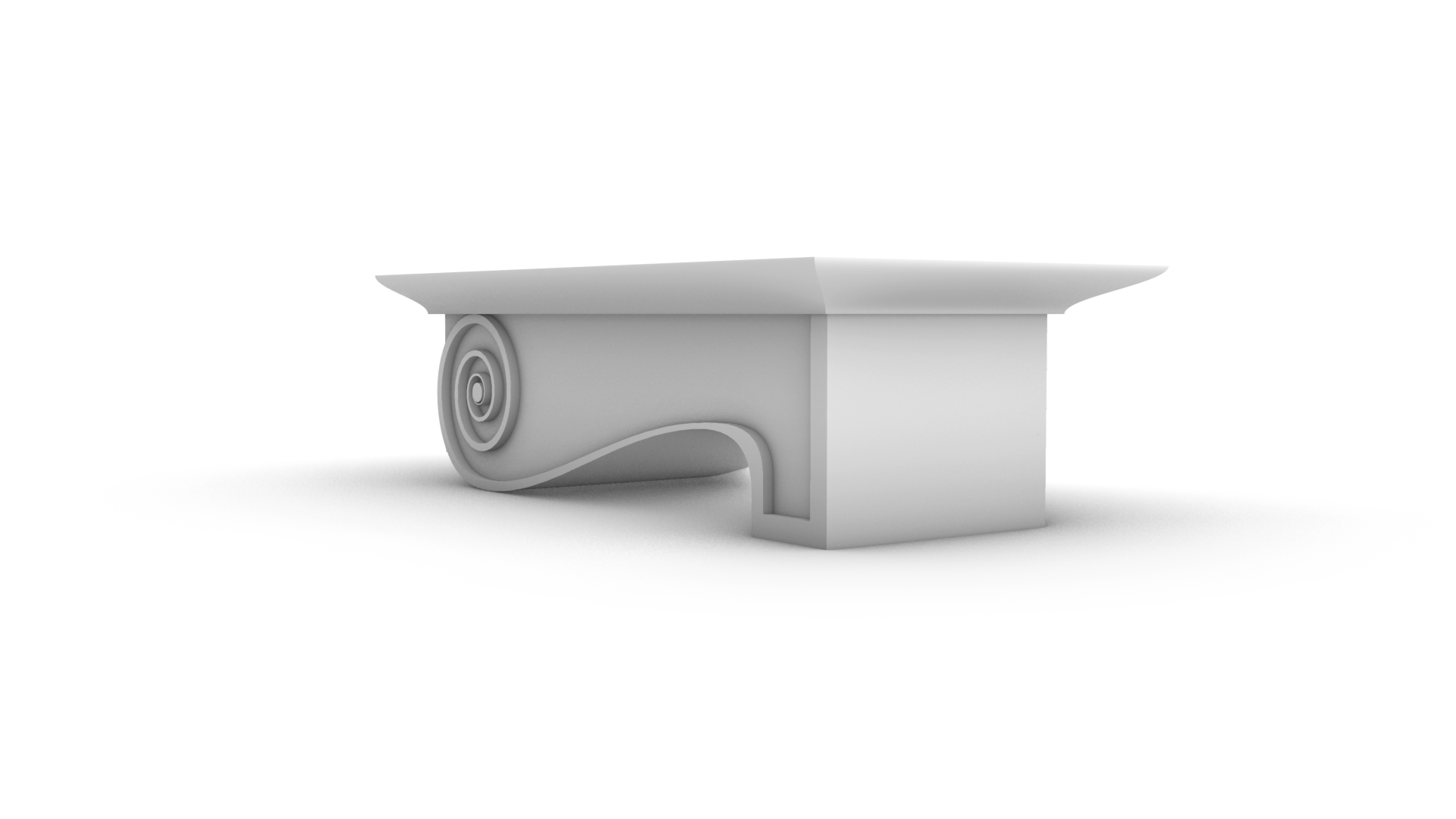
#Modillion for the #ModernIonicEntablature

In https://pixelfed.social/p/Splines/790782316675150160 , I mentioned that there are two variations of the #IonicEntablature — a classic version that we saw in https://pixelfed.social/p/Splines/804548474524642209, and a modern version that has a new feature called #modillions, which are projecting brackets under the #corona of the #cornice. Note that, "modern" is a relative term. For designs that are more than 2000 years old, even an alteration hundreds of years ago would qualify as modern.

The modillion design continues a similar pattern but not identical to that of a #keystone. The measurements can be found in https://babel.hathitrust.org/cgi/pt?id=mdp.39015031201190&view=1up&seq=45 from which you can surmise that the length is 130 units (based on µ = 144) and the height is 36 units excluding the flamboyant #cymaReversa. The depth is not given, but can be derived from the sketch in https://babel.hathitrust.org/cgi/pt?id=mdp.39015031201190&view=1up&seq=141.

The measurements for the cymaReversa are listed between the corona and medallions, but its #profileCurve is attached to the modillion, not to the corona. Like #dentils, we attach modillions separately to the entablature. The dentils are still there with the same square footprint and same interdental spacing, but they are shorter to make room for the modillions above.

The original #volute that forms the basis of the modillion design is µ = 144 wide (including #arcZero) and 128 tall. Since the modillion height divides evenly into µ, I used that orientation for constructing the modillion, creating a box 144 units wide and 520 units tall. After construction, I scaled it to 1/4 to get 36 x 130 units, and then rotated it 90°.

The length of 520 was divided into 128*3.5 = 448 for the curved portion (which aligns with the wall) and 72 for the straight portion, which faces the front. Try to recreate it on your own first, and if you need help, just ask me.
2025-02-13
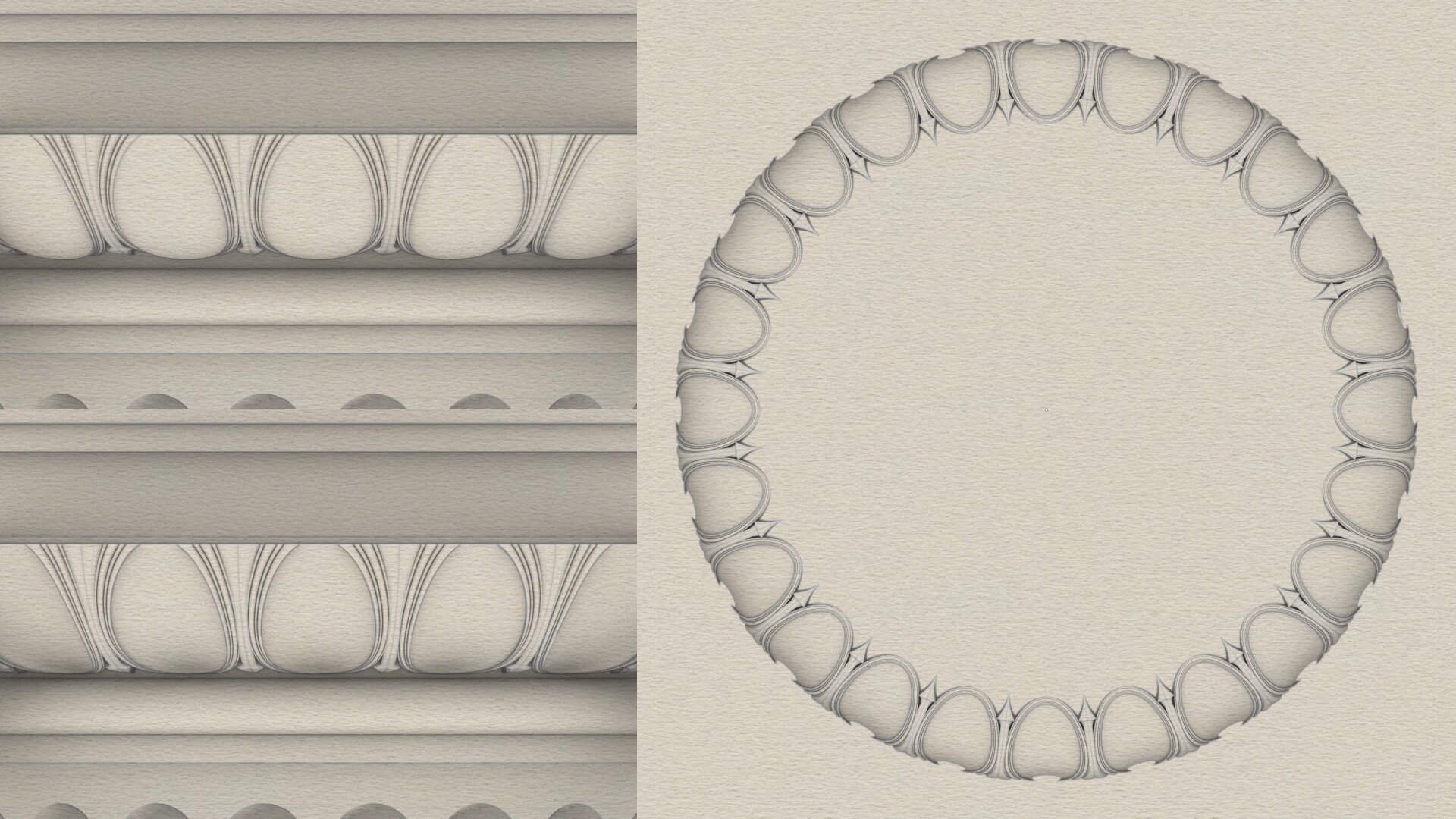
#EggsAndDarts is a common classical design motif with endless variations, two of which are shown here — the top-left variant has convex eggs and the bottom-left variant has concave eggs. The sketch on the right shows the bottom view of the concave variant.

This motif is neither specific to the #IonicOrder, nor limited to the #ovolo of the capital. It is common to find it laid on linear #moldings like #cymaRecta or #cymaReversa of a #cornice.

The egg shape, the dart shape, the degree of convexity or concavity, and so on, are infinitely variable from subtle to pronounced. Designers are not limited to convex or concave, and it is possible to combine both in a single design. Also, it is not necessary to use the eggs and dart motif at all. There are infinite possibilities. However, when the eggs and darts motif is used, it is almost invariably sliced off at the top, as the bottom view of concave variant on the right reveals.

The concave version here is quite subtle, but a more pronounced version can be really eye-popping. I will show how to construct one using just straight lines and circular/elliptical arcs exclusively as I originally promised in https://pixelfed.social/p/Splines/789956327130679640.

As usual, we start with a flat 2-dimensional plan with lines and ovals to use as #sweepingRails. Then, we add circles and arcs as #sweepingCurves to define the cross-sections. After sweeping the cross section curves on the rails, we create the eggs.

Simply #revolve an ellipse on its major axis to get the convex version of an egg. To get the concave version of an egg, simply create a flat slab and perform a #booleanDifference on that slab using a convex egg.

Once we have all of this preparatory work done, we have to transfer the 3-dimensional design from the flat surface it was originally created on to the #doublyCurved surface of the Ovolo. This requires some elementary calculations using circle geometry.

Previous— https://pixelfed.social/p/Splines/795361973789834465
2025-01-31
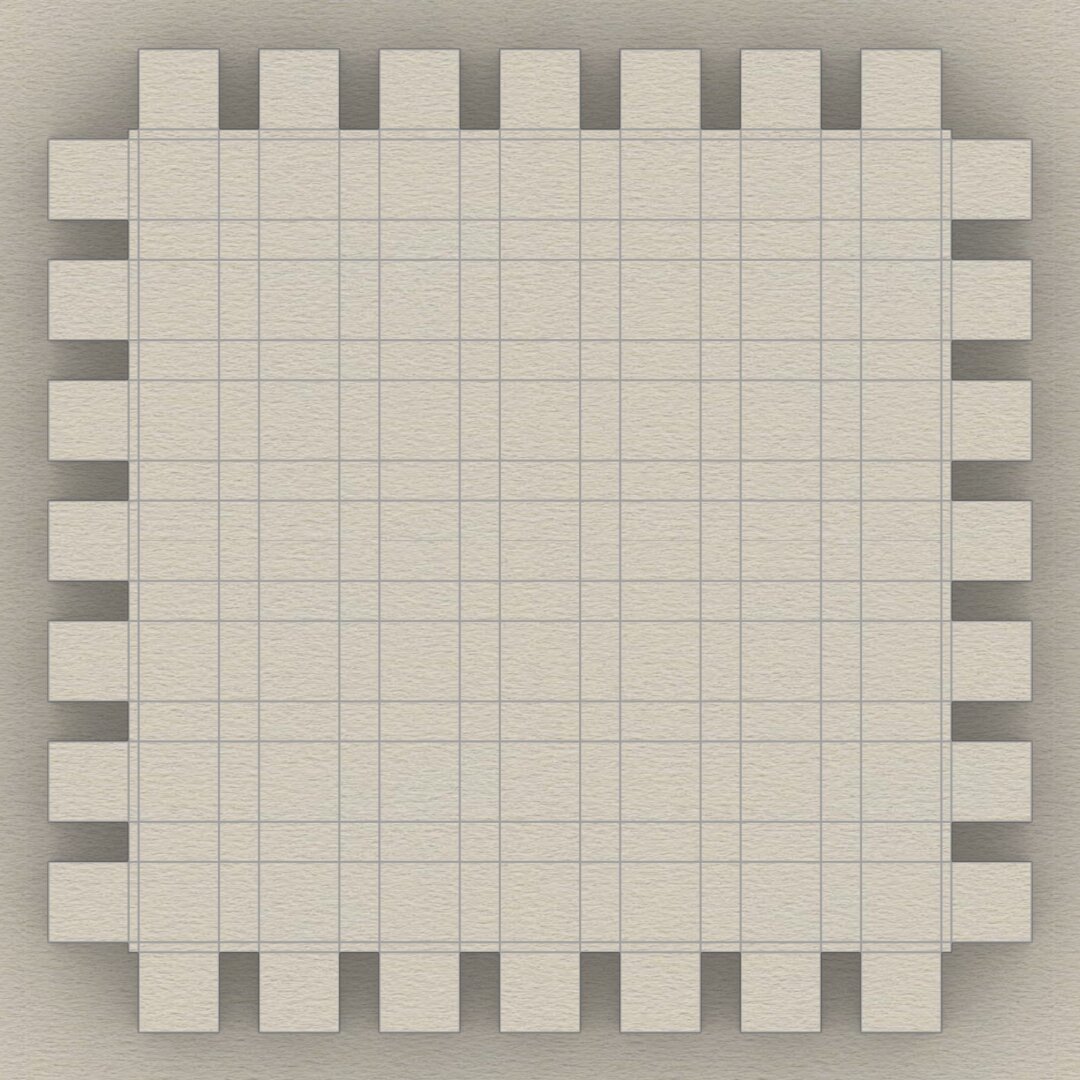
This sketch shows the arrangement of #dentils in the classic variation of the #IonicEntablature. It shows the full layout, but most of the top is obscured by the top portion of the #cornice. Only the outside square shapes are actually visible.

Each #dentil has a square "footprint" that is 4 parts by 4 parts (32*32 units) and is 6 parts (48 units) tall. The spacing between each dentil is 2 parts (16 units).

Dentils project 4 parts (or 32 units) from the face of the #fascia on which they rest.

Each face of the fascia has 7 dentils with the middle dentil laterally centered and directly in front of the column axis. The 2 side dentils are on side faces, and that is apparent in the darker shading in the sketch at https://pixelfed.social/i/web/post/790782316675150160. Take the time to reconcile this with the numbers listed in #Scarlata's #PracticalArchitecture.

The 3D reconstruction from the #primaryProfileCurves is very similar to that of the #IonicPedestal, with #extrusion, #mitering, #joining, and #capping planar holes as described in https://pixelfed.social/i/web/post/790645054230337543 — just set the dentils aside, for now.

Once you have capped the #planarHoles to get a solid, analyze the edges of the solid in the #CAD program for #nakedEdges and #nonManifoldEdges.

Then, extrude the dentils outline (in the top view) to a height of 48 units (in the front view).

Now perform a #booleanUnion of the two solid shapes to get the complete #entablature.

Finally, check the edges of the solid in the #CAD program AGAIN for #nakedEdges and #nonManifoldEdges.

With this, we have finished two of the three main components of the #IonicOrder. There's a modern version of the Ionic entablature with #modillions, which I will describe later.

Next, we move on to the biggest, most conspicuous part of the order — the #IonicColumn.
2025-01-31
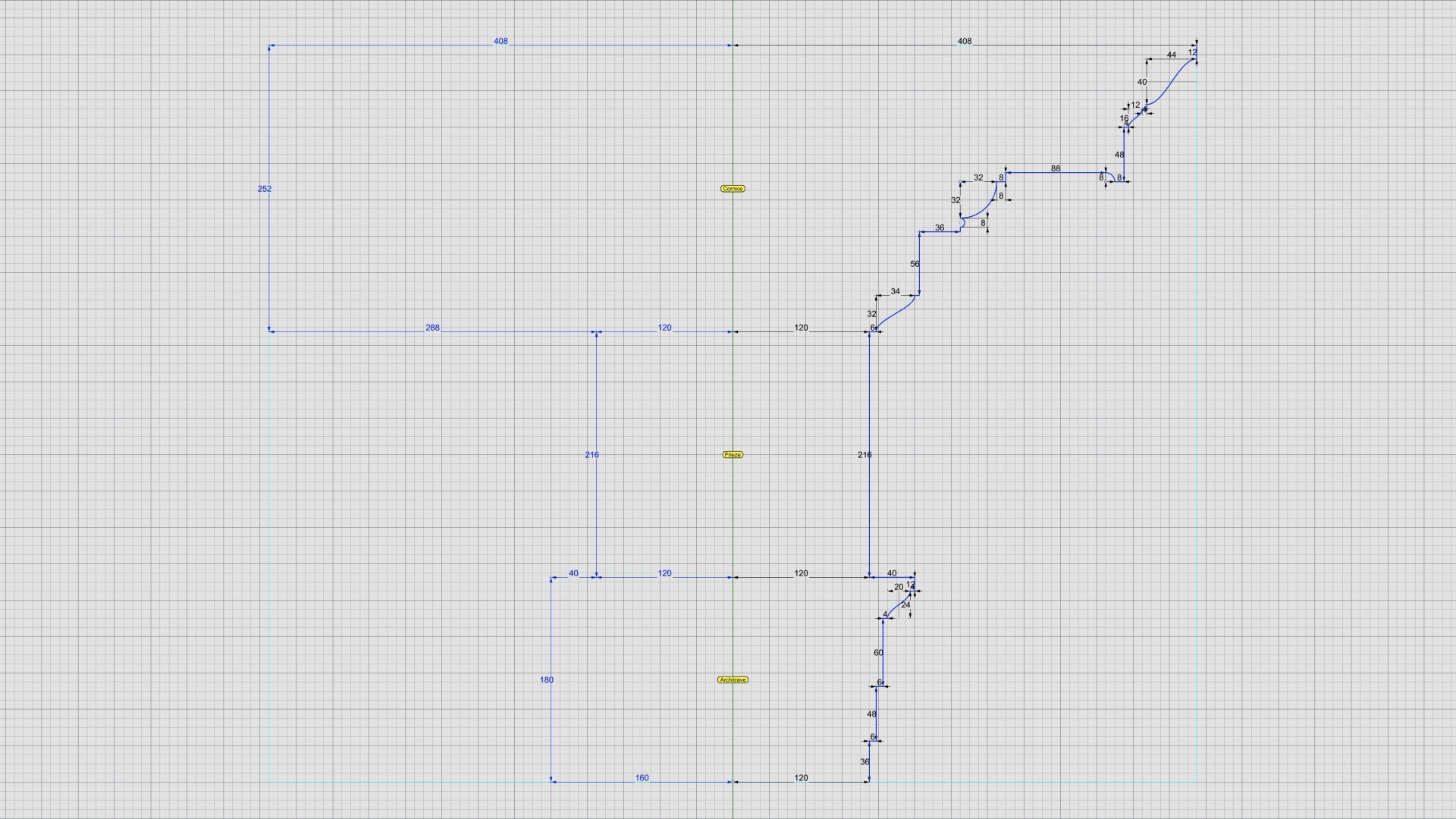
Classic variation of the #IonicEntablature. Left side shows the macro-level plan. Right side shows the detailed plan for the #moldings.

All moldings should be familiar from the #IonicPedestal, except the #fascia — flat bands, of which there are 3, at the bottom of the #Architrave. The fascias grow progressively taller, starting at 36 units at the bottom, to 48 in the middle, and 60 at the top, with each successive one offset horizontally by 6 units from the previous one.

Above the fascia, we have a #cymaReversa which is 24 units tall and 20 units wide. Here we are using half turn of a helix with a vertical axis. Either helix or elliptical arcs are acceptable, but the choice must be consistent across the entire order. You cannot use ellipses in the pedestal and helices in the entablature, for example.

If you do use a helix, remember that it is a 3D shape like a round coil. To use it as a #profileCurve, it must be flattened to a 2D shape by #projecting it to the #constructionPlane. I will describe this technique in detail later.

The #frieze is a flat surface with no moldings. It is meant as a blank space on which to put custom decorative 3D #ReliefCarvings or sculptures.

There are no new moldings in the #cornice. Note that the order of #cymaRecta and cyma reversa are reversed from that of the #pedestal, with cyma recta at the top and cyma reversa at the bottom. The only difference between the two is that the recta has a horizontal axis and reversa has a vertical axis. Rotating either one 90° yields the other.

So, the bottom of the cornice starts with a cyma reversa 32 units tall and 34 wide. This is followed by a fascia 56 units tall on which the #dentils will appear later on. The 36 unit horizontal offset for the 4-unit thick fillet above it is to leave room for the dentils.

This is followed by a #reed (8 units), #ovolo (32 units), #corona (48 units), cyma reversa (16 x 12 units), fillet (4 units), cyma recta (40 x 44 units), and fillet 12 units
2025-01-31
There are two variations of the #IonicEntablature. The classic variation has #dentils, which are teeth-like structures shown here above the #frieze. The modern version has #modillions, which are projecting brackets under the #corona of the #cornice. Well, "modern" is a relative term. For designs that are more than 2000 years old, even an alteration 1000 years ago would qualify as modern.

Although the sketch shows the #entablature with a square footprint, in practice, it runs the entire length of a #colonnade (multiple columns) or an #arcade (multiple arches).

#CAD construction of the entablature is very similar to that of a #pedestal.

The first step is to consult #Vignola's #RegolaArchitettura for the visual appearance, and then consult #Scarlata's #PracticalArchitecture for #VignolaProportions in tabular form.

It is convenient to create a spreadsheet to convert the measurements given in Scarlata's book from module "parts" to your own model units based on your choice of value for the module parameter µ.

Armed with these measurements, it is time to plot the points and draw the #primaryProfileCurves on our standard 2D grid with minor grid lines 8 units apart and major grid lines 32 units apart.

In the first pass, skip the dentils and draw the profile curves for the rest of the moldings. Just as with the pedestal, I will show the macro-level plan as well as the detail plan. So, you don't have to go to Scarlata's book, but you know it's there if you want to.

I will show the dentil arrangement in a subsequent post.

Based on µ = 144, the classic Ionic entablature is 648 units (36 parts, or 4.5*µ) tall. Of this, the #architrave at the bottom is 180 units (10 parts, or 1.25*µ) tall, the frieze in the middle is 216 units (12 parts, or 1.5*µ) tall, and the cornice at the top is 252 units (14 parts, or 1.75*µ) tall.
2025-01-29
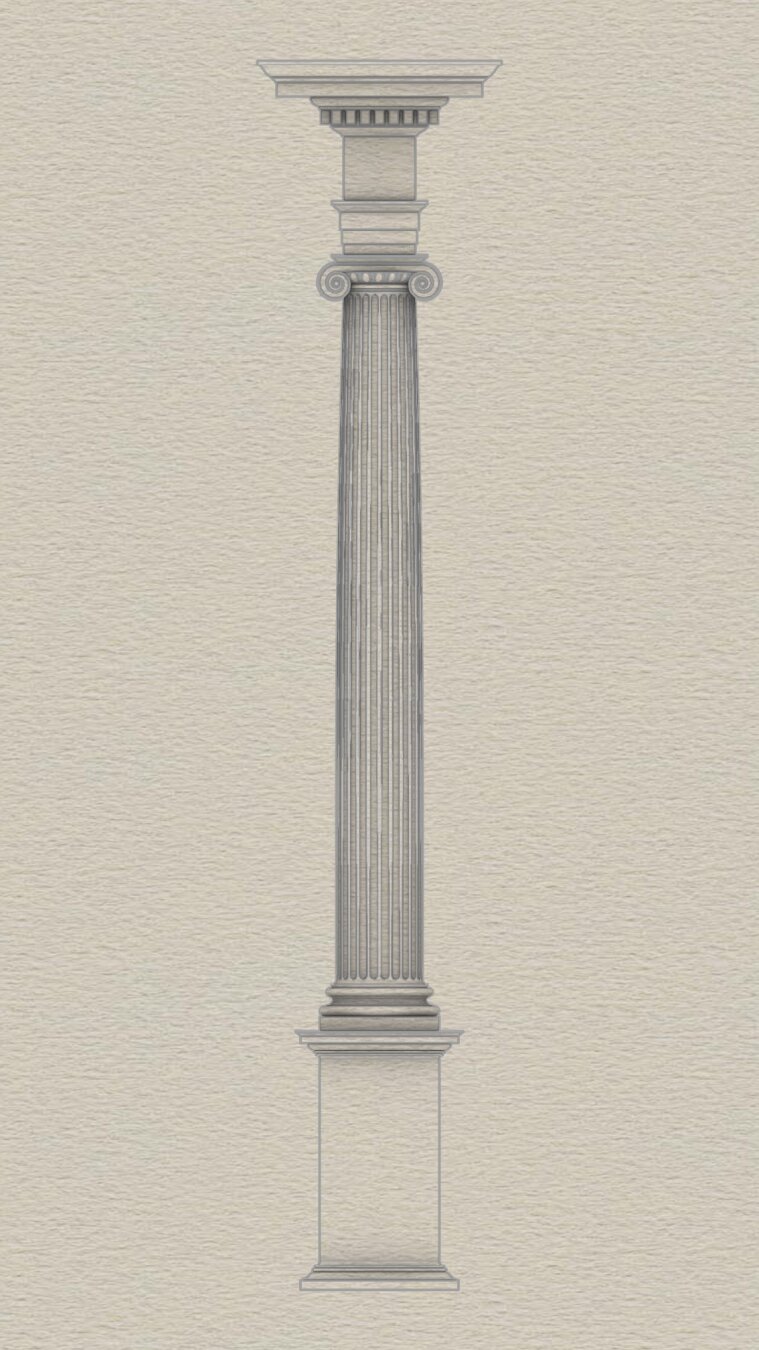
This is a sketch of the complete #IonicOrder, excluding #intercolumniation and #arches, which came later.

Different people have different abilities and different levels of mathematical knowledge. I make few assumptions about the minimum knowledge one must possess to follow my posts. At a minimum, one must understand ratio, proportion, similar, congruent triangles, Pythagoras, and basic properties of circles, including radius, diameter, circumference, tangents, secants, and chords.

No trigonometry or calculus is assumed, but people who have a knowledge of differentiable continuity, maxima, minima, and inflection points will have increased appreciation of the nuances of some designs featuring smooth curves and surfaces.

I start with first principles, even if it might be a little boring for people with advanced skills. The most basic requirement is that one must be able to mark points on a 3D grid, draw a straight line between two points, and draw a circle or arc from the center. The CAD tools should help with the rest, for example, to find a point of tangency, draw a circle through three arbitrary points, or tangential to three curves (if possible).

There are three components in the #Ionic order. Starting at the bottom is the #pedestal (which is optional), the #column, and the #entablature. Each of these three components has three subcomponents:
— Pedestal has #basement, #dado, and #cap.
— Column has #base, #shaft, and #capital.
— Entablature has #architrave, #frieze, and #cornice.

The pedestal, column, and entablature are always in 4:12:3 ratio. If all components are present, the total order height is divisible by 19. If there's no pedestal, the total height is divisible by 15.

The entire order is parameterized by a SINGLE parameter — the radius of the column at its base. #Vitruvius called the radius a "module" (µ) — an abstract unit of measure independent of physical units.

Components of Ionic column and entablature also have classic and modern variations.
Suren Gevorgyan CNC-ProfArtistGazZzaN
2025-01-27

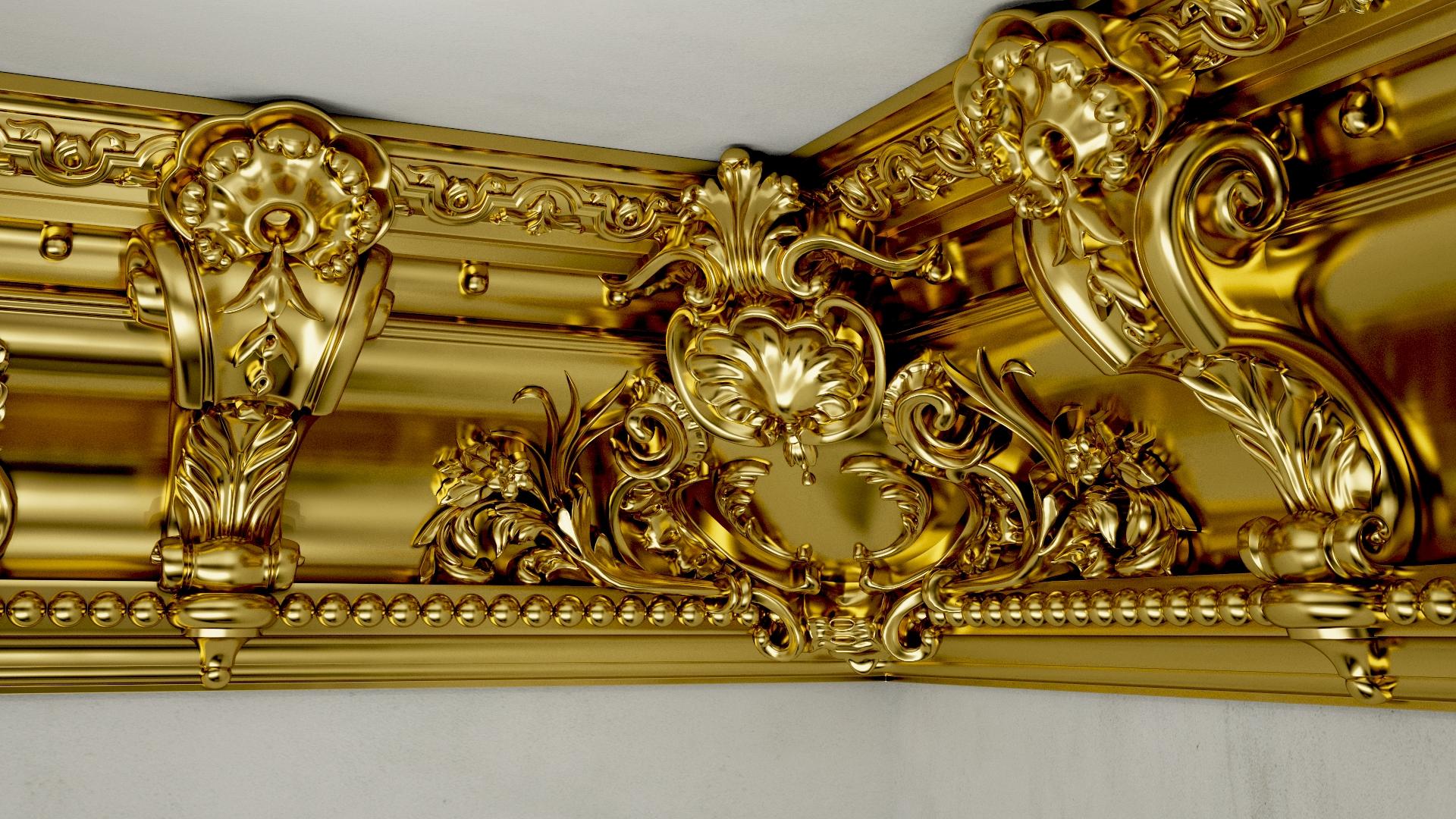
🪑 Large Victorian Cornice BAROQUE GYPSUM FOR CNC FABRICATION • STL and OBJ files
➡️ Download 3D print model: cults3d.com/:1713525
💡 Designed by @GazZzaN

@cults3d

2024-12-30

⬆️ #CAD #3DModeling

>> #IonicOrder is medium in complexity

There are 3 components in the #Ionic order. Starting at the bottom is the #pedestal (which is optional), the #column, and the #entablature.

Each of the 3 components has 3 subcomponents.

Pedestal has #basement, #dado, and #cap.

Column has #base, #shaft, and #capital.

Entablature has #architrave, #frieze, and #cornice.

Components of Ionic column and entablature also have classic and modern variations.

2023-04-19

Stunning plasterwork cornice from the interior of Holmwood House in Glasgow featuring Alexander 'Greek' Thomson's signature palmette or anthemion motif.

#glasgow #alexandergreekthomson #holmwoodhouse #architecture #design #designdetail #cornice #glasgowarchitecture #anthemion #palmette

Adoro il Genio :verified:AdoroIlGenio@mastodon.uno
2023-01-13

ADORO ILGENIO - MIOCUGGINO

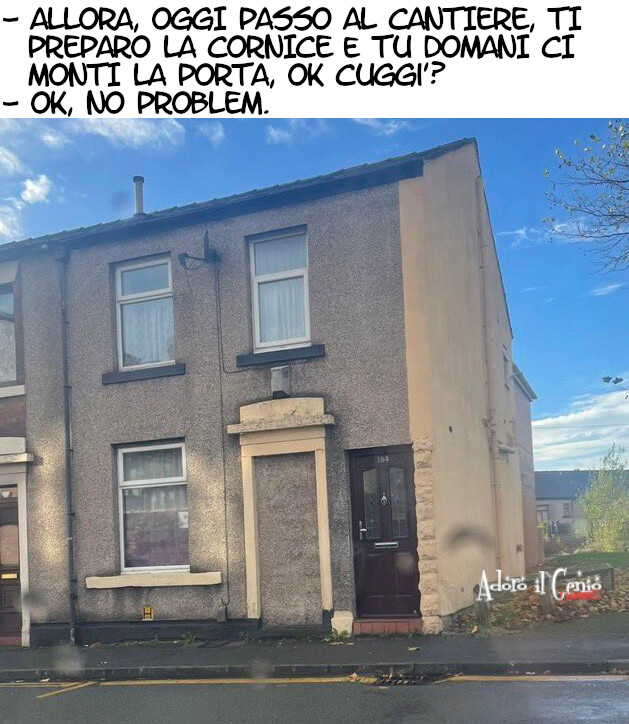
Lo sapevate? Quel #genio di #miocuggino✌🏼️ adesso si occupa di infissi...

#adoroilgenio #13gennaio #case #costruzioni #porte #porta #infissi #ammiocuginostyle #OK #NoProblem #ttappost #cornice #cornici #cantieri #incantiere

2023-01-11

#WoodWorking #DIY #NoPowerTools

A very easy #picture #frame (easier than this there is just attaching you picture to the wall with sticky tape).

~~

#MastoFalegname

Una #cornice molto facile da fare (più facile di così c'è solo l'attaccare la foto al muro con lo scotch).

invidious.weblibre.org/watch?v

About Buildings + Citiesabout_buildings
2020-01-10

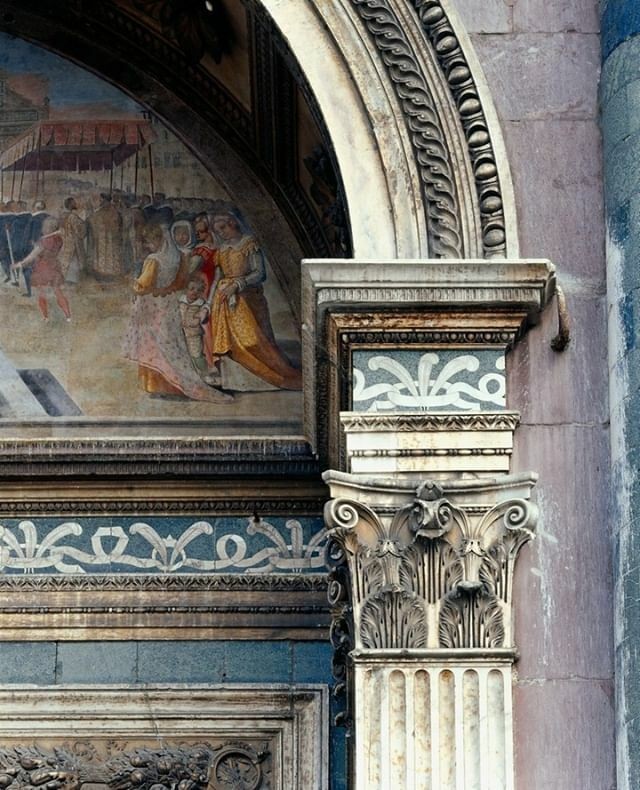
Details from the facade of Santa Maria Novella, designed by Leon Battista Alberti in Florence.⁠

Check out our latest bonus episode on Alberti on our Patreon.⁠

ift.tt/35HIjLm

Client Info

Server: https://mastodon.social
Version: 2025.07
Repository: https://github.com/cyevgeniy/lmst