#sciencecovers

Daniel Pomarèdepomarede
2025-03-14

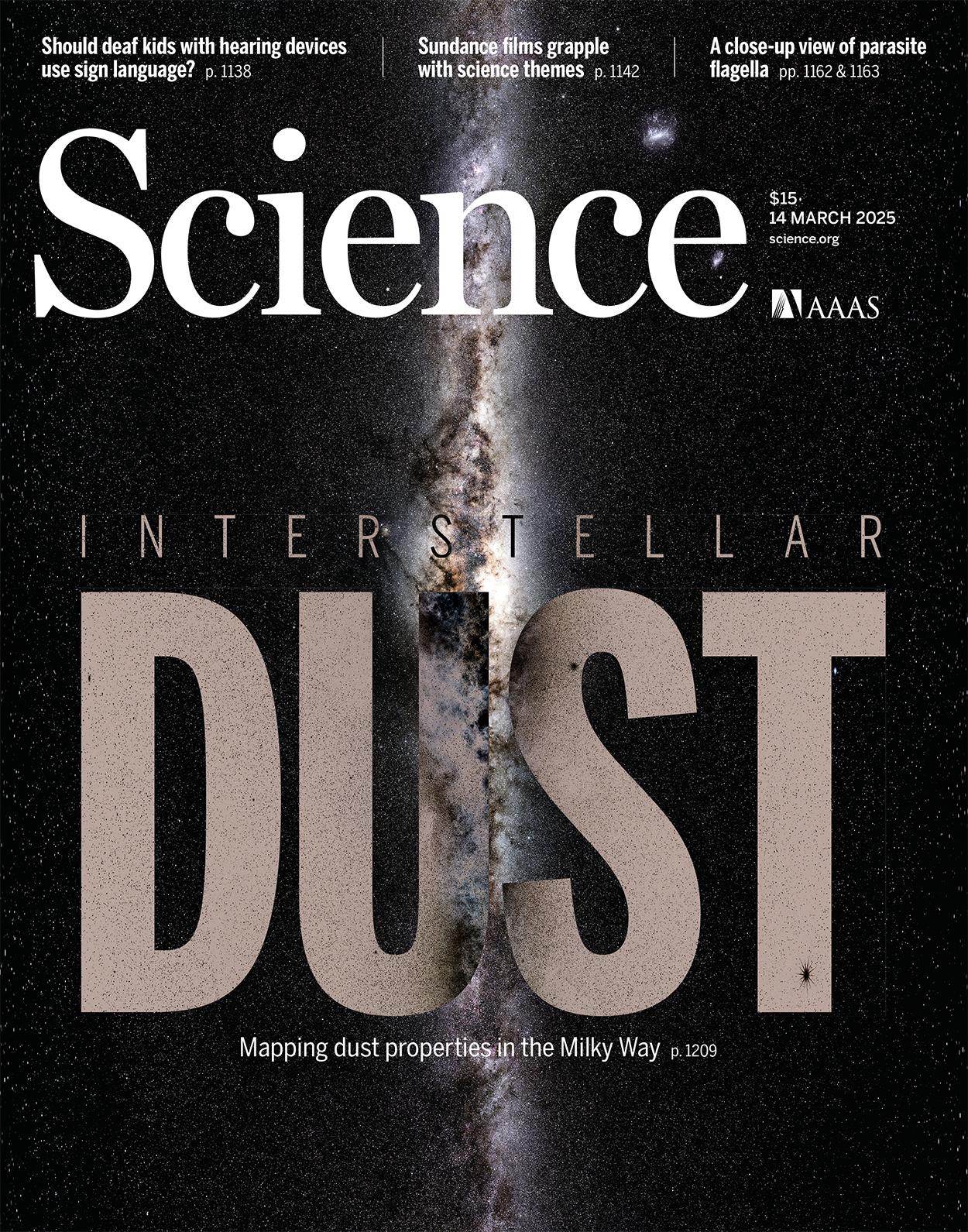
On the cover of Science Magazine this week

Interstellar Dust: Mapping dust properties in the Milky Way

Credit image: ESO/Serge Brunier
science.org/toc/science/387/67

A cover of Science Magazine, dated 14 March 2025, featuring an optical image mosaic of the Milky Way galaxy in a view looking toward the Galactic Center. The smooth band of starlight is occluded by dark clouds of interstellar dust, which absorbs and scatters background light (extinction), causing distant stars to appear fainter and redder. Variations in the properties of this dust extinction have been mapped in three dimensions using 130 million stellar spectra. Title reads INTERSTELLAR DUST in capital letters. Subtitle reads Mapping dust properties in the Milky Way.
Daniel Pomarèdepomarede
2023-10-21

A lovely, vintage 1968 cover of Science Magazine to celebrate the international night, featuring a lunar gravimetric map of the earthside hemisphere, obtained by the Lunar Orbiter spacecraft tracking data.

science.org/toc/science/161/38

Daniel Pomarèdepomarede
2023-10-15

The Arecibo Telescope makes the cover of this 1964 issue of Science Magazine.

Feature article by William E. Gordon, the father of the Arecibo Observatory, describing the recently completed instruments and its science goals.

science.org/toc/science/146/36

A cover of Science Magazine, dated 2 October 1964, featuring he reflector of a radio-radar telescope, located in the hilly terrain south of Arecibo, Puerto Rico, 1000 feet in diameter and suspended in a natural bowl. The triangular structure, held by cables from concrete towers, supports and positions the antenna feed that illuminates the reflector and steers the beam through a 40-degree cone centered overhead. See page 26 of this issue.
Daniel Pomarèdepomarede
2023-10-02

Science Magazine astronomy covers appreciation post

BLACK HOLES (2012) - Featuring an illustration of the black hole in Cygnus X-1, a binary star system 6000 light-years away.

Credit image: NASA/Chandra X-ray Center/M. Weiss

science.org/toc/science/337/60

A cover of Science Magazine, dated 3 August 2012, featuring an illustration of the black hole in Cygnus X-1, a binary star system 6000 light-years away. A disk of stellar material feeds this black hole, which is 15 times as massive as the Sun but less than 60 kilometers across. As it falls toward the black hole, some of the material gets expelled in two opposite jets.
Daniel Pomarèdepomarede
2023-09-02

Science Magazine astronomy covers

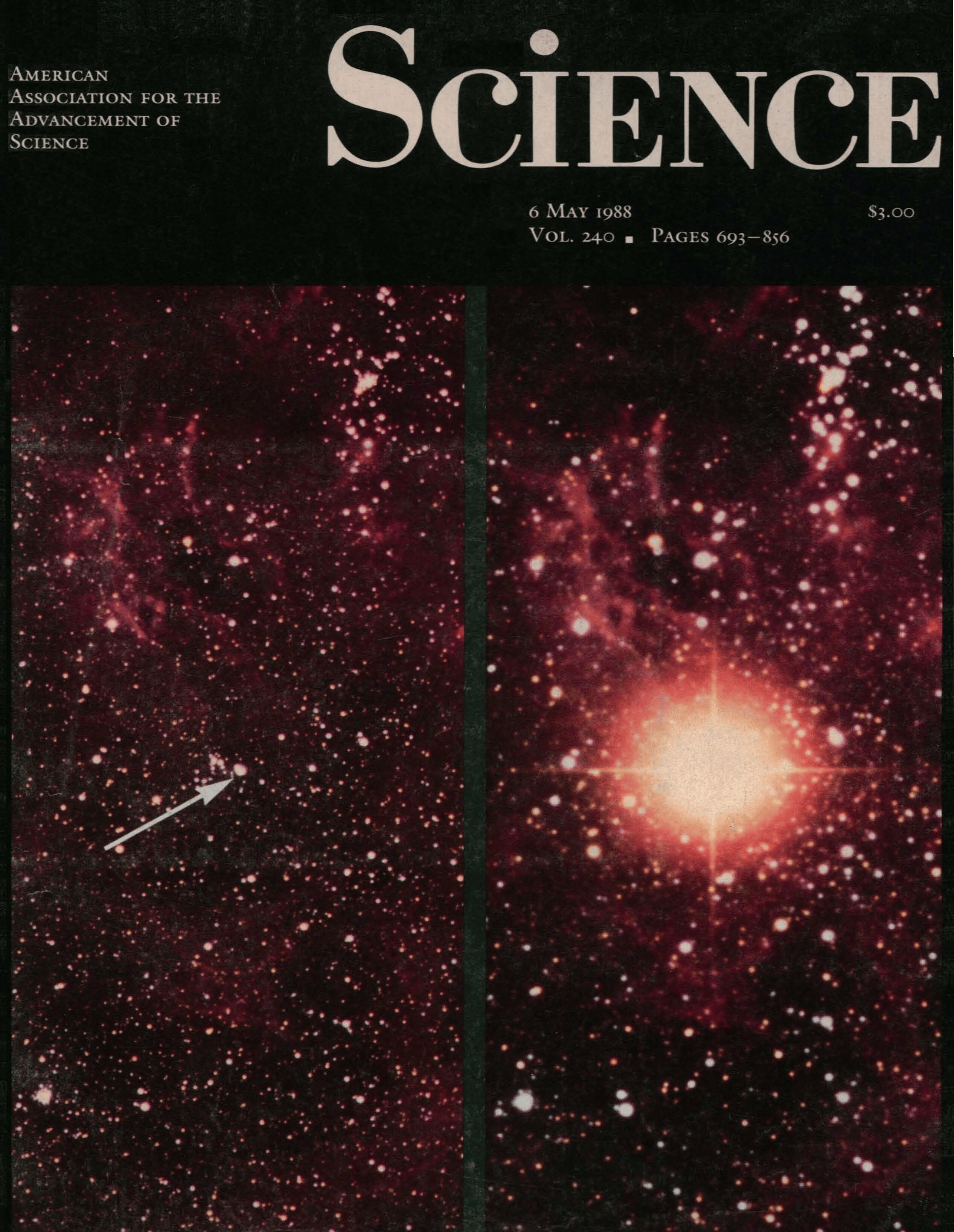
Supernova 1987A

Before (left) and after (right) photos taken using the 3.9-meter Anglo-Australian Telescope show the star that exploded and the supernova shortly after outburst. Credits: David Malin.

science.org/toc/science/240/48

A cover of Science Magazine, dated 6 May 1988, featuring a supernova explosion.
Daniel Pomarèdepomarede
2023-07-25

Science Magazine Astronomy Covers - 2014

How far are these stars? Precise interferometry settles the question for the Pleiades.

Featuring a photography by Roberto Colombari.

science.org/toc/science/345/62

A cover of Science Magazine, dated 29 August 2014, featuring a gorgeous photography of the Pleiades star cluster.

The Pleiades, also known as the Seven Sisters, is a cluster of stars easily seen in fall and winter that is critical for our understanding of stars throughout the universe. For decades, there has been considerable debate over the distance from our solar system to the Pleiades. Very long baseline radio interferometry now provides a "gold standard" distance measurement.
Daniel Pomarèdepomarede
2023-07-21

Science Magazine Astronomy Covers

Ulysses at Jupiter (1992)

Featuring a drawing of the Ulysses spacecraft leaving Jupiter, traveling southward in the previously unexplored dusk sector. Also featured: the large Io plasma torus and a small Auroral Oval. Credit: Jet Propulsion Laboratory.

science.org/toc/science/257/50

A cover of Science Magazine, dated 11 September 1992, featuring a magnificent drawing of the Ulysses spacecraft as it left Jupiter traveling southward in the previously unexplored dusk sector, showing the large Io plasma torus (yellow ring) and a small auroral oval (violet). Credit illustration: Jet Propulsion Laboratory 

In February 1992, Ulysses flew past Jupiter to take advantage of the gravity assist that redirected it toward the sun's polar regions. The scientific results obtained during this encounter with Jupiter are presented in this issue in a series of reports.
Daniel Pomarèdepomarede
2023-07-19

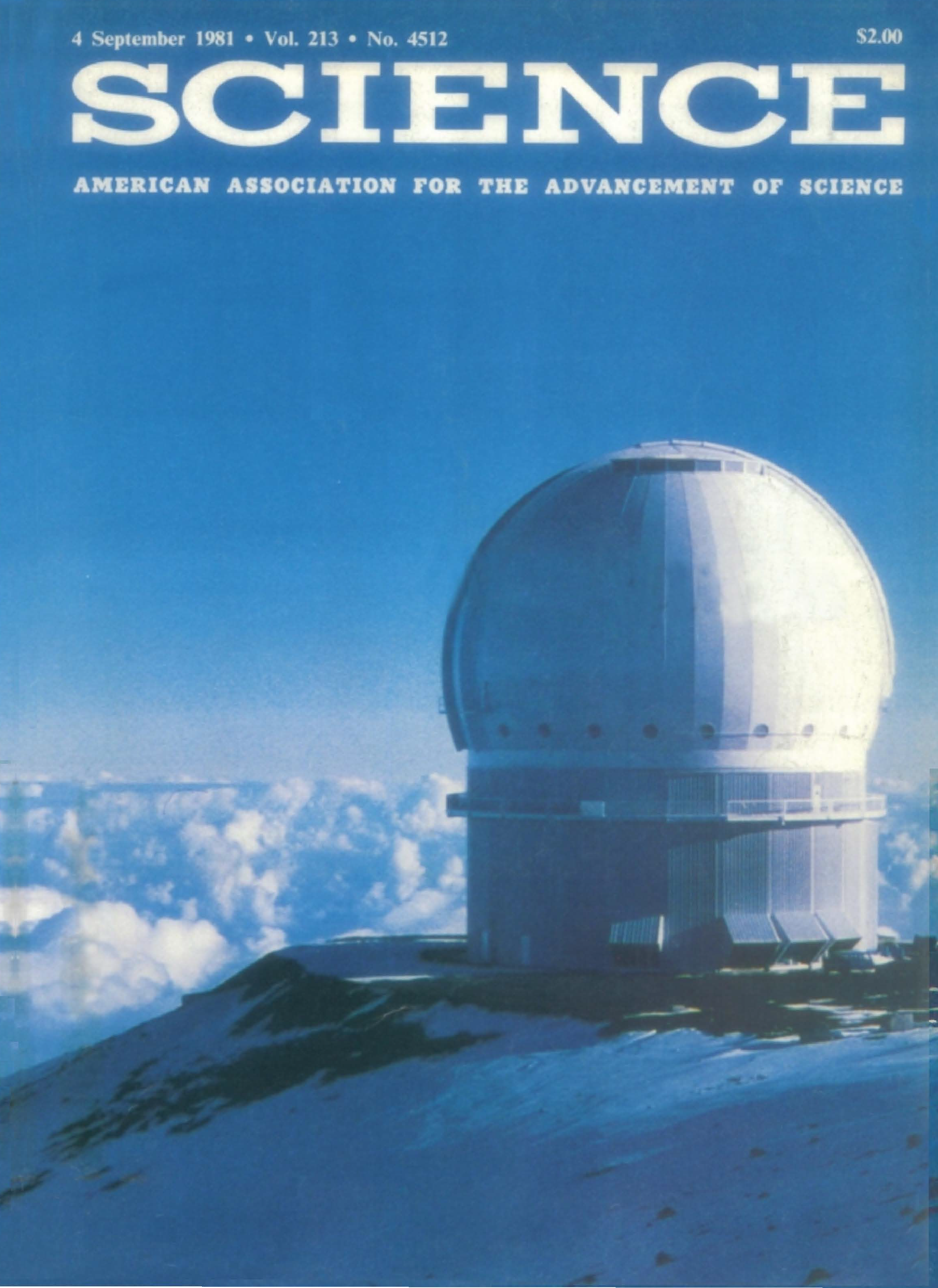
Beautiful cover for this 1981 issue of Science featuring the Canada-France-Hawaii Telescope, to illustrate the success of scientific projects as international cooperative efforts.

science.org/toc/science/213/45

📷 by René Racine
✍️ feature article by Larkin Kerwin, President of the National Research Council of Canada: science.org/doi/10.1126/scienc

A cover of Science Magazine dated 4 September 1981, featuring the Canada-France-Hawaii Telescope.
Daniel Pomarèdepomarede
2023-07-15

Science Magazine astronomy covers

Lunar impact (2016) - How this crater got its rings

Featuring a digital terrain model of the Orientale impact basin.
Credit: Ernest Wright, NASA/Goddard Space Flight Center Scientific Visualization Studio

science.org/toc/science/354/63

A cover of Science Magazine, featuring a view of the 930-kilometer Orientale impact basin on the Moon. A simulated digital terrain model is rendered 1 day after full moon. Overlain in color are gravitational anomalies measured by the Gravity Recovery and Interior Laboratory (GRAIL) spacecraft. Red indicates stronger-than-average gravity (blue, weaker), due to the topography and density of the underlying rocks. 
Image: Ernest Wright, NASA/Goddard Space Flight Center Scientific Visualization Studio
Daniel Pomarèdepomarede
2023-07-11

Astronomy covers of Science Magazine

Is the Earth affected by its cosmological setting in the Universe?

A fascinating paper by the great Princeton physicist Robert Dicke is the feature article of this 1962 issue of Science: science.org/toc/science/138/35

A cover of Science Magazine dated 9 November 1962

This cover features two adjacent images: left, the Earth, taken in infrared radiation, from a height of about 70 miles. The Pacific Ocean is on the horizon, with Los Angeles near the upper right. The largest dark area on the left is the Gulf of California. Right, Andromeda Nebula, the nearest large spiral nebula, distant about 9 10^18 miles.
Daniel Pomarèdepomarede
2023-07-07

Astronomy covers of Science Magazine

The Maze of Haze (2023) - Labmade aerosols help make sense of alien atmospheres

science.org/toc/science/379/66

Credit: NASA; ESA; CSA; Joseph Olmsted (STScI)

Cover story by Zack Savitsky: science.org/content/article/li

-b

A cover of Science Magazine featuring an artist's view of the hazy atmosphere of an exoplanet, and its host star in the background.

DESCRIPTION: In this artist's conception, light from a star 700 light-years from Earth glints off the soupy cloud tops of WASP-39b, a water-rich gas giant. In November 2022, astronomers using JWST, NASA’s giant space telescope, reported detecting sulfur dioxide—a contributor to smog—in WASP-39b’s skies. Hazes can obscure a planet’s atmosphere, but recreating them in the laboratory could help unlock their secrets.
Daniel Pomarèdepomarede
2023-07-05
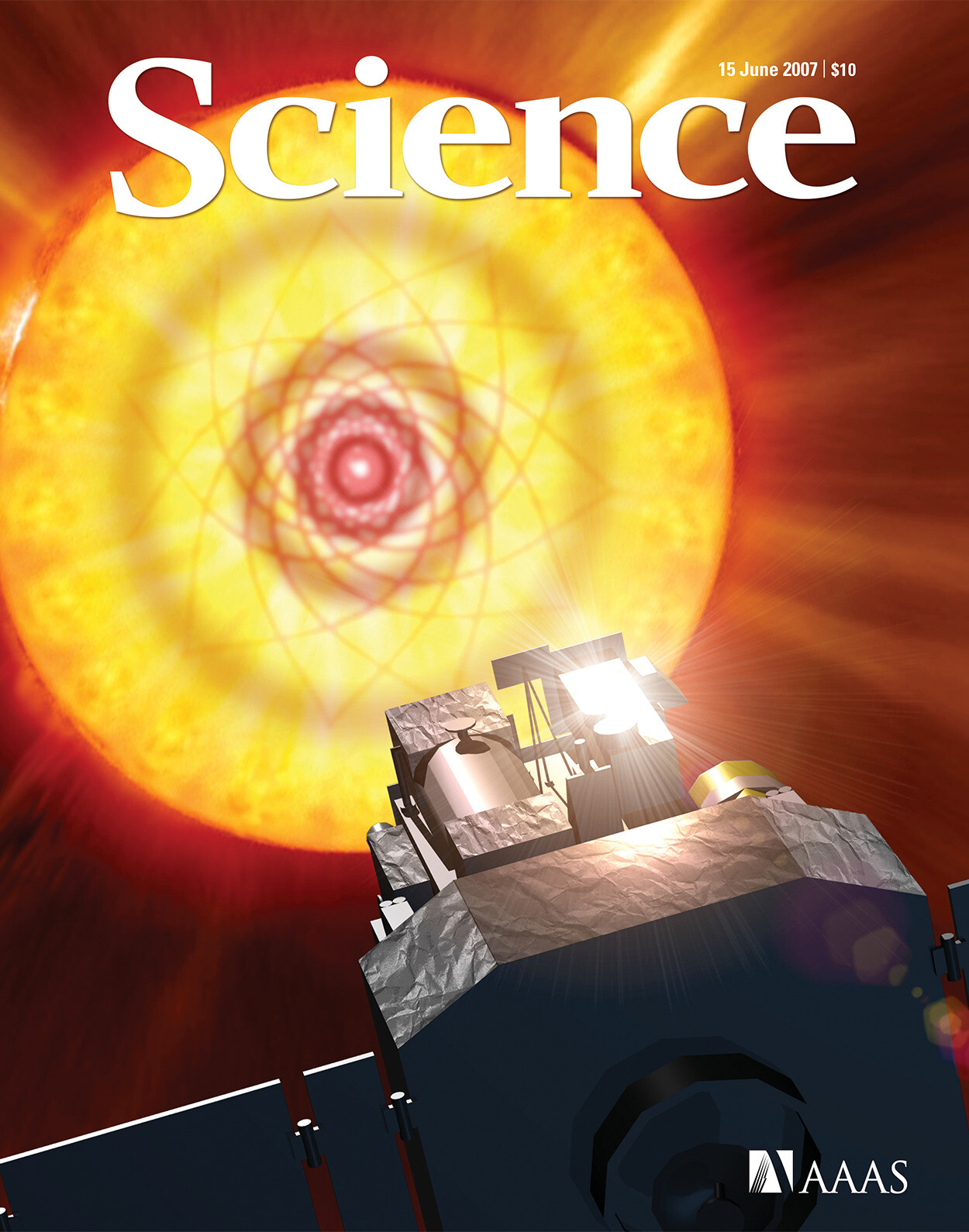
A cover of Science Magazine featuring an artist's rendition of the Solar and Heliospheric Observatory (SOHO) spacecraft targeting our star with its Global Oscillation at Low Frequency (GOLF) instrument. 

The Sun's vibrations can reveal details of its inner structure. Pressure-driven modes have long been observed, but they provide only limited information about the center of the Sun, which contains more than half the Sun's mass and is the region where fusion occurs. Gravity-driven modes can potentially reveal more about changes in buoyancy of the Sun's dense inner core but are very weak at the Sun's surface and have been hard to detect. García et al. (p. 1591, see also the news story by Kerr, and the Perspective by Hill) report the observation, in 10 years of data accumulated by SOHO/GOLF, of a periodic structure in the solar power spectrum that is characteristic of gravity modes.
Daniel Pomarèdepomarede
2023-07-03

Science Magazine astronomy covers appreciation post

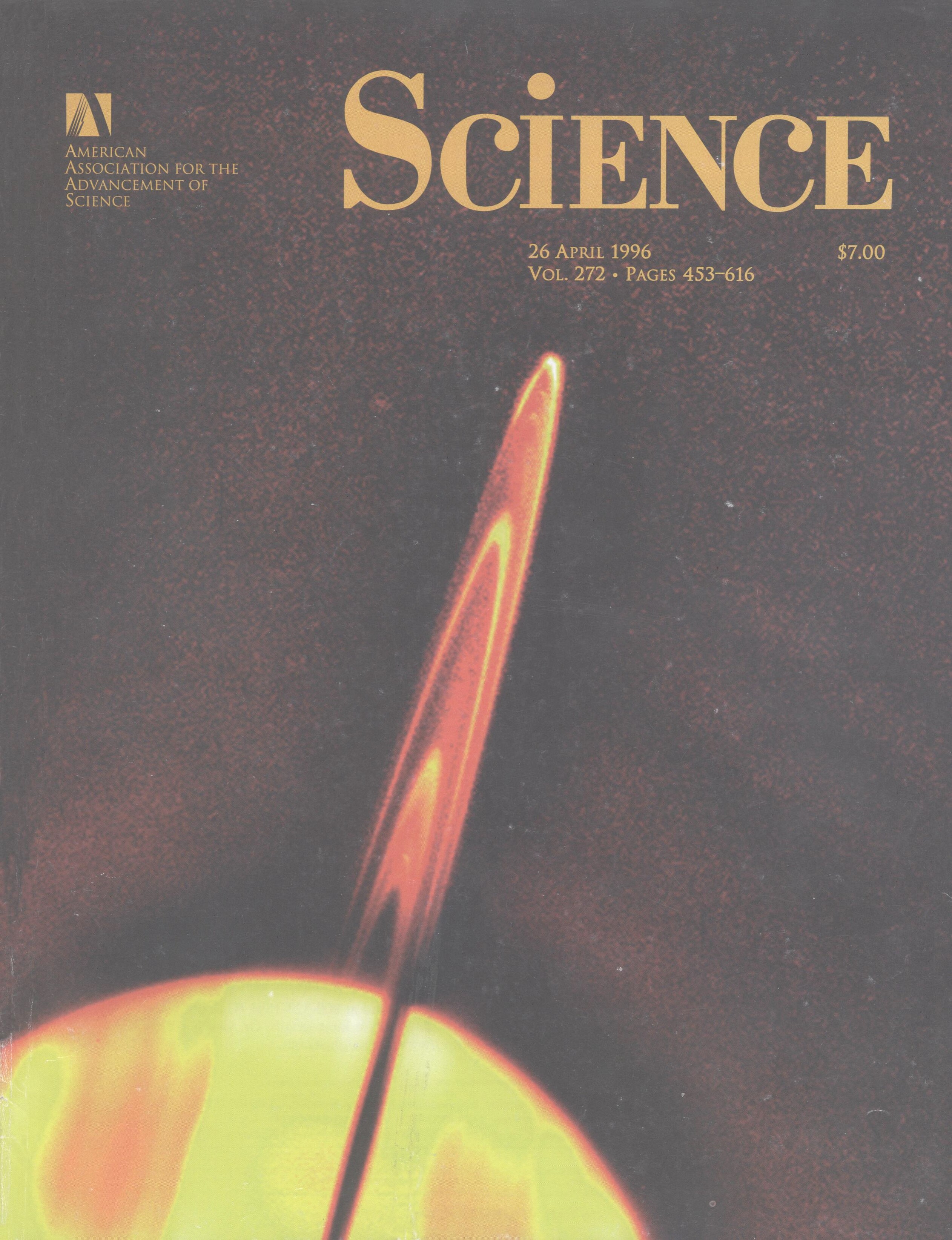
The dark side of Saturn's rings (1996) - imaged by the Hubble Space Telescope

The main rings are illuminated by reflected saturnshine and by sunlight diffusely transmitted through the translucent C ring and Cassini division.

science.org/toc/science/272/52

The dark side of Saturn's rings, imaged by the Hubble Space Telescope on 21 November 1995. The main rings are illuminated by reflected saturnshine and by sunlight diffusely transmitted through the translucent C ring and Cassini division. The outermost bright feature is the narrow, multistranded F ring, seen here from Earth for the first time. Just inside the F ring, the Encke gap and the outer edge of the A ring are seen as a pair of faint bands. 

Image: P. D. Nicholson et al.
Daniel Pomarèdepomarede
2023-06-30

Sky Watchers - Maya astronomy, then and now

Beautiful 2022 Science cover, featuring a 10th-century Maya structure at Chichen Itza called the Observatory for its expansive view of the sky and a design guided by key positions of the ☀️, 🌒, and planets

science.org/toc/science/376/65

➡️ the feature article by Joshua Sokol science.org/content/article/wh

A cover of Science Magazine featuring a 10th-century Maya structure at Chichen Itza, Mexico, photographed against a starry sky.

Photo: Buena Vista Images via Getty Images
Daniel Pomarèdepomarede
2023-06-27

Well, since we are bracing for the impact of an imminent major announcement on pulsars and, maybe, some gravitational wave background, why not enjoy this 2004 special Science Magazine issue on pulsars!

science.org/toc/science/304/56
see in particular the paper by Ingrid Stairs p.547

A cover of Science Magazine, featuring the Crab Nebula, home of the Crab Pulsar
Daniel Pomarèdepomarede
2023-06-26

Science Magazine astronomy covers appreciation post

LARGE SCALE MEASUREMENTS (1992) - featuring an illustration of one site of the proposed LIGO Laser Interferometer Gravitational-Wave Observatory

Beautiful art by Ruth Sofair Ketler

science.org/toc/science/256/50

A cover of Science Magazine published in 1992, featuring an illustration of one site in the proposed Laser Interferometer Gravitational-Wave Observatory (LIGO). The LIGO facilities will consist of two such interferometers located at widely dispersed sites; scientists hope LIGO will be able to detect gravitational waves emanating from collisions of black holes and neutron stars. See page 325. A special section in this issue of Science focuses on large scale measurements; see the Editorial and pages 316 to 349. [Illustration: Ruth Sofair Ketler]
Daniel Pomarèdepomarede
2023-06-22

Amazing 1965 Science cover: Mariner IV approaches Mars

at first glance looking at the miniature image I thought it was an X-wing squadron in attack formation!

📷 Drawing by Federal Graphics

science.org/toc/science/149/36

Mariner IV left Earth 28 November 1964 on a cruise to the neighborhood of Mars. Data transmitted by instruments aboard the spacecraft during encounter, 14 to 15 July 1965, are presented and interpreted in the reports on the nature of the magnetic fields and particle fluxes near Mars (pages 1226-1248). [Drawing by Federal Graphics]
Daniel Pomarèdepomarede
2023-06-21

Science Magazine astro covers appreciation post

The Cosmic Web (2008)

The is filled with filamentary structures of dark and visible matter that make up the “cosmic web”, as suggested in this ’s rendering of cosmic bubbles and connected clumps. In this issue are considered the latest into its origins and evolution.
📷 Shigemi Numazawa/Atlas Photo Bank/Photo Researchers Inc.

science.org/toc/science/319/58

A cover of Science Magazine, published in 2008, featuring an artits's view of the cosmic web.

Description: the universe is filled with filamentary structures of dark and visible matter that make up the “cosmic web,” as suggested in this artist’s rendering of cosmic bubbles and connected clumps.
A special section beginning on page 46 considers the latest research into the origins and evolution of the cosmic web.

Client Info

Server: https://mastodon.social
Version: 2025.07
Repository: https://github.com/cyevgeniy/lmst