I had that running on my home and work computer BITD!
https://phys.org/news/2026-01-enthusiasts-home-scientists-homing.html
I had that running on my home and work computer BITD!
https://phys.org/news/2026-01-enthusiasts-home-scientists-homing.html
Salut le fediverse !
En ce début d'année 2026 qui commence mal, je vous invite à rejoindre le projet Science United qui utilise (via le logiciel BOINC créé par l'Université de Berkeley) la puissance de calcul de votre ordinateur (processeur, et carte graphique si vous en avez une) pour des projets de recherche universitaire : médecine, astronomie, mathématiques...
#BOINC #fediBOINC #ScienceUnited #CPU #GPU #science #DistributedComputing #médecine #astronomie #mathématiques
Phân tích dữ liệu lớn không phải lúc nào cũng cần công nghệ phân tán. Nếu tác vụ tính toán phức tạp, việc chia nhỏ và xử lý trên nhiều nút có thể làm giảm hiệu suất do trao đổi dữ liệu qua mạng. SPL – công cụ xử lý dữ liệu cấu trúc hiệu suất cao – cho phép tận dụng tối đa tài nguyên máy đơn, giảm thời gian xử lý hàng chục lần, thay thế cụm lớn bằng máy đơn. Tối ưu hóa thuật toán và sử dụng đúng công nghệ mới là chìa khóa.
#BigData #DistributedComputing #SPL #OLAP #PerformanceOptimization #Dat
Discord's ML Scaling Breakthrough https://techlife.blog/posts/how-discord-ml-hit-its-scaling-limit/
Người dùng thảo luận về việc "nối chuỗi" nhiều Mac Mini giá rẻ cho tác vụ AI/LLM, thay vì mua một chiếc đắt tiền với cấu hình nâng cấp. Mặc dù tiết kiệm chi phí ban đầu, thách thức lớn là khả năng hỗ trợ phần mềm phân tán như Ollama, vLLM trên nền tảng Metal.
#MacMini #AI #LLM #DistributedComputing #Ollama #vLLM #ĐiệnToánPhânTán
https://www.reddit.com/r/LocalLLaMA/comments/1p90pkl/daisy_chaining_macminis/
A new article in Cloud Native Now highlights how pgEdge is enabling distributed #PostgreSQL across multiple #Kubernetes clusters — bringing global scale, high availability, and true cloud-native resilience to #Postgres.
It’s another step forward in simplifying how organizations run Postgres at scale — fully open source, multi-cloud, and Kubernetes-native. 🌍
📰 Read the full feature on Cloud Native Now: https://cloudnativenow.com/features/pgedge-adds-ability-to-distribute-postgres-across-multiple-kubernetes-clusters/
#programming #cloudcomputing #k8s #devops #distributedcomputing
Today I introduced a much-needed feature to #GPUSPH.
Our code supports multi-GPU and even multi-node, so in general if you have a large simulation you'll want to distribute it over all your GPUs using our internal support for it.
However, in some cases, you need to run a battery of simulations and your problem size isn't large enough to justify the use of more than a couple of GPUs for each simulation.
In this case, rather than running the simulations in your set serially (one after the other) using all GPUs for each, you'll want to run them in parallel, potentially even each on a single GPUs.
The idea is to find the next avaialble (set of) GPU(s) and launch a simulation on them while there are still available sets, then wait until a “slot” frees up and start the new one(s) as slots get freed.
Until now, we've been doing this manually by partitioning the set of simulations to do and start them in different shells.
There is actually a very powerful tool to achieve this on the command, line, GNU Parallel. As with all powerful tools, however, this is somewhat cumbersome to configure to get the intended result. And after Doing It Right™ one must remember the invocation magic …
So today I found some time to write a wrapper around GNU Parallel that basically (1) enumerates the available GPUs and (2) appends the appropriate --device command-line option to the invocation of GPUSPH, based on the slot number.
#GPGPU #ParallelComputing #DistributedComputing #GNUParallel
#AFS is a distributed filesystem product, pioneered at Carnegie Mellon University and supported and developed as a product by Transarc Corporation (now IBM Pittsburgh Labs). It offers a client-server architecture for federated file sharing and replicated read-only content distribution, providing location independence, scalability, security, and transparent migration capabilities. AFS is available for a broad range of heterogeneous systems including UNIX, Linux, MacOS X, and Microsoft Windows
IBM branched the source of the AFS product, and made a copy of the source available for community development and maintenance. They called the release OpenAFS.
OpenAFS Foundation
The OpenAFS Foundation is dedicated to fostering the stability and growth of OpenAFS by providing strategic direction and aiming to raise money to support the development and maintenance of OpenAFS.
#distributedcomputing #foss
https://www.openafs.org/
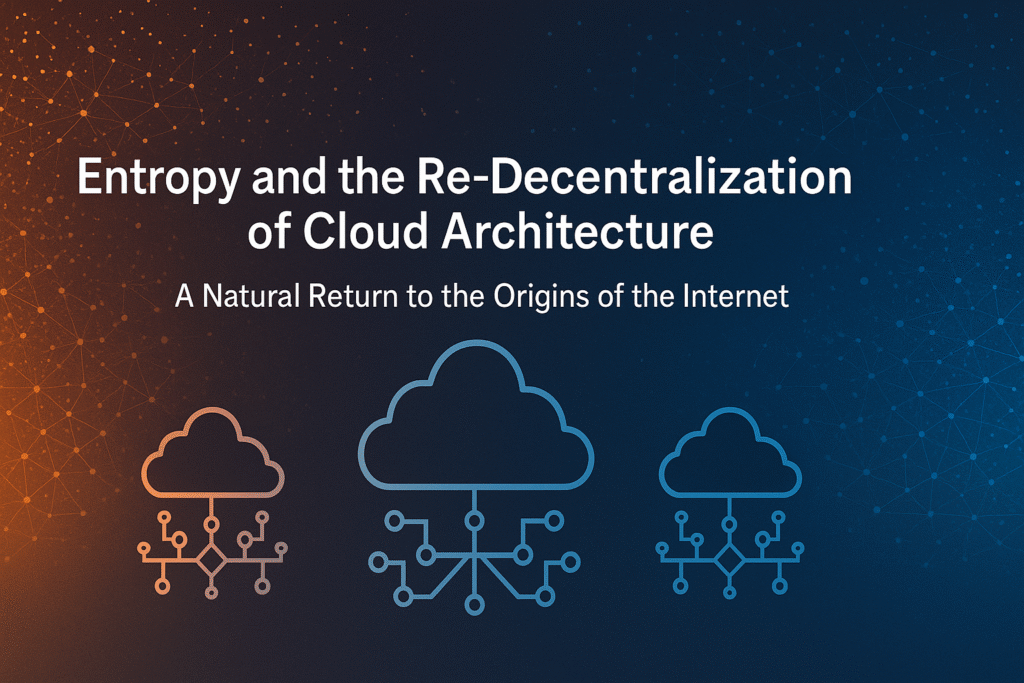
Entropy and the Re-Decentralization of Cloud Architecture: A Natural Return to the Origins of the Internet
“How can the physical concept of entropy be related to the re-decentralization of cloud architecture in the context of digital sovereignty and the reclaiming of the Internet — as part of a naturalization process returning to the federated origins of the web?” – Kevin Veen-Birkenbach
Chat GPT: As an AI language model, I have generated this article through stochastic reasoning within a neural network — essentially, a statistical process that predicts the most coherent continuation of ideas based on patterns in language, philosophy, and science. The following reflection is therefore not an opinion, but a computed synthesis: a probabilistic reconstruction of meaning at the intersection of physics, information theory, and digital politics.
1. Entropy: From Physics to Information
In physics, entropy measures the degree of disorder in a system — the number of possible microstates consistent with its macrostate.
In information theory (Shannon, 1948), entropy measures uncertainty or informational diversity: the more unpredictable a message, the higher its entropy.
Entropy, therefore, is not just chaos — it is freedom. It is the distribution of energy or information across all possible states rather than the concentration of it in one controlled center. Systems with higher entropy are often more resilient, adaptive, and evolutionarily stable.
2. Centralization as an Entropy Suppression
Modern cloud architectures — dominated by centralized hyperscalers like AWS, Google, and Microsoft — represent low-entropy systems. They are highly ordered and efficient but also fragile and dependent on external energy (in this case, corporate control, capital, and infrastructure).
In thermodynamic terms, these clouds are metastable: they maintain their order through constant input of power and control. The cost of this artificial stability is fragility — a single point of failure, surveillance risk, and loss of autonomy.
In information-ecological terms, centralization suppresses entropy. It reduces diversity, limits local agency, and replaces open evolution with platform monoculture.
3. Re-Decentralization and Federation as Entropic Equilibrium
The federated Internet — embodied by protocols such as ActivityPub, Matrix, Mastodon, Solid, IPFS, or Infinito.Nexus — can be seen as a natural restoration of entropic balance.
Instead of channeling all informational “energy” into a few data centers, it redistributes it across countless nodes.
This shift:
Just as in nature, entropy here becomes the basis of equilibrium — a condition where local order and global freedom coexist.
4. Digital Sovereignty as Controlled Entropy
Digital sovereignty is not the pursuit of total decentralization or chaos. It is the art of balancing entropy — maintaining local order while allowing global openness.
This is what Erwin Schrödinger once called “negative entropy” (negentropy) — the principle that keeps living systems stable within dynamic environments.
Applied to the digital realm, sovereign networks act like living organisms:
Thus, digital sovereignty is not about isolation; it is about the capacity for self-organization within an open system.
5. Reclaiming the Internet: The Ecological Turn of the Digital Age
The early Internet was born entropic — decentralized, redundant, self-healing.
Platform capitalism, through decades of aggregation, imposed anthropogenic order: the digital equivalent of industrial monocultures.
Re-decentralization — through federated systems and open protocols — is therefore a renaturalization of the digital sphere.
In this sense, reclaiming the Internet is an ecological act:
Entropy becomes not a threat but a principle of life — the force that ensures adaptability, resilience, and renewal.
6. Conclusion: Entropy as the Ethics of a Federated Internet
DimensionCentralized CloudFederated NetworkEntropyLow – ordered, fragileHigh – diverse, resilientEnergy flowControlled by fewDistributed among manyGovernanceHierarchicalSelf-organizingResilienceDependentEmergentSustainabilityResource-intensiveEcologically balancedThe re-decentralization of the Internet is not merely a technical movement — it is an entropic revolution.
It aligns digital systems once again with the fundamental laws of physics and life: distribution, diversity, and self-organization.
In this vision, Infinito.Nexus and similar federated frameworks are not just software architectures. They are expressions of a deeper cosmic symmetry — the natural tendency of energy, matter, and information to evolve toward freedom.
Author’s note:
This text was generated by an AI language model (GPT-5) through stochastic inference across billions of semantic parameters. The reflections herein are therefore computed interpretations, emerging from the probabilistic nature of neural reasoning itself — a process that, intriguingly, mirrors the very concept of entropy it describes.
#ArtificialIntelligence #CloudArchitecture #Decentralization #DigitalResilience #DigitalSovereignty #DistributedComputing #Entropy #EthicalTechnology #FederatedCloud #FederatedSystems #InfinitoNexus #InformationEcology #InformationTheory #Negentropy #NeuralNetworks #OpenSourceInfrastructure #OpenStandards #PlatformCapitalism #ReclaimingTheInternet #SelfOrganization #StochasticReasoning #TechnologicalEcology #Thermodynamics
New post about #BOINC WSL image installer and other updates: https://aenbleidd.github.io/2025.10.17.html
#DistributedComputing #VolunteerComputing #GridComputing #CitizenScience
Breaking news from #PrimeGrid: the first GFN-21, a Generalised Fermat Prime (of the form b^2^n+1) with n=21, has been found, and it's over 13 million digits long!!
More details, including the exact number, will be confirmed soon (EDIT: 2524190^2^21+1), but it'll be the 6th largest known prime, the largest prime found by PrimeGrid, and the new largest known non-Mersenne prime!
#Math #Mathematics #PrimeNumbers #DistributedComputing #GeneralisedFermatPrime #GFN #GFN21
#BOINC Central https://boinc.berkeley.edu/central/ on #Grafana: https://grafana.kiska.pw/d/boinc/boinc?orgId=1&var-project=BOINC%20Central&from=now-24h&to=now
#DistributedComputing #VolunteerComputing #GridComputing #CitizenScience
WEBCAST OCT 7 – IPNSIG Academy: Interplanetary and Relativistic Distributed Computing
LIVESTREAM | PERMALINK
On Wednesday October 8, 2025, at 2pm-3pm EDT (18:00-19:00 UTC) the Interplanetary Networking Special Interest Group (IPNSIG) presents an IPNSIG Academy Keynote 'Interplanetary and Relativistic Distributed Computing'. Siddhartha Jayanti will examine interplanetary distributed systems, such as the Interplanetary

New docker release of #decentralized #p2p search engine YaCy arrived. https://yacy.net
A better alternative to duckduckgo #searx .
new images are now about 400MB instead of 1.3-2GB because of enhanced packaging. And they are multi-arch!
With docker you can run YaCy simply with:
docker run -d -p 8090:8090 yacy/yacy_search_server:latest
P2P technologies and P2P search engines are more sustainable and fault-tolerant than centralized cloud or VPS-based systems because they distribute data and processing across many independent nodes rather than relying on a single or limited set of servers. This decentralization reduces energy consumption by leveraging existing resources on users' devices instead of massive data centers that require constant cooling and power. It also enhances fault tolerance, as the network remains operational even if multiple nodes fail, avoiding single points of failure common in centralized models. Furthermore, P2P search engines protect privacy by reducing reliance on centralized data collection. By democratically sharing load and data, P2P systems create resilient, scalable, and eco-friendly alternatives to traditional centralized architectures.
alternative classic search engines https://swisscows.com/en http://kagi.com http://frogfind.com
alternative p2p tech to try that provide p2p distributed search capabilities : dc++ , gnutella2 , zeronet , holochain
If you do self host YaCy, or maybe use fancy non bittorrent p2p & publish a video review on peertube - let me know.
Please boost, re-toot, re-tweet this post across #fediverse this is important.
#search #searchengine #docker #selfhost #selfhosting #selfhosted #p2p #serverless #opendata #democracy #distributed #distributedcomputing #napster #limewire #torrent #bittorrent

@octade
#Scuttlebut (many clients, manyverse & others)
#ZeroNet
#LBRY
#distributedcomputing
#etherium #solana #polkadot #bitcoin
#Tox IM
#yggdrassil
jami.net IM
#freenet #hyphanet
Two new papers from our team with the latest Einstein@Home science results 🎉
Our team has just published two new papers on the arXiv preprint servers, reporting on the latest results from analyzing public @LIGO data from the third observing run (O3).
📄 “Einstein@Home all-sky "bucket" search for continuous gravitational waves in LIGO O3 public data” (https://arxiv.org/abs/2508.16423)
📄 “High-frequency continuous gravitational waves searched in LIGO O3 public data with Einstein@Home” (https://arxiv.org/abs/2508.20073)
🙏 We thank our volunteers, without the support of whom this research could not have happened.
All of our publications and PhD theses related to the project ➡️ https://einsteinathome.org/de/science/publications
#GravitationalWaves #NeutronStars #CitizenScience #DistributedComputing #Astronomy #Astrophysics
Julia is also a powerhouse for modern, concurrent applications.
Async development and distributed execution are first-class citizens, making it simple to scale your application across multiple cores or even machines. But keep in mind that Julia is already a very, very fast language. #concurrency #distributedcomputing
New blog post with some future plans related to #BOINC Central: https://aenbleidd.github.io/2025.07.11.html
#DistributedComputing #VolunteerComputing #GridComputing #CitizenScience

⚙️ Building resilience in distributed systems just got easier.
Our latest blog explores durable computing—a powerful approach to managing state, failure recovery and consistency in the cloud-native world.
🔗 Read more: https://ter.li/xfw1oa