My First Computers: Apple II and Commodore 64 BASIC #shorts: BASIC interpreters introduced many to computing. The Apple II and Commodore 64 would boot directly to a BASIC interpreter, launching many people's careers. #BASIC #interpreter #computers #AppleII #Commodore64 https://www.youtube.com/shorts/fEEnfJyChtE
#interpreter

Một dev 15 tuổi vừa hoàn thành Lento, ngôn ngữ thông dịch đầu tiên của mình viết bằng Go! Cậu ấy dùng cách này để hiểu sâu các ngôn ngữ mới. Lento có cú pháp giống C, hỗ trợ biến, hàm, cấu trúc điều khiển, mảng, đối tượng & REPL, thiết kế đơn giản, nhanh. Thành tựu đáng nể!
#Lento #Programming #GoLang #Interpreter #YoungDev #LậpTrình #NgônNgữMới
https://www.reddit.com/r/programming/comments/1pfqbkv/built_my_first_interpreted_language_at_15/
SedaiBasic, trình thông dịch BASIC hoàn toàn bằng Free Pascal, đã ra mắt! Mô phỏng Commodore BASIC v7, SedaiBasic cho thấy hiệu suất ấn tượng, nhanh hơn Python 2-8 lần trong các benchmark quan trọng. Phát triển với sự hỗ trợ của AI (Claude), hứa hẹn tốc độ ngang ngửa C. Đây là bản tiền phát hành đầy tiềm năng.
#SedaiBasic #FreePascal #BASIC #Interpreter #Programming #AI #Performance
#TrìnhThôngDịch #LậpTrình #HiệuNăng #NgônNgữLậpTrình

Все главные нововведения Python 3.14: от JIT до инструментов отладки
Представьте: ваш Python-код работает на 30% быстрее благодаря JIT-компиляции, обработка запросов масштабируется на все ядра процессора без ограничений GIL, а отладка высоконагруженных систем происходит в реальном времени, без остановки продакшена. Это не футуристический сценарий “what-if” — это реальность Python 3.14, релиза, который переосмысливает саму природу разработки с высокой производительностью на Python.
https://habr.com/ru/companies/axenix/articles/970806/
#python #python314 #многопоточность #нововведения #gil #jit #отладка #zero_overhead #интерпритатор #interpreter

#Development #Collections
JavaScript engines zoo · Meet the creatures running your JavaScript code https://ilo.im/168g8q
_____
#Engine #EcmaScript #JavaScript #TypeScript #Browser #Rust #Interpreter #Compiler #WebDev #Backend

Tags are sets. Many apps support tagging of content, but most of them (incl. Mastodon) treat tags only as singular/isolated topic filters, akin to a flat folder-based approach. But tagging can be so, so much more powerful when treating tags as sets and offering users the possibility to combine and query tagged content as sets (think Venn diagrams), i.e. allowing tags to be combined using AND/OR/NOT aka intersection/union/difference operations...
Below is a simple query engine to do just that in ~40 lines of code (sans comments), incl. using an extensible interpreter for a simple Lisp-like S-Expression language to define arbitrarily complex nested tag queries (the code is actually lifted & simplified from my personal knowledge graph tooling, also talked about here recently[1]...)
https://gist.github.com/postspectacular/ff997a4f1016b17bbfe9beb989984ac3
For example, the query:
`(and (or 'Alps' 'PNW') (or 'LandscapePhotography' 'NaturePhotography') (not 'Monochrome'))`
...would select all items which have been tagged with `Alps` OR `PNW`, AND have at least one of the two photography tags given, but have NOT the `Monochrome` tag.
Whilst this syntax is probably alien-looking to the average user, it'd would be fairly straightforward to create visual/structural UIs for defining such queries (over the past 20 years I've done that myself several times already), heck even a SLM (small language model) could be used to translate natural language into such query expressions — what matters here is the widespread lack of treating tags this way in terms of conceptual/data modeling in most applications. Imagine being able to use hashtags this way on Mastodon to assemble personalized timelines (and extend the system to not just deal with hashtags, but other post metadata/provenance too)...
The code example illustrates how, with the right tools, such features are actually not hard to implement (or to integrate into existing apps). The example uses the following #ThingUmbrella packages for its key functionality:
- https://thi.ng/associative: Set-theory operations, custom Map/Set data types (unused here)
- https://thi.ng/lispy: Customizable/extensible S-expression parser, interpreter & runtime
- https://thi.ng/oquery: Optimized object and array pattern query engine
[1] https://mastodon.thi.ng/@toxi/115497555185158157
#Tagging #Sets #QueryEngine #Lisp #Syntax #Parser #Interpreter #TypeScript #JavaScript


SPy: An interpreter and compiler for a fast statically typed variant of Python
https://antocuni.eu/2025/10/29/inside-spy-part-1-motivations-and-goals/
#HackerNews #SPy #Python #Interpreter #Compiler #Fast #Programming #Language

🎩✨ "Nix #Derivation Madness": Farid dives deep into the labyrinth of #Nix, only to find himself confounded yet again by its whimsically impenetrable logic. 🤯🔍 Spoiler: He discovers the #Ruby #interpreter is neither buildable nor runnable, as if the code itself is taunting him with a mischievous "you're not worthy" laugh. 😂🔄
https://fzakaria.com/2025/10/29/nix-derivation-madness #Madness #Nix #Coding #Challenges #Tech #Humor #HackerNews #ngated


Only now realizing that if you have a variable called "notice", my Basic #interpreter parses it as "not ice". A sentiment we can all get behind, but rather misplaced here. Not so easy to fix, either.
Guess that's another reason for C-style operators being all symbolic.
JIT: So you want to be faster than an interpreter on modern CPUs
https://www.pinaraf.info/2025/10/jit-so-you-want-to-be-faster-than-an-interpreter-on-modern-cpus/
#HackerNews #JIT #Performance #Interpreter #CPUs #Optimization #Programming
Completing a new BASIC interpreter in 2025 (strings, math funcs, cassette)
https://nanochess.org/ecs_basic_2.html
#HackerNews #BASIC #Interpreter #BASIC2025 #RetroProgramming #MathFunctions #CassetteEmulation
there are a numbef of boot sector interpreters; basic, forth, lisp, etc.
example for x86;
https://github.com/Vierkantor/Lisp-Assembly
https://handmade.network/p/572/bootstrap-os/
maybe for arm too;
http://forum.ulisp.com/t/an-arm-assembler-written-in-lisp/1237
A Lisp Interpreter for Shell Scripting
https://github.com/gue-ni/redstart
#HackerNews #Lisp #Interpreter #ShellScripting #Programming #GitHub #Redstart
Coding a new BASIC interpreter in 2025 to replace a slow one
https://nanochess.org/ecs_basic.html
#HackerNews #Coding #BASIC #Interpreter #BASIC2025 #TechInnovation #Programming #RetroComputing #SlowInterpreter

Here's a #language #interpreter from my 20 years in #JavaScript #development: https://www.CodeWithBolt.com Help your #kids #learn #programming with this FREE
tool.

Kinda interesting end of my work shift.. was speaking spanish with a client who speaks little english.. then another person joined the convo and only knew english..and I ended up interpreter. Thatll test your language skills..lol..

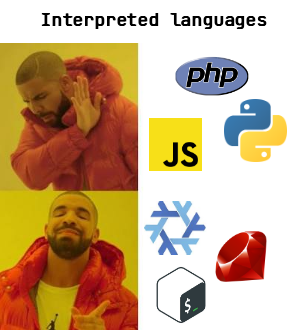
I'm strongly in favor compiled languages, but well. (Yeah, Ruby 🙄, I like the gems 💎).
#programming #code #interpreter #php #python #javascript #js #nix #nixos #ruby #bash #linux #meme #memes #humor

"#Switzerland-based International Association of Conference #Interpreters (AIIC) issued a statement saying, 'For decades, #MIIS was the quintessential #ConferenceInterpreting training in the United States, and in recent years, it had also become the last comprehensive #conference program. This is part of a larger program affecting conference interpreting #globally, but with its own national undertones.
“'With this decision, there will be no conference #interpreter training in the entire U.S.… given the gravity of the situation, we urge the MIIS president and board of trustees to reassess.’”—from a report by Sara Rubin in #MontereyCountyNow
We'd miss MIIS! Favorite bike advocacy memories include welcoming MIIS students to #Monterey County, at MIIS Information Fairs and in the wider community. https://bikemonterey.org/82313-welcome-to-monterey-institute-of-international-studies-and-bike-friendly-monterey-county.html https://bikemonterey.org/international-national-state-and-regional-collaborations-bicycling-monterey-teams-up-with-others-on-bike-advocacy-efforts.html
#MontereyInstituteOfInternationalStudies #MiddleburyInstituteOfInternationalStudies #USA #GlobalImpact #MontereyCounty #MiddleburyCollege
Here's a #language #interpreter from my 20 years in #JavaScript #development: https://www.CodeWithBolt.com Help your #kids #learn #programming with this FREE
tool.
Client Info
Server: https://mastodon.social
Version: 2025.07
Repository: https://github.com/cyevgeniy/lmst