
If running in a cluster - maybe add #ProxLB to distribute the guest workloads across nodes :)
#ProxLB
#ProxLB start supporting #Proxmox's native HA rules (affinity/anti-affinity) with release 1.1.11.
This way, you can simply use the built-in rules via the interface, but still use enhanced rules via ProxLB by tags or pools (even for non HA VMs/CTs). This feature was already requested a long time ago and get's now streamlined over all ways, ensuring we can balance our VMs (and CTs) across the nodes with and even without any configured HA objects - fully flexible to your needs!
Requirements:
* Proxmox 9.x
* ProxLB 1.1.11
Version 1.1.11 is expected to be released by the end of this or within the upcoming week; depending on my spare time.
PS: Keep in mind, tomorrow starts our "Virtualization Gathering" at @credativde@mastodon.social and I'm providing a talk about my @BoxyBSD@bsd.cafe project where I tell you a bit more about the infrastrucutre/hypervisors (due to the limited time only very high level)! Feel free to join, it's free!
Tags: #opensource #PVE #homelab #enterprise #vmware #virtualization #cloud #onprem #kvm #pve #resourcescheduler #loadbalancer #loadbalancing #drs
https://github.com/gyptazy/ProxLB/issues/391
This way, you can simply use the built-in rules via the interface, but still use enhanced rules via ProxLB by tags or pools (even for non HA VMs/CTs). This feature was already requested a long time ago and get's now streamlined over all ways, ensuring we can balance our VMs (and CTs) across the nodes with and even without any configured HA objects - fully flexible to your needs!
Requirements:
* Proxmox 9.x
* ProxLB 1.1.11
Version 1.1.11 is expected to be released by the end of this or within the upcoming week; depending on my spare time.
PS: Keep in mind, tomorrow starts our "Virtualization Gathering" at @credativde@mastodon.social and I'm providing a talk about my @BoxyBSD@bsd.cafe project where I tell you a bit more about the infrastrucutre/hypervisors (due to the limited time only very high level)! Feel free to join, it's free!
Tags: #opensource #PVE #homelab #enterprise #vmware #virtualization #cloud #onprem #kvm #pve #resourcescheduler #loadbalancer #loadbalancing #drs
https://github.com/gyptazy/ProxLB/issues/391
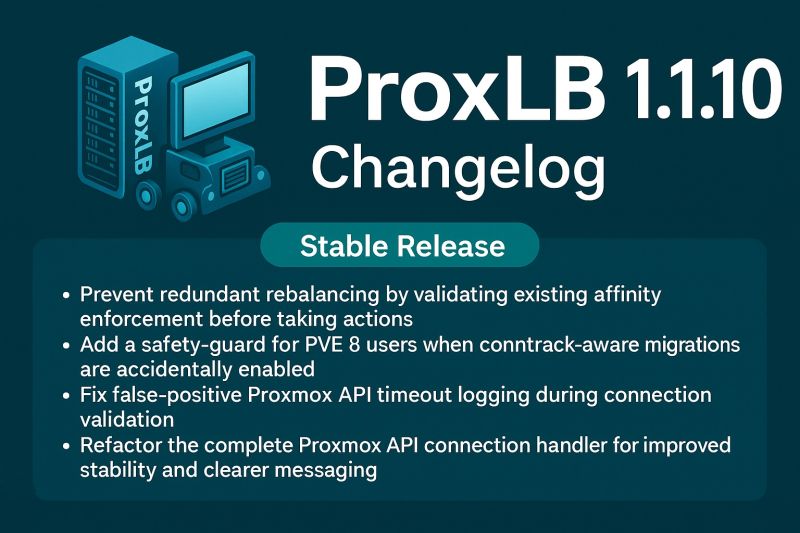
I just released #ProxLB 1.1.10 for#Proxmox clusters!
This release mainly focuses on stability and smoother usage, especially for everyone who's still running Proxmox VE 8.x. This update helps avoid a few pitfalls that only show up on PVE 8 and makes the overall experience more predictable.
The release was a bit delayed because I moved everything to a brand-new infrastructure, which now provides more bandwidth for the Docker/Container registry, the Debian repo, and the upcoming runners that will handle automated security-update integration for ProxLB.
Changelog highlights:
• Prevent redundant rebalancing when affinity enforcement is already in place (#335)
• Add a safety-guard for PVE 8 users when enabling conntrack-aware migrations (#359)
• Fix false-positive API timeout logs (#361)
• Refactor and improve the API connection logic (#361)
• Fix a crash when resource-pool members miss a name property (#368)
Run #opensource!
#PVE #homelab #enterprise #virtualization #VM VMs #VPS #VirtualMachine #LoadBalancer #ResourceScheduler #DRS #VMware #Cloud
This release mainly focuses on stability and smoother usage, especially for everyone who's still running Proxmox VE 8.x. This update helps avoid a few pitfalls that only show up on PVE 8 and makes the overall experience more predictable.
The release was a bit delayed because I moved everything to a brand-new infrastructure, which now provides more bandwidth for the Docker/Container registry, the Debian repo, and the upcoming runners that will handle automated security-update integration for ProxLB.
Changelog highlights:
• Prevent redundant rebalancing when affinity enforcement is already in place (#335)
• Add a safety-guard for PVE 8 users when enabling conntrack-aware migrations (#359)
• Fix false-positive API timeout logs (#361)
• Refactor and improve the API connection logic (#361)
• Fix a crash when resource-pool members miss a name property (#368)
Run #opensource!
#PVE #homelab #enterprise #virtualization #VM VMs #VPS #VirtualMachine #LoadBalancer #ResourceScheduler #DRS #VMware #Cloud
We at @credativde@mastodon.social are launching our very first & free open-source virtualization gathering in Germany, Mönchengladbach.
This new community event brings together everyone who’s passionate about open virtualization technologies, whether it’s Proxmox VE, XCP-ng, bhyve, Harvester, or any of the countless projects that make open infrastructure thrive. It’s about sharing experiences, learning from each other, and connecting with those who build and rely on open platforms every day.
We start the evening with two talks:
* "Enterprise-Ready? How people use Proxmox VE & Ceph" by Ronald Otto from Tuxis B.V.
* "BoxyBSD – Creating a free VPS hosting platform" by Florian Paul Azim Hoberg from credativ GmbH
Afterwards, the space opens up for discussion, networking, and casual chats. If you like to join with a talk, please feel free to reach out to me.
More details can be found here:
* https://gyptazy.com/open-source-virtualization-gathering-in-germany-monchengladbach/
* https://www.credativ.de/blog/aktuelles/open-source-virtualization-gathering-dezember-2025/
* https://www.meetup.com/de-DE/monchengladbach-oss-virtualization-gathering/events/311284475/
Tags: #meet #meetup #gathering #virtualization #virtualisation #container #kvm #proxmox #proxlb #xcpng #xen #bhyve #sylve #klee #kleene #incus #vmware #alternatives #opensource #free
This new community event brings together everyone who’s passionate about open virtualization technologies, whether it’s Proxmox VE, XCP-ng, bhyve, Harvester, or any of the countless projects that make open infrastructure thrive. It’s about sharing experiences, learning from each other, and connecting with those who build and rely on open platforms every day.
We start the evening with two talks:
* "Enterprise-Ready? How people use Proxmox VE & Ceph" by Ronald Otto from Tuxis B.V.
* "BoxyBSD – Creating a free VPS hosting platform" by Florian Paul Azim Hoberg from credativ GmbH
Afterwards, the space opens up for discussion, networking, and casual chats. If you like to join with a talk, please feel free to reach out to me.
More details can be found here:
* https://gyptazy.com/open-source-virtualization-gathering-in-germany-monchengladbach/
* https://www.credativ.de/blog/aktuelles/open-source-virtualization-gathering-dezember-2025/
* https://www.meetup.com/de-DE/monchengladbach-oss-virtualization-gathering/events/311284475/
Tags: #meet #meetup #gathering #virtualization #virtualisation #container #kvm #proxmox #proxlb #xcpng #xen #bhyve #sylve #klee #kleene #incus #vmware #alternatives #opensource #free

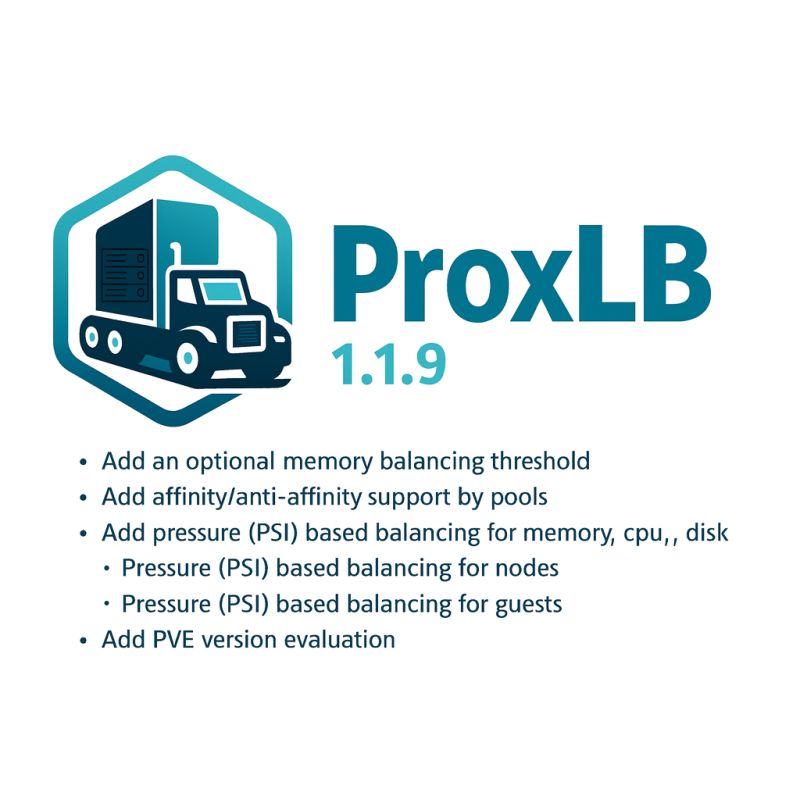
Still looking how to balance your VMs in #Proxmox clusters? #ProxLB 1.1.9 is here!
This release adds features that were requested during the #DutchProxmoxDay2025 which was hosted by our friends Tuxis (tuxis.nl). I'm hearing your feedback and all your feedback from the community and user base is important to me, so let me introduce the following new features:
* Add an optional memory balancing threshold
* Add affinity/anti-affinity support by pools
* Add pressure (PSI) based balancing for memory, cpu, disk
* Pressure (PSI) based balancing for nodes
* Pressure (PSI) based balancing for guests
You can simply upgrade via APT or by obtaining the latest Docker/Container image. PSI based balancing (still in beta) requires Proxmox VE 9 or greater.
Thanks to my employer
@credativ@mastodon.social (https://credativ.de) who provides me the required time to work at this.
GitHub: https://github.com/gyptazy/ProxLB
GitHub Release: https://github.com/gyptazy/ProxLB/releases/tag/v1.1.9
Author: @gyptazy@gyptazy.com
#PVE #Proxmox #Community #OpenSource #FOSS #gyptazy #DutchProxmoxDay #coding #projects #virtualization #vms #hypervisor #homelab #vmware #alternatives #pve #balancing
This release adds features that were requested during the #DutchProxmoxDay2025 which was hosted by our friends Tuxis (tuxis.nl). I'm hearing your feedback and all your feedback from the community and user base is important to me, so let me introduce the following new features:
* Add an optional memory balancing threshold
* Add affinity/anti-affinity support by pools
* Add pressure (PSI) based balancing for memory, cpu, disk
* Pressure (PSI) based balancing for nodes
* Pressure (PSI) based balancing for guests
You can simply upgrade via APT or by obtaining the latest Docker/Container image. PSI based balancing (still in beta) requires Proxmox VE 9 or greater.
Thanks to my employer
@credativ@mastodon.social (https://credativ.de) who provides me the required time to work at this.
GitHub: https://github.com/gyptazy/ProxLB
GitHub Release: https://github.com/gyptazy/ProxLB/releases/tag/v1.1.9
Author: @gyptazy@gyptazy.com
#PVE #Proxmox #Community #OpenSource #FOSS #gyptazy #DutchProxmoxDay #coding #projects #virtualization #vms #hypervisor #homelab #vmware #alternatives #pve #balancing
Automated Security Patch Management for #Proxmox clusters? The next major feature of #ProxLB comes with automated node patching on Proxmox clusters! This becomes real with the upcoming version 1.2.0!
#opensource #pve #proxmoxve #foss #debian #linux #apt #security #homelab
#opensource #pve #proxmoxve #foss #debian #linux #apt #security #homelab

🚀 Live from the Dutch #Proxmox Day in Ede: #ProxLB takes the stage!
Today, you can get some more insights about the ProxLB project at the Dutch Proxmox Day 2025, hosted by our friends Tuxis (tuxis.nl)! Even I cannot make it, I'm really happy to know that my mate @formorer@rollenspiel.social (from @credativde@mastodon.social) is stepping in for me to provide you more information and details about ProxLB and its functions!
Together, we can improve and create a fully open source based virtualization environment, fitting all needs - and Proxmox is a perfect base! And we will also see some more talks from Tuxis (tuxis.nl), Proxmox Server Solutions, ESA and Veeam Software.
#opensource #proxmox #pve #foss #virtualization #conference #talk #dutchproxmoxday #dutchproxmoxday2025
Today, you can get some more insights about the ProxLB project at the Dutch Proxmox Day 2025, hosted by our friends Tuxis (tuxis.nl)! Even I cannot make it, I'm really happy to know that my mate @formorer@rollenspiel.social (from @credativde@mastodon.social) is stepping in for me to provide you more information and details about ProxLB and its functions!
Together, we can improve and create a fully open source based virtualization environment, fitting all needs - and Proxmox is a perfect base! And we will also see some more talks from Tuxis (tuxis.nl), Proxmox Server Solutions, ESA and Veeam Software.
#opensource #proxmox #pve #foss #virtualization #conference #talk #dutchproxmoxday #dutchproxmoxday2025
I just released ProxLB 1.1.7 for Proxmox - bringing in DRS alike VM resource based balancing to your Proxmox cluster!
What is ProxLB?
The Prox Load Balancer (ProxLB) helps you to rebalance your Container and VM workloads across your nodes in your Proxmox cluster based on the resource usage of nodes (e.g., CPU, memory, local disk).
Changelog:
* Add conntrack state aware migrations of VMs. (Closes: 305)
* Add graceful shutdown for SIGINT command. (Closes: 304)
* Fix crash when validating absent migration job ids. (Closes: 308)
* Fix guest object names are not being evaluated in debug log. (Closes: 310)
* Note: Have a great Dutch Proxmox Day 2025!
ProxLB is fully #opensource and under #GPL (#GPLv3).
Changelog: https://github.com/gyptazy/ProxLB/releases/tag/v1.1.7
Project: https://proxlb.de
#ProxLB #Proxmox #Virtualization #Loadbalancer #OpenSource #Python #Coding #DutchProxmoxDay #DutchProxmoxDay2025 #PVE #Proxcon #Proxday #KVM
What is ProxLB?
The Prox Load Balancer (ProxLB) helps you to rebalance your Container and VM workloads across your nodes in your Proxmox cluster based on the resource usage of nodes (e.g., CPU, memory, local disk).
Changelog:
* Add conntrack state aware migrations of VMs. (Closes: 305)
* Add graceful shutdown for SIGINT command. (Closes: 304)
* Fix crash when validating absent migration job ids. (Closes: 308)
* Fix guest object names are not being evaluated in debug log. (Closes: 310)
* Note: Have a great Dutch Proxmox Day 2025!
ProxLB is fully #opensource and under #GPL (#GPLv3).
Changelog: https://github.com/gyptazy/ProxLB/releases/tag/v1.1.7
Project: https://proxlb.de
#ProxLB #Proxmox #Virtualization #Loadbalancer #OpenSource #Python #Coding #DutchProxmoxDay #DutchProxmoxDay2025 #PVE #Proxcon #Proxday #KVM

@rbo_ne@chaos.social thanks for your input! And this plays together with my #ProxLB project for #Proxmox clusters. Right now, it’s just something like DRS which you might now from VMware, but for Proxmox. The idea, adding automated node patching - and when reboots are required, it can manage in a DRS alike style the draining of a node :)
Unfortunately, my PR upstream at Proxmox got rejected (unattended updates might be dangerous) which makes it challenging to include. So, patching and repackaging on my own is one of the solutions I now have but first I want to see if the efforts are worth for proceeding…
Unfortunately, my PR upstream at Proxmox got rejected (unattended updates might be dangerous) which makes it challenging to include. So, patching and repackaging on my own is one of the solutions I now have but first I want to see if the efforts are worth for proceeding…
@ascherbaum@mastodon.social hey Andres, thanks for your feedback! You can query the status by a different api path, indeed. Currently, I'm trying to find out if people would be open in general to use an unattended upgrade way (if existing) - or already go this way by different toolings. For it's interesting to know for #ProxLB, because I have multiple approaches to solve this issue for automated node patching but would prefer an API driven way.
Personally, I'm running clusters all over the world (for my @BoxyBSD@bsd.cafe) project - Germany, Netherlands, Italy, France, USA, Canada, Singapore, Japan etc. - so there's already a higher node count and this made me create #ProxLB. Since PVE8, I always run unattended upgrade and never had any issues:
* Node Validation
* Patch node
* Validate if patches req. reboot
If yes:
* Move all guests to another node by evaluating free resources (DRS alike style)
* Reboot
* Rebalance cluster again
* goto next node ;)
Even if there would be any issue - what is my benefit by seeing this on the console rather than being notified by the monitoring afterwards and just looking at the logs of the specific node. I'm fully with you for major upgrades, but for minors I never encountered any issues - but that's exactly why I ask - my references may not fit for all setups ;) So, thanks a lot for your feedback - appreciate it!
* Node Validation
* Patch node
* Validate if patches req. reboot
If yes:
* Move all guests to another node by evaluating free resources (DRS alike style)
* Reboot
* Rebalance cluster again
* goto next node ;)
Even if there would be any issue - what is my benefit by seeing this on the console rather than being notified by the monitoring afterwards and just looking at the logs of the specific node. I'm fully with you for major upgrades, but for minors I never encountered any issues - but that's exactly why I ask - my references may not fit for all setups ;) So, thanks a lot for your feedback - appreciate it!
Hey #Proxmox community! I would like to hear your thoughts on how you usually update your Proxmox nodes and clusters. How do you handle minor Proxmox and #Debian package upgrades with #APT?
What would you think about a new API endpoint that lets you run unattended upgrades with a simple call like:
I have already been running this approach on several internal clusters since the release of PVE 8 without issues. Now I am interested to hear if you would use unattended upgrades in general or if you are already running them today.
#Linux #OpenSource #PatchManagement #Security #DevOps #Automation #Ansible #PVE #PVE8 #PVE9
What would you think about a new API endpoint that lets you run unattended upgrades with a simple call like:
/nodes/{node_name}/apt/upgrade
At the moment you need to use the node’s HTML5 console to perform upgrades. Other methods exist such as running unattended Debian upgrade scripts, using patch management tools like #Spacewalk or #QualvoSec, or automating the process with #Ansible over SSH. My idea is to have an API based solution that relies on Proxmox authentication and authorization. This would also allow third party tools such as #ProxLB to provide automated patch management and even handle guest rebalancing in a way that is similar to DRS without requiring direct SSH access.I have already been running this approach on several internal clusters since the release of PVE 8 without issues. Now I am interested to hear if you would use unattended upgrades in general or if you are already running them today.
#Linux #OpenSource #PatchManagement #Security #DevOps #Automation #Ansible #PVE #PVE8 #PVE9

DRS alike VM balancing in #Proxmox clusters? #ProxLB 1.1.6.1 has been released. ProxLB is free and #opensource.
#devops #virtualization #python #python3 #coding #tools #pve #prox #proxlb #drs #clustering #loadbalancing #features
GitHub: https://github.com/gyptazy/ProxLB
#devops #virtualization #python #python3 #coding #tools #pve #prox #proxlb #drs #clustering #loadbalancing #features
GitHub: https://github.com/gyptazy/ProxLB

DRS but for #Proxmox? Yes!
With #ProxLB (free and #opensource / #GPLv3) you can get something which comes close to it - also featuring things like affinity/anti-affinity rules, node pinning, grouping and maintenance mode for multiple nodes. And if you’re even more interested, there’ll be a talk about my project at the #DutchProxmoxDay next month :)
#drs #loadbalancing #gpl #gpl3 #pve #proxmox9 #virtualization #alternatives #vmware #esx #KVM
https://github.com/gyptazy/ProxLB
With #ProxLB (free and #opensource / #GPLv3) you can get something which comes close to it - also featuring things like affinity/anti-affinity rules, node pinning, grouping and maintenance mode for multiple nodes. And if you’re even more interested, there’ll be a talk about my project at the #DutchProxmoxDay next month :)
#drs #loadbalancing #gpl #gpl3 #pve #proxmox9 #virtualization #alternatives #vmware #esx #KVM
https://github.com/gyptazy/ProxLB

For #Proxmox and/or #ProxLB I would wish a function for upgrading a cluster.
That is: download new packages/kernel, install them on node A, rebalance VMs/containers, reboot noide A when ready, after reboot rebalance everything again, wait for Ceph to be healthy, proceed with node B, and so on...
But maybe it's just me...
:boost_ok:
#ProxLB compatibility tested with #Proxmox 9.
Also added a compatibility matrix, now.
https://github.com/gyptazy/ProxLB
#Proxmox9 #PVE #PVE9 #virtualization #loadbalancing #drs alternatives #opensource
Probably the most interesting new feature in Proxmox 9 (Beta 1):
Finally we're able to create #Snapshots of VMs with shared block storage (such like #iSCSI, #FibreChannel & #NVMeoF) with LVM Thick without doing dirty workarounds. Well done Proxmox (& Alex!).
Recently, I created a plugin (including PVE UI integration) for #NetApp based storages to create storage side snapshots.
PS: #ProxLB also already supports PVE9!
#Proxmox #blockstorage #Proxmox9 #PVE #virtualization #beta #OnTap
Let's test #Proxmox 9 (Beta 1).
Time to test that all automation stuff still works with PVE 9; also ProxLB & Co :)
#opensource #ProxLB #ansible #automation #PVE #virtualization
Client Info
Server: https://mastodon.social
Version: 2025.07
Repository: https://github.com/cyevgeniy/lmst