
“Nothing is more on the nose,than sun cream.”
― Anthony T. Hincks
#Smell
5-Feb-2026
Breathing in the past: How #museums can use biomolecular #archaeology to bring ancient #scents to life

Perhaps not the Magic System we need, but the Magic System we deserve! 😜😂
@bookstodon @books
@worldbuilding @humor@fedigroups.social @humor@fedigroups.social @humor@lemmy.world @aiop
#MagicSystem #Magic #System
#Witch #Wizard #Cast #Smell #Fart #Joke
#SpeculativeFiction #FantasyBooks
#FantasyMemes #SciFiMemes #Fantasy #SciFi #Meme #Memes #Humor #Humour #Funny
#Low #High #Epic #Science #Opera #Hard #CottageCore #SolarPunk #Comedic #Whatever #GiveMeAllYouveGot
#Book #Books #Novel #Novels #Bookstodon #Bookworm #Bookwyrm #BookLove


"The team even re-created the scent of Christian 'Hell' as described in 16th century sermons, including notes of sulfur and brimstone and a whiff of 'a million dead dogs.'"
Kaja Šeruga for Knowable Magazine: https://knowablemagazine.org/content/article/society/2026/recreating-the-smells-of-the-past

“To-day I think / Only with scents”*…
We’ve considered before smell, the unsung hero of the senses. Today, Kaja Šeruga explains how scientists using chemistry, archival records, and AI are reviving the aromas of old libraries, mummies and battlefields…
We often learn about the past visually — through oil paintings and sepia photographs, books and buildings, artifacts displayed behind glass. And sometimes we get to touch historical objects or listen to recordings. But rarely do we use our sense of smell — our oldest, most primal way of learning about the environment — to experience the distant past.
Without access to odor, “you lose that intimacy that smell brings to the interaction between us and objects,” saysanalytical chemist Matija Strlič. As lead scientist of the Heritage Science Laboratory at the University of Ljubljana in Slovenia and previously deputy director of the Institute for Sustainable Heritage at University College London, Strlič has devoted his career to interdisciplinary research in the field of heritage science. Much of his work focused on the preservation and reconstruction of culturally significant scents.
Reconstructed scents can enhance museum and gallery exhibits, says Inger Leemans, a cultural historian at the Royal Netherlands Academy of Arts and Sciences. Smell can provide a more inviting entry point, especially for uninitiated visitors, because there’s far less formalized language for describing smell than for interpreting visual art or displays. Since there’s no “right way” of talking about scent, she says, “your own knowledge is as good as the others’.”
Despite their potential to enrich our understanding of history and art, smells are rarely conserved with the same care as buildings or archaeological artifacts. But a small group of researchers, including Strlič and Leemans, is trying to change that — combining chemistry, ethnography, history and other disciplines to document and preserve olfactory heritage…
Read on for the fascinating details: “Recreating the smells of history,” from @knowablemag.bsky.social.
* Edward Thomas, “Digging“
###
As we take a whiff, we might recall that it was on this date in 1924 that Coco Chanel agreed with the Wertheimer brothers Pierre and Paul, directors of the perfume house Bourjois, to create a new corporate entity, Parfums Chanel, Its signature product was Chanel No. 5. She had been selling small quanitites of the scent in her boutique since 1921.
Traditionally, fragrances worn by women had fallen into two basic categories. Respectable women favored the essence of a single garden flower while sexually provocative indolic perfumes heavy with animal musk or jasmine were associated with women of the demi-monde. Chanel sought a new scent that would appeal to the flapper and celebrate the seemingly liberated feminine spirit of the 1920s. Her scent was formulated by chemist and perfumer Ernest Beaux, who designed an unprecedented olfactory architecture, a bouquet of 80 scents whose precious notes were blended with high proportions of aldehydes, organic compounds that carry a crisp, soapy, and floral citrusy scent. In late 1920, when presented with small glass vials containing sample scents numbered 1 to 5 and 20 to 24 for her assessment, she chose the fifth vial. Chanel told Beaux, “I present my dress collections on the fifth of May, the fifth month of the year and so we will let this sample number five keep the name it has already, it will bring good luck.”
The first promotion for Chanel No. 5 appeared in The New York Times on December 16, 1924– a small ad for Parfums Chanel announcing the Chanel line of fragrances available at Bonwit Teller, an upscale department store. The fragrance, of course, become a fave. An Andy Warhol subject and worn by everyone from Marilyn Monroe and Catherine Deneuve to Mad Men’s Peggy Olson, the perfume, is a foundational part of fragrance history… and still sells a bottle every 30 seconds.
#AI #Archaeology #aroma #artificialIntelligence #ChanelNo5 #chemistry #CocoChanel #culture #history #museums #perfume #scent #Science #smell #Technology


I'm a supertaster. You might be one too; about one in four people is a supertaster. We have more taste buds than the average, so our senses of smell and taste are more keen - sometimes *considerably* more keen.
That's not always a good thing. In my case, I was constantly reproached and mocked for being a picky eater. It caused me quite a bit of grief. It wasn't until much later in life that I found out that there was a physical cause for what I (and the rest of my family) had always assumed was because I was "difficult".
Some supertasters really suffer a lot. Perfumes can be unbearable for them (personally I like perfume). They can be incredibly limited in what they can eat, even more than I was.
On the other hand, there can be plusses, too. I often find it hard to understand how normal tasters can miss out on so much of their environment. For me, the world is *filled* with interesting smells. Sometimes I wonder if in that regard I'm a bit more like a dog or cat!
My sense of taste and smell have been a huge help with cooking. I'm a pretty good cook; I like to experiment and develop new recipes.
Also I could never stand the taste of alcohol. My family used to try to sneak alcohol into my drinks sometimes, but I always detected it instantly. I don't know if I would have had any tendency towards alcoholism (the rest of my family likes to drink, except for my son), but I think it's safe to say that I'm never going to find out.
I also seem to be highly resistant to the effects of alcohol. My ex-wife once twisted my arm to drink three glasses of wine in a row; they had no effect at all. Medications are the same way; after surgery once I was given a triple dose of Percodan. It had absolutely no effect, and the doctors were stunned. They said even an elephant would have felt the dose they gave me.
Anyway, if you're curious about the phenomenon of supertasting you can read about it here.
https://en.wikipedia.org/wiki/Supertaster
There's a simple test you can do to find out if you're a supertaster, but if you ARE one, you'll probably already know it on some level.

Using chemistry, archival records and AI, scientists are reviving the aromas of old libraries, mummies and battlefields.
@KnowableMag explains how the scents of history are re-created: https://flip.it/8ZGnen

Scientists are using chemistry to recreate and conserve the smells of the past. @KnowableMag explains why and how.
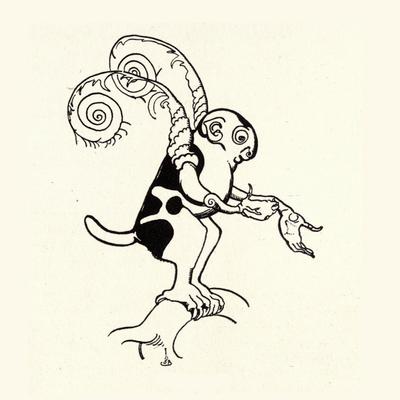
Bonnacon (ca. 1450), from The Hague, MMW, 10 B 25.
Source: National Library of the Netherlands
https://pdimagearchive.org/images/874939de-b92c-42b0-8535-356ab30611a8
#myth #bestiary #excrement #defecation #smell #legend #swords #shields #art #publicdomain


夜明け Світанок明けぬはずの夜が明けた
Мої очі починають горіти
https://www.pixiv.net/novel/show.php?id=26322958
<>
#night #never #supposed #finally #sunlight #like #lethal #weapon #pierce #mercilessly #sharply #eyeballs #hurt #death #everywhere #desolate #scorched #desert #countless #kind #scattered #with #smell #burn #rust #dawn #illuminate #disaster

夜明け Світанок明けぬはずの夜が明けた
Мої очі починають горіти
https://www.pixiv.net/novel/show.php?id=26322958
<>
#night #never #supposed #finally #sunlight #like #lethal #weapon #pierce #mercilessly #sharply #eyeballs #hurt #death #everywhere #desolate #scorched #desert #countless #kind #scattered #with #smell #burn #rust #dawn #illuminate #disaster
夜明け Світанок
明けぬはずの夜が明けた
Мої очі починають горіти
https://note.com/poison_raika/n/n79554b99921e
<>
#night #never #supposed #finally #sunlight #like #lethal #weapon #pierce #mercilessly #sharply #eyeballs #hurt #death #everywhere #desolate #scorched #desert #countless #kind #scattered #with #smell #burn #rust #dawn #illuminate #disaster

Smellosophy by A. S. Barwich. 2020
What the Nose Tells the Mind
A pioneering exploration of olfaction that upsets settled notions of how the brain translates sensory information.
Decades of cognition research have shown that external stimuli “spark” neural patterns in particular regions of the brain.

Smells by Robert Muchembled, 2020
A Cultural History of Odours in Early Modern Times
Why is our sense of smell so under-appreciated? We tend to think of smell as a vestigial remnant of our pre-human past, doomed to gradual extinction, and we go to great lengths to eliminate smells from our environment, suppressing body odour, bad breath and other smells.

夜明け Світанок
明けぬはずの夜が明けた
Мої очі починають горіти
https://note.com/poison_raika/n/n79554b99921e
<>
#night #never #supposed #finally #sunlight #like #lethal #weapon #pierce #mercilessly #sharply #eyeballs #hurt #death #everywhere #desolate #scorched #desert #countless #kind #scattered #with #smell #burn #rust #dawn #illuminate #disaster
Smell by Matthew Cobb, 2020
Our sense of smell—or olfaction as it is technically known—is our most enigmatic sense. It can conjure up memories, taking us back to very specific places and emotions, whilst powerful smells can induce strong feelings of hunger or nausea. In the animal kingdom smell can be used to find food, a mate, or a home; to sense danger; and to send and receive complex messages with other members of a species.


Gente sulla #metropolitana di #milano che alle ore 7.00 già puzza...
#smell #welcometomilano #fateviunadoccia
Last year's feature on the #evolution of our sense of #smell is now in the #openArchives: https://proseandpassion.blogspot.com/2025/01/on-origins-of-smell.html
Client Info
Server: https://mastodon.social
Version: 2025.07
Repository: https://github.com/cyevgeniy/lmst