#Xarray

2026-01-16

RE: wisskomm.social/@ioer/11589933

I really took a deep dive into #datashader with this map: Locals & Tourists in Germany, as derived from 67 Million Geo-Social Media Posts (2007-2022) in Germany. The data includes public shared posts from Instagram, Flickr, Twitter and iNaturalist.

I always wanted to create such a map, following the footsteps of Eric Fisher's Locals & Tourists dataset from 2011 [1].

I shared the code for producing this map here [2]. The repository is available here [3]. This includes some neat methods for various #geospatial processing tasks in #Python, such as exporting a datashader map to a #GeoTiff [4] with the help of #Xarray and #Rasterio.

Finally, all of this was created in a privacy-preserving way using #HyperLogLog, which allowed me to share the code and abstracted data publicly for full reproducibility and transparency. [6] #FAIR

Below you'll find the link to the (quite succinct) publication in Natur und Landschaft in Karten (#NuL).

[1]: flickr.com/photos/walkingsf/al
[2]: code.ad.ioer.info/wip/digital_
[3]: gitlab.hrz.tu-chemnitz.de/ad/d
[4]: gitlab.hrz.tu-chemnitz.de/s739
[5]: nul-online.de/article-7301410-
[6]: doi.org/10.71830/VDMUWW

Olivier D'Hondt ๐Ÿ›ฐ๏ธ๐ŸŒ๐ŸŒฑtyldurd@framapiaf.org
2026-01-15

๐Ÿš€ PolSARpro update released!

This new version includes:

โ€ข a new tutorial showing how to run PolSARpro on BIOMASS data directly in the cloud via the ESA MAAP platform (no local download needed)
โ€ข access to an ALOS-1 sample dataset to get started with the tutorials
โ€ข bug fixes and stability improvements

๐Ÿ“ฆ Available on conda-forge
๐Ÿ”— Code: github.com/satim-co/PolSARpro
๐Ÿ“˜ Docs: polsarpro.readthedocs.io

#PolSAR #SAR #RemoteSensing #EarthObservation #OpenSource #Python #ESA #MAAP #BIOMASS #Dask #Xarray

Philipp GรคrtnerMixed_Pixels@mapstodon.space
2026-01-11

I added to "band_data" a '_CRS' attribute as dict with 'url', 'wkt' & 'projjson' infos (EPSG 3857), saved the whole thing as :zarr: file and hoped :gdal: can open it in :qgis:

However :gdal: seems to have trouble finding the coordinate reference and assumes the origin is 0,0 (Extent 0.0, -8192.0 : 4096.0, 0.0).

Now, my question: where do I store the "_CRS" dict correctly? Do I also need to add a GeoTransform infos? If yes, where?

2/2 #xarray #gdal #zarr

Philipp GรคrtnerMixed_Pixels@mapstodon.space
2026-01-11

Sorry, that I misuse this platform for my silly question:

I have a :xarray: dataset
Dimensions: (time: 1, band: 4, y: 8192, x: 4096)
Coordinates:
* time datetime64[ns] 8B 2023-06-15
* band <U5 80B 'Red' 'Green' 'Blue' 'Alpha'
* y float32 33kB 7.064e+06 7.064e+06
* x float32 16kB 1.194e+06 1.194e+06
Data variables:
band_data (time, band, y, x) uint8 134MB dask.array<chunksize=(1, 4, 1024, 1024), meta=np.ndarray>
spatial_ref int64 8B ...

1/2 #xarray #gdal #zarr

STOP OCCUPATION ๐Ÿ‰ S. Costasteko@scholar.social
2026-01-02

Does anybody have experience with #xarray for #numpy labeled arrays?

My use case is rather simple with a 2d ndarray and I'm mostly after easier development for myself and contributors if it's possible to switch from ndarray[:, 0] and ndarray[:, 1] to ndarray[fieldname]

#python

Philipp GรคrtnerMixed_Pixels@mapstodon.space
2025-11-18

@jeremy beautiful, thanks. ๐ŸŽ‰

#zarr
#xarray

Philipp GรคrtnerMixed_Pixels@mapstodon.space
2025-11-18

@jeremy useful to add #zarr #xarray emojis? ๐Ÿ™ ๐Ÿ˜€

Laurent CourtyLaurentCourty
2025-11-03

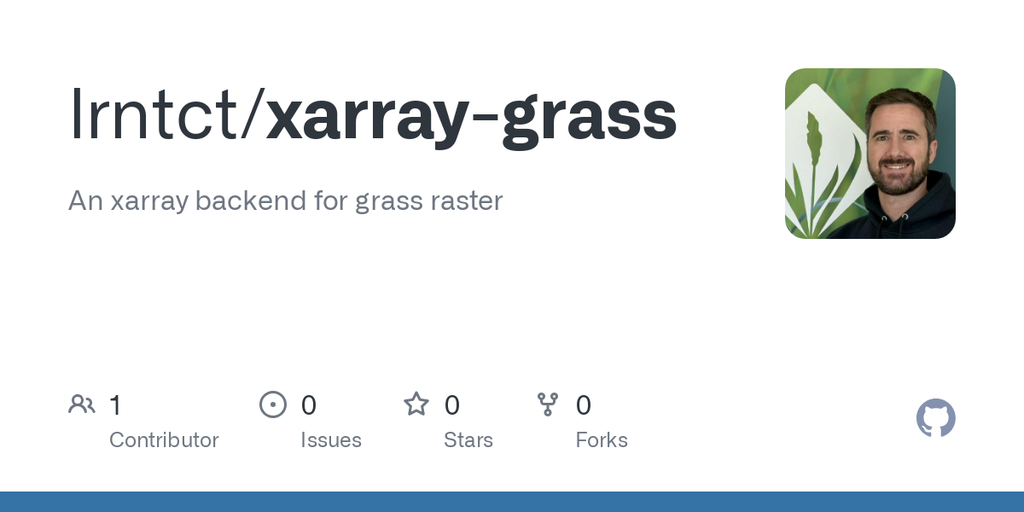
๐Ÿšจ New version of xarray-grass ๐Ÿšจ

I'm glad to announce that I've release version 0.4.0 of xarray-grass! It comes with many improvements: ๐Ÿš€ Lazy loading of GRASS space-time datasets, ๐Ÿ“… Better management of time dimensions, including support of units when writing relative-time series to GRASS
๐Ÿ—˜ Automatic transposition of arrays when writing to GRASS.

Try it today !

pypi.org/project/xarray-grass/

@grassgis

Michael Sumnermdsumner@rstats.me
2025-09-26

if you wonder about coordinates in arrays and netcdf and Zarr and #xarray check out this awesome video and gallery, to see where xarray is going

youtube.com/watch?v=I-NHCuLhRjY

xarray-indexes.readthedocs.io/

excellent presentation by Deepak Cherian of #earthmover

Michael Sumnermdsumner@rstats.me
2025-09-25

made some huge af virtual #Zarr today, each var is 12Tb uncompressed, all referenced to public available netcdf servers but not using netcdf lib at all for read

(Reliant on pretty recent #GDAL or #xarray if you want to explore)

github.com/mdsumner/virtualized

been plodding towards this a long time, and finally closed the circle

More to come ๐Ÿ‘Œ

Olivier D'Hondt ๐Ÿ›ฐ๏ธ๐ŸŒ๐ŸŒฑtyldurd@framapiaf.org
2025-08-03

Anyone would know a workaround about the lack of native support for complex valued arrays in #xarray netcdf writer?

#datascience #python

Laurent CourtyLaurentCourty
2025-06-05

I am excited to announce xarray-grass, a new free software Python library designed to bridge two open source data science heavy weights: @grassgis and (xarray.dev/).

Although xarray-grass is in its nascent phase, I encourage you to check out the repository on GitHub (github.com/lrntct/xarray-grass) and experiment with it. Your insights and contributions will play a significant role in the project's future.

#geo #RemoteSensing #earthobservation people! Has anyone got an example of using the #Copernicus #DataSpace -> documentation.dataspace.copern to go from searching using #pystac to getting a working #xarray dataset for #Sentinel2 reflectances? #python #geopython

Olivier D'Hondt ๐Ÿ›ฐ๏ธ๐ŸŒ๐ŸŒฑtyldurd@framapiaf.org
2025-04-24

๐Ÿš€ EO-Tools 2025.4.0 is out!

๐ŸŒ New in this release:
- Support for Sentinel-1C products!
- H-Alpha dual-pol decomposition from SLCs ๐Ÿ›ฐ๏ธ

๐Ÿ“˜ Dive in: eo-tools.readthedocs.io
๐Ÿ’ป Code: github.com/odhondt/eo_tools

#EO_tools #RemoteSensing #Sentinel1 #SAR #EarthObservation #OpenSource #Python #Dask #Xarray

Yann Bรผchau :nixos:nobodyinperson@fosstodon.org
2025-04-15

I am really looking forward to a time when scientific data analysis is less of a constant fuckaround and fight with technical bullshit. I'd *really* like

- #netCDF natively supporting complex numbers
- #Python #xarray and #pandas to natively support physical units (#pint is great on its own but the integrations leave a LOT to be desired)
- #Jupyter notebooks to suck less (crashes, glitches, widget plots not saved statically, an effing BUILTIN formatter, etc.)
- proper data pipeline systems
...

2025-02-28

๐—š๐—ฒ๐—ผ๐˜€๐—ฝ๐—ฎ๐˜๐—ถ๐—ฎ๐—น ๐—ฃ๐˜†๐˜๐—ต๐—ผ๐—ป ๐—ง๐˜‚๐˜๐—ผ๐—ฟ๐—ถ๐—ฎ๐—น๐˜€
SpatialThoughts provides tutorials which cover a broad range of geospatial topics and technologies, e.g., #GeoPandas, #XArray, #dask, and more. Each technology is described in a notebook with step-by-step explanation. Check it out.
geopythontutorials.com

๐Ÿ’ง๐ŸŒ Greg CocksGregCocks@techhub.social
2025-01-31
Conceptual diagram of GSPy workflow. Data from a variety of formats and types are read into GSPy, along with required metadata files. Through the GSPy software, data are converted into a standardized NetCDF file containing the dataset and metadata appropriate for archiving and sharing.GS data convention. (A) Datasets are structured into three fundamental group types based on content and data geometry. The Survey group contains general metadata about the dataset. Unstructured datasets, such as from CSV or TXT files, form Tabular groups, whereas structured (gridded) datasets are categorized under the Raster group. Metadata is attached to all groups, with various required attributes (green text) that expands on the CF-1.8 convention. (B) Groups follow a strict hierarchy in the NetCDF file, with a single Survey group at the top to which all data groups are attached. Datasets are indexed within their respective group type. (C) Tabular and Raster data groups must contain clearly defined dimensions, such as index or x, y, z, as well as coordinate variables. Raster groups are distinct in that dimensions are also coordinates, whereas Tabular datasets are assigned spatial coordinates that align with the index dimension. Lastly, the coordinate variable โ€œspatial_refโ€ is required for all data groups, which expands on the โ€œcoordinate_informationโ€ variable required in the Survey metadata.photo - rigs preparing to do a seismic survey, Middle EastGSPy code base - Writing and plotting examples. Once all groups have been attached to a Survey, the โ€œwrite_netcdfโ€ and โ€œwrite_ncmlโ€ methods will write the GS NetCDF and NcML files, respectively. GSPy also provides methods to generate scatter and pcolor plots for variables.
2024-12-05

Justus made a great intro on using #DGGS through #xarray #xdggs at the #Pangeo showcase talk. Xdggs is now in a stage where you can use it fairly robustly with #HEALPIX and #H3. Other integrations like for #DGGRID are developed as separate plugins.

youtube.com/watch?v=bAMGFKsxsj

2024-09-30

... while I find ChatGPT increasingly useful for technical things like telling me how to manipulate #xarray datasets in #python, or how to add a docstring to my python routine.

Virgile AndreaniArmavica@fosstodon.org
2024-09-18

I am moving all my computing libraries to #xarray, no regrets. It is a natural way to manipulate datasets of rectangular arrays, with named coordinates and dimensions: xarray.dev/
There are several possible backends, including #dask which allows lazy data loading.
I had the pleasure of meeting some of the devs last week, who showed me a preview of the upcoming `DataTree` structure which is going to make this library even more versatile!

#Python #numpy #ScientificComputing

Client Info

Server: https://mastodon.social
Version: 2025.07
Repository: https://github.com/cyevgeniy/lmst