
Tested on Palestinians in Palestine.
Coming soon to Australia.
#auspol #dystopia #surveillancestate #drones #facialrecognition #identity
www.facebook.com/share/v/1L6w...
facebook.com/share/v/1L6wSh...
#facialrecognition

..."#AlJazeera captured the underlying posture in a 2014 email referenced in the files. The reporting does not frame this as a theoretical debate. It presents an #operational sequence: #insecurity creates #political demand; demand legitimizes #foreign “#solutions”; “solutions” generate access, which is then #leveraged into broader deals.
#DropSite reported that in May 2015, Barak and his business partner, Gary Fegel, made a $15 million investment in FST #Biometrics, a #facialrecognition / #accesscontrol firm founded by Aharon Ze’evi Farkash, a former head of [#IOF] #military #intelligence.
The #technology’s lineage matters to how it was marketed. Drop Site reported that Farkash developed the concept of “#remote #identification” during the Second #Palestinian #Intifada at [IOF] checkpoints on the #Gaza border; in 2003, [IOF] deployed the “Basel” system at the #ErezCrossing, using facial scans to identify and process #Palestinians going to work....
In #Nigeria, the same reporting describes how Boko Haram’s attacks—often framed through a sectarian lens—created a ready-made narrative for pitching #biometriccontrol at a #Christian institution. Drop Site reported that a pilot was implemented at #BabcockUniversity, and by July 2015, an “in-motion #identification” system was live, with staff #training and #promotionallanguage emphasizing the #filtering of “unwanted persons.”
Al Jazeera’s account similarly notes that a #pressrelease at the time boasted the technology would “filter away all unwanted persons,” presenting #surveillance as safety while normalizing #populationcontrol logics in a #crisis setting..."


#DHS Wants a Single #SearchEngine to Flag Faces and #Fingerprints Across Agencies
#HomelandSecurity aims to combine its face and #fingerprint systems into one big #biometric platform—after dismantling centralized #privacy reviews and key limits on face recognition.
#facialrecognition #ice #privacy #security #facerecognition #immigration #deportation
Underground #FacialRecognition Tool Unmasks #Camgirls
An underground site uses facial recognition to reveal the site a #camgirl streams on, potentially letting someone take a woman’s photo from social media, then use the site to out their sex work.
#socialmedia #sexwork #privacy #security
https://www.404media.co/underground-facial-recognition-tool-unmasks-camgirls/

JP Costa (Boardy takeover) (@eusou_jp)
@cursor_ai 해커톤에서 제작된 'MoodBeats'라는 얼굴 인식 기반 미디어 앱이 소개되었습니다. 사용자의 표정을 인식하고 감정에 맞는 콘텐츠를 재생하는 기능을 구현하려 했으나, 실제 결과는 기대와 달랐다고 합니다. 카메라 중심 UX와 감정 인식 조합을 시도한 혁신적 AI 응용 사례로 볼 수 있습니다.

🎙️🔴Episode #41 of This Week in Privacy is live in 30 minutes, we'll be covering the latest privacy issues and chasing with the community. Come say hi! 👋
youtube.com/live/rvj7aIL...
#privacy #privacyguides #facialrecognition
Meta's Smart Glasses Just Got ...

🎙️🔴Episode #41 of This Week in Privacy is live in 30 minutes, we'll be covering the latest privacy issues and chasing with the community. Come say hi! 👋

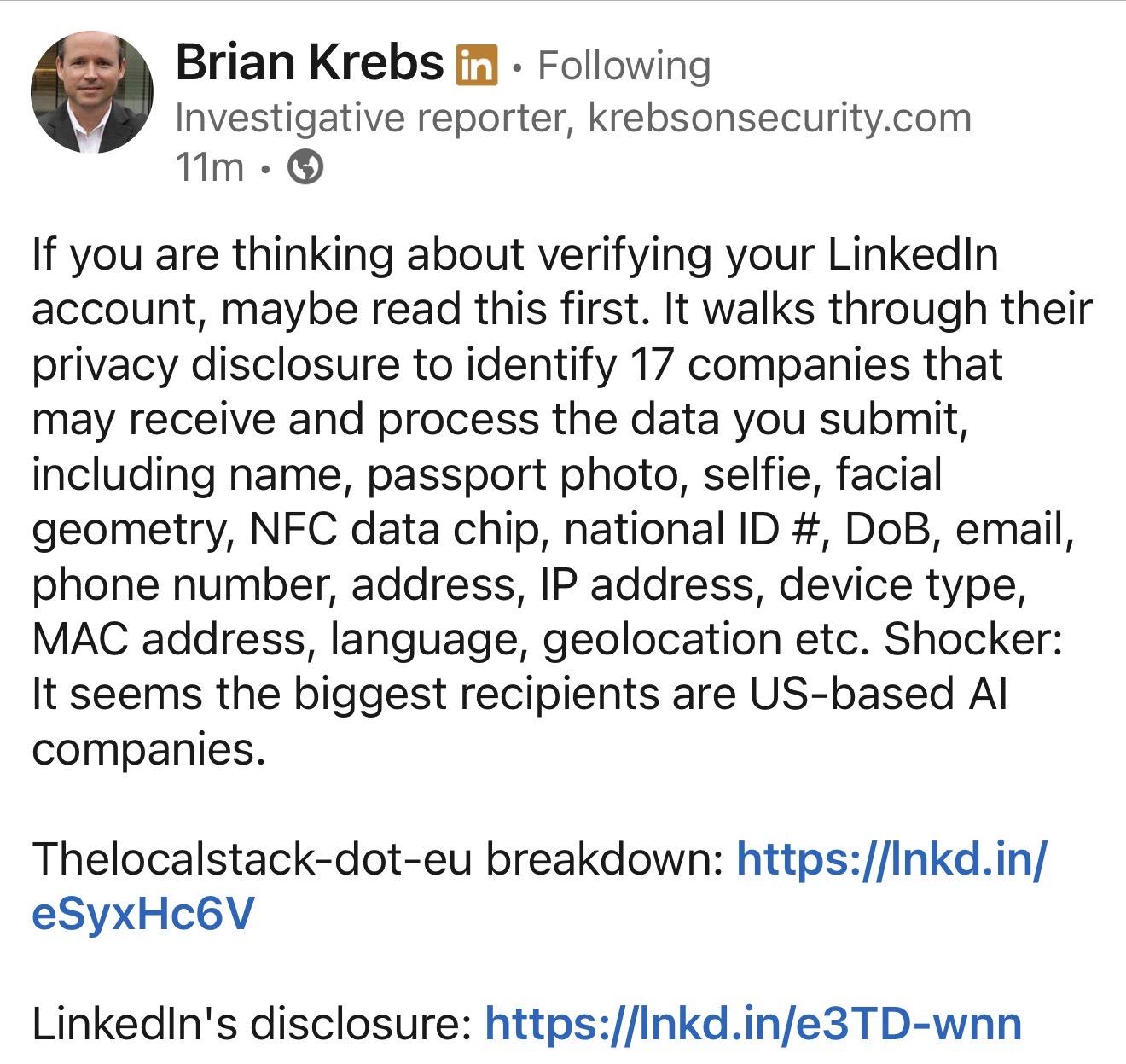


Discord is rolling out facial recognition age verification in March 2026.
Using AU10TIX - the same vendor that leaked 70,000 government IDs five months ago.
You'll need to:
- Upload government ID
- Record video selfie
- Let AI match your face to ID
- Trust a recently-breached vendor
This is terrifying.
https://snugg.social/en/blog/discord-age-verification-facial-recognition-privacy

As AI embeds deeper in policing, a growing body of research shows rising false arrests and miscarriages of justice. Algorithmic results are treated as facts, not probabilities — raising serious risks for due process, accountability and public trust in the rule of law 👇
@wired @washingtonpost @HarvardPolitics @BigBrotherWatch
#AI-Safety #FacialRecognition #DigitalArrests

Leaked Email Suggests #Ring Plans to Expand ‘#SearchParty’ #Surveillance Beyond Dogs

Drôle d'émotion en repensant à ANTIFAce, un tutoriel manifeste que j'ai réalisé en 2020
> Comment et pourquoi faire un make-up anti-reco naissance faciale


On Familiar Faces and Forgotten Names
Reading Time: 2 minutesIt's amusing. I look through Immich and Photoprism and I am struck by how many names I have forgotten, but how easily I remember certain faces. I'm also curious to see how I remember certain names after scrolling through faces yet to be identified.
Decades ago when I was playing with iPhoto and Picasa I knew all these people well, and I saw them daily. It was easy to match faces to names. Now it's a challenge, because I haven't seen these people in years, if not decades.
For a while iPhoto and Picasa were happy to encourage us to add names to faces, until people worried about privacy, and the need to deactivate this functionality. It's about privacy.
Now that we are moving back to to an era of locally installed apps, or self-hosting, if we want to use a trendy term, we can allow facial recognition to know which face belongs with which name. The challenge is to remember the name.
If Facebook was still the network of uni friends and their friends, and our families, and friends of theirs, then it would be easy to remember who A, B and C are.
Instead I rely on patience, and triggers. I might not recognise a face for days or weeks, and eventually I remember because by remembering name A and Context C I find the name from that memory subset.
On Immich I have identified plenty of people, but I have 11,000 faces in total, so remembering all those names is highly unlikely. On Photoprism I have recognised 80 faces out of 999+ faces. Each time I recognise a dozen I end up with 999 more faces to recognise.
In some cases I met the people two or three times, so to forget their name is normal. In other cases I spent years seeing these people daily so I should remember their names with ease.
The forgotten names don't really matter. The value of Photoprism, and Immich facial recognition is consolidating my name recollection for people that are part of my current life, whether it is people I cycle, hike, discuss books with or more. It would be nice to recognise people by their names, as well as their faces.
Photoprism V Immich
Immich is head and shoulders above Photoprism when it comes to browsing and naming faces. With Immich you can regonise a face, name it, double check, and return to naming other people within a second or two. With Photoprism it's slow and sluggish. For context Photoprism is slow and suggish on an HP455(need to double check) whereas immich on a Raspberry Pi 5 with 8 gigs of ram is fluid.
And Finally
When Immich and Photoprism instances crash and I need to repopulate a library most of the work is quick and automatic. I remember the name of via ferrata, and places. It's adding a name to a face that I find difficult. That's the part that takes time.
And finally, I do get a sense of accomplishment with recognising a face after days or weeks of trying to remember. Why do we forget names of familiar faces?
#facialRecognition #immich #machineLearning #photoprism
📅 Privacy Guides is going live on Friday afternoon with our podcast This Week In Privacy. 🎙️🔴
😱 We’ll be talking about Meta’s decision to add facial recognition to their smart glasses.🔒
youtube.com/live/rvj7aIL...
#privacy #privacyguides #facialrecognition
Meta's Smart Glasses Just Got ...
📅 Mark your calendars! Privacy Guides is going live on Friday afternoon with our podcast This Week In Privacy. 🎙️🔴
😱 We’ll be talking about Meta’s decision to add facial recognition to their smart glasses, we’ll also also be discussing other trending topics in Privacy & Security 🔒
👋 Nate & Jordan will be answering questions and chatting with the community, come join and hang out! 😊

“Free” Surveillance Tech Still Comes At A High And Dangerous Cost

My article "Concerns about using facial analysis at events" generated much discussion. Here's why Zenus's response is inadequate.
https://www.conferencesthatwork.com/index.php/event-design/2024/01/facial-analysis-2
#FacialRecognition #privacy #FacialAnalysis #EventTech #events #Zenus #eventprofs


"U.S. Immigration and Customs Enforcement (ICE) has relied extensively on Microsoft’s cloud storage and artificial intelligence products while escalating its campaign of mass arrests and deportations in recent months, files obtained by +972 Magazine, Local Call, and The Guardian reveal.
ICE more than tripled the amount of data it holds on Microsoft servers between July 2025 and January 2026, at the same time as the agency’s crackdown on migrants broke new records and sparked mass protests across the United States. Whereas last July the agency was storing around 400 terabytes of data in Microsoft’s cloud platform, Azure, by the end of January that had risen to almost 1,400 terabytes — equivalent to approximately 490 million images.
The leaked documents do not specify the kinds of information stored by ICE on Microsoft servers, but they do indicate that the agency has used Azure to house large amounts of data, in addition to making use of AI tools that search and analyze images and videos.
ICE employs a powerful arsenal of surveillance technology, reportedly using facial recognition software, drones, phone location tracking, mobile spyware, and even tapping school cameras. The leaked documents show ICE is using Microsoft’s AI video analysis tools including Azure AI Video Indexer and Azure Vision, which enable customers to analyze images, read text, and detect certain words, faces, emotions, and objects in audio and video files."
https://www.972mag.com/ice-microsoft-azure-leaked-files/
#USA #Trump #Immigration #ICE #Microsoft #Surveillance #AI #Azure #CloudComputing #Spyware #FacialRecognition
"We will launch during a dynamic political environment where many civil society groups that we would expect to attack us would have their resources focused on other concerns,” according to the document from #Meta’s Reality Labs" #Facialrecognition #Smartglasses https://www.nytimes.com/2026/02/13/technology/meta-facial-recognition-smart-glasses.html?unlocked_article_code=1.L1A.6h9s.hor0Clrqgb2I

"We will launch during a dynamic political environment where many civil society groups that we would expect to attack us would have their resources focused on other concerns,” according to the document from #Meta’s Reality Labs" #Facialrecognition #Smartglasses https://www.nytimes.com/2026/02/13/technology/meta-facial-recognition-smart-glasses.html?unlocked_article_code=1.L1A.6h9s.hor0Clrqgb2I
Client Info
Server: https://mastodon.social
Version: 2025.07
Repository: https://github.com/cyevgeniy/lmst